-
Graphene Nanoplatelets for Li–S Battery Cathodes - Poznan University of Technology, 2015
Jun 09, 2026 | ACS MATERIAL LLCSwiderska-Mocek, A., & Rudnicka, E. (2015). Lithium–sulphur battery with activated carbon cloth-Sulphur cathode and ionic liquid as electrolyte. *Journal of Power Sources*. https://doi.org/10.1016/j.jpowsour.2014.09.020
Journal of Power Sources · 2015
Poznan University of Technology used ACS Material graphene nanoplatelets and single layer graphene in a Li–S battery achieving 830 mAh/g after 50 cycles.
About this research
Researchers at Poznan University of Technology demonstrated a lithium–sulphur (Li–S) battery in which a binder-free activated carbon cloth–sulphur (ACC-S) cathode was combined with graphene nanoplatelets and single layer graphene from ACS Material and an ionic liquid electrolyte, delivering a reversible capacity of approximately 830 mAh/g after 50 cycles. The work, published in the Journal of Power Sources (2015) by Agnieszka Swiderska-Mocek and Ewelina Rudnicka, focuses on suppressing polysulphide dissolution and improving long-term cycling in Li–S systems by pairing a microporous sulphur host with a non-volatile ionic liquid electrolyte. The ACC-S cathode achieved 99% coulombic efficiency and clearly outperformed a reference sulphur cathode based on graphene nanoplatelets and carbon black.
Lithium–sulphur batteries are attractive for next-generation energy storage thanks to a theoretical specific capacity of 1675 mAh/g and a theoretical energy density of 2600 Wh/kg, several times higher than conventional Li-ion chemistries. Sulphur is also abundant, low-cost, and environmentally benign. However, two challenges have slowed Li–S commercialization: the insulating nature of elemental sulphur, which demands a conductive carbon host, and the solubility of long-chain polysulphide intermediates (Li2Sx, 2 < x < 8) in conventional carbonate or ether electrolytes, which leads to capacity fade and shuttle losses. Strategies that combine carefully engineered microporous carbon hosts with electrolytes that limit polysulphide solubility, such as imidazolium-based ionic liquids, address both problems simultaneously and are central to ongoing Li–S research.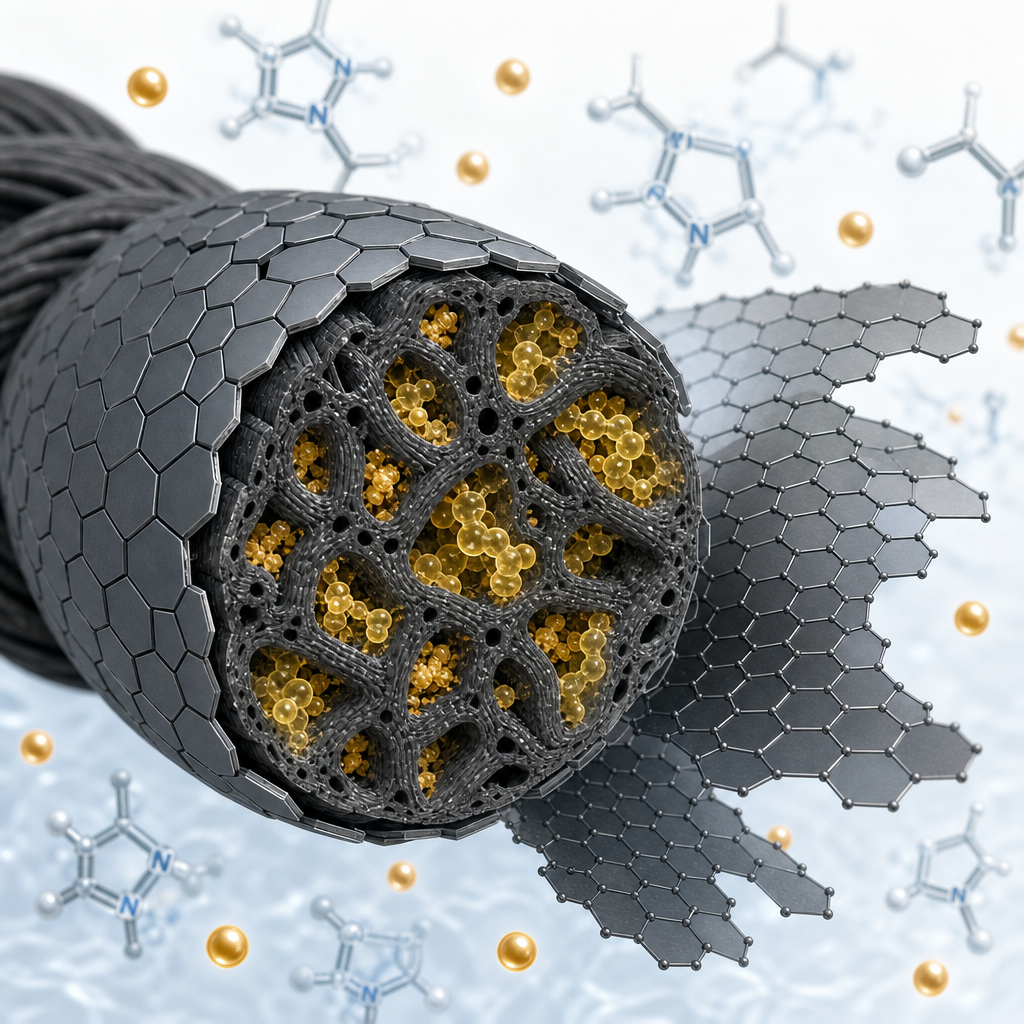
In this study, ACS Material's graphene nanoplatelets (GN, thickness 2–10 nm) and single layer graphene (specific surface area 570 m²/g) played supporting and comparative roles within the cell architecture. The ACC-S cathode was prepared by impregnating microporous activated carbon cloth (Kynol, 2485 m²/g) with melted elemental sulphur at 160–180 °C for 5 h. Prior to cycling, the ACC-S disc was rubbed with a mixture of graphene nanoplatelets and PVdF binder suspended in acetone (S:GN:PVdF = 80:10:10 by weight), so the ACS Material graphene nanoplatelets served as a conductive coating that improved the electronic pathway to the sulphur trapped inside the cloth's micropores. A reference cathode used the same graphene nanoplatelets together with carbon black and PVdF on aluminium foil (S:GN:CB:PVdF = 60:20:10:10). The single layer graphene supplied by ACS Material was deployed as the carbon electrode in a separate ACC-S-Li/electrolyte/G test cell, enabling the authors to study sulphur cycling against a graphene counter electrode. The electrolyte was 1 M LiNTf2 dissolved in 1-ethyl-3-methylimidazolium bis(trifluoromethanesulphonyl)imide (EtMeImNTf2), with water content kept below 50 ppm.
The ACC-S cathode achieved a capacity loading of 2.12 mAh/cm², within the 2.5–3.5 mAh/cm² range typical of commercial electrodes. Galvanostatic charge/discharge cycling at 100 mA/g between 1.2 and 2.8 V vs. Li/Li+ produced a reversible capacity of about 830 mAh/g after 50 cycles, with a coulombic efficiency of 99%. The ionic liquid electrolyte's negligible vapour pressure, wide electrochemical window, and high thermal stability helped to suppress polysulphide dissolution and stabilize the cell over extended cycling. Cyclic voltammetry between 1.4 and 2.9 V at 0.1 mV/s captured the characteristic reduction and oxidation peaks of the S8 ↔ Li2S conversion, and electrochemical impedance spectroscopy over 100 kHz–10 mHz tracked interfacial resistance evolution. By comparison, the cathode that combined sulphur with graphene nanoplatelets and carbon black exhibited significantly lower capacity retention in the same EtMeImNTf2 electrolyte, indicating that the microporous activated carbon cloth confines sulphur and intermediate polysulphides more effectively than a flat platelet host. SEM imaging with EDX mapping confirmed uniform sulphur deposition on the 10 μm-diameter carbon fibres and penetration into the microporous interior, which is consistent with the strong cycling performance.
The results support the use of binder-free microporous carbon hosts together with imidazolium-based ionic liquid electrolytes for Li–S batteries targeting safety-critical applications, including stationary storage, aerospace power, and electric mobility where high gravimetric energy density and non-volatile electrolytes are valuable. The authors note that further work is needed to increase volumetric capacity and to extend cycle life beyond 50 cycles, and they identify pore-size and structural tuning of carbon hosts—including graphene and carbon nanotube hybrids—as promising directions. The strong performance of the ACC-S cathode also motivates pairing it with carbon anodes in future cell designs, addressing safety concerns associated with lithium metal dendrite formation.
For researchers working on lithium–sulphur chemistry, conductive cathode coatings, or 2D carbon composites, the graphene nanoplatelets and single layer graphene used in this study are available from ACS Material's Graphene Series. The materials served as both an in-electrode conductive component and a comparison carbon host, allowing the authors to benchmark microporous activated carbon cloth against a planar graphene-based architecture under identical ionic-liquid conditions.How ACS Material products were used
- Graphene Nanoplatelets (2-10nm) (Graphene Series) — “graphene nanoplatelets (GN, thickness 2-10 nm, ACS Material, USA)”
- Single Layer Graphene (Graphene Series) — “single layer graphene (G, specific surface: 570 m2 g-1, ACS Material, USA)”
Product Performance in this StudyGraphene nanoplatelets from ACS Material were used both as a conductive additive in the ACC-S cathode coating and as the primary carbon host in the comparison sulphur cathode. The comparison sulphur/GN/CB cathode showed inferior cycling stability versus the ACC-S design, supporting the conclusion that microporous ACC outperforms GN-based composites in this ionic-liquid electrolyte.
Related product categories
Frequently asked questionsWhy are graphene nanoplatelets used in lithium–sulphur battery cathodes?
Graphene nanoplatelets provide a high-conductivity carbon network that compensates for the insulating nature of elemental sulphur. In this study, ACS Material graphene nanoplatelets (2–10 nm thick) were used both as a conductive coating on the activated carbon cloth–sulphur cathode and as the carbon host in a reference electrode, helping to maintain electronic contact with sulphur during the S8 to Li2S conversion and supporting capacities around 830 mAh/g.
How does an ionic liquid electrolyte improve Li–S battery cycling stability?
Ionic liquids such as EtMeImNTf2 have negligible vapour pressure, wide electrochemical windows, high thermal stability, and limited polysulphide solubility compared to carbonate or ether electrolytes. In the Poznan study, the 1 M LiNTf2 in EtMeImNTf2 electrolyte allowed the activated carbon cloth–sulphur cathode to retain about 830 mAh/g after 50 cycles at 99% coulombic efficiency, reducing the polysulphide shuttle that normally degrades Li–S batteries.
What is the role of single layer graphene in Li–S battery research?
Single layer graphene offers a high specific surface area, here 570 m²/g, which makes it a useful conductive scaffold and reference electrode material in lithium–sulphur cells. The authors used single layer graphene from ACS Material as the carbon electrode in an ACC-S-Li/electrolyte/G test cell, enabling comparison of sulphur cycling behaviour against a well-defined graphene surface in the ionic liquid electrolyte.