-
Industrial Graphene Oxide Carbocatalyst — Shinshu University, 2017
Jun 15, 2026 | ACS MATERIAL LLCDeng, D. et al. (2017). Industrial-quality graphene oxide switched highly efficient metal-and solvent-free synthesis of β-ketoenamines under feasible conditions. *ACS Sustainable Chemistry & Engineering*. https://doi.org/10.1021/acssuschemeng.6b02766
Shinshu University · ACS Sustainable Chemistry & Engineering · 2017
Shinshu University researchers used industrial-grade graphene oxide as a metal- and solvent-free carbocatalyst, achieving 86–100% yields of β-ketoenamines.
About this research
Researchers at Shinshu University reported that industrial-quality graphene oxide (IQGO) functions as a highly efficient, metal- and solvent-free carbocatalyst for the synthesis of β-ketoenamines, delivering 86–100% isolated yields with 100% selectivity across a broad substrate scope. Published in ACS Sustainable Chemistry & Engineering (2017), the study by Deng, Xiao, Chung, Kim and Gopiraman positions a low-cost, commercially available graphene oxide as a credible alternative to noble- and transition-metal catalysts traditionally used for β-enamino ketone and ester synthesis. The work directly compares IQGO with single-walled and multi-walled carbon nanotubes, carbon nanofibers and graphene nanoplatelets, providing a rare apples-to-apples benchmark of common carbocatalysts.
β-Ketoenamines are key building blocks for peptides, β-amino esters, γ-amino alcohols and alkaloids, and they themselves possess antitumor, antibacterial and anti-inflammatory activity. The state of the art for their preparation relies on metal catalysts such as Cu, Ag, Au, Zn, Zr, Sn, In, Ce, Mg and Co salts. These suffer from high cost, leaching, complicated recovery and end-of-life disposal issues flagged by the US EPA. There is therefore strong motivation to develop metal-free routes that retain high yield and chemoselectivity while accommodating diverse substrates. Carbocatalysis using graphene oxide answers several of these needs: GO offers a tunable 2D structure, abundant oxygenated functional groups, acidic, basic, redox and defect sites, and good thermal stability — but its cost-effectiveness at industrial scale had not been established for this transformation.
The authors used industrial-grade graphene oxide as supplied, without elaborate post-treatment, and characterized it thoroughly before use. TEM showed continuous, transparent, wrinkled IQGO sheets with a mean thickness of 0.8–2.0 nm. EDS gave a C:O weight ratio of 63:37. Raman spectra exhibited a D-band at ~1353 cm⁻¹ and a G-band at ~1557 cm⁻¹ with an I_G/I_D of 0.88, confirming abundant defect sites. XRD showed a weak (002) graphite reflection at 26.5°. XPS deconvolution of the C 1s and O 1s regions verified C=C/C–H, C=O, –COOH, C–OH, C–O–C and H₂O environments along with a π→π* shake-up at ~294 eV. Nitrogen sorption gave a BET surface area of 767 m²/g, a BJH pore volume of 1.3 cm³/g and an average pore size of 6.8 nm. In the catalytic protocol, IQGO was loaded into a condensation reaction between β-dicarbonyl compounds (e.g., acetylacetonate) and amines (e.g., aniline) under neat, solvent-free conditions, where it acted as a Brønsted-acidic/redox-active solid catalyst.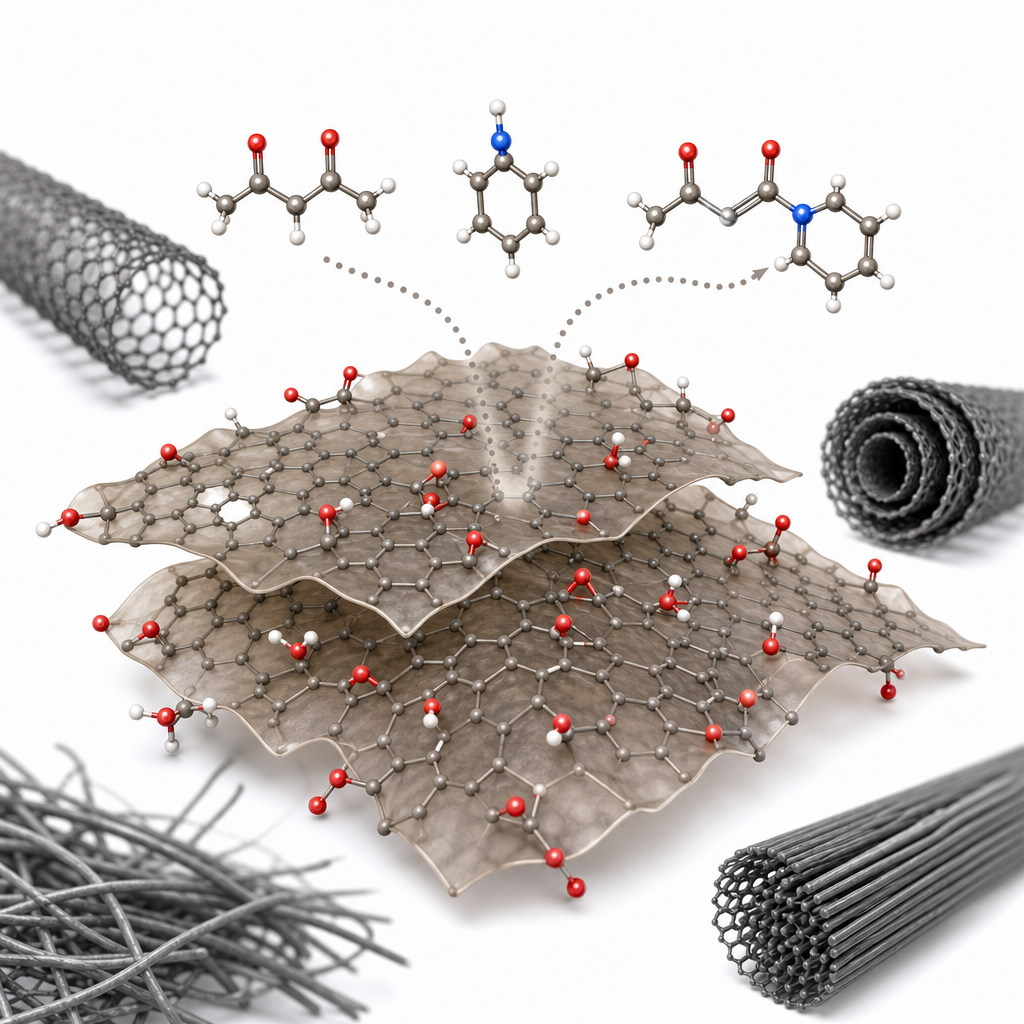
With the model reaction of acetylacetonate and aniline to form (Z)-4-(phenylamino)pent-3-en-2-one, the uncatalyzed control gave only 49% yield. IQGO raised this to 96%, while SWCNTs (462 m²/g) gave 98%, MWCNTs (210 m²/g), CNFs (352 m²/g) and GNPs (63 m²/g) lagged behind. The correlation between BET surface area, oxygen functionality and catalytic activity was clear: IQGO and SWCNTs, which expose more accessible defect and oxygen-rich sites, outperformed the lower-surface-area carbons. Across the substrate scope, IQGO consistently delivered 86–100% isolated yields with 100% selectivity for the β-ketoenamine product, tolerating a range of aromatic and aliphatic amines paired with β-dicarbonyl partners. The catalyst was recovered by simple filtration, reused over multiple cycles with sustained activity, and the reaction proved scalable, chemoselective and free of metal contamination — important for downstream pharmaceutical use.
These findings broaden the scope of carbocatalysis to a previously unaddressed C–N bond-forming reaction, giving process chemists a low-cost, recyclable, green alternative for synthesizing pharmacologically relevant β-enamino ketones and esters. Because the catalyst is industrial-grade rather than research-scale, the work also speaks directly to scale-up feasibility for contract manufacturing of fine chemicals, agrochemicals and active pharmaceutical intermediates. Beyond β-ketoenamine synthesis, the same IQGO carbocatalyst is plausibly extendable to other condensation, oxidation and coupling reactions where solid acid/redox sites are useful. The authors highlight the importance of carbon-bond structure, π-conjugation and defect chemistry, suggesting that further tuning of GO oxidation state or doping could unlock additional reactivity.
For researchers exploring metal-free organic synthesis, sustainable catalysis or graphene-based functional materials, the industrial-grade graphene oxide examined here is representative of the bulk GO grades available from ACS Material, including Industrial-Grade Graphene Oxide and related GO products in the Graphene Series. The paper's careful comparison with SWCNTs, MWCNTs, CNFs and GNPs also illustrates how procurement decisions among carbon nanomaterials directly affect catalytic outcomes, making it useful reading for groups specifying carbon materials for green chemistry workflows.How ACS Material products were used
- Graphene Nanoplatelets (comparison sample) (Graphene Series) — “GNPs (63 m2/g)”
- Industrial-Grade Graphene Oxide (IQGO) (Graphene Series) — “low-cost industrial quality graphene oxide (IQGO) as an efficient carbocatalyst for the metal- and solvent-free synthesis of β-enamino ketones and esters”
- Multi-walled Carbon Nanotubes (comparison sample) (Carbon Series) — “MWCNTs (210 m2/g)”
- Single-walled Carbon Nanotubes (comparison sample) (Carbon Series) — “various CMs such as CNFs, SWCNTs, MWCNTs, and GNPs ... were tested as catalyst. Among them, both IQGO and SWCNTs gave 3a in better yields of 96% and 98%”
Product Performance in this StudyIQGO delivered 86–100% yields with 100% selectivity for β-ketoenamines under metal- and solvent-free conditions. Its high BET surface area (767 m²/g), abundant oxygenated functional groups and defect sites provided active sites enabling carbocatalysis competitive with SWCNTs and superior to MWCNTs, CNFs and GNPs.
Related product categories
Frequently asked questionsCan graphene oxide replace metal catalysts for β-ketoenamine synthesis?
Yes. This study shows that industrial-quality graphene oxide catalyzes the condensation of β-dicarbonyl compounds with amines under metal- and solvent-free conditions, delivering 86–100% yields with 100% selectivity for β-ketoenamines. Performance is comparable to or better than common Cu, Ag, Zn, Zr and Sn catalysts, while avoiding metal leaching, complex recovery and the disposal hazards that the US EPA associates with spent metal catalysts.
Why does industrial-grade graphene oxide work as a carbocatalyst?
Industrial-grade graphene oxide combines a high BET surface area (767 m²/g in this work), abundant oxygenated functional groups (–COOH, C–OH, C=O, C–O–C) and a high density of defect sites, evidenced by an I_G/I_D Raman ratio of 0.88. These features provide Brønsted-acidic, basic and redox-active centers on an accessible 2D π-conjugated framework, which together activate β-dicarbonyl substrates toward enamination with amines.
How does graphene oxide compare to carbon nanotubes for catalysis?
In the model reaction of acetylacetonate with aniline, single-walled carbon nanotubes (462 m²/g) gave 98% yield and industrial graphene oxide (767 m²/g) gave 96%, while multi-walled carbon nanotubes (210 m²/g), carbon nanofibers (352 m²/g) and graphene nanoplatelets (63 m²/g) underperformed. Activity tracks surface area and oxygen-functional content. Graphene oxide remains preferred because it is lower cost, easier to recover and more readily produced at industrial scale than SWCNTs.