-
Mesoporous Silica Fining Agents for White Wine - University of Córdoba, 2018
Jun 12, 2026 | ACS MATERIAL LLCDumitriu, G. et al. (2018). Study of the potential use of mesoporous nanomaterials as fining agent to prevent protein haze in white wines and its impact in major volatile aroma compounds and polyols. *Food Chemistry*. https://doi.org/10.1016/j.foodchem.2017.07.163
Food Chemistry · 2018
Researchers evaluated KIT-6, SBA-15, and MCM-41 mesoporous silicas from ACS Material as fining agents to prevent protein haze in white wines while preserving aroma compounds.
About this research
Researchers led by the University of Córdoba demonstrated that KIT-6, SBA-15, and MCM-41 mesoporous silica nanomaterials purchased from ACS Material LLC can act as effective fining agents to prevent protein haze in white wines while retaining significantly more aroma compounds than traditional sodium bentonite. Published in Food Chemistry (2018) by Dumitriu, López de Lerma, Luchian, Cotea, and Peinado, the work compares three ordered mesoporous silicas against bentonite and gelatin on Pedro Ximénez and Muscat Ottonel wines. The study quantifies haze stability, volatile aroma retention, and polyol balance after fining, establishing mesoporous silicas as a promising bentonite alternative for protein stabilization in enology.
Protein haze is one of the most persistent quality problems for bottled white wines. Heat-unstable grape proteins, primarily thaumatin-like proteins and chitinases, unfold during storage or transport and aggregate into a visible cloud that consumers reject. Sodium bentonite has been the industry standard fining agent for decades because it efficiently adsorbs cationic proteins, yet it is non-selective and strips out aroma compounds, polyphenols, and color, reducing sensory quality and producing large volumes of wine-loaded lees. The wine industry has been actively searching for selective adsorbents that remove haze-active proteins without depleting the volatile and non-volatile compounds that define varietal character. Ordered mesoporous silicas — with their tunable pore size, high surface area, and silanol-rich surfaces — are attractive candidates because pore geometry can in principle discriminate between protein adsorption and the retention of smaller aroma molecules.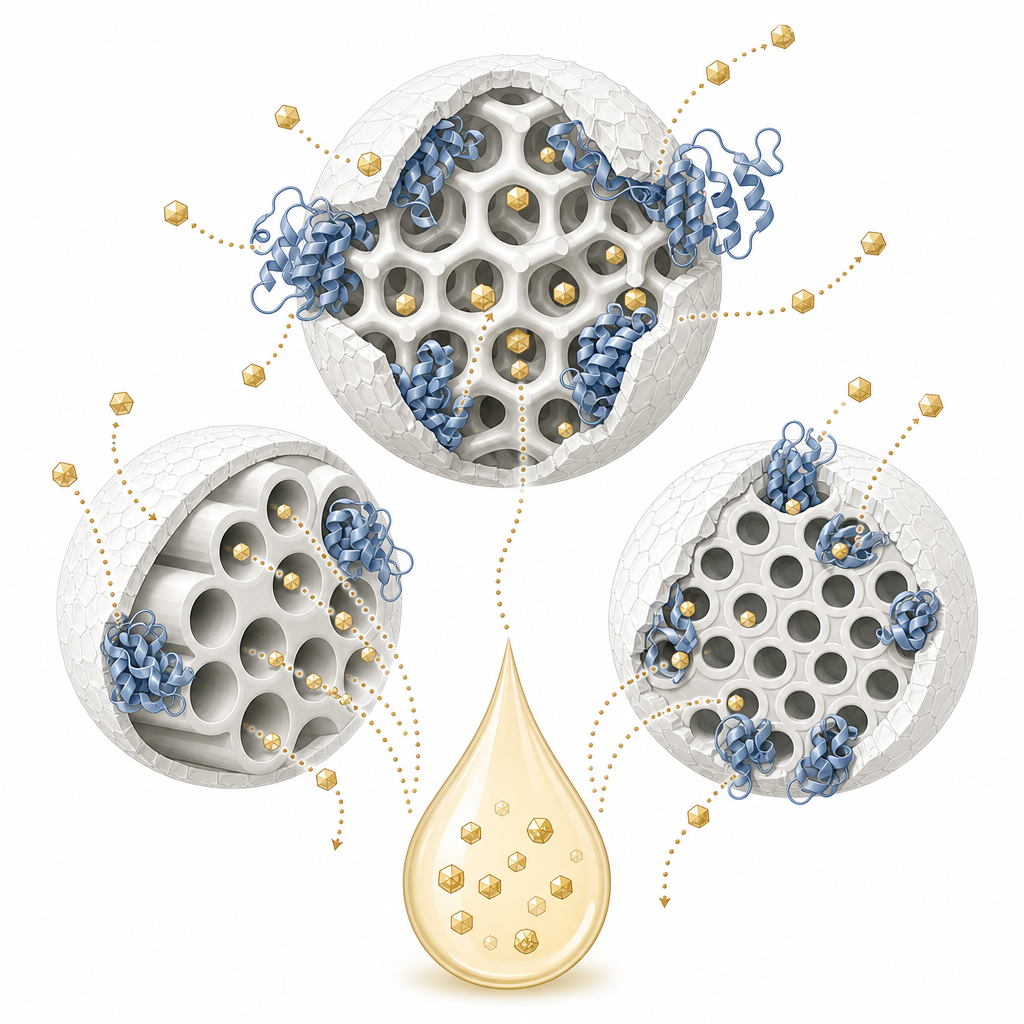
The authors purchased KIT-6, SBA-15, and MCM-41 directly from ACS Material LLC (Medford, USA) and used them as received. KIT-6 features a three-dimensional cubic Ia3d pore network, SBA-15 has hexagonally ordered cylindrical pores in the 6–10 nm range, and MCM-41 has smaller two-dimensional hexagonal channels around 3 nm — a deliberate selection spanning different pore architectures and sizes. The mesoporous powders were added to filtered, unfined Pedro Ximénez and Muscat Ottonel wines (both produced without malolactic fermentation, sulfited to 100 mg/L SO2, and stored at 4 °C). Heat stability was assessed using the Pocock and Waters protocol — 80 °C for 6 hours followed by 4 °C for 12 hours — and turbidity was measured with a HANNA HI 93703 C nephelometer. Total polyphenol index and browning index were tracked by UV-Vis at 280 and 420 nm on a Perkin Elmer Lambda 25 spectrophotometer. Activated sodium bentonite (Microcol) and gelatin (Gelaffort) from Laffort served as benchmarks.
All three ACS Material mesoporous silicas successfully achieved heat stability in both white wines at doses comparable to bentonite. Importantly, the mesoporous fining agents retained higher concentrations of major volatile aroma compounds — including key fermentation esters, higher alcohols, and varietal terpenes characteristic of Muscat Ottonel — than the bentonite treatment. Polyol levels (glycerol and 2,3-butanediol), which contribute to mouthfeel and body, were also better preserved. Differences among the silicas tracked with pore architecture: the larger-pore SBA-15 and three-dimensional KIT-6 networks generally outperformed the smaller-pore MCM-41 in selectivity, consistent with size-exclusion-driven protein adsorption that leaves smaller aroma molecules largely free in solution. Color and total polyphenol indices were also less perturbed relative to the bentonite control. Together, the data indicate that ordered mesoporous silicas can deliver equivalent protein-haze protection with measurably smaller losses of the volatile and non-volatile compounds that define wine quality.
The findings open a practical pathway for enology and the broader beverage industry. Selective mesoporous fining agents could reduce aroma stripping in aromatic white wines (Muscat, Riesling, Sauvignon Blanc, Gewürztraminer) and in sweet styles such as Pedro Ximénez. The same materials are candidates for stabilization of beers, fruit juices, and plant-protein beverages where colloidal stability and flavor retention must be balanced. The authors point toward optimization of pore size and surface chemistry, regeneration of the silica for reuse, and scale-up trials as natural next steps. Functionalization with affinity ligands targeting thaumatin-like proteins and chitinases could push selectivity further, and packed-bed configurations would enable continuous in-line fining instead of batch dosing and racking.
For researchers exploring selective adsorption, food-grade nanomaterials, or alternatives to bentonite, the KIT-6, SBA-15, and MCM-41 ordered mesoporous silicas used in this study are available from ACS Material's molecular sieves catalog. The paper provides a useful reference point on dosing, heat-stability testing, and analytical workflows for evaluating these silicas in real wine matrices. Because the work used commercially supplied materials without further modification, results should be reproducible by other groups working on beverage stabilization, protein adsorption, and selective fining.How ACS Material products were used
- KIT-6 Mesoporous Silica (Molecular Sieves) — “Korea Institute of Technology-6 (KIT-6), Santa Barbara Amorphous-15 (SBA-15) and Mobil Composition of Matter-41 (MCM-41) mesoporous materials were purchased from ACS Material, LLC 18 Vernon Street Medford, USA.”
- MCM-41 Mesoporous Silica (Molecular Sieves) — “Korea Institute of Technology-6 (KIT-6), Santa Barbara Amorphous-15 (SBA-15) and Mobil Composition of Matter-41 (MCM-41) mesoporous materials were purchased from ACS Material, LLC”
- SBA-15 Mesoporous Silica (Molecular Sieves) — “Korea Institute of Technology-6 (KIT-6), Santa Barbara Amorphous-15 (SBA-15) and Mobil Composition of Matter-41 (MCM-41) mesoporous materials were purchased from ACS Material, LLC”
Product Performance in this StudyKIT-6 was evaluated as a fining agent to remove haze-forming proteins from white wines while limiting losses of volatile aroma compounds and polyols.
Related product categories
Frequently asked questionsWhy use mesoporous silica instead of bentonite for wine fining?
Sodium bentonite removes haze-forming proteins but is non-selective, also stripping aroma compounds, polyphenols, and polyols, which reduces sensory quality and creates significant wine loss as lees. Ordered mesoporous silicas such as KIT-6, SBA-15, and MCM-41 have tunable pore sizes that can preferentially adsorb proteins while leaving smaller aroma molecules in solution, achieving heat stability with better preservation of varietal character.
How do KIT-6, SBA-15, and MCM-41 differ as fining agents?
KIT-6 has a three-dimensional cubic Ia3d pore network, SBA-15 has hexagonally ordered cylindrical pores in the 6–10 nm range, and MCM-41 has smaller 2D hexagonal channels around 3 nm. In the study, the larger-pore SBA-15 and interconnected KIT-6 generally retained aroma compounds better than the smaller-pore MCM-41, consistent with size-selective adsorption of haze-active proteins.
What is the heat stability test for white wines?
The heat stability test predicts whether a wine will form visible haze in the bottle. In the Pocock and Waters protocol used here, 20 mL of filtered wine is sealed, heated at 80 °C for 6 hours, held at 4 °C for 12 hours, then equilibrated to room temperature. Turbidity is measured with a nephelometer; a small change indicates the wine is protein stable at the tested fining agent dose.