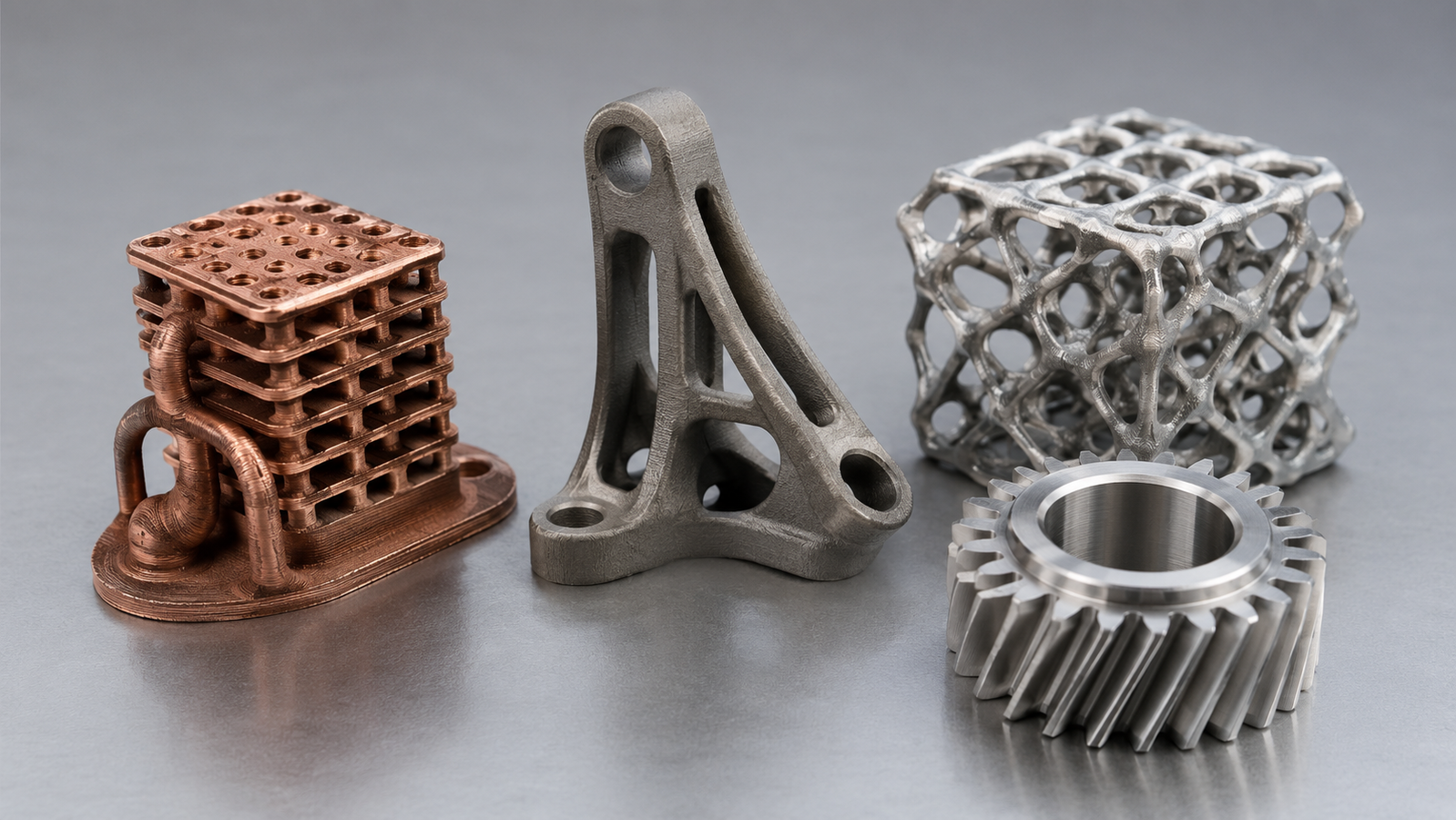
The alloy you choose shapes almost everything about a metal 3D-printed part — its strength, weight, heat and corrosion resistance, how it is finished, and what it costs. This guide covers the seven metal families that dominate metal additive manufacturing today: stainless steel, tool and maraging steel, titanium, aluminum, cobalt-chrome, nickel superalloys, and copper. For each, it gives what the material is good at, the grades most used in laser powder bed fusion, the things to watch, and where it fits.1,2
How to choose a metal AM alloy
Choosing an alloy for metal 3D printing means ranking the requirements that actually drive the part and matching them to a material. The main axes are mechanical properties (strength, hardness, fatigue), service temperature, corrosion resistance, weight (strength-to-density), biocompatibility, thermal and electrical conductivity, and cost.3,4 Two AM-specific factors matter just as much: printability — how readily the alloy processes without cracking or excessive defects — and the post-processing (stress relief, heat treatment, hot isostatic pressing, machining) needed to reach final properties.5,6 No single alloy wins on every axis, so the practical approach is to fix the one or two requirements that cannot be compromised, then choose from the alloys that meet them. Beyond the seven families below, more specialized alloys — including refractory metals such as tantalum — are also printable for niche high-performance uses.7
Interactive: alloy selector
Pick the requirement that matters most for your part to see the metal AM alloy that typically fits best, and why.
A guide to typical first choices; the best alloy for a specific part depends on the full set of requirements and should be confirmed with your provider.
Stainless steel (316L, 17-4PH)
Stainless steel is the workhorse of metal AM: forgiving to print, well-characterized, and inexpensive relative to titanium or nickel alloys. 316L is an austenitic stainless prized for corrosion resistance, ductility, and weldability; it reaches high density in laser powder bed fusion and is widely used for fluid, marine, food, and general engineering parts; it is also among the most-studied alloys across other AM routes.8,9,10 17-4PH is a precipitation-hardening stainless that can be heat-treated to much higher strength while keeping good corrosion resistance, making it a common choice where strength and corrosion both matter.11 Both are natural starting points when a part does not demand the specialized properties of the other families.
Tool & maraging steel (18Ni300)
When a part must be hard and strong — injection-mold tooling, dies, jigs — maraging and tool steels are the go-to. Maraging steel 18Ni300 prints well and, after aging heat treatment, develops nanoscale precipitates that push tensile strength to roughly 1,900–2,100 MPa with good toughness.12,13 Its low carbon content reduces cracking risk and gives excellent dimensional stability through heat treatment, which is why it dominates 3D-printed tooling — particularly molds with conformal cooling channels that cannot be machined into a solid block.13
Titanium (Ti-6Al-4V)
Ti-6Al-4V is the most important titanium alloy in AM, valued for an outstanding strength-to-weight ratio, excellent corrosion resistance, and biocompatibility. Its microstructure — and therefore its strength and ductility — is highly sensitive to the rapid solidification of laser melting and to subsequent heat treatment, so parameters and post-processing are tuned carefully.14,15,16,17 As-built titanium carries high residual stress and benefits from stress relief and often hot isostatic pressing to maximize fatigue performance.18,19 It is the default for lightweight aerospace structures and for orthopedic and dental implants.
Aluminum (AlSi10Mg)
AlSi10Mg is the established aluminum alloy for laser powder bed fusion — essentially a casting alloy well suited to the rapid melting and solidification of AM. It offers low density with good strength, thermal conductivity, and printability, making it the choice for lightweight structural brackets, housings, and heat-management parts.20,21 Achieving low porosity and a good surface depends strongly on process parameters, and its properties respond to heat treatment; careful parameter control is needed to reach full density.22,23
Cobalt-chrome (CoCrMo)
Cobalt-chrome (CoCrMo) combines high hardness, excellent wear and corrosion resistance, good high-temperature strength, and biocompatibility. Medical-grade cobalt-chrome alloys are a mainstay for dental frameworks and crowns, orthopedic implants, and wear components, where hardness and corrosion resistance outlast stainless steel.24,25 Like the other alloys, its as-built microstructure and mechanical performance are refined by appropriate heat treatment.24 It is chosen when wear resistance or medical-grade biocompatibility is the priority rather than low weight.
Nickel superalloys (Inconel 625 / 718)
Nickel-based superalloys keep their strength where most metals fail — at high temperature. Inconel 625 offers excellent high-temperature strength, fatigue, creep, and corrosion resistance and prints with good geometrical freedom, serving hot-section aeroengine, chemical, and marine parts.26,27 Inconel 718 is one of the most-used aerospace superalloys; as-built material needs solution and double-aging heat treatment to precipitate the nanoscale phases that give it high strength and creep resistance up to around 650 °C.28,29 These alloys are also prone to scan-strategy-dependent cracking, so processing is developed with care.30 Choose them for turbine, combustion, and other high-temperature components.
Copper (CuCrZr, pure copper)
Copper is the material for moving heat and electricity — heat exchangers, heat sinks, inductors, and electrical components. It is also the hardest of these families to print, because copper strongly reflects the near-infrared laser and conducts heat away from the melt pool, so specialized parameters, powder treatments, or green/blue lasers are used to reach density.31,32 Pure copper maximizes conductivity, while CuCrZr is a precipitation-hardening copper alloy that trades a little conductivity for much higher strength; a suitable heat treatment can give roughly 200 HV hardness while keeping thermal conductivity around 300 W/m·K.33 Copper is chosen when thermal or electrical performance drives the design.
Alloys compared
A high-level comparison of the seven families. Grades and applications are typical; properties depend on parameters, heat treatment, and part design.34
| Alloy family | Key strengths | Typical grades | Typical applications |
|---|---|---|---|
| Stainless steel | Corrosion resistance, ductility, low cost, easy to print | 316L, 17-4PH | General engineering, fluid, marine, food |
| Tool / maraging steel | Very high hardness & strength after aging | 18Ni300 (1.2709) | Injection molds, dies, tooling |
| Titanium | Strength-to-weight, corrosion, biocompatible | Ti-6Al-4V | Aerospace structures, implants |
| Aluminum | Lightweight, thermal, good printability | AlSi10Mg | Light structural, housings, heat management |
| Cobalt-chrome | Wear & corrosion resistance, biocompatible | CoCrMo | Dental, orthopedic implants, wear parts |
| Nickel superalloy | High-temperature strength & creep resistance | Inconel 625, 718 | Turbine, combustion, hot-section parts |
| Copper | Thermal & electrical conductivity | Pure Cu, CuCrZr | Heat exchangers, heat sinks, inductors |
Post-processing by alloy
Almost every metal AM part needs some post-processing, and the recipe depends on the alloy:
- Stress relief on the build plate is near-universal for laser powder bed fusion, especially for high-stress alloys such as titanium and nickel superalloys, to prevent distortion when the part is removed.18
- Aging / precipitation heat treatment is what unlocks strength in 17-4PH, maraging steel, nickel superalloys, and CuCrZr — the as-built part is comparatively soft until the strengthening phases are precipitated.12,29,33
- Hot isostatic pressing (HIP) closes internal porosity and improves fatigue life, and is common for critical titanium and nickel parts.19
- Machining of critical faces and fits follows, because as-built surfaces are rougher than machined ones across all alloys.16
The bigger picture
There is no single “best” metal for 3D printing — only the best fit for a given part. Rank the requirements that cannot be compromised, choose from the alloys that meet them, and plan the heat treatment and finishing that turn an as-built part into a functional one.1
ACS Material’s metal 3D printing service works across these alloy families on laser powder bed fusion, including the stress relief, aging, HIP, and machining each material needs. If you are still weighing processes, see our comparison of SLM vs DMLS vs binder jetting, our guide to metal 3D printing precision and tolerance, and how we handle large-format metal parts; we also supply the XDM metal 3D printers. Tell us your part’s requirements and we will recommend the alloy and process.
FAQs
What metals can be 3D printed?
The most common metal AM materials are stainless steels (316L, 17-4PH), tool and maraging steels (18Ni300), titanium (Ti-6Al-4V), aluminum (AlSi10Mg), cobalt-chrome (CoCrMo), nickel superalloys (Inconel 625 and 718), and copper (pure copper and CuCrZr). Many other alloys are printable, but these seven families cover the large majority of industrial parts.
Which metal is strongest for 3D printing?
It depends on what “strongest” means. For sheer hardness and tensile strength, aged maraging steel is among the highest (roughly 1,900–2,100 MPa). For strength at high temperature, nickel superalloys like Inconel lead. For strength relative to weight, titanium Ti-6Al-4V is usually the best choice.
What is the best metal for 3D-printed implants?
Titanium Ti-6Al-4V and cobalt-chrome (CoCrMo) are the leading choices for medical and dental parts because both are biocompatible and corrosion-resistant. Titanium is favored for its strength-to-weight ratio and bone-friendly properties; cobalt-chrome is favored where hardness and wear resistance matter, such as dental frameworks and bearing surfaces.
Which metal is best for heat and electrical conductivity?
Copper. Pure copper offers the highest thermal and electrical conductivity, while CuCrZr trades a little conductivity for much higher strength. Copper is harder to print than other metals because it reflects the laser and conducts heat away from the melt pool, so it needs specialized parameters or laser sources.
Do 3D-printed metal parts need heat treatment?
Usually. Stress relief is near-universal to prevent distortion, and several alloys — 17-4PH, maraging steel, nickel superalloys, and CuCrZr — only reach their full strength after an aging heat treatment that precipitates strengthening phases. Critical titanium and nickel parts often also receive hot isostatic pressing to close porosity.
Which metal 3D printing material is cheapest?
Stainless steel is generally the most economical common metal AM material and is also one of the easiest to print, which is why it is a frequent default. Titanium, nickel superalloys, and copper cost more per kilogram and can be more demanding to process.
References
This article is provided by ACS Material LLC for educational purposes and describes common metal 3D printing (metal additive manufacturing) alloys, including stainless steel, tool and maraging steel, titanium, aluminum, cobalt-chrome, nickel superalloys, and copper. Grade designations, mechanical-property figures (such as tensile strength, hardness, and conductivity), service temperatures, and application examples are typical values from the referenced studies and general material characteristics; the properties achievable for any specific part depend on the alloy grade, machine, process parameters, orientation, and post-processing, and must be confirmed for your application. Consult product datasheets and safety data sheets for grade-specific specifications and handling guidance. The interactive alloy selector is a schematic teaching tool based on typical first-choice materials, not a substitute for engineering material selection.