-
N-Doped Graphene Additive for Li-S Batteries - Cornell, 2024
Jun 10, 2026 | ACS MATERIAL LLCShah, V. R. et al. (2024). Modality-tunable exfoliated N-doped graphene as effective electrolyte additive for high-performance lithium–sulfur batteries. *ACS Applied Materials & Interfaces*. https://doi.org/10.1021/acsami.4c12157
Cornell University · ACS Applied Materials & Interfaces · 2024
Cornell University used ACS Material single-layer and N-doped graphene as commercial benchmarks for tunable N-doped graphene electrolyte additives in lithium-sulfur batteries.
About this research
Researchers at Cornell University evaluated commercial single-layer graphene and N-doped graphene from ACS Material as benchmark carbon additives while developing modality-tunable, nitrogen-doped graphene electrolyte additives that raised lithium–sulfur (Li–S) battery capacity retention to 73% after 225 cycles at 0.2 C and delivered a 4-fold capacity increase at 2 C relative to a reference cell. The team produced few-layered graphene in-house using a patented Taylor–Couette reactor, then thermally annealed it with urea to reach up to 27 atom % nitrogen with tunable bonding modality. The ACS Material products were carried alongside as commercially available comparison samples to place the new additives in context, addressing a central question in the field: how nitrogen content and dopant configuration govern electrochemical performance.
This research matters because Li–S batteries promise an ultrahigh theoretical energy density of about 2600 Wh kg⁻¹ with abundant, low-cost sulfur cathodes, yet their commercialization is limited by lithium polysulfide (LiPS) shuttling, the insulating nature of sulfur and Li₂S, and lithium anode instability. Many laboratory fixes—exotic cathode hosts, redox mediators, solid electrolytes, and engineered separators—work at small scale but are too costly or complex to manufacture. The authors argue that a scalable, green graphene additive dropped directly into a conventional liquid electrolyte is a more practical route. Understanding which nitrogen modality (pyridinic, pyrrolic, or graphitic) most effectively anchors polysulfides and accelerates Li⁺ transport is therefore valuable to anyone working on energy storage, electrocatalysis, or doped two-dimensional carbon materials.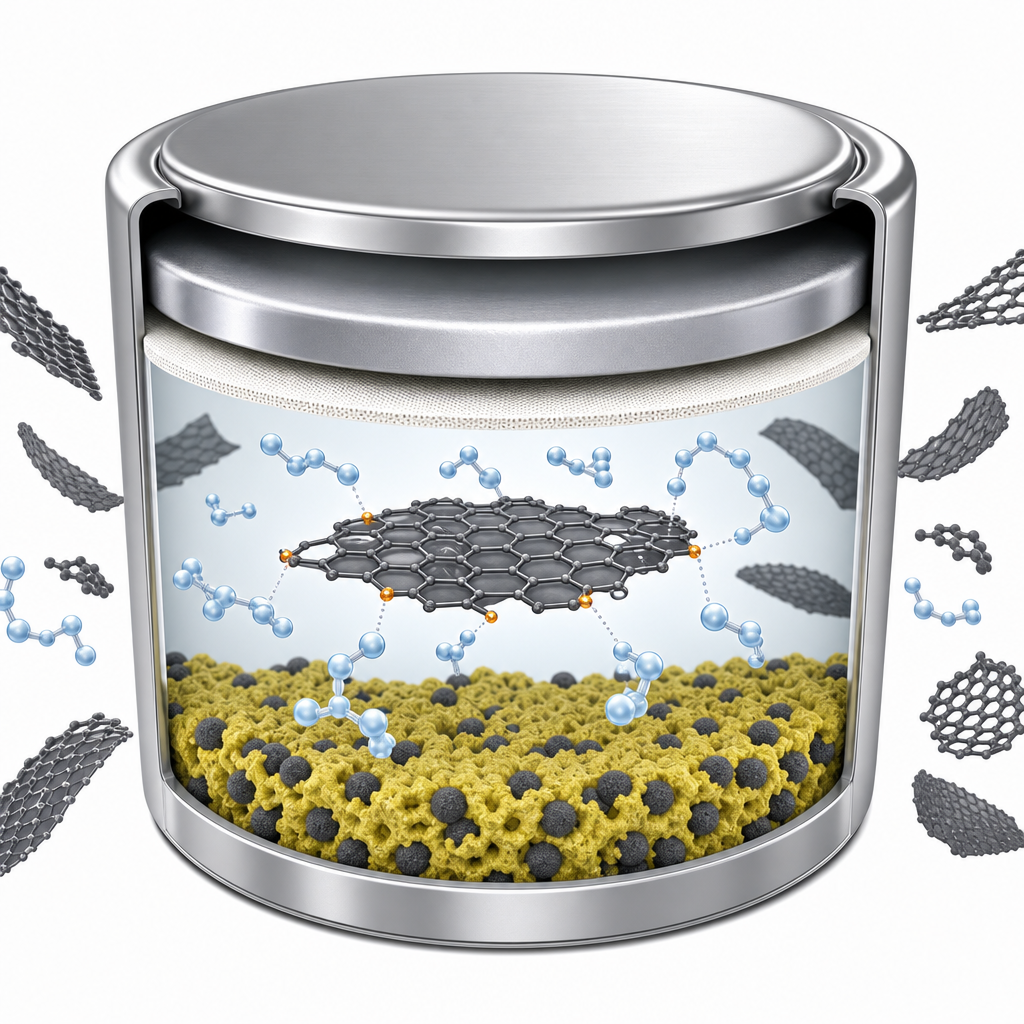
The ACS Material graphene products entered the workflow as the "commercial carbon materials for electrolyte additives" comparison set. According to the Materials section, the study used single-layer graphene (ACS Material) and N-doped graphene (ACS Material) as received, drying all carbon materials in a vacuum oven at 600 °C overnight before incorporation. The in-house graphene was synthesized by continuous high-shear exfoliation of synthetic graphite in aqueous media, then doped with urea at controlled ratios, temperatures (460–502 °C), and annealing times to produce four samples (N-Gr 1–4) spanning 7–27 atom % nitrogen. All additives, including the commercial ACS Material references, were loaded at 0.25 wt % of the liquid electrolyte, ultrasonicated for 90 minutes, and used immediately. Cells used Ketjen Black/sulfur cathodes, LiTFSI/LiNO₃ in DME/DOL electrolyte, lithium metal anodes, and Celgard 2400 separators, with CR2032 coin cells and pouch cells assembled in an argon glovebox.
The key results show that higher nitrogen content and pyridinic-type bonding most strongly improve performance. Cells with N-doped graphene additives reached a reversible capacity of 897 mAh g⁻¹ at 0.5 C with a low capacity fade of 0.13% per cycle. Capacity retention reached 73% after 225 cycles at 0.2 C for higher-nitrogen samples, while pyridinic-rich N-Gr 1 excelled at high C rates, giving roughly a 4-fold capacity increase at 2 C and 3-fold at 1 C (628 mAh g⁻¹) relative to the reference. Polarization potentials dropped to 160 mV (N-Gr 1) and 183 mV (N-Gr 4) versus 260 mV for the plain liquid electrolyte. Electrochemical impedance spectroscopy showed lower charge-transfer resistance for graphene-additive cells, with pyridinic-rich samples showing the lowest impedance. Cyclic voltammograms confirmed faster electron transfer and well-overlapped curves indicating stable cycling. Polysulfide adsorption tests and UV–vis measurements demonstrated stronger LiPS binding to nitrogen-doped surfaces, and post-mortem imaging revealed smoother, dendrite-free lithium anodes. DFT and ab initio molecular dynamics simulations validated the strong adsorption affinity of pyridinic nitrogen for Li₂S₄, Li₂S₆, and Li₂S₈ and improved Li⁺ mobility along the graphene backbone, corroborating the experimental trends.
This work enables a low-cost, scalable route to higher-performing Li–S cells by simply tailoring nitrogen doping in an electrolyte additive rather than redesigning electrodes or separators. The findings are relevant to grid-scale and high-energy-density storage, electric mobility, and any application demanding sulfur-based chemistries beyond 500 Wh kg⁻¹. The modality-control concept—favoring pyridinic nitrogen for polysulfide anchoring and ion transport—also informs electrocatalysis, supercapacitors, and lithium-metal anode protection. The authors point toward further experimental and computational study to fully map the electrochemistry of N-doped graphenic species in Li–S systems and to scale the aqueous Taylor–Couette exfoliation process for industrial production.
For researchers pursuing similar comparisons, commercial single-layer graphene and nitrogen-doped graphene of the type used here as benchmarks are available from ACS Material's Graphene Series, making it straightforward to reproduce baseline measurements against newly synthesized doped carbons. Having a consistent, commercially sourced reference material strengthens the credibility of additive-performance claims and supports reproducible studies on polysulfide mitigation, ionic conductivity, and doped-graphene electrochemistry.How ACS Material products were used
- N-doped Graphene Powder (ACS Material) (Graphene Series) — “(2) N-doped graphene (ACS Material). All the carbon materials were used after drying in a vacuum oven at 600 °C overnight.”
- Single Layer Graphene (ACS Material) (Graphene Series) — “The commercial carbon materials for electrolyte additives used in this study are as follows: (1) single-layer graphene (ACS Material); (2) N-doped graphene (ACS Material).”
Product Performance in this StudyUsed as a commercial benchmark carbon additive to compare against the in-house Taylor–Couette-exfoliated and N-doped graphene. It served as a reference point in the electrolyte-additive performance evaluation.
Related product categories
Frequently asked questionsHow does N-doped graphene improve lithium-sulfur battery performance?
Nitrogen-doped graphene added to the electrolyte anchors lithium polysulfides through nitrogen-polysulfide interactions, reducing the shuttle effect. Its conducting graphene backbone improves Li-ion conductivity and electron transfer. In this Cornell study, higher nitrogen content raised capacity retention to 73% after 225 cycles at 0.2 C, while pyridinic-rich graphene gave a 4-fold capacity increase at 2 C versus the reference cell.
Why is pyridinic nitrogen important for lithium-sulfur battery additives?
Pyridinic nitrogen shows the strongest binding affinity for lithium polysulfides and lowers Li-ion diffusion barriers, as confirmed by DFT and AIMD simulations. Cells with pyridinic-rich graphene additives had the lowest charge-transfer resistance and best high-rate capability, delivering roughly a 4-fold capacity increase at 2 C. Pyrrolic nitrogen introduces ring strain that folds the sheet and impedes ion diffusion.
What is single-layer graphene used for in battery research?
Single-layer graphene serves as a highly conductive, high-surface-area carbon additive and as a benchmark reference material. In this lithium-sulfur study it was used as a commercial comparison sample alongside N-doped graphene to evaluate how nitrogen doping changes electrochemical performance, providing a consistent baseline for capacity, impedance, and polysulfide adsorption measurements.