-
Ordered Mesoporous Carbon as Pt/C Support for ORR - DECHEMA, 2018
May 29, 2026 | ACS MATERIAL LLCSakthivel, M., & Drillet, J. (2018). An extensive study about influence of the carbon support morphology on Pt activity and stability for oxygen reduction reaction. *Applied Catalysis B: Environmental*. https://doi.org/10.1016/j.apcatb.2018.02.050
Applied Catalysis B: Environmental · 2018
DECHEMA researchers used ACS Material Ordered Mesoporous Carbon and GNP10 as Pt supports, showing ~30% ECSA retention after 10,000 ORR cycles.
About this research
Researchers at DECHEMA-Forschungsinstitut (Frankfurt am Main, Germany) used Ordered Mesoporous Carbon (OMC) and Graphite Nano Particles (GNP10) supplied by ACS Material as Pt catalyst supports and demonstrated that Pt deposited on the mesoporous OMC retained close to 30% of its electrochemical surface area (ECSA) after 10,000 accelerated degradation test (ADT) cycles, compared with only about 1% for the same catalyst loading on standard Vulcan XC-72R. The study by Sakthivel and Drillet, published in Applied Catalysis B: Environmental, systematically compares five commercial carbons as Pt supports for the oxygen reduction reaction (ORR) in direct methanol fuel cell (DMFC) cathodes, mapping how BET surface area, pore architecture, and graphitization control both intrinsic ORR activity and long-term Pt stability.
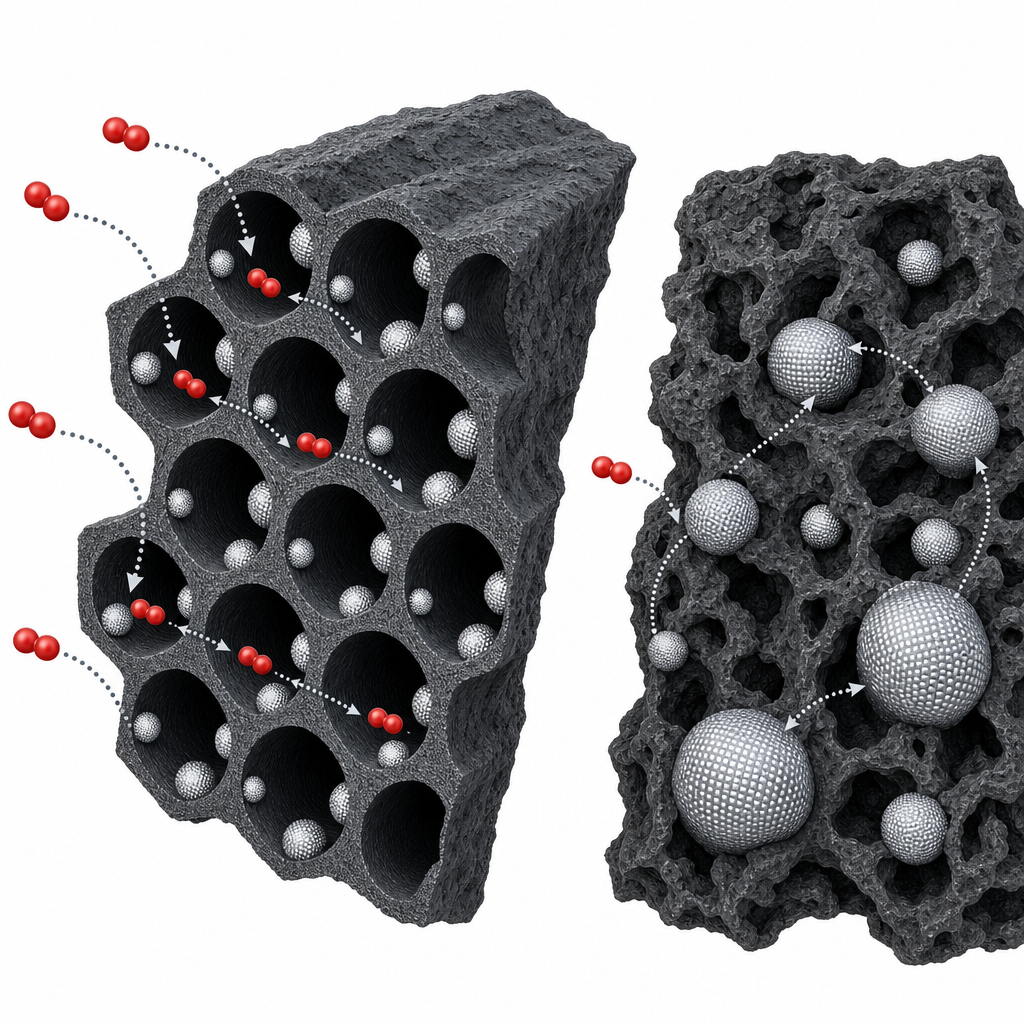
This work addresses one of the central obstacles to widespread adoption of proton exchange membrane fuel cells (PEMFCs) and DMFCs: insufficient cathode durability under high current density. Five degradation pathways are known to erode Pt/C catalysts—Ostwald ripening, particle migration and coalescence, detachment, dissolution into the ionomer, and corrosion of the underlying carbon. Standard carbon blacks such as Vulcan are dominated by micropores (<2 nm) that trap ionomer and are not fully accessible to reactants, while also exposing Pt anchors to oxidative attack at high cathode potentials. Identifying a carbon morphology that simultaneously offers strong Pt anchoring, good electronic conductivity, gas-accessible mesopores, and oxidative stability is therefore a key step toward longer-lived low-temperature fuel-cell stacks for portable and stationary power applications.
For the catalyst series the authors impregnated each carbon support with hexachloroplatinic acid and reduced it with formaldehyde/methanol under reflux at 80 °C to give a nominal 40 wt% Pt loading. The ACS Material Ordered Mesoporous Carbon used in this study has a BET surface area of about 1000 m² g⁻¹ with an average pore size of 3.9–5.5 nm, while the ACS Material GNP10 graphite nanoparticles offer 660–720 m² g⁻¹ at roughly 10 nm primary particle size. These were benchmarked against Vulcan XC-72R, HSAG300 high-surface-area graphite, and Sigma-Aldrich GNP500 graphitized nanoparticles, plus two commercial 40 wt% Pt/C references from Johnson Matthey and Heraeus. Catalyst inks (catalyst plus 1–10 wt% Nafion) were deposited on a rotating ring-disk electrode at ~80 µg_Pt cm⁻² and also formulated into gas diffusion electrodes on Toray TGP-H-60 carbon paper, with PTFE added to Nafion to tune hydrophobic domains in the catalyst layer.
TGA in air revealed a clear inverse relationship between thermal corrosion resistance and BET surface area: low-area GNP500 retained near 100% mass up to 700 °C, while the high-area OMC degraded earlier, and Pt loading consistently shifted T90 to 175–315 °C lower than the bare carbons due to catalytic oxidation of carbon by densely dispersed Pt nanoparticles. XRD confirmed face-centered-cubic Pt on every support, with stronger (002) graphite reflections for GNP and HSAG300. Electrochemically, the highest ORR activity was obtained on Pt/GNP500, but the best ADT stability was delivered by Pt/OMC: after 10,000 cycles between 0.4 and 1.4 V vs. NHE at 1 V s⁻¹ in 0.5 M H₂SO₄, ECSA retention reached ~30% for Pt/OMC versus ~1% for Pt/Vulcan. Identical-location TEM showed that Pt particles on Vulcan coarsened from a few nanometers to roughly 40 nm, whereas Pt on OMC grew only to about 15 nm, indicating that the mesoporous, graphitic OMC framework physically anchors nanoparticles and suppresses Ostwald ripening and migration. Adding PTFE to the Nafion binder in the GDE catalyst layer further improved ECSA retention by stabilizing hydrophobic transport channels.
The results point to a practical design rule for next-generation fuel-cell electrodes: pair Pt nanoparticles with carbons that combine mesopores in the 3–6 nm range and a high degree of graphitization. Such supports are directly relevant to DMFC cathodes, PEMFC stacks for transportation, regenerative fuel cells operating under ORR/OER cycling, and electrolyzer cathodes where carbon corrosion at high potentials is the dominant aging mechanism. The findings also inform the formulation of ionomer/PTFE binder systems in gas diffusion electrodes and support continued benchmarking of Pt-alloy and non-PGM catalysts on mesoporous carbon platforms.
For researchers working on electrocatalysis, fuel cells, and electrolyzers, the Ordered Mesoporous Carbon and graphite nanoparticle supports used in this study are available from ACS Material as part of the Carbon Series catalog, alongside related porous carbons, CMK-3/CMK-8, and N-doped mesoporous carbons. The paper provides a quantitative benchmark for how a higher-cost mesoporous support trades off against standard carbon blacks in long-duration ORR testing, making it a useful reference for groups screening Pt and Pt-alloy catalysts on engineered carbon morphologies.How ACS Material products were used
- Graphite Nano Particles (GNP10) (Carbon Series) — “Graphite Nano Particles (GNP10, ACS Materials)... BET surface 660-720 m² g−1, Avg. particle size 10 nm”
- Ordered Mesoporous Carbon (OMC) (Carbon Series) — “Ordered Mesoporous Carbon (OMC, ACS Materials)... BET surface 1000 m² g−1, Avg. pore size 3.9-5.5 nm”
Product Performance in this Study
OMC from ACS Material served as a Pt catalyst support and delivered the best stability among tested carbons, with ECSA retention near 30% after 10,000 ADT cycles compared to ~1% for Pt/Vulcan. Its mesoporous structure immobilized Pt nanoparticles and limited particle growth to ~15 nm versus ~40 nm on Vulcan.
Related product categories
Frequently asked questions
Why does ordered mesoporous carbon improve Pt stability in ORR catalysts?
Ordered mesoporous carbon combines pores in the 3–6 nm range with graphitic domains. The mesopores physically confine Pt nanoparticles and limit migration and Ostwald ripening, while graphitization improves oxidative stability at high cathode potentials. In this study, Pt on OMC retained nearly 30% ECSA after 10,000 accelerated degradation cycles and grew only to about 15 nm, versus about 40 nm on Vulcan XC-72R.
How does BET surface area of the carbon support affect Pt/C thermal corrosion?
Higher BET surface area correlates with faster carbon corrosion in air. Low-area GNP500 (100 m² g⁻¹) retained nearly 100% mass up to 700 °C, while high-area OMC (1000 m² g⁻¹) lost mass much earlier. Adding 40 wt% Pt shifted the 90% retention temperature down by roughly 175–315 °C across all systems, because well-dispersed Pt nanoparticles catalyze oxidation of the surrounding carbon to CO₂.
What carbon support gives the best balance of ORR activity and durability?
Activity and durability are governed by different supports. The highest ORR activity in this study was obtained on Pt/GNP500, while the best stability was delivered by Pt/OMC, which combines high mesoporous surface area with sufficient graphitization. The paper concludes that a graphitic, mesoporous carbon morphology is the most promising compromise for long-life Pt/C cathodes in DMFC and PEMFC systems.