
Pristine graphene and carbon nanotubes are famously inert. The same flawless sheet of sp2 carbon that makes them strong and conductive also makes their surfaces slippery, water-repelling, and reluctant to bond to anything — so they clump in solvents, settle out of inks, and pull loose from the polymers they are meant to reinforce. Plasma functionalization fixes this in minutes, without solvents or strong acids: a gas plasma grafts chemical groups onto the carbon surface, turning an unwettable, aggregating powder into one that disperses and bonds. This guide explains how it works, what it changes, the trade-offs to manage, and how to choose gases and equipment — with verified figures throughout.
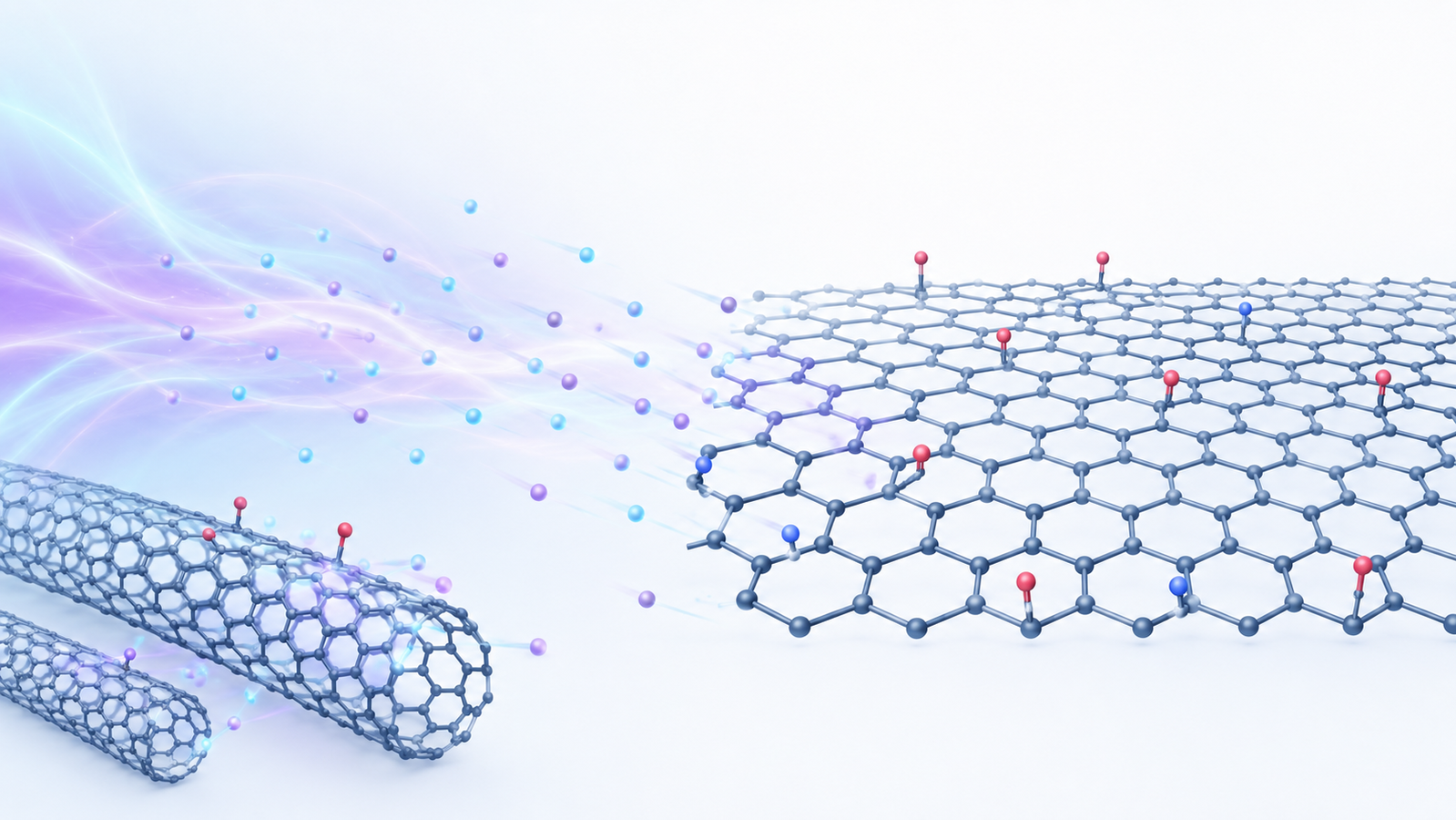
Short answer: a plasma is an ionized gas full of reactive species — electrons, ions, radicals, and ultraviolet photons. When graphene or carbon nanotubes pass through it, those species break a fraction of the surface carbon bonds and graft new functional groups onto the edges and basal plane. The gas you choose sets the chemistry: oxygen plasmas add –OH, C=O, and –COOH groups; nitrogen or ammonia plasmas add amine and pyridinic-nitrogen groups; fluorine-bearing gases add C–F. The payoff is higher surface energy, far better dispersion in water and polymers, stronger composite interfaces, and tunable doping — all dry, fast, and scalable. The cost is that every grafted group is a small defect in the conducting lattice, so over-treatment lowers conductivity. The craft is in the dose.
Why pristine graphene and CNTs need functionalizing
The properties that make carbon nanomaterials desirable come from one feature: a continuous, defect-free lattice of sp2-bonded carbon. That lattice is what makes monolayer graphene the strongest material ever measured, with an intrinsic strength near 130 GPa and a stiffness near 1 TPa1, and an outstanding conductor of both electricity and heat2,3. Carbon nanotubes share the same surface chemistry — a rolled-up graphene wall.
But a perfect sp2 surface has almost no dangling bonds and no polar groups for other molecules to grab. It is chemically inert and strongly hydrophobic. Worse, the flat π-surfaces attract one another through van der Waals forces: graphene sheets restack into graphite-like aggregates, and nanotubes rope together into tight bundles. The practical result is that graphene and carbon nanotubes disperse poorly in water and most solvents, separate out of inks and slurries, and bond weakly to the polymer or ceramic matrices they are added to — so a composite often captures only a fraction of the filler’s intrinsic strength or conductivity. Functionalization — deliberately attaching chemical groups to the surface — is how that interface problem is solved. The question is how to do it without destroying the very lattice you are trying to exploit.
How plasma functionalization works
A plasma is a partially ionized gas. Energy from a high-voltage discharge (for example cold-plasma and dielectric-barrier-discharge sources) strips electrons from gas molecules and produces a reactive soup of free electrons, positive ions, neutral radicals, excited molecules, and ultraviolet photons. When a carbon surface is placed in this environment, those species do two things at once: energetic ions and electrons break a fraction of the surface C–C and C=C bonds, creating reactive sites, and reactive radicals from the feed gas immediately bond to those sites. The surface is functionalized atom by atom, while the bulk of the material is left untouched. Reviews of plasma processing of graphene describe this as a fast, dry, and highly controllable route to surface chemistry4.
The single most important control is the feed gas, because the radicals available decide which groups are grafted. Oxygen, carbon dioxide, air, or water vapor plasmas graft oxygen functionalities — hydroxyl (–OH), carbonyl (C=O), epoxy, and carboxyl (–COOH) — and these dominate when the goal is wettability and dispersion5,6. Nitrogen or ammonia plasmas incorporate nitrogen as amine, pyridinic, pyrrolic, and graphitic configurations, which is the basis of nitrogen doping; hydrogen plasmas add C–H (hydrogenation), and argon — a noble gas that grafts nothing — instead bombards the surface to create dangling bonds and defects, either to activate it or to etch it7. Fluorine-bearing gases such as CF4 add C–F bonds, which lower the surface energy and can p-dope the lattice. Beyond gas, the operator tunes power, pressure, exposure time, and gas flow — together these set the dose, which is the theme of section 5.
What changes: wettability and dispersion
The most immediate, easily measured change is wettability. A pristine graphenic surface is hydrophobic, with a water contact angle around 90–100°; a polar functionalized surface lets water spread. Low-power oxygen plasma has been shown to improve the wettability of graphene without adding measurable damage, precisely because it solves the adhesion problems that otherwise plague device fabrication8, and contact-angle studies map directly how surface energy rises as oxygen groups are added9. On graphene oxide films, a short air-plasma exposure drives the surface from ordinary hydrophilic (contact angle ~55°) to superhydrophilic (below 10°) within seconds6.
Higher surface energy translates directly into better dispersion. Once a flake or nanotube carries polar groups, water and polar solvents wet it, hydrogen bonding and electrostatic repulsion keep particles apart, and the suspension resists re-aggregation. Plasma-treated multiwalled nanotubes show markedly better macro-dispersion and phase adhesion than untreated tubes when mixed into a polymer10, and atmospheric-pressure plasma has been used specifically to find the optimum dispersion conditions for carbon-fiber and nanotube–phenolic systems11. For anyone formulating an ink, coating, or masterbatch, this is the difference between a stable dispersion and a jar of sediment.
Stronger composites and coatings
Dispersion is only half the benefit. The grafted groups also give the matrix something to hold onto, converting a weak van der Waals contact into strong — sometimes covalent — interfacial bonding, so that mechanical load and electrical charge actually transfer between matrix and filler. Oxygen-plasma treatment of carbon fiber raises the interfacial shear strength of the resulting composite by increasing surface oxygen groups12. Plasma-functionalized nanotubes melt-mixed into polycarbonate raise the stress at yield and the strain at break through better dispersion and phase adhesion at once10. The bonding can be made explicitly covalent: nanotubes plasma-grafted with reactive groups and then coupled through maleic anhydride become part of the cross-linked epoxy network rather than a separate phase13. And because plasma pretreatment improves contact between filler and polymer, it has been used to make highly conductive nanotube–polyaniline composites14. Crucially, when the dose is kept modest, these gains in dispersion and adhesion arrive without raising the electrical percolation threshold — the conductive network survives10.
The conductivity trade-off: controlling dose
Functionalization is never free. Every group grafted onto the basal plane converts a flat, conjugated sp2 carbon into a puckered sp3 site, and every sp3 site is a scattering center that interrupts the path electrons and phonons travel. Push the plasma too hard — too much power, too long — and the surface accumulates so many groups and vacancies that conductivity falls and sheet resistance climbs. A study treating graphene with oxygen, hydrogen, and argon plasmas showed sp3 carbon and oxygen content rising with exposure, with a corresponding electrical penalty7.
The standard way to watch this happening is Raman spectroscopy. The ratio of the disorder-induced D band to the G band (ID/IG) rises as defect density rises, giving a direct, quantitative read on how much damage a treatment has done — calibrated against controlled ion bombardment in the foundational work of Cançado and co-workers15, and routinely used to track doping and disorder in graphene devices16. The practical lesson is that there is an optimal dose: enough functional groups to wet and bond the surface, but not so many that you erase the conductivity you bought the material for. Lighter treatments preserve transport; aggressive treatments are reserved for cases where chemistry matters more than conductivity.
Beyond functionalization: doping, reduction, etching
The same equipment, with a different gas or a different dose, does three closely related jobs that are worth their own attention — and their own follow-up reading.
Doping. Nitrogen and ammonia plasmas do more than decorate the surface; they substitute nitrogen atoms into the carbon lattice in pyridinic, pyrrolic, and graphitic configurations. Those nitrogen sites are catalytically active: nitrogen-doped graphene works as a metal-free electrocatalyst that rivals platinum for the oxygen-reduction reaction in fuel cells17, and combined oxygen-and-nitrogen plasma etching produces graphene with abundant edges and dopant sites for exactly this kind of catalysis18.
Reduction. Run on graphene oxide with a reducing or inert gas, plasma does the opposite of oxygen functionalization — it strips oxygen groups away and partially restores the conducting network. A dielectric-barrier-discharge plasma jet at atmospheric pressure has been shown to reduce graphene oxide to roughly 87% carbon content in minutes, a fast and low-cost alternative to hot chemical reduction19, and the broader toolbox of plasma-assisted reduction is now well reviewed20.
Etching. Taken to a higher dose, plasma stops modifying and starts removing — etching carbon away layer by layer. The same air-plasma process that makes graphene oxide superhydrophilic begins to etch the surface atomically once the exposure is extended6, which can be used deliberately to thin films, open pores, or pattern a surface. Each of these — doping, reduction, and etching — deserves a dedicated treatment, and we will cover them in their own articles.
Plasma vs. wet-chemical functionalization
The traditional way to functionalize carbon nanomaterials is wet chemistry — refluxing in strong acids and oxidizers, as in the classic graphite-oxide route21. Wet methods are effective and treat material in bulk, but they use hazardous reagents, generate liquid waste, require washing and drying, and tend to cut and heavily damage the lattice. Plasma trades those drawbacks for a different set: it is dry, solvent-free, fast, and tunable simply by changing the gas, and it modifies only the surface. Its limits are that it is largely a line-of-sight, batch process, and that the grafted groups can be metastable — some studies see the surface chemistry and wettability partially relax over days to weeks as groups recover or migrate6, so treated material is often best used soon after processing or stabilized afterward.
| Aspect | Plasma functionalization | Wet-chemical functionalization |
|---|---|---|
| Reagents | Process gas only (O2, N2, NH3, Ar, etc.); no solvents | Strong acids and oxidizers; large solvent volumes |
| Speed | Seconds to minutes | Hours, plus washing and drying |
| Depth | Surface-selective; bulk lattice preserved | Acts throughout; can cut and exfoliate the bulk |
| Tunability | Change the gas to change the chemistry; dose set by power and time | Set by reagent chemistry and conditions |
| Damage | Controllable; low at modest dose, severe if over-dosed | Typically high; many defects introduced |
| Waste | Minimal; no liquid effluent | Acidic liquid waste to neutralize and dispose |
| Throughput / form | Line-of-sight, batch; films, papers, and (with agitation) powders | Bulk slurries; large quantities at once |
| Durability of groups | Can partially relax over days to weeks | Generally stable once formed |
Equipment and getting started
Most surface functionalization uses cold (non-thermal) plasma, so the substrate stays near room temperature while the electrons stay energetic. Several source types deliver it: dielectric-barrier-discharge (DBD) cells and atmospheric-pressure plasma jets for films, papers, and continuous webs; low-pressure radio-frequency reactors for fine control; and simple plasma cleaners for surface activation. ACS Material’s plasma power supplies drive DBD and jet configurations across air, oxygen, nitrogen, and inert gases for exactly this kind of work.
Powders are the harder case, because a static bed only exposes its top surface to the plasma. The practical answer is to agitate the material while it is treated — for example the PlasMil™ plasma ball mill, which combines cold-plasma discharge with vibratory milling so that particles tumble and every surface is activated. Low-temperature plasma has been shown to enhance the reactivity of graphene nanoplatelets in just this way, introducing oxygen functionality across the powder5.
If you would rather start from already-functionalized material, carboxyl graphene and graphene oxide ship with oxygen groups already in place, and our CVD graphene films are common substrates for plasma surface engineering. For the physics of how cold plasma and DBD reactors actually generate these reactive species, see our companion overview of cold-plasma and DBD sources, and pair it with the material grades above.
Frequently asked questions
Does plasma treatment damage graphene?
It introduces some sp3 defects — that is inherent to grafting groups onto the lattice — but the amount is dose-dependent and measurable. Raman spectroscopy quantifies it through the D-to-G band ratio15. At low power and short times the damage is minor and conductivity is largely preserved; only aggressive treatments cause serious degradation.
Which gas should I use for which functional group?
Oxygen, CO2, air, or water vapor for oxygen groups (–OH, C=O, –COOH) and wettability; nitrogen or ammonia for amine and pyridinic-nitrogen groups and N-doping; hydrogen for hydrogenation; fluorine-bearing gases (e.g., CF4) for C–F and p-doping; and argon for purely physical activation, defect creation, or etching.
Is the effect permanent, or does it fade?
It can fade. Some plasma-grafted surfaces partially relax over days to weeks as groups recover, migrate, or react with the air6. For best results, use treated material soon after processing or apply a stabilization step.
How is plasma better than acid treatment?
Plasma is dry, solvent-free, fast, surface-selective, and tunable by gas, with minimal waste, whereas acid oxidation works in bulk but uses hazardous reagents and damages the lattice more heavily21. The trade-off is that plasma is largely a batch, line-of-sight process.
Can I treat powders, or only films?
Both, but powders need agitation so the plasma reaches every particle surface rather than just the top of a static bed — for example by combining plasma with milling5. Films, papers, and coatings are straightforward.
Does it work the same on carbon nanotubes as on graphene?
The surface chemistry is the same — both are sp2 carbon — so the same gases graft the same groups. Plasma is widely used to disperse and bond nanotubes in composites with the same improvements in adhesion and dispersion seen for graphene10.
References
This article is provided by ACS Material LLC for educational purposes and describes the plasma functionalization of graphene, carbon nanotubes, and graphene oxide. Property values cited for these materials — such as an intrinsic strength near 130 GPa, a stiffness near 1 TPa, contact angles, surface energies, and conductivity or defect figures — refer to idealized or single-layer material and the specific samples and conditions in the referenced studies; real multilayer flakes, papers, powders, films, and composites will differ, and the actual result of a plasma treatment depends on the material grade, the gas, and the power, pressure, and exposure time used. Consult product datasheets and safety data sheets for grade-specific specifications and handling guidance. The interactive simulators are schematic teaching tools based on the stated models (gas-to-functional-group chemistry, surface-energy and dispersion behavior, and the functionalization-versus-conductivity dose trade-off), not predictive design software; optimal process parameters must be established experimentally for each material and system.