-
TS-1 & H-ZSM-11 Zeolites for CO2-to-Aromatics - DTU, 2025
Jul 08, 2026 | ACS MATERIAL LLCNikolajsen, M. T. et al. (2025). Direct CO2 Hydrogenation to Aromatics Using ZnO/t‐ZrO2 and Zeolite Bifunctional Catalysts. *ChemCatChem*. https://doi.org/10.1002/cctc.202500099
Department of Chemical and Biochemical Engineering Technical University of Denmark (DTU) Kongens Lyngby 2800 Denmark · ChemCatChem · 2025
DTU researchers used ACS Material TS-1 and H-ZSM-11 zeolites in ZnO/t-ZrO2 bifunctional catalysts, reaching 42.4 carbon mol% aromatics selectivity from CO2.
About this research
Researchers at the Technical University of Denmark (DTU), working with Topsoe A/S, used ACS Material-supplied TS-1 and H-ZSM-11 zeolites in combination with a ZnO/t-ZrO2 methanol-synthesis catalyst to map the achievable yield of aromatics from direct CO2 hydrogenation, ultimately reaching 33.2 carbon mol% aromatics selectivity with H-ZSM-5 and 42.4 carbon mol% with larger-pore H-ZSM-12. The study explores a bifunctional route in which methanol forms over the oxide while simultaneous dehydration over the zeolite drives the methanol-synthesis equilibrium past its normal limit. By systematically varying temperature, pressure, residence time, bed configuration, zeolite acid-site density, and zeolite topology, the authors define how far direct CO2-to-aromatics chemistry can realistically be pushed.
The work addresses a pressing sustainability challenge: aromatics such as para-xylene and ethenylbenzene are monomers for polyethylene terephthalate and polystyrene, with combined annual output near 50 million tons and growing. Producing these from captured or biogenic CO2 could store an estimated 170–200 million tons of CO2 per year, offering a greenhouse-gas saving alternative to naphtha reforming. The open challenge is selectivity: Fischer–Tropsch routes suffer from broad Anderson–Schulz–Flory distributions, while oxide-plus-zeolite bifunctional systems show wildly inconsistent reported aromatics selectivities, ranging from roughly 15% to 85% across the literature. This paper aims to resolve those inconsistencies by carefully decoupling conversion from selectivity and identifying the mechanistic ceiling imposed by the hydrocarbon-pool dual-cycle mechanism.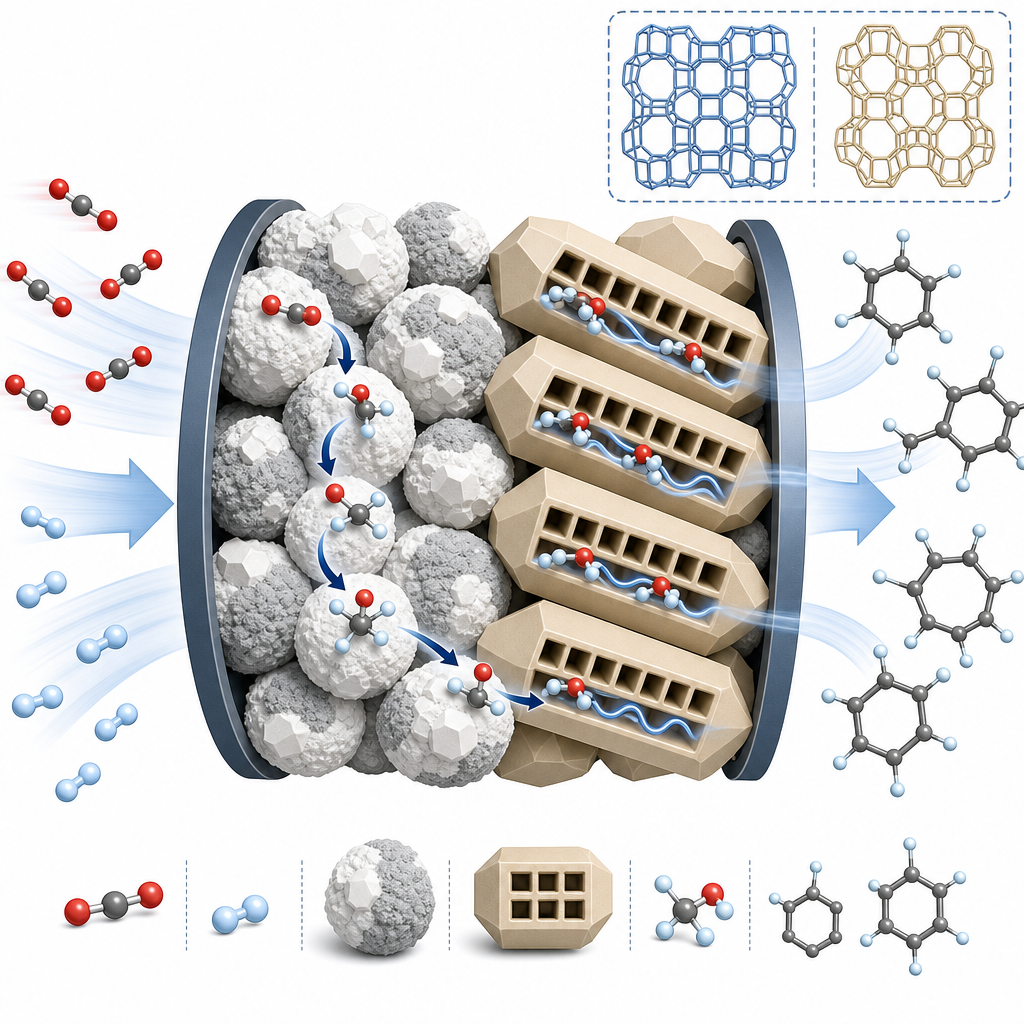
The ACS Material zeolites entered the study as part of a topology comparison. After the NH4-form ZSM-5 and ZSM-12 were sourced from Zeolyst, the authors note in the Materials section that "TS-1 and H-ZSM-11 were obtained from ACS Material®." All zeolite samples were pelletized and calcined for 3 hours at 550 °C to desorb NH3 and strengthen the pellets, then crushed to 300–600 μm sieve fractions. They were physically mixed as granulates with the ZnO/t-ZrO2 catalyst, typically at 80 wt% oxide and 20 wt% zeolite. The zeolites were characterized by XRD (confirming pure MFI, MEL, and MTW structures), XRF for Si/Al ratio, and NH3-TPD for weak and strong acid-site densities. H-ZSM-11 (MEL) provided larger cages than MFI, while TS-1 served as a near-acid-free reference (only 3.2 μmol g-1 total acid sites). These materials let the team test how pore geometry and acidity govern aromatic formation in the bifunctional bed.
Quantitatively, the bifunctional system reached its highest aromatics selectivity of 33.2 carbon mol% at 320 °C and 10 bar, at a CO2-to-hydrocarbon conversion of 4.5%, using ZnO/t-ZrO2 with H-ZSM-5(40). Low temperature and low pressure favored aromatics by moderating hydrogenation activity, which otherwise converted intermediate olefins to paraffins and isoparaffins. Increasing residence time raised CO2 conversion (a 4-fold increase gave only 1.8-fold higher conversion, indicating thermodynamic and kinetic limits as the RWGS reaction approached equilibrium near 1.4 (s·g)/mL). Raising zeolite acid-site density from 65 to 258 μmol g-1 optimized aromatics, but a further increase to 309 μmol g-1 lowered it through over-hydrogenation of light olefins. Switching to larger-pore zeolites improved methylation: H-ZSM-11 and H-ZSM-12 generated poly-methylated C7–C12 species, and H-ZSM-12 delivered 42.4 carbon mol% aromatics at 9.8% CO2-to-hydrocarbon conversion (340 °C, 30 bar), with penta- and hexamethylbenzene as dominant products. TS-1 showed negligible hydrocarbon activity. Mechanistic analysis using the hydrocarbon-pool model estimated an upper aromatics-selectivity limit of 45–52 carbon mol% for durene formation over H-ZSM-5, indicating the measured values are near the practical ceiling. Carbon balance closure averaged 99.0 ± 0.3%.
The findings inform the design of CO2 valorization processes targeting renewable aromatics and synthetic fuels. The authors conclude that a direct CO2-to-aromatics process would struggle to meet industrial productivity targets because of the inherent trade-off between conversion and selectivity, requiring large reactors and recycle streams. However, the low zeolite deactivation rate observed (no methanol-conversion drop even at 60 gMeOH/gzeolite, with an assumed capacity near 90 gMeOH/gzeolite) is an advantage, and the team points toward a more promising direct CO2-to-isoparaffin-rich synthetic-fuel route, with further communications on deactivation and CO2-to-fuels in preparation. The topology results also guide researchers choosing between MFI, MEL, and MTW frameworks for tuning methylation versus hydrogenation balance in methanol-to-hydrocarbon chemistry.
For researchers pursuing similar catalytic studies, the TS-1 and H-ZSM-11 zeolites used here are available from ACS Material, alongside related molecular sieves such as ZSM-5, ZSM-12, beta zeolite, and SAPO frameworks. The paper demonstrates how well-characterized zeolite samples of defined topology and acidity enable rigorous mechanistic mapping of bifunctional CO2 conversion, where pore geometry and acid-site density directly control aromatic yield. Selecting the appropriate framework is essential for any group benchmarking methanol-to-aromatics or CO2-to-hydrocarbon performance.How ACS Material products were used
- Titanium Silicalite-1 (TS-1) (Molecular Sieves) — “TS-1 and H-ZSM-11 were obtained from ACS Material®.”
- ZSM-11 (H-ZSM-11) (Molecular Sieves) — “TS-1 and H-ZSM-11 were obtained from ACS Material®.”
Product Performance in this StudyH-ZSM-11 provided a considerable increase in aromatics selectivity through poly-methylated C7–C12 species, owing to its larger intersecting cavities that enhanced the aromatic cycle in the hydrocarbon pool mechanism.
Related product categories
Frequently asked questionsWhat role does zeolite pore size play in CO2-to-aromatics selectivity?
Larger-pore zeolites enhance the aromatic cycle in the hydrocarbon-pool mechanism by allowing more methylated products to form. In this study, H-ZSM-12 with its larger MTW pores produced penta- and hexamethylbenzene and raised aromatics selectivity to 42.4 carbon mol%, compared with 33.2% for the smaller-pore H-ZSM-5. H-ZSM-11 with larger intersection cavities also boosted poly-methylated C7–C12 aromatics.
Why does TS-1 show low activity in bifunctional CO2 hydrogenation catalysts?
TS-1 has a near-absence of Bronsted acid sites, with only about 3.2 micromol per gram of total acid sites measured by NH3-TPD. Because methanol-to-hydrocarbon conversion requires acid sites for olefin oligomerization and aromatization, TS-1 showed no significant hydrocarbon formation. It only caused minor methanol dehydration to DME, shifting the methanol equilibrium slightly.
How do temperature and pressure affect aromatics selectivity in CO2 hydrogenation?
Low temperature and low pressure favor aromatics because they moderate hydrogenation activity that otherwise converts intermediate olefins into paraffins. The highest aromatics selectivity of 33.2 carbon mol% was obtained at 320 degrees C and 10 bar over ZnO/t-ZrO2 with H-ZSM-5. Higher temperature and pressure increased CO2 conversion but lowered selectivity, reflecting the trade-off between conversion and aromatic yield.