
On paper, the case is finished: high-purity synthetic single-crystal diamond conducts heat at roughly 2,000 W·m−1·K−1 — near five times copper1 — while its low thermal expansion promises mechanical peace with silicon. In practice, engineers who drop a diamond or diamond-composite spreader into a stack expecting a five-fold improvement may realize only part of that material-level advantage once the diamond is placed inside a complete thermal stack. The gap is not fraud and it is not bad diamond. It is the physics of spreading resistance, the tyranny of interfaces, and the difference between an ingredient’s datasheet and a system’s behavior. This article walks through all three — and ends, as every spreader decision should, at measurement.
- 1Why diamond, and why now
- 2What a spreader actually does - and what limits it
- 3The second virtue: what low CTE actually buys
- 4See where five-fold conductivity goes
- 5Diamond/copper: engineering around the hard problems
- 6From lab curiosity to supercomputer hardware
- 7Qualifying a spreader lot: what to measure and how
- 8Keep exploring the knowledge hub
Why diamond, and why now
Diamond’s conductivity comes from phonons racing through one of the stiffest, lightest lattices in nature; the measured ~2,000 W·m−1·K−1 figure belongs to high-purity single crystals at room temperature1, with CVD polycrystalline plates running lower and varying with grain structure. The “why now” is the flux escalation covered in the thermal-wall analysis: kilowatt-class packages concentrate dissipation into hotspots that a ~400-class copper spreader can become insufficient in some source-to-spreader geometries and temperature budgets. When the spreading term becomes first-order, the leaderboard’s upper rungs — surveyed in the materials-race companion — stop being exotic and start being quotations.
What a spreader actually does — and what limits it
A spreader’s job is geometric: take heat entering through a small footprint and deliver it to a larger one, so the downstream cooler sees a manageable flux. The price of that service is spreading (constriction) resistance — a resistance that exists purely because the heat must funnel through the small source before it can fan out; classical closed-form treatments express it through the source-to-plate size ratio and a thickness function2. Here is the precise shape of the trap. For a fixed geometry and boundary condition, the spreader’s own resistances — spreading plus through-thickness — scale approximately as 1/k: five times the conductivity really does cut the spreader’s own term to roughly a fifth. What does not follow is the junction temperature, because the complete junction-to-coolant stack also contains die, interface and cooler terms that do not automatically scale with the spreader’s bulk conductivity — some may themselves change with surface finish, CTE and bonding. A fivefold material improvement therefore delivers far less than a fivefold system improvement unless the spreader already dominates the stack — and in many well-engineered stacks it does not.
The second limit is the interfaces on either side. A spreader is bonded to the die below and the cold plate above, and each joint contributes bond-line plus contact resistance that no spreader conductivity can touch3. Interfacial resistance is its own physics with its own measurement problem4 — treated in depth in the TIM companion article — and in some high-performance stacks it can claim a share of the budget comparable to the spreader contribution. A 2,000-class spreader between two mediocre joints is a sports car in traffic.
The second virtue: what low CTE actually buys
Conductivity sells the spreader; thermal expansion keeps it employed. Every power cycle strains the bonds between materials that expand at different rates, and the thermal-expansion mismatch between silicon and copper is a fatigue engine: solder joints fatigue or crack, attach materials delaminate, and joints that measured well on day one can degrade over repeated thermal cycles. Diamond’s expansion coefficient sits near silicon’s, which can widen the feasible die-attach design space toward thinner, stiffer joints — subject to adhesion, elastic modulus, residual stress and the thermal-cycling behavior of the actual joint. Diamond/copper composites offer a tuning knob, trading loading fraction against both conductivity and CTE to hit a target pair rather than a single number. This is why a composite datasheet worth reading quotes k and CTE together, on the same lot: because conductivity and CTE are both influenced by loading, porosity and interface quality, process drift may move both properties. A spreader qualification that measures conductivity but takes expansion on faith is auditing half the ledger.
See where five-fold conductivity goes
The tool below implements a pedagogical circular-equivalent model inspired by classical spreading-resistance correlations, placed in series with a fixed, representative non-spreader resistance (die, interfaces, cooler). Slide the conductivity from copper to composite to single-crystal diamond: the spreader’s own resistance obediently tracks 1/k, while the system total — the number the junction actually feels — moves far less.
Try the reverse experiment too: hold conductivity at copper and enlarge the heat source or thin the plate — geometry moves the spreader term as strongly as material does. And once the spreader shrinks to a minority of the system total, every further dollar of conductivity is buying the smallest term on the ledger — which is why “we switched to diamond” is not a thermal result until the stack is measured.
Diamond/copper: engineering around the hard problems
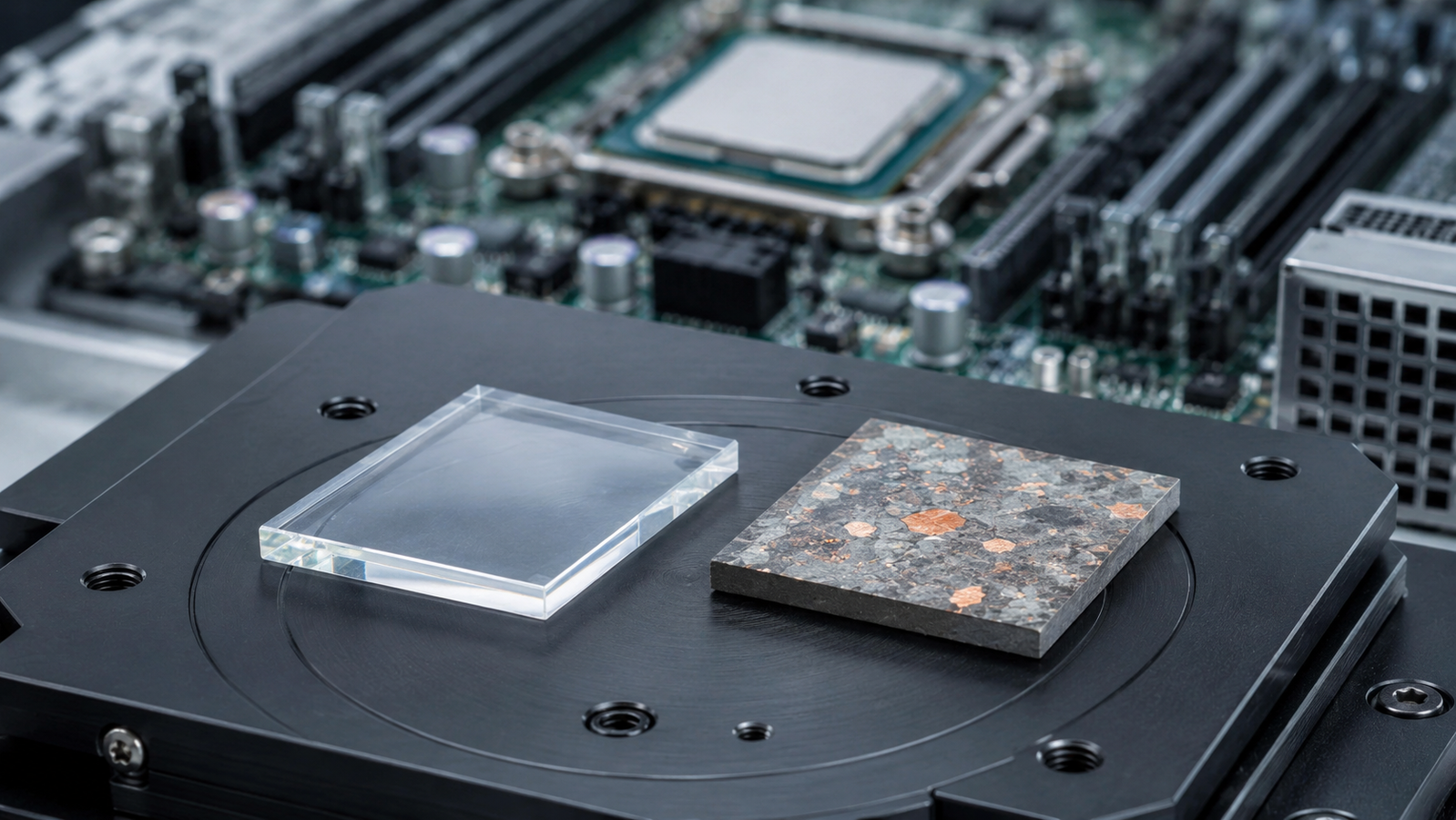
The manufacturing problems split by material class. Diamond plates face practical limits in available size, cost and machining — the hardest known material resists exactly the shaping and drilling a package demands — plus surface preparation and joining, because diamond wets poorly and an unengineered metal contact leaves the interface to strangle what the bulk promises. Diamond/copper composites introduce a different set of challenges: particle dispersion, loading fraction, densification, carbide-forming interlayers and the thermal conductance of millions of internal metal–diamond interfaces — a processing–interface–conductivity relationship now mapped by dedicated reviews5.
From lab curiosity to supercomputer hardware
The technology has crossed from papers to plant floors. The Ningbo Institute of Materials Technology and Engineering (CAS) has reported diamond/copper composite material exceeding 1,000 W·m−1·K−1 deployed in a megawatt-class immersion phase-change cooling cabinet, and — according to the institute’s announcement for that specific deployed module — an 80 % improvement in module heat transfer, running in a national supercomputing node cluster6. Two readings of that milestone are both correct. The optimistic one: composite spreaders are reported in the cited deployed system, paired with the liquid architectures that high-density racks now require7. The metrological one: “exceeding 1,000” is a measured claim about specific deployed material — and reproducing it in your supply chain means reproducing not just the recipe but the verification.
Deployment also changes the statistics that matter. A record specimen proves feasibility; a production cabinet is a bet on distributions — tile-to-tile, lot-to-lot, month-to-month. Composite conductivity is exquisitely sensitive to the parameters a plant fights daily: powder size distribution, interlayer thickness, densification temperature and time. The practical consequence is that incoming inspection for high-value spreader material looks less like reading a certificate and more like running a control chart: periodic measured conductivity on sampled tiles, tracked against the qualified baseline, with anisotropy spot-checks whenever the process route implies texture. That regime is cheap insurance against the expensive failure mode — a thermally under-performing batch discovered only as a fleet-wide junction-temperature anomaly.
Qualifying a spreader lot: what to measure and how
One method-specific caution before the checklist, because it bites diamond-class materials hardest. Flash diffusivity — the natural workhorse for plates — times a heat pulse crossing the specimen’s thickness; the characteristic time scales as thickness squared over diffusivity8. For a thin tile of very high diffusivity, that time collapses toward the instrument’s pulse width and detector response, and the correction terms start doing the measuring. (1) Optical treatment and pulse-time suitability — depending on optical absorption, emissivity and detector response, diamond specimens may require a validated surface treatment or radiative-transfer correction; for thin, very high-diffusivity samples, verify that the excitation-pulse width, detector response and any surface coating do not themselves dominate the measured transient8,9. (2) Homogeneity — composites can vary point-to-point with loading and consolidation; a single-spot number may not represent an inhomogeneous tile. (3) Anisotropy where processing implies it — rolled, pressed or tape-cast bodies deserve both directions measured, not assumed equal. (4) The joints — because the stack’s behavior includes the interfaces, the spreader’s qualification is incomplete without the interface characterization covered in the TIM article. Our bulk-materials thermal testing service matches the measurement method to the specimen’s actual form and geometry; the full method map lives in the pillar guide. Diamond will not save a stack nobody measured — but measured, it is the strongest material on the board.
Keep Exploring the ACS Thermal Metrology Knowledge Hub
This article is one chapter of the ACS thermal metrology knowledge hub. To keep going:
- Thermal conductivity & diffusivity testing: the pillar guide — methods, samples and a buyer’s framework in one place.
- The high-conductivity materials race — diamond, TaN and the leaderboard, read like a metrologist.
- Thermal interface material testing — what actually limits the stack.
- Bulk materials testing service — larger-format methods for spreader lots and composites.