
HDT vs Vicat compares bending deflection with local indentation during controlled heating. HDT loads a bar in three-point bending and reports the temperature at which it has deflected by a set amount; Vicat presses a flat-ended needle into a specimen and reports the temperature at which it has sunk 1 mm.1,2 Both give comparative numbers read at a stated load and a stated heating rate. This guide compares what each measures, how each is loaded and heated, what each result is and is not, and quotes what the Polytevo Series HDT and Vicat tester page says, within the Polytevo Series by ACS Material.
1. HDT vs Vicat: bending or indentation
Heat deflection temperature (HDT, also called deflection temperature under load) is the temperature at which a standard test specimen, loaded in three-point bending under a constant load, reaches a standard deflection as the temperature is raised.1 The Vicat softening temperature (VST) is the temperature at which a flat-ended indenter penetrates the specimen to a depth of 1 mm under a specified load, using a selected uniform rate of temperature rise.2
Neither is a maximum service temperature. The current general HDT method says its results do not necessarily represent maximum applicable temperatures, because in practice factors such as time, loading conditions and nominal surface stress can differ from the test conditions, and that the data are not intended to predict actual end-use performance.3 The ASTM heat deflection method says the same kind of thing: the data are not to be used to predict behavior at elevated temperatures except where time, temperature, method of loading and fiber stress are similar to the test, and are not intended for design.4
2. The two tests side by side
The table summarizes the ISO approaches discussed here. The ASTM methods are discussed separately and should not be assumed to use identical conditions.
| Question | HDT | Vicat (VST) |
|---|---|---|
| What is the result? | The temperature at which the specimen reaches the standard deflection as the temperature rises.1 | The temperature at which a flat-ended indenter has penetrated 1 mm.2 |
| How is the specimen loaded? | Three-point bending, flatwise, under a constant load that produces a flexural stress; the method letter A, B or C selects the stress.1,5 | A steel indenter with a flat tip of circular cross-section, area (1.000 ± 0.015) mm², exerts a specified force perpendicular to the specimen; the method letter A or B selects the force.2 |
| What ends the test? | The standard deflection, which corresponds to a specified increase in flexural strain; the deflection caused by loading at room temperature is not measured.1 | Penetration of (1 ± 0.01) mm from the starting position, set after 5 minutes under load.2 |
| How fast is it heated? | A uniform rate of (120 ± 10) °C/h in the 2013 text.1 | (50 ± 5) or (120 ± 10) °C/h; reference tests use 50 °C/h.2 |
| What specimen? | The preferred bar is 80 mm × 10 mm × 4 mm; the span is (64 ± 1) mm.5 | 3 mm to 6.5 mm thick and at least 9.5 mm square or 9.5 mm in diameter; at least two specimens per sample.2 |
| Which materials? | Plastics, including filled and fibre-reinforced plastics up to a stated fibre length, and ebonite.5 | Thermoplastics only; the result is a measure of the temperature at which they start to soften rapidly.2 |
The method letters matter. The HDT methods A, B and C use different flexural stresses. The method letter identifies the applied-stress condition, but preparation and other test conditions can also affect HDT; report them with the value.5 The Vicat methods are named A50, B50, A120 and B120: the letter selects the force and the number is the heating rate in °C/h.2 This guide leaves the load values themselves to the method texts.
3. HDT in more detail
The inspected 2013 text describes flatwise three-point loading and permits a liquid bath, fluidized bed or air oven, with liquid heating treated as the reference approach where applicable in a dispute.1 Three points are worth carrying to the datasheet.
- Comparability is limited. The method says true comparability can only be achieved for materials with the same room-temperature flexural modulus, and that the method is suitable for assessing relative behavior at elevated temperature under load at a specified rate of temperature increase.3 The second part adds that the ratio of the flexural-strain increase to the initial flexural strain depends on the room-temperature modulus, so the method is only suitable for comparing materials with similar room-temperature elastic properties.5
- Material type and preparation matter. The methods give better reproducibility with amorphous plastics than with semi-crystalline ones; with some materials the specimens may need annealing, which generally raises the temperature of deflection; and results on moulded specimens depend on the moulding conditions.5 Use annealing only when required by the material specification or agreed by the interested parties, and report the preparation history.5
- The two families are not interchangeable. The ASTM method is titled for the edgewise position, where the ISO method described here is flatwise; it describes its test as the temperature at which an arbitrary deformation occurs under an arbitrary set of testing conditions, applies to molded and sheet materials 3 mm or thicker that are rigid or semirigid at normal temperature, and states that it and the ISO method address the same subject matter but differ in technical content, so results shall not be compared between the two.4
4. Vicat in more detail
In the Vicat test the specimen lies horizontally under the indenting tip, which must be no nearer than 3 mm to the edge, and the temperature of the heating equipment is at most 25 °C at the start unless earlier tests have shown no error from starting elsewhere and the start is at least 50 °C below the expected VST.2 The VST is the arithmetic mean of the specimens tested; if the individual results span more than 2 °C, record them and repeat using at least two additional specimens. Report the individual values from both tests; do not discard the first set merely because it triggered the repeat.2
The ASTM Vicat method covers the temperature at which a specified needle penetration occurs under specified controlled conditions, is used to compare the heat-softening qualities of thermoplastic materials, and is not recommended for ethyl cellulose, nonrigid poly(vinyl chloride), poly(vinylidene chloride) or other materials with a wide Vicat softening range.6 It is described as technically similar to the current ISO text.6
5. Heating rate: why the number needs its rate
Both tests raise the temperature at a uniform rate, and the rate is part of the result. The Vicat text allows two rates, says reference tests use the lower one, and notes that, for some materials tested, Vicat softening temperatures obtained at the higher rate have been observed to be up to 10 °C higher than those obtained at the lower rate.2 The 2013 HDT text specifies one rate.1 The Vicat text also allows the first 10 minutes, or up to 40 °C, of the ramp to lie outside the prescribed tolerances because instruments with PID heating tune themselves to the required rate.2
So a datasheet line that gives an HDT or a VST without its method letter and heating rate is missing part of its meaning, and two values read at different rates should not be set side by side without saying so.
6. Which question each one answers
| If your question is… | Read this | What the method texts say |
|---|---|---|
| How does a loaded bar compare with another as it warms? | HDT, with its method letter | The method is suitable for assessing the relative behavior of materials at elevated temperature under load at a specified rate of temperature increase.3 |
| At what temperature does a thermoplastic start to soften rapidly? | Vicat, with its method code | The methods give a measure of the temperature at which thermoplastics start to soften rapidly, and apply only to thermoplastics.2 |
| Does the method cover this material and reinforcement? | Check the applicable method’s scope first | The cited HDT part covers specified plastics and ebonite, including defined reinforcement categories.5 The cited Vicat method concerns thermoplastics.2 Filler presence alone does not select between the tests. |
| What is the highest temperature the part can see? | Neither number answers it | Results do not necessarily represent maximum applicable temperatures, and the data are not intended to predict end-use performance.3 |
HDT and Vicat are different measurements of different things, so this guide does not convert one into the other. Where a datasheet gives both, read each against its own method. The datasheet view of both is in the guide How to Read a Plastics Datasheet: MFR, HDT and Vicat Values; for strength, toughness and hardness, see Mechanical Testing of Plastics: Match the Test to the Question.
Test method reference: ISO 75-1:2020, ISO 75-2:2013 and ASTM D648-18 for heat deflection; ISO 306:2022 and ASTM D1525-25 for Vicat.3,5,4,2,6
7. What the Polytevo Series tester page says
The page values below are quoted as published. They are not datasheet values for any material, and this guide does not say that the tester realises any particular method.
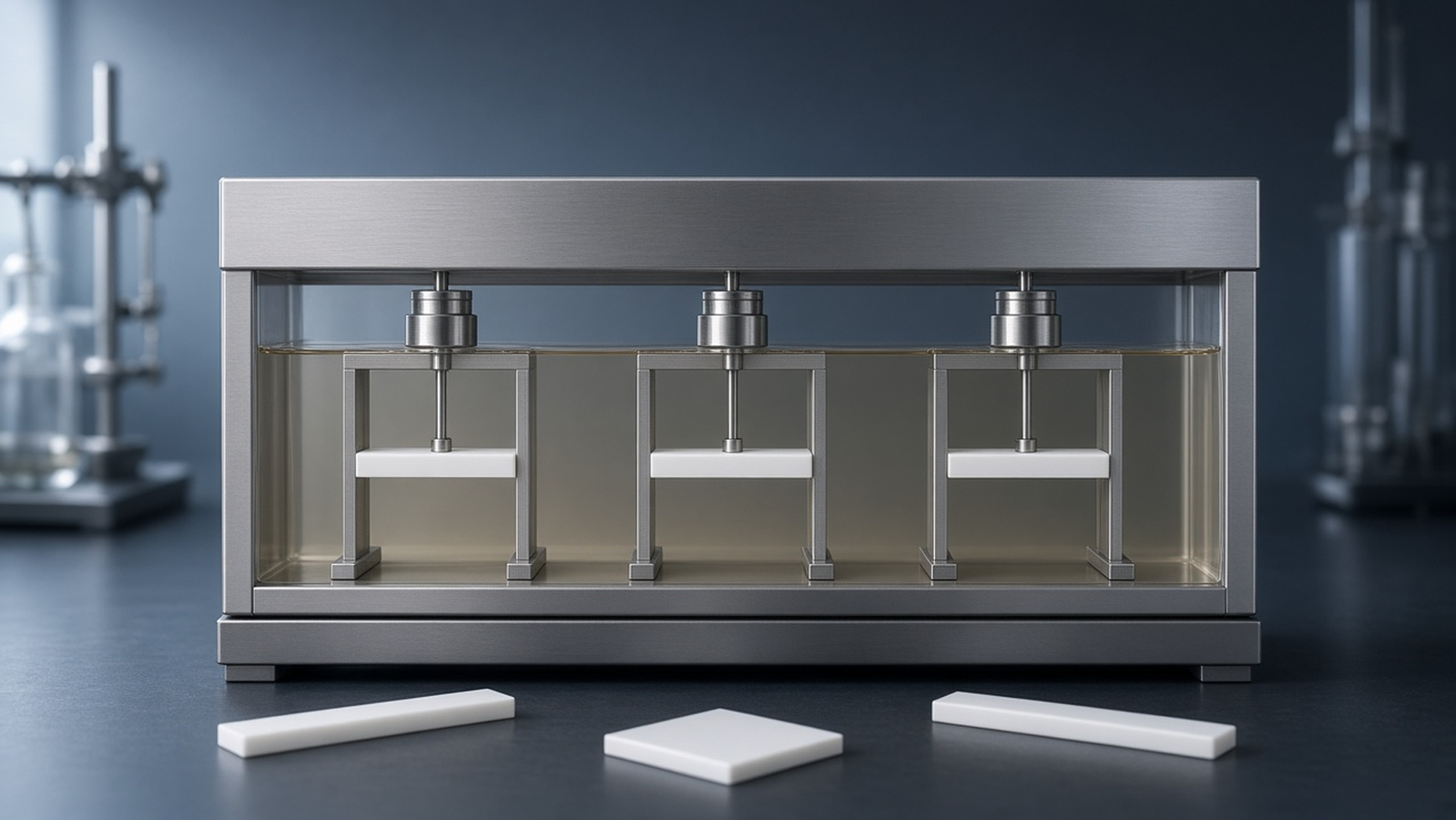
The Polytevo Series HDT and Vicat Softening Temperature Tester page describes the ACS-5006-TC3 as a three-station heat deflection temperature (HDT) and Vicat softening temperature (VST) tester with a temperature range of RT to 300°C, two selectable heating rates, a 25 L oil bath and computer-controlled operation.
It lists three sample frames, and says HDT and Vicat tests can be run separately or at the same time.
The two heating rates are listed as (120 ± 10)°C/h and (50 ± 5)°C/h, selectable and switchable freely.
The page lists PID temperature control with an accuracy of ±0.5°C and a deformation measurement range of 0–2 mm.
The heating medium is methyl silicone oil or transformer oil, supplied by the customer, in a tank of approximately 25 L, with natural cooling above 150°C and water cooling or natural cooling below 150°C.
It lists the sample support span as 64 mm or 100 mm, as set by the test standard.
A PLC programmable controller regulates the temperature and a computer displays and operates the test, with temperature and deformation monitored in real time, heating stopping automatically at the end of the test, and the test report and curves printable. The page also lists a lifting sample rack and dual over-temperature protection.
The package list names a computer (industrial computer main unit), an electrical control box, the main frame, three sample frames, three HDT press heads, three Vicat needles, three sets of weights and an instruction manual, and the page says the itemized bill of materials is confirmed on the quotation.
The heating power is listed as AC 220 V ±10%, 4 kW.
The supplied configuration is confirmed on the quotation. The route from material to test is set out in the Lab-Scale Polymer Processing and Testing: A Workflow Guide.
8. What to write down with either result
A short record for each series: the method and its edition, the method letter (HDT) or method code (Vicat), the heating rate, the specimen dimensions and how they were prepared, the conditioning, the number of specimens and each individual value, the heat-transfer medium, and the result with its unit. The Vicat text asks its report to give the method employed, the preparation of the specimens and the thickness of any stacked layers;2 the HDT second part notes that moulding conditions and annealing change the result.5
9. Keep Exploring the Lab-Scale Polymer Processing Knowledge Hub
This guide belongs to the ACS Material library on lab-scale polymer processing and testing, built around the Polytevo Series by ACS Material. Start from the Lab-Scale Polymer Processing and Testing: A Workflow Guide, which places every stage of the work, from material to test, on one route. The other guides on melt flow and heat tests are:
- How to Read a Plastics Datasheet: MFR, HDT and Vicat Values — which datasheet line comes from which test: flow, softening and heat resistance.
- MFR vs MVR: Melt Flow Rate by Mass and by Volume (coming soon) — how melt mass-flow rate and melt volume-flow rate are defined, and the arithmetic that links them.
- Melt Flow Index Test Conditions and Instrument Types (coming soon) — what a melt flow test condition contains, and how the three indexer configurations differ.
10. Before you request a quote
To help identify a suitable configuration, describe the heat tests you need to run. Please tell us:
- whether you need HDT, Vicat or both, and whether they run at the same time;
- the materials you test and the form of the specimens;
- the heating rate your method or material specification requires;
- the temperature you expect to reach;
- your mains supply and the heating medium you plan to use.
Send these through Request a Quote. Specifications are as published on each product page, and final configurations are confirmed on quotation.
11. FAQ
What is the difference between HDT and Vicat?
HDT is the temperature at which a bar loaded in three-point bending reaches a standard deflection; Vicat is the temperature at which a flat-ended indenter penetrates 1 mm.1,2 They measure different things and are not converted into each other.
Is the HDT the highest temperature a plastic can be used at?
No. The HDT method says its results do not necessarily represent maximum applicable temperatures and are not intended to predict actual end-use performance.3
Does the heating rate change the result?
Heating rate can affect Vicat results. The method reports that some tested materials gave values up to 10 °C higher at the higher rate; this is not a universal difference or conversion rule. Reference tests use the lower rate.2
Can an HDT from one method family be compared with one from the other?
The ASTM heat deflection method states that results shall not be compared between the two methods.4
Can the Polytevo Series tester run HDT and Vicat at the same time?
The product page says HDT and Vicat tests can be run separately or at the same time on its three stations.