
Mechanical testing of plastics starts from the question you need answered: how strong and stiff is the material, how tough is it when struck, or how hard is its surface. Tensile, impact and hardness tests answer those three questions, and none of them stands in for another. This guide is the index to the mechanical and hardness testing guides in the library: it matches each question to a test, says what each test does not tell you, and quotes what the Polytevo Series pages for the universal testing machine, the Charpy and Izod impact testers and the Shore durometer say, using only what those pages say.
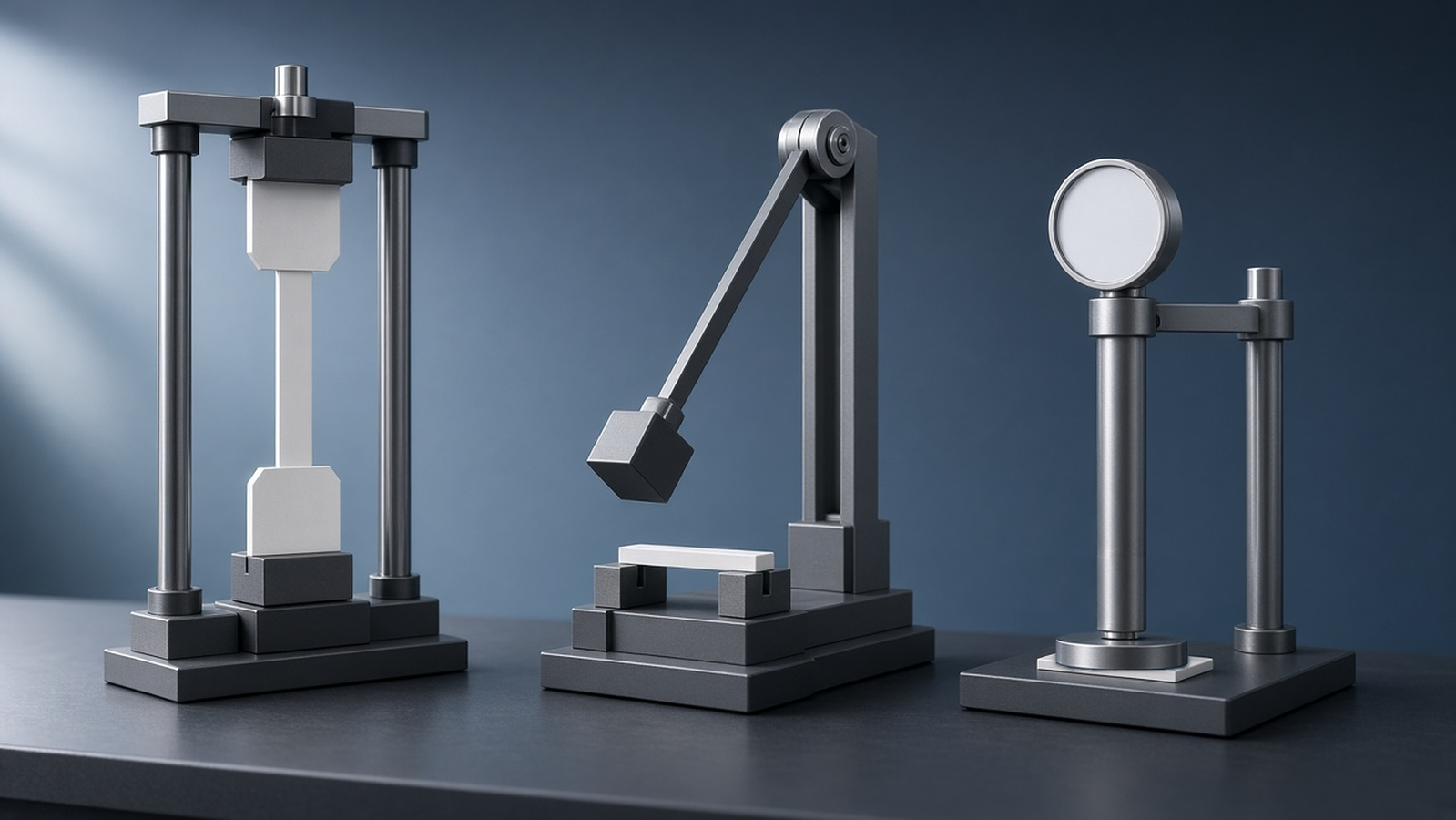
1. Mechanical testing of plastics: one question, one test
Match the test to the question and write the method reference with the result. A tensile test pulls a specimen and records force against elongation, from which the tensile strength, the tensile modulus and other aspects of the stress-strain relationship are determined.1 A pendulum impact test strikes a specimen in a single swing, determines absorbed energy and records the failure outcome required by the selected method.2,3,4 A durometer presses an indenter into the surface and reads the indentation hardness.5
| The question | The test | What you get | Where to read more |
|---|---|---|---|
| How strong and stiff is it? | Tensile test | A stress-strain curve: modulus, yield, strength, strain at break | Tensile Testing of Plastics: Reading the Stress-Strain Curve; the machine in How to Choose a Universal Testing Machine for Plastics |
| How does it behave when struck? | Pendulum impact test, Charpy or Izod | Absorbed energy and failure outcome; a result per unit of cross-section or width | Charpy vs Izod Impact Testing for Plastics; the arithmetic in Choosing a Pendulum Energy and Calculating Impact Strength |
| How hard is its surface? | Shore durometer, scale A or D | An indentation hardness number with its scale letter | Shore A vs Shore D Hardness |
Test method reference: ISO 527-1:2019 and ASTM D638-22 for tensile properties, ISO 179-1:2026, ISO 180:2023 and ASTM D256-26 for impact, and ISO 868:2003 and ASTM D2240-15(2021) for durometer hardness.1,6,7,8,4,5,9
2. What each test does not tell you
Each answer has a boundary, and the methods say so themselves.
- Tensile. The result belongs to the specimen, the speed and the conditioning. The withdrawn 1993 ISO text says that results from specimens of different dimensions, or prepared under different conditions, may not be comparable, and that factors such as the speed of testing and conditioning can also influence the results.10
- Impact. The result is a property of the whole test: the bar, the notch, the pendulum and the way the bar is held. The withdrawn 1993 ISO impact texts say the method should not be used as a source of data for design calculations of components.2
- Hardness. The durometer method is an empirical method intended primarily for control purposes, and no simple relationship exists between its result and any fundamental property of the material.5 No simple relationship exists either between measurements made with one type of durometer and those made with another.9
Do not treat results from different methods or scales as interchangeable, apply an unvalidated conversion, or report a number without its method, specimen and test conditions.
3. How to choose: four prompts
- What is the question? Stiffness or strength points to tensile; behavior under a sudden blow points to impact; surface indentation points to hardness. If a specification asks for two of them, run both, and do not expect one to predict the other.
- What does the specification or customer name? If a method is named, use it, with the notch, scale or specimen it prescribes. Keep the instrument, specimen and conditioning consistent across lots where the method allows.
- What form is the sample? Molded or cut bars suit tensile and impact tests; a flat plaque or pressed piece suits a durometer if it is thick enough and flat. Specimen preparation can affect measured properties. For example, Parodi and co-workers investigated effects of preparation and conditioning on the deformation and failure behavior of injection-molded polyamide 6.11
- What will you record? The method reference and edition, the specimen, the conditioning, the speed or pendulum, the number tested and the units. Handbooks of polymer testing treat these points property by property.12,13,14
Test at room temperature is the default in these guides. For heating and cooling modules see the existing guide on temperature modules for universal testing machines, and for stage-based tensile work see in-situ tensile testing at variable temperature.
4. What the Polytevo Series pages say
The Polytevo Series Universal Testing Machine page lists tensile, compression, bending, shear, tear, peel and penetration testing of metallic and non-metallic materials, including plastics, in its “where it fits” line; the guides in this library deal with its tensile use.
The Polytevo Series Charpy Impact Tester page describes a digital Charpy impact tester for impact testing of rigid plastics and other non-metallic materials.
The Polytevo Series Izod Impact Tester page describes an Izod impact tester for measuring the impact toughness of plastics and other non-metallic materials.
The Polytevo Series Shore Durometer page describes pointer-type Shore durometers, Shore A and Shore D, with a constant-load test stand, for testing the hardness of vulcanized rubber and plastic products.
| Question, page snapshot 15 November 2026 | Polytevo Series page |
|---|---|
| How strong and stiff? | Polytevo Series Universal Testing Machine |
| How tough when struck? | Polytevo Series Charpy Impact Tester and Polytevo Series Izod Impact Tester |
| How hard? | Polytevo Series Shore Durometer |
The pages identify applications and configurations. Suitability for a particular material, specimen and method still needs to be established. Supplied configurations are confirmed on the quotation, and the detailed guides listed in section 1 give each instrument its own page values.
5. A minimal test plan for a new formulation
When a new material or formulation arrives, a short plan keeps the three tests consistent.
- Write the question and the method reference first, so that the specimen, notch or scale is chosen to suit the method and not the other way round.
- Within each comparison series, use the applicable preparation and conditioning procedures consistently, except for variables deliberately included in the experiment. Different tests may require different specimen forms and preparation procedures.
- Test a set, not a single specimen. Test the number of specimens required by the applicable material specification and selected method edition; record exclusions and replacement specimens.
- Record how each specimen failed, not only its number: a break type for impact, where the break occurred for tensile, and the time of reading for hardness.10,2,5
- Keep the instrument and the settings consistent across the series where the method allows, and write down any change.
Historical note. The withdrawn 1993 ISO texts asked for a minimum of five tensile specimens and, for impact, a minimum of ten, or five when the coefficient of variation was below 5%, unless the material standard said otherwise; this describes those withdrawn editions and is not a default prescription for a test plan.10,2
6. Why the tests are not interchangeable
Three tempting shortcuts are worth naming. A Charpy value is not an Izod value: the two tests load the bar differently and may report different quantities, and the units can differ; see Charpy vs Izod Impact Testing for Plastics. A Shore A reading is not a Shore D reading: there is no universal Shore A-to-D conversion for arbitrary materials, so measure the specified scale rather than substituting a converted value; see Shore A vs Shore D Hardness. A hardness number is not a strength: hardness is an empirical indentation measurement used mainly for control, while strength comes from a tensile test.9,5
What can be done safely is to compare like with like: the same method, specimen type, speed or pendulum where valid, conditioning and units. The route from material to test, including the specimen-preparation steps that come first, is set out in the Lab-Scale Polymer Processing and Testing: A Workflow Guide.
7. Keep Exploring the Lab-Scale Polymer Processing Knowledge Hub
This guide belongs to the ACS Material library on lab-scale polymer processing and testing, built around the Polytevo Series by ACS Material. Start from the Lab-Scale Polymer Processing and Testing: A Workflow Guide, which places every stage of the work, from material to test, on one route. The other guides on mechanical and hardness testing are:
- How to Choose a Universal Testing Machine for Plastics — how to start from the method and specimen, estimate the force, and evaluate load-cell performance and capacity.
- Charpy vs Izod Impact Testing for Plastics — what each impact geometry loads, why the units differ, and how the notch ties the result to preparation.
- Choosing a Pendulum Energy and Calculating Impact Strength — a bounded worked example of pendulum energy shares and impact-strength arithmetic.
- Shore A vs Shore D Hardness — how the Shore scale is chosen, why there is no universal conversion, and what a constant-load test stand adds.
- Tensile Testing of Plastics: Reading the Stress-Strain Curve — how a tensile test produces method-defined stress and strain quantities for a plastic.
8. Before you request a quote
To help identify a suitable configuration, describe the testing you need to run. Please tell us:
- the question you need answered: strength and stiffness, behavior under impact, hardness, or a combination;
- the materials and the form of the samples, bars, sheet or plaques;
- the test method references you work to;
- the number of specimens you test per sample and how you report results;
- whether you also test at other temperatures.
Send these through Request a Quote. Specifications are as published on each product page, and final configurations are confirmed on quotation.
9. FAQ
Which test should I run first on a new plastic?
The one that answers your question. Tensile gives strength and stiffness, impact gives behavior under a sudden blow, and hardness gives surface indentation; none of them replaces another.1,2,5
Can a hardness test replace a tensile test?
No. The durometer method is an empirical method intended primarily for control purposes, and no simple relationship exists between its result and any fundamental property of the material.5
Can I compare a Charpy result with an Izod result?
Not by a simple rule. The tests load the bar differently and may report different quantities, so compare Charpy with Charpy and Izod with Izod unless a validated relationship exists; see the guide on Charpy and Izod in this library.2,3
Do I need to record the method reference?
Yes. The withdrawn 1993 ISO texts say that results from specimens of different dimensions, notches or conditions may not be comparable, so the method reference and the conditions go with every number.10,2
Where do I read about tests at other temperatures?
In the existing guides on temperature modules for universal testing machines and in-situ tensile testing at variable temperature.