
Impact tester pendulum energy must be selected under the applicable method and apparatus requirements. This guide illustrates the energy-share calculation and impact-strength arithmetic; it is not an operating procedure. It works one historical selection-rule example and the impact-strength formula, adds a calculator that does only the arithmetic, and summarizes in a snapshot table what the Polytevo Series Charpy and Izod tester pages in the Polytevo Series by ACS Material list, using only what those pages say.
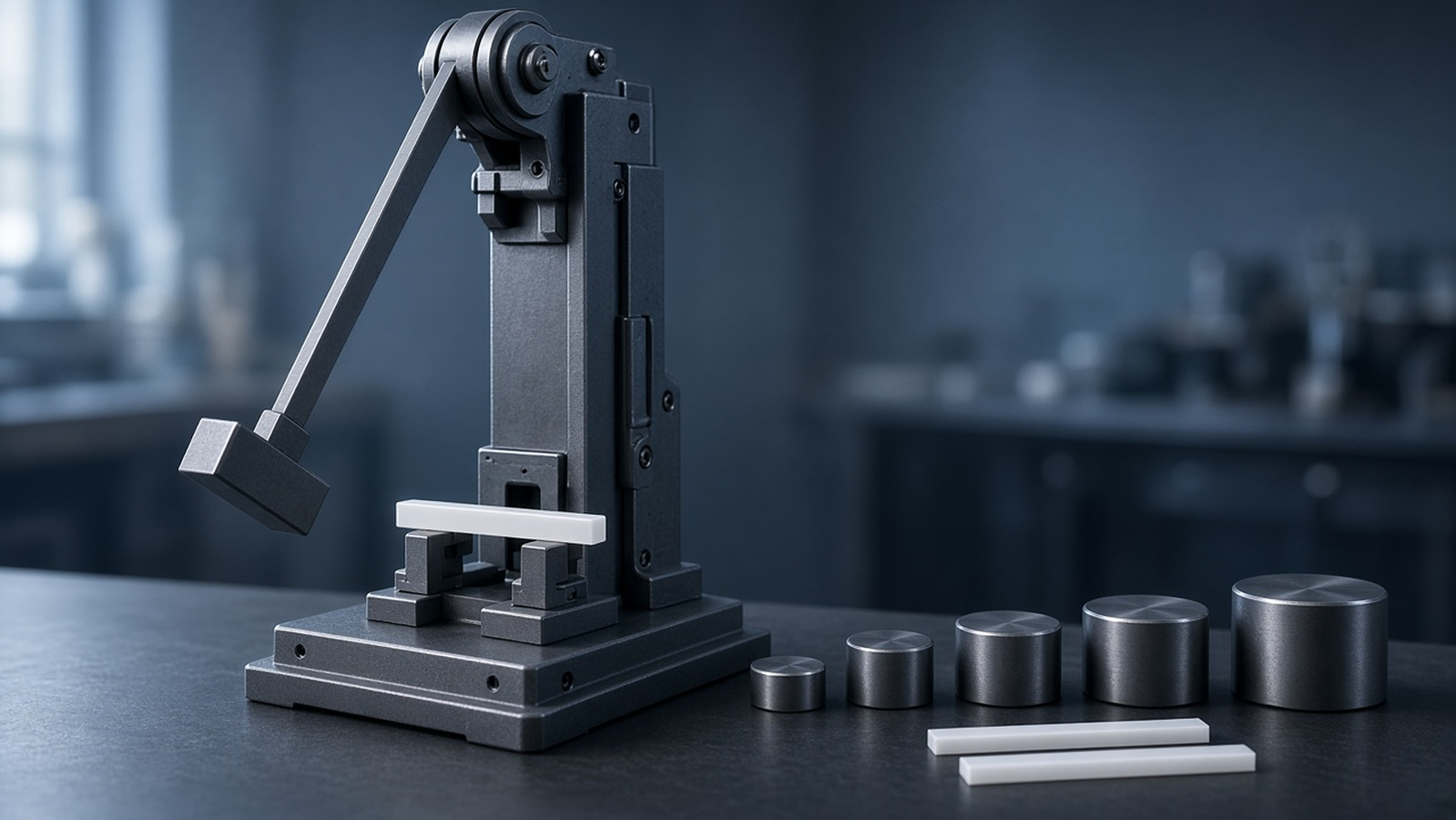
1. Impact tester pendulum energy: what the energy-share arithmetic shows
A pendulum energy has to be matched both to the energy the bar is expected to absorb and to the apparatus requirements of the selected method. In the withdrawn 1993 editions of the ISO Charpy and Izod methods, the absorbed energy had to lie between 10% and 80% of the pendulum energy and, if more than one of the pendulums described in the apparatus table of those texts met the requirements, the pendulum with the highest energy was to be used.1,2 Both texts also say it is not advisable to compare results obtained with different pendulums.1,2
Those rules come from withdrawn 1993 editions that were read in public preview copies. The current methods may word the range differently, so treat 10% to 80% as the rule of the older texts and read the edition you actually work to. Test method reference: ISO 179-1:2026 for Charpy and ISO 180:2023 for Izod, with ASTM D256-26 for Izod pendulum impact.3,4,5
2. The energies involved: initial, absorbed and corrected
A pendulum test works with three energies. The initial energy of the pendulum is fixed by the hammer and the lift angle. The absorbed energy is the difference between that initial energy and the energy remaining in the pendulum after the specimen breaks. That difference has to be corrected for losses due to friction and air resistance.1,2
The same withdrawn texts ask for a blank test, a swing with no specimen in place, to record the frictional energy loss, and they set a maximum permissible loss for each pendulum, to be checked periodically.1,2 The ASTM Charpy method adds that the energy a pendulum gives up is more than crack initiation and growth: it includes toss energy, bending, vibration and friction.6 In both families, the reading used in the formula is therefore the corrected absorbed energy, not a raw reading, and the pendulum itself is verified under its own standard. Test method reference: ISO 13802:2025.7
Instruments differ in how they apply this. Establish which corrections the instrument has already applied; do not subtract the same loss twice. The Polytevo Series pages describe a correction built into the tester, summarized below, but how a given instrument does it is a matter for its manual.
3. A historical selection-rule example and the arithmetic
This illustration applies the numerical energy-share rule stated in the withdrawn 1993 texts. It does not establish a suitable present-day test configuration. Use the applicable edition for apparatus, velocity, specimen count, correction and reporting requirements. The numbers below are arithmetic, not measurements of any material.
- Measure the bar. Record the thickness, h, and the width, b, in millimetres. For a notched bar record the remaining width at the notch, bN, after the notch has been cut. In the example h = 4.0 mm and bN = 8.0 mm.
- Estimate the energy. A previous result for the same material and notch, or a trial bar, tells you roughly how much energy the bar will absorb. In the example it is about 0.45 J.
- Compare the energy shares. List the pendulum energies you have and work out the absorbed energy as a share of each. Under the 1993 rule, the highest-energy pendulum that keeps the share between 10% and 80% was used, among the pendulums that met the other apparatus requirements of the texts.1,2
- Blank swing (historical text). The withdrawn texts asked for a blank swing to record the frictional loss and compared it with a limit for that pendulum; establish what the selected method and the instrument require.1,2
- Record the corrected energy and failure outcome for each specimen. Apply the selected method’s rules for which outcomes may be reported or combined.
- Calculate. For an eligible notched-specimen result using this area-based calculation, divide corrected energy by thickness times remaining width and apply the stated unit conversion: impact strength a = E / (h × bN) × 1,000, with E in joules and the dimensions in millimetres, gives kilojoules per square metre.1 In the example 0.45 / (4.0 × 8.0) × 1,000 = 14.1 kJ/m².
Step 2 of the example gives an illustrative absorbed energy of 0.45 J. The table sets that reading against the pendulum energies listed in the snapshot for the two testers; the listed energies are published inputs, and the shares and band positions are calculated outputs.
| Illustrative energy shares using the page snapshot dated 15 November 2026 | Pendulum energy listed on the page | Calculated share of an illustrative 0.45 J reading | Calculated position against the historical 10% to 80% band |
|---|---|---|---|
| Charpy Impact Tester | 1 J | 45.0% | inside |
| Charpy Impact Tester | 2 J | 22.5% | inside |
| Charpy Impact Tester | 4 J | 11.3% | inside |
| Charpy Impact Tester | 5 J | 9.0% | outside |
| Charpy Impact Tester | 7.5 J | 6.0% | outside |
| Charpy Impact Tester | 15 J | 3.0% | outside |
| Charpy Impact Tester | 25 J | 1.8% | outside |
| Charpy Impact Tester | 50 J | 0.9% | outside |
| Izod Impact Tester | 2.75 J | 16.4% | inside |
| Izod Impact Tester | 5.5 J | 8.2% | outside |
| Izod Impact Tester | 11 J | 4.1% | outside |
| Izod Impact Tester | 22 J | 2.0% | outside |
The dated table identifies which listed capacities fall inside the historical numerical band for the illustrative reading. These are arithmetic comparisons, not pendulum recommendations. They do not establish suitable impact velocity, fixtures or method suitability.
Whether the result is expressed in kJ/m² or J/m is a separate question of units, covered in the guide Charpy vs Izod Impact Testing for Plastics.
4. What the Polytevo Series impact tester pages list
The page values are reproduced so that you can set them beside your own absorbed energies.
The Polytevo Series Charpy Impact Tester page lists selectable pendulum ranges and matching hammer/weight-set configurations, with built-in energy-loss correction.
The Polytevo Series Izod Impact Tester page lists pendulum and weight-set options, automatic result calculation and selectable reporting units.
| Tester page, snapshot 15 November 2026 | Pendulum energies the page lists | Hammer and weight sets | Display, correction and results |
|---|---|---|---|
| Charpy Impact Tester | 1 / 2 / 4 / 5 J; 7.5 / 15 J; 25 / 50 J (three ranges, one range or all ranges) | Pendulum hammers (1 J, 7.5 J, 25 J) with weight sets (2 / 4 / 5 J, 15 J, 50 J) for the selected energy ranges | LCD touch screen shows the absorbed energy directly, with built-in energy-loss correction |
| Izod Impact Tester | 2.75 J, 5.5 J, 11 J and 22 J | 2.75 J impact hammer with 5.5 J, 11 J and 22 J weight sets | Final results calculated automatically; selectable units J/m, kJ/m², kg-cm/cm or ft-lb/in |
The pages identify pendulum options and applications; suitability for a particular material, specimen and method still needs to be established. The supplied configuration, including which Charpy ranges and which weight sets, is confirmed on the quotation.
5. The calculator
The calculator below does the arithmetic of the energy shares and of the impact-strength formula: enter the corrected absorbed energy, the thickness and the remaining width at the notch, and optionally a pendulum energy. It returns the impact strength in kJ/m², the energy divided by the thickness in J/m, and the share of the pendulum energy, and it can list the page energies from the snapshot table with their shares of your reading.
Arithmetic only. The selected method determines whether the specimen outcome is reportable. This calculation does not establish test validity, method equivalence or pendulum suitability. Display rounding does not establish measurement precision or test validity.
If the calculator does not load in your browser, the formula in step 6 gives the same impact strength: corrected absorbed energy in joules, divided by thickness times remaining width in millimetres, multiplied by 1,000.
The green band in the calculator is the historical numerical band of the withdrawn 1993 texts, drawn as context. The calculator does not decide that a result is acceptable, it does not recommend a pendulum, it does not establish test validity or pendulum suitability, and it gives no pass or fail result.
6. Limits and what to write down
Three limits are worth stating plainly. First, the share of the pendulum energy says where a reading sits on the scale; it does not say whether the material is tough or brittle enough for any purpose. Second, the historical texts caution against comparing results obtained with different pendulums.1,2 Use a method-appropriate pendulum, record any change and establish comparability rather than assuming it. Third, the impact-strength figure inherits everything the notch and the bar preparation did to the reading, which is why the notch and the units belong with the number; see Charpy vs Izod Impact Testing for Plastics and the overview in Mechanical Testing of Plastics: Match the Test to the Question.
A minimal record for each series: the method reference and edition, the bar dimensions, the notch, the pendulum energy, the blank-swing loss, the corrected energy of each bar with its break type, and the units of the result. Handbooks of polymer testing discuss these points property by property.8,9
The route from material to test is set out in the Lab-Scale Polymer Processing and Testing: A Workflow Guide.
7. Keep Exploring the Lab-Scale Polymer Processing Knowledge Hub
This guide belongs to the ACS Material library on lab-scale polymer processing and testing, built around the Polytevo Series by ACS Material. Start from the Lab-Scale Polymer Processing and Testing: A Workflow Guide, which places every stage of the work, from material to test, on one route. The other guides on mechanical and hardness testing are:
- Mechanical Testing of Plastics: Match the Test to the Question — which test answers which question: tensile, impact or hardness.
- How to Choose a Universal Testing Machine for Plastics — how to start from the method and specimen, estimate the force, and evaluate load-cell performance and capacity.
- Charpy vs Izod Impact Testing for Plastics — what each impact geometry loads, why the units differ, and how the notch ties the result to preparation.
- Shore A vs Shore D Hardness — how the Shore scale is chosen, why there is no universal conversion, and what a constant-load test stand adds.
- Tensile Testing of Plastics: Reading the Stress-Strain Curve — how a tensile test produces method-defined stress and strain quantities for a plastic.
8. Before you request a quote
To help identify a suitable configuration, describe the impact test you need to run. Please tell us:
- the method reference you work to and whether bars are notched;
- the material and the thickness of the bars;
- the energy you expect the bars to absorb, from earlier results or trial bars;
- the pendulum energy ranges you would like to have available;
- how you record and report results.
Send these through Request a Quote. Specifications are as published on each product page, and final configurations are confirmed on quotation.
9. FAQ
How do I choose a pendulum energy?
Start from the selected method and its apparatus requirements. As a historical illustration, the withdrawn 1993 ISO texts asked for an absorbed-energy share between 10% and 80% and, if several of the pendulums they describe qualified, for the highest-energy one; check the edition you work to.1,2
Why is the energy corrected before I calculate impact strength?
Because the pendulum also loses energy to friction and air resistance, which the blank swing of the historical texts records. The impact-strength formula uses the corrected absorbed energy; establish which corrections the instrument has already applied and do not subtract the same loss twice.1,2
How is impact strength calculated?
In the ISO style, as the corrected absorbed energy divided by the thickness and the remaining width at the notch, multiplied by 1,000, giving kJ/m² when E is in joules and the dimensions are in millimetres.1
Can I compare results from two different pendulums?
The historical texts caution against comparing results obtained with different pendulums. Use a method-appropriate pendulum, record any change and establish comparability rather than assuming it.1,2
Does the calculator tell me whether a result passes?
No. It does arithmetic on the numbers you enter and shows where the reading sits against the historical 10% to 80% window of the older texts; method suitability is not assessed. It gives no pass or fail result.