
Choosing an in-situ stage looks harder than it is. The InSitu Pro™ line spans sixty-odd models — optical windows, electrical probes, tensile frames, XRD domes, SEM modules, battery cells — and every one of them heats, cools, or both. But underneath the catalog sits a short, orderly set of decisions, and once you know them the model names practically read themselves. This guide walks those decisions in order, explains the physics behind each one, and hands you an interactive selector that applies them for you. It is the practical half of a pair: our companion in-situ stages theory guide covers the underlying science in depth.
Start with two questions
Every stage in the line exists to hold a specimen at a known, controlled temperature while an instrument watches it. The reason this is worth an instrument at all is that the most informative things a material does are processes, not endpoints — nucleation, coarsening, switching, freeze-out — and the migration of materials characterization from post-mortem snapshots toward in-situ observation has been one of the defining trends of the last two decades1. Its stricter cousin, operando measurement, goes further and records structure and function at the same instant, under realistic working conditions2. What separates one stage model from another is simply which instrument it couples to and which temperatures it commands.
So before touching a datasheet, settle two things. First, the signal: are you collecting photons through a window, current through probes, load through a grip, diffracted X-rays, electron images, or an electrochemical cycle? That single answer places you in one of the line's families. Second, the thermal window your experiment actually needs — not the widest range you might ever want, but the range this study requires, because paying for 1500 °C when your polymer melts at 240 °C buys nothing, and discovering at install time that you needed −190 °C buys regret. With those two answers, the remaining choices — how the stage cools, what surrounds the sample, and whether anything needs to move — are refinements, taken one at a time in the sections below.
Step 1 · Optical window or electrical probes?
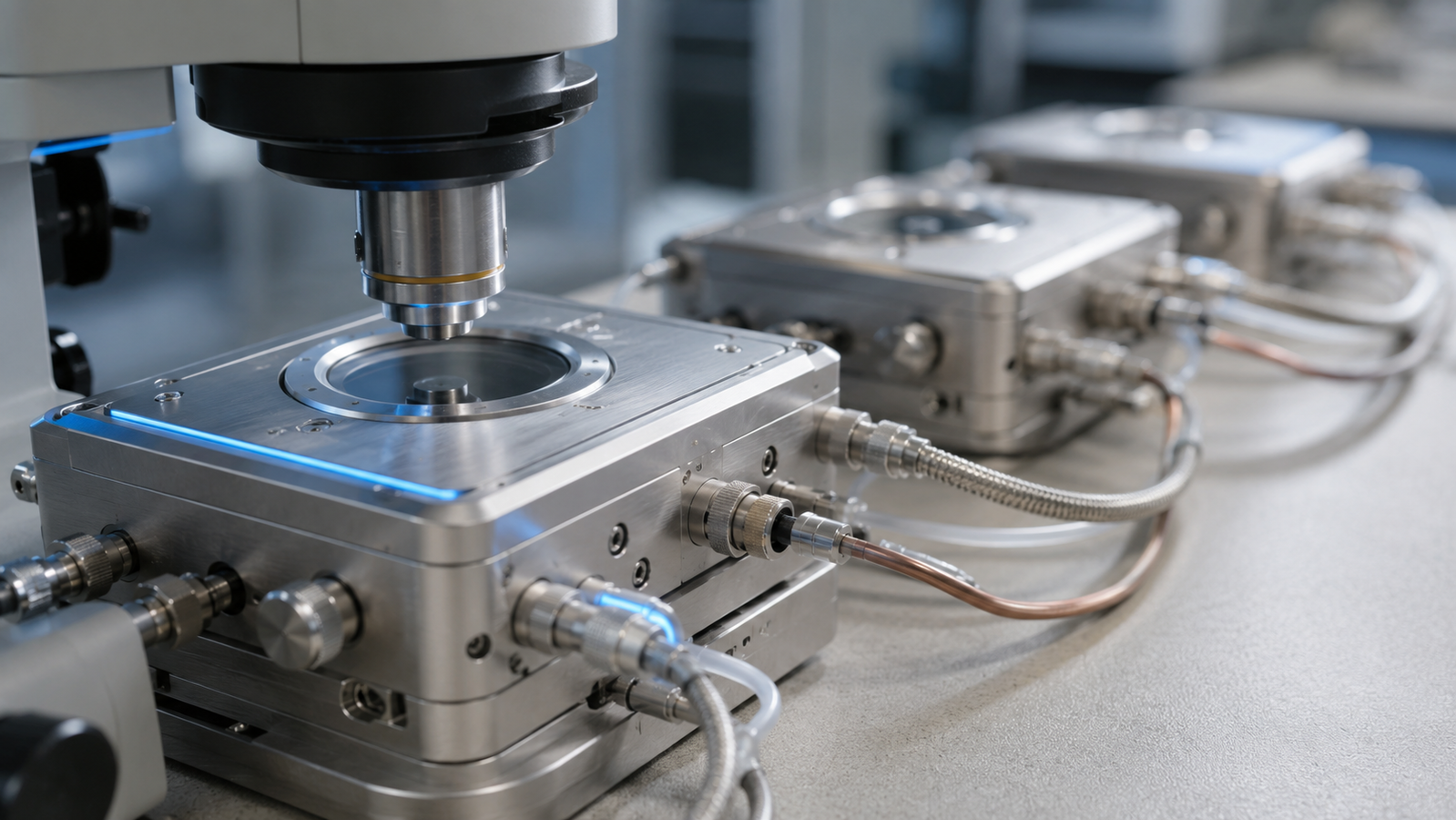
The two largest families mirror the two ways most labs measure. Optical-application stages put the temperature-controlled sample under a sealed quartz window so a microscope objective, Raman spectrometer, or other optical system views it from above. This is the direct descendant of hot-stage microscopy, a technique with more than half a century of methodology behind it for watching melting, crystallization, polymorphic transitions, and morphology evolve in real time3,4. The modern version is quantitative: a Raman peak position is itself a thermometer — the graphene G band shifts by about −0.016 cm⁻¹ per °C, a coefficient established by variable-temperature measurements from −190 to +100 °C5 — because heating softens and broadens phonon modes through lattice expansion and anharmonic phonon–phonon scattering6, a behaviour seen across layered materials and nanotubes and sharpened by cooling7. The ACH600S is the archetype of this family: liquid-nitrogen cooling and resistive heating give it −190 °C to 600 °C under the window, it integrates with microscopes and Raman systems, and it ships with control software plus LabVIEW VIs and a C# SDK for scripted runs. Browse the full set on the Optical Application page.
Electrical-application stages take the same thermal platform and add a probe system, so a source meter, bridge, or multimeter measures transport while temperature sweeps — resistance versus T, I–V families, carrier freeze-out, metal–insulator transitions. Two measurement facts shape this family's design. Contact resistance corrupts a two-probe measurement, which is why serious transport work uses four-point and van der Pauw configurations that cancel the contact drops8; and separating carrier density from mobility requires the Hall effect, which needs a magnetic field and therefore a non-magnetic stage construction near the sample9. The AECH600S is the electrical twin of the ACH600S — the same −190 °C to 600 °C window, with probe contacts and electrical feedthroughs in place of a clear aperture — and the lineup lives on the Electrical Application page.
If your stimulus is mechanical force, your detector is a diffractometer or an electron column, or your specimen is a battery cell, skip ahead to the technique shortcuts — those families follow the same naming logic but live outside the two big application pages.
Step 2 · Decode the model number: temperature range
Here is the single most useful fact in the whole catalog: the number in a model name is its maximum temperature in degrees Celsius. AH1500 reaches 1500 °C. ACH600S reaches 600 °C. AH200-Mini reaches 200 °C. Once you know this, a page of part numbers becomes a sorted list of thermal ceilings. The lower end is spelled the same way: a "C" in the name means the stage cools, and on the liquid-nitrogen models that means all the way down to −190 °C. Across the whole line the envelope runs from −190 °C to 1500 °C, with control stability on the order of ±0.1 °C, heating rates up to about 150 °C/min, and liquid-nitrogen cooling rates up to about 40 °C/min depending on model.
Why insist on a stage that goes both ways? Because first-order transitions do not retrace their steps. Ever since Morin's 1959 discovery that several transition-metal oxides switch abruptly from insulator to metal at a characteristic temperature10, vanadium dioxide — switching near 68 °C — has been the textbook case: the transition happens at a higher temperature on heating than on cooling, and near the transition the material is not even spatially uniform, with nanoscale metallic puddles nucleating and percolating through the insulating matrix11. A heating-only instrument can trace only one branch of that hysteresis loop; measuring its width, or catching the inhomogeneous texture as it forms, requires controlled cooling under the same objective. Rate belongs in the same conversation as range: micro-fabricated heaters have pushed laboratory heating and quenching to around a million degrees per second12, which is a useful reminder that a stage's rate specification is a real experimental axis — fast ramps probe kinetics and trap metastable phases, slow ramps approach equilibrium — not a convenience figure.
Two buying rules follow. Pick a ceiling comfortably above your hottest planned point — running a stage at its limit all day is like red-lining an engine — but resist paying for headroom in a different class: the ultra-high-temperature furnace-type stages (AH1000/AH1200 and the AH1500-RG/AH1400-RG-XY tier) are built differently from the mid-range bodies, not merely hotter. And if any protocol in the next few years says "quench," "cryo," or "below ambient," take the C model now; cooling cannot be retrofitted.
Step 3 · Cooling: liquid nitrogen, TEC, or none
Three cooling philosophies cover the line, and the model name tells you which one you are looking at. Liquid-nitrogen (LN₂) cooling is the deep-cold workhorse — the C-series stages such as ACH600S and AECH600S pair an LN₂ circuit with resistive heating to sweep the full −190 °C to 600 °C span, with an optional cooling controller managing the nitrogen side. It is the choice whenever the physics lives below roughly −25 °C: freeze-out studies, low-temperature phases, cryo work. The practical cost is logistics — your lab keeps a dewar of liquid nitrogen on hand.
Thermoelectric (TEC) cooling powers the AEPE series: −25 °C to 120 °C, ±0.1 °C, ramps to 30 °C/min, no cryogens anywhere. A Peltier element pumps heat electrically, a solid-state approach whose temperature-control behaviour is well characterised and highly tunable13, which makes these stages the low-maintenance pick for work that brackets room temperature — biological samples, polymers near their glass transition, device burn-in. It is also, not coincidentally, exactly the band where much application-driven phase-change physics happens: VO₂-based thermochromic smart-window materials, for instance, switch in the tens of degrees Celsius14, squarely inside a TEC stage's fine-stepping range. Heating-only models — no C in the name — start at room temperature and go up, cooling back naturally; if your experiment only ever climbs (grain growth, annealing, decomposition), this is the simplest and most economical body, and it is how the ultra-high-temperature tier reaches 1000, 1200, 1400 and 1500 °C.
The planner below makes the choice concrete. Set the temperature your experiment needs and press Start: three curves race downward under each technology's rated limit, and the verdict line tells you which ones arrive — and when.
What the model is and what to take from it: each curve is a controller-limited linear ramp — LN₂ at up to ~40 °C/min toward a −190 °C floor, TEC at up to 30 °C/min toward a −25 °C floor — with a Newton-type exponential approach as it nears that floor, which is how a real controlled stage behaves as the driving temperature difference shrinks. The takeaway is structural, not numerical: your target temperature alone decides the cooling technology. Anything below −25 °C is liquid-nitrogen territory, full stop; between −25 °C and ambient, TEC wins on convenience; and with no active cooling the sample simply never leaves room temperature. Curves are schematic family-level behaviour, not the guaranteed performance of a specific model.
Step 4 · Vacuum and atmosphere
What surrounds the sample matters as much as its temperature, and the reason is chemistry with an exponential accelerator. Oxide growth on a hot metal follows the classic diffusion-limited parabolic law — thickness² proportional to time — worked out by Deal and Grove for thermal oxidation15, with the rate constant rising exponentially with temperature; even near room temperature, the thin-film oxidation theory of Cabrera and Mott shows a native oxide is the default fate of a clean metal surface in air16. Heat that surface a few hundred degrees and "in-situ experiment" quietly becomes "oxidation experiment." Controlling the environment — pumping to vacuum, or flowing an inert or reducing gas — is therefore part of doing the experiment honestly, and it is the bridge from in-situ toward operando work, where gas, temperature, and sometimes potential are all set to mimic real service2.
The suffix logic is mechanical: a "V" in the name means a vacuum-capable chamber. ACH400SV is the vacuum sibling in the ACH family, AEPE120V the vacuum TEC stage, AXCH400V the vacuum XRD stage. Pull vacuum to protect an oxidation-prone specimen at temperature, to kill condensation during deep cooling, or to remove convection from a sensitive measurement. Ambient-chamber models hold the sample in a sealed enclosure at atmospheric pressure — fine for air-stable work and anything that must stay hydrated — while a small open-design stage like the AH200-Mini trades the enclosure for maximum accessibility at modest temperatures. One family note for probe users: within the AEPE probe stages the 120 body is the atmospheric variant and 120V the vacuum one, so the atmosphere choice and the probe choice are made together.
The simulator below is the V-suffix argument in one picture. Choose a temperature, hold the sample for an hour, and compare the oxide scale that grows in air with the one that grows in vacuum.
What the model is and what to take from it: the scale thickness follows x² = kp·t with an Arrhenius rate constant, the diffusion-limited parabolic regime of classical oxidation theory15; the vacuum panel runs the same law with the oxidant supply suppressed. The takeaway: above a few hundred degrees in air, oxidation is the default outcome for most non-oxide materials — and because the rate constant is exponential in temperature, "a bit hotter" means "much faster." If your sample must come through the excursion chemically unchanged, plan on the V model; kinetics are representative and in relative units, a schematic teaching aid rather than data for any specific alloy.
Step 5 · Probes, motion, and special bodies
The remaining suffixes describe what moves. On electrical stages, -EM marks an externally adjustable probe platform: arms outside the chamber steer the internal probe tips in X, Y and Z (±6 mm of travel on the AEPE-based probe stages), so you can land contacts on any point of the sample surface without opening the chamber — the way to probe a specific device on a die rather than a blanket film. The -EC variant is the precision electronically adjusted version of the same idea, and fixed-probe bodies such as the AECH600 keep four contacts at set positions for straightforward bar-and-film transport in the four-point spirit of van der Pauw8. Where Hall measurements are on the menu, remember the field: the Hall-capable option in the line uses non-magnetic construction near the sample, because a magnet has to live there9.
On optical stages, -XY adds a motorized sample stage so you can raster or revisit fields of view at temperature (ACH600S-XY / ACH400SV-XY), the -T variants adapt the body for transmission-mode work, and the -RG on the 1400/1500-class furnace stages is a rotating viewport that keeps the optical path clear as evaporants fog the window during long ultra-high-temperature runs. None of these change the thermal spec — they change what you can do while you are there, which is exactly why they are suffixes and not new families.
Shortcuts by technique
Raman and microscopy. This is the optical family's home turf — start at the Optical Application page. If you are quantifying peak positions against temperature, the variable-temperature Raman literature is your calibration reference5, and the theory guide's spectroscopy section explains what the data will look like.
X-ray diffraction. Dedicated XRD stages put the temperature control under a diffraction-friendly dome: AXCH600 covers −190 °C to 600 °C in ambient, AXCH400V does −190 °C to 400 °C in vacuum, AXH1200 heats to 1200 °C with programmable ramps, and the AIH1600-SR infrared-heated stage reaches 1600 °C at up to 30 °C per second. Coupling controlled fast thermal cycles with live diffraction is precisely how modern studies catch phase transformations mid-flight — up to and including melt-and-requench conditions probed by high-speed in-situ XRD17.
SEM and FIB. In-chamber modules bring the same control inside the electron microscope: ASCH200 spans −190 °C to 200 °C with fast ramps, ASCH200-RS adds five-axis motion for cryo work with full stage freedom, and ASFH5000-1200 combines 5000 N of tensile force with heating to 1200 °C. Pairing in-SEM straining with EBSD mapping is one of the richest experiment classes in modern materials science — grain-scale rotation, slip, twinning and phase instability tracked live through deformation18.
Mechanical testing. The force family runs from the AFCH500-200 dual-range tester (20 N and 500 N load cells, −190 °C to 200 °C, 100 mm of travel) to 5000 N frames like the AFH5000-1000V that pull to 1000 °C in vacuum — tensile, compression, and bending with temperature as a live variable rather than a pre-treatment.
Batteries and electrochemistry. Operando cells close the loop between structure and cycling — the approach that synchrotron and laboratory XRD battery studies have turned into a standard methodology, with purpose-built coin- and pouch-format cells19. In the line: the ABE 316L cell opens a 10–180° 2θ window for operando XRD at room temperature, the AXCH100-PB and AXCH100-BB temperature-controlled cells take pouch and coin formats across −100 °C to 100 °C, and the ACH80-BE stage handles operando Raman and microscopy of cells from −60 °C to 80 °C.
Rapid thermal processing. When the point is the thermal cycle itself — spike anneals, dopant activation, fast crystallization — the process family applies: the ARTP600 rapid thermal processor ramps at up to 150 °C per second at 21 kW, the same fast-anneal regime that drives semiconductor RTP practice20, and the Wafer Heating Module holds 2–12 inch wafers at up to 600 °C with ≤10 µm flatness.
Interactive selector: answer, match, quote
Everything above is now one widget. The selector below carries the complete current range — all sixty models across the seven families, including new releases not yet on the product pages (tagged "New · quote" in results) — and applies the five steps for you. Use the Guided tab to answer one question at a time with full back-tracking, or the Advanced tab to set every requirement on one screen if you already hold a spec sheet. The live tracker underneath shows every model in your family turning green (still fits) or red (ruled out) as you choose, so you can see exactly which requirement eliminated what. When you land on a match, "View" opens the product page and "Request a quote" pre-fills an inquiry with your selections — and if nothing fits, the same button sends us your exact requirement list, which is precisely the information a custom configuration starts from.
How it decides, in one sentence: your answers become hard filters — family, minimum and maximum temperature, cooling type, chamber, probe motion — applied against each model's cataloged specifications, so the shortlist contains only stages whose published envelope covers your requirement; the tool recommends, and the final configuration is confirmed with our engineers at quotation.
The whole family at a glance
| Family | Models | Temperature envelope¹ | Cooling options | Where to start |
|---|---|---|---|---|
| Optical stages | 19 | −190 – 1500 °C | LN₂ / none | Optical Application page |
| Electrical & probe stages | 18 | −190 – 1500 °C | LN₂ / TEC / none | Electrical Application page |
| Mechanical testing | 5 | −190 – 1200 °C · to 5000 N | LN₂ / none | Use the selector above |
| XRD / synchrotron | 4 | −190 – 1600 °C | LN₂ / none | Use the selector above |
| SEM / FIB modules | 3 | −190 – 1200 °C | LN₂ / none | Use the selector above |
| Battery / electrochemistry | 5 | −100 – 100 °C (cells) | LN₂-assisted / none | Use the selector above |
| Furnaces & special equipment | 6 | RT – 1200 °C · RTP to 150 °C/s | — | Use the selector above |
¹ Envelope of the family including new-release models orderable by quote; individual models cover a subset — the number in each model name is that model's maximum temperature, and specifications on each product page prevail.
FAQ
What does the number in a model name mean?
Its maximum temperature in °C: AH1500 reaches 1500 °C, ACH600S reaches 600 °C, AH200-Mini reaches 200 °C. A "C" in the name means the stage also cools — down to −190 °C on the liquid-nitrogen models — and a "V" means a vacuum-capable chamber. Read the name, and you have read half the datasheet.
What do I need in the lab to run a −190 °C stage?
A supply of liquid nitrogen and the optional cooling controller that manages it; the stage's resistive heater handles everything above. If your work stays between −25 °C and 120 °C, the TEC-cooled AEPE series reaches it with no cryogens at all.
Vacuum model or ambient model?
Choose vacuum ("V") when the sample would oxidize at your top temperature, when condensation threatens your coldest point, or when convection disturbs the measurement. Choose ambient when the sample is air-stable or must not be dried out. The choice is per-model — e.g. AEPE120 (atmosphere) versus AEPE120V (vacuum) — so decide it alongside the temperature range.
Some results carry a "New · quote" badge — what is that?
The selector covers the complete current range, including newly released models that are orderable but do not yet have individual product pages. For those, "Request a quote" is the direct path: your requirements go straight to our engineers, who confirm specifications and lead time with a formal quotation.
My requirement doesn't match any model. Now what?
Send it anyway — the selector's "no exact match" screen pre-fills a quote request with the exact combination you asked for, and that requirement list is where a custom configuration starts. Many stages in the line accept factory options beyond the standard catalog entries.
Still weighing two candidates? Tell us your instrument, temperature range, atmosphere, and measurement type via the contact form and our team will recommend and price the right stage — or browse the full InSitu Pro™ overview and dive into the physics in the theory guide companion to this article.
References
This selection guide is provided by ACS Material LLC to help researchers match an InSitu Pro™ heating, cooling, or electrical stage to their experiment. Temperature ranges, rates, and capabilities quoted here are family-level figures drawn from current product documentation; the specifications on each individual product page and technical data sheet prevail, and final configurations — including new-release and custom models — are confirmed at quotation. The two embedded simulators are schematic teaching tools built on the cited physical models, not performance data for any specific instrument, and the interactive selector is a guidance tool based on cataloged specifications, not a substitute for an engineering consultation.