
Most of materials science is taught with before-and-after pictures: a sample is heated in a furnace, cooled, and then examined. But the interesting physics happens during the heat, not after it — grains migrate, phases nucleate, carriers freeze out, bonds rearrange — and an endpoint photograph throws that trajectory away. An in-situ heating, cooling, or electrical stage puts the experiment under the instrument: it holds the specimen at a known, controlled temperature (or bias) right at the point of measurement, so the microscope, spectrometer, or source meter records the process as it unfolds. This article is a theory-first tour of why that matters, the physics each kind of stage lets you watch, and what separates a stage that merely gets hot from one you can trust a measurement to.
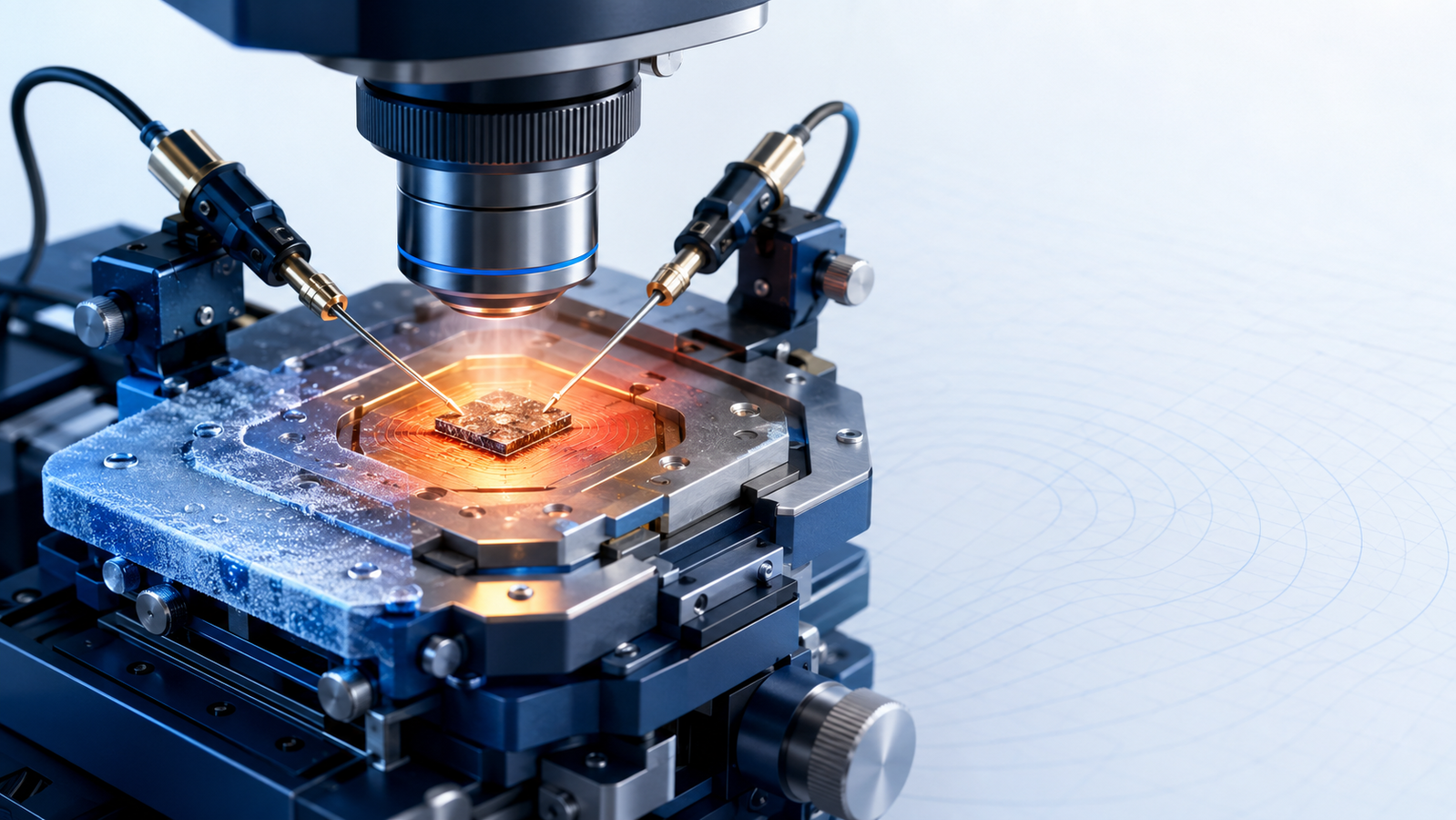
In one paragraph: an in-situ stage is a small, instrumented environment — a heater, a cooler, or a set of electrical probes — that sits inside a microscope, Raman system, diffractometer, or probe station and applies a controlled stimulus while you observe. The point is to capture kinetics and reversible behaviour that disappear from a quenched, room-temperature sample: how fast grains coarsen and at what temperature, whether a transition follows the same path up and down (it usually does not), how a Raman peak shifts with temperature, and whether conduction is metallic or activated. The hard part is not reaching temperature; it is knowing the temperature the sample actually sees, controlling the rate, and coupling cleanly to the measurement. The rest of this guide builds that picture from the physics up, with four interactive models you can drive yourself.
What “in situ” and “operando” really mean
In situ — Latin for “in place” — means observing a material while it is being treated, rather than removing it from the process to look at it afterward. A sample is characterized as it is heated, cooled, biased, strained, or exposed to a gas, so the measurement follows the change in real time. Operando is the stricter cousin: the material is observed while it is actually performing its function under realistic working conditions — a catalyst mid-reaction, a battery electrode mid-cycle — so that structure and activity are recorded at the same instant1,2. Both stand in contrast to ex situ work, where the only data come from snapshots taken before and after.
The reason the distinction matters is informational. Many of the most important things a material does are paths, not states: a coarsening microstructure, a transformation that overshoots its equilibrium temperature, a reaction intermediate that exists for seconds. Quench the sample and you recover a single frozen frame — and worse, the act of cooling can itself change what you are trying to see, reversing a transition or relaxing a metastable structure. Characterization in materials science has steadily migrated from pure ex-situ examination toward in-situ and operando methods for exactly this reason1. In the electron microscope, the development of dedicated heating, cooling, and biasing holders has turned the TEM from a camera for static structures into a laboratory for watching nucleation, growth, and phase evolution with atomic resolution3.
The stage as a controlled experiment
A stage is easy to underrate as a mere accessory — a hot plate that happens to fit under a lens. It is better understood as the experiment itself: a small, instrumented environment whose job is to apply one variable cleanly while everything else is held fixed and observed. Three families of stimulus dominate. A heating stage drives thermally activated processes — diffusion, grain growth, sintering, decomposition, and most phase transitions. A cooling stage reaches below ambient to freeze in metastable states, study transitions that only appear on the way down, suppress thermal broadening in spectra, and access low-temperature transport. An electrical stage lands probes on the specimen to source current and measure voltage — turning the same platform into a variable-temperature probe station. The best systems combine them, because the questions do.
Two design ideas separate a usable stage from a heat source. The first is that temperature must be known at the sample, not merely supplied to a heater some distance away — the gap between the two is the recurring theme of section 8. The second is rate: how fast a stage can ramp and, just as importantly, quench. Modern micro-fabricated (MEMS) heating chips push this to extremes — nanocalorimeter sensors heat samples at rates approaching a million kelvin per second and cool nearly as fast, which is what makes it possible to catch fast reactions and trap high-temperature phases before they relax4. The catalogue of commercial in-situ heating holders, from bulk-furnace designs to chip-based MEMS stages, reflects a long engineering effort to deliver a stable, calibrated, observable temperature inside the cramped pole-piece gap of a microscope5.
Heating I: microstructure in motion
Start with the most visual consequence of heat: grain growth. A polycrystalline solid is a mosaic of crystallites separated by grain boundaries, and every boundary carries an excess energy per unit area. The system can lower its total energy by reducing boundary area, which it does by letting large grains grow at the expense of small ones — atoms hop across each boundary from the convex (small-grain) side to the concave (large-grain) side, so boundaries migrate toward their centres of curvature and small grains eventually vanish6. The same curvature-driven logic governs the coarsening of second-phase particles, where large precipitates grow as small ones dissolve — Ostwald ripening, in Greenwood’s classic treatment7.
Because the rate-limiting step is atomic jumping, grain growth is thermally activated and follows a parabolic-type law, ⟨D⟩n − ⟨D₀⟩n = k·t, where the rate constant k = k₀·exp(−Q/RT) climbs steeply with temperature. Two features make this worth watching live rather than inferring from a quenched pair of samples. First, the kinetics are exponential in temperature, so a stable, accurately known temperature is essential to extract a meaningful activation energy. Second, growth is not always “normal”: a few grains can grow abnormally fast and devour their neighbours, a runaway that a before-and-after experiment would miss entirely but an in-situ stage captures as it happens6. The practical importance is broad — grain size sets strength, and uncontrolled coarsening degrades everything from structural alloys to fuel pellets under irradiation8. In-situ TEM heating has made this kind of microstructural evolution — grain growth, sintering, and the diffusion behind it — directly observable at temperature3.
The simulator below makes the trade-off tangible. Set a temperature, press Heat, and watch the field coarsen — or fail to, when it is too cold.
Heating II: transitions, reversibility, and why cooling matters
Heat a material far enough and it changes phase. Transitions come in two broad kinds. Second-order (continuous) transitions, such as an ordinary magnetic or order–disorder transition, evolve smoothly through the critical point with no latent heat and no abrupt jump. First-order transitions — melting, most structural and many electronic transitions — are discontinuous: they absorb or release latent heat, and crucially they require a new phase to nucleate, which costs interfacial energy. Because nucleation has a barrier, a first-order transition can overshoot — by how much depends on nucleation barriers, defects, strain, sample size, ramp rate, and thermal history. On heating, the old phase persists above its equilibrium temperature (superheating); on cooling, the new phase persists below it (supercooling). The result is thermal hysteresis: the transition happens at a higher temperature on the way up than on the way down, and the two branches enclose a loop.
The textbook example is vanadium dioxide. Since Morin’s 1959 discovery that several transition-metal oxides switch from insulator to metal at a characteristic temperature9, VO₂ has been the workhorse of this physics: near 68 °C its resistance drops by orders of magnitude across a first-order structural transition, and the switching temperature on heating sits well above that on cooling10. The same transition flips the material’s optical properties, which is why VO₂ is the basis of thermochromic “smart” windows11. The width and shape of the hysteresis loop are not nuisances — they encode nucleation density, strain, and defect content, and they are sensitive to particle size.
This is the clearest argument for a stage that both heats and cools. A heating-only instrument traces the heating branch, and may still record data during passive cooldown — but without controlled cooling the return branch is hard to reproduce at a defined rate, so it cannot reliably locate the cooling-branch transition, measure the hysteresis width, or confirm reversibility. Cooling has its own independent motivations: rapid quenching traps high-temperature phases for study, low temperatures sharpen spectroscopic features that overlap at room temperature, and many transport phenomena only emerge in the cold. Capturing a transition on the way down — and trapping the phases it produces — is one of the things fast cooling on a calorimetric stage was built to do4. Drive the loop yourself below: heat the sample through its transition, then cool it, and watch the operating point take a different road home.
Optical and spectroscopic in situ
Not every in-situ measurement is an image. A great deal of what we learn at temperature comes through light — hot-stage optical microscopy to watch melting, crystallization, and morphology; and, more quantitatively, vibrational spectroscopy. A Raman spectrum is a set of sharp peaks at the frequencies of a material’s phonons, and those frequencies are temperature-dependent in a precise, calibratable way. As temperature rises, two things happen at once: the lattice expands, lowering the phonon frequencies, and anharmonic phonon–phonon scattering shortens the phonon lifetime, broadening the peaks. Many modes therefore soften (shift to lower wavenumber) and broaden as a sample is heated — though the sign and magnitude are material- and mode-dependent, and strain, doping, and phase transitions leave their own fingerprints12,13.
The numbers are clean enough to use as a thermometer. For the graphene G band near 1580 cm⁻¹, the measured temperature coefficient is about −0.016 cm⁻¹ per °C — a value established by variable-temperature Raman measurements from −190 to +100 °C12. The same anharmonic behaviour is seen across layered materials and in carbon nanotubes, and it sharpens on cooling, which is one reason low-temperature spectroscopy resolves features that merge at room temperature14. Defects and doping modify the coefficients in their own characteristic ways, so a variable-temperature spectrum reports not just temperature but strain, layer number, and disorder15. And when a peak does something other than drift smoothly — splitting, vanishing, or jumping — that abrupt change flags a phase transition caught in the act. The model below lets you sweep temperature and watch a peak move and broaden.
Electrical in situ: transport versus temperature
An electrical stage answers a different question: how do charges move through this material, and how does that change with temperature? The experiment is a current–voltage (I–V) sweep, and the slope of the I–V line is the conductance. What the temperature dependence of that conductance reveals is the conduction mechanism. In a metal, the carriers are already present; heating simply adds lattice vibrations that scatter them, so resistivity rises roughly linearly with temperature (dR/dT > 0). In a simplified intrinsic semiconductor in the activated regime, carriers must be thermally excited across a band gap, with a population often approximated as n ∝ exp(−Eg/2kT); conductance therefore climbs steeply with temperature and resistance falls (dR/dT < 0) — though doping, traps, contacts, and hopping conduction can produce different behaviour. The sign of dR/dT gives a first clue to the dominant regime rather than a unique fingerprint of the mechanism, and the detailed shape — activated, hopping, or tunnelling — pins down the transport physics. Cool a semiconductor far enough and the carriers freeze out almost entirely, a regime only a cooling stage can reach.
Getting these numbers right requires care with the contacts. A simple two-probe measurement lumps the wanted sample resistance together with the resistance of the contacts and leads. The standard fix is the four-point method: source current through one pair of probes and measure voltage with a separate pair that carries negligible current, so lead and contact drops are greatly reduced. The van der Pauw configuration generalises this to thin films of arbitrary shape — provided the sample is homogeneous, uniformly thick, simply connected, and contacted with sufficiently small probes at its perimeter — and, with a magnetic field, yields the Hall coefficient as well — and a careful error budget for both techniques accounts for finite contact size, sample thickness, and probe placement16. The Hall effect itself, measured on the same stage, separates carrier density from mobility, which a resistance measurement alone cannot do; because it needs a magnetic field, a Hall-capable stage must use non-magnetic construction near the sample (in the simple single-carrier picture; multicarrier or strongly anisotropic systems need a fuller transport analysis). Pairing these transport measurements with a simultaneous structural probe — as in-situ TEM does for battery electrodes during cycling — links what the carriers do to what the lattice is doing at the same moment17. Toggle between a semiconductor and a metal below and sweep the temperature to see the slopes move in opposite directions.
The capability envelope of a stage
With the physics in hand, the requirements on a stage follow directly. The questions decide the specifications: a study of grain growth in a refractory alloy needs ultra-high temperature; a metal–insulator transition needs both heating and cooling with a fine, stable step; a transport study needs clean probe contacts and, for Hall, a magnetic-field-compatible design. Five axes describe most of what matters — the temperature range (how cold and how hot), the temperature stability (how tightly a setpoint is held, since kinetics are exponential in T), the rate of heating and cooling, the environment (vacuum, inert, or reactive gas), and the coupling to the measurement (an optical window and working distance, or electrical feedthroughs and probes). The table summarises how the two principal stage classes line up against those axes.
| Axis | Optical & spectroscopic stages | Electrical & probe stages |
|---|---|---|
| What you observe | Morphology, melting and crystallization, and spectra (Raman, photoluminescence, reflectance) through a window | Current–voltage curves, resistance versus temperature, and the Hall effect through landed probes |
| Physics it targets | Phase transitions, thermal expansion, strain, optical-property switching | Conduction mechanism, carrier density and mobility, contact behaviour |
| Temperature access | Cryogenic (down to about −190 °C with liquid nitrogen) up to ultra-high temperature (to ~1500 °C for dedicated heating designs) | Cryogenic to several hundred °C, matched to device-relevant and freeze-out regimes |
| How temperature is set | Resistive heating; thermoelectric (Peltier) modules for moderate ranges; liquid-nitrogen flow for cooling | Same heating and cooling methods, integrated with a probe platform and electrical feedthroughs |
| What touches the sample | Nothing but the support and atmosphere; an optical path is kept clear | Movable or fixed probes plus shielded electrical connections; non-magnetic build where Hall is required |
| Principal constraint | Optical access and working distance; window material sets the usable spectral range | Contact quality and parasitic resistance; magnetic compatibility for Hall measurements |
Getting the temperature right
The single most common error in variable-temperature work is treating the controller’s setpoint as the sample’s temperature. They are not the same. A thermocouple or resistance sensor sits at the heater, separated from the specimen by some thermal resistance, so the sample lags the setpoint during a ramp and settles at a slightly different value at steady state. The discrepancy grows with heating rate, with poor thermal contact between sample and stage, and with radiative losses at high temperature. Because the processes being studied are exponential in temperature, even a small offset can shift an apparent activation energy or transition temperature noticeably. Good practice is to use a calibrated sensor placed as close as practical to the sample, or certified melting-point standards appropriate to the range — a transition like the VO₂ example can serve as an application-specific check only when the sample’s transition behaviour is well characterised — and to allow the sample to equilibrate at each step.
Gradients and rate add a second layer. A real specimen is not isothermal: temperature varies across it, more so in larger samples and at higher temperatures, which broadens any measured transition and blurs kinetics. Heating rate is a genuine experimental variable, not just a convenience — ramp quickly and you probe the kinetic, non-equilibrium path; ramp slowly and you approach equilibrium. The ability to switch between these regimes deliberately is why controllable, well-characterised ramp and quench rates matter. Chip-based stages reduce both problems by shrinking the heated region to a tiny, low-mass membrane that is nearly isothermal and responds almost instantly, which is part of why MEMS nanocalorimeter and heating designs have become central to quantitative in-situ thermal work18.
Atmosphere, vacuum, and the limits of in situ
Temperature is rarely the only variable that matters. Heat a metal or a carbon material in air and it oxidises; the “in-situ” experiment then measures oxidation, not the intended process. Controlling the environment — pumping to vacuum, or flowing an inert or reducing gas — is therefore part of doing the experiment honestly, and it is the bridge from in situ toward operando, where the gas, temperature, and sometimes potential are all set to mimic real service. Operando infrared and Raman spectroscopy, for instance, follow how adsorbed species and the catalyst surface change together as a reaction proceeds19, and dedicated high-temperature reaction cells track a catalyst’s oxidation state through heating, reaction, and cooling under flowing gas using X-ray absorption spectroscopy20.
It is worth being clear-eyed about the limits. Any stage is an approximation of the real world: a thin specimen in a microscope vacuum, or a small sample under a window, is not a working reactor or a packaged device, and electron or photon beams can themselves perturb what they measure. The art is to make the stage environment close enough to the question that the answer transfers — and to interpret the data with the residual gap in mind. That caveat does not diminish the method; it is precisely why operando work, which narrows the gap, has become its own discipline within catalysis, energy storage, and electronics2.
The InSitu Pro™ stage family
ACS Material’s InSitu Pro™ stages are built to put the physics above into practice across the application landscape described in section 7. The line is organised into optical-application stages — for microscopy, Raman, and other through-window measurements — and electrical-application stages that add a probe platform for transport and Hall measurements. The line now extends well beyond these two classes: mechanical platforms — desktop tensile stages and UTM temperature modules — plus XRD stages, SEM stages, and battery test cells carry the same temperature engine into diffraction, electron microscopy, and electrochemistry. Together they span cryogenic temperatures (to roughly −190 °C with liquid-nitrogen cooling) up to ultra-high temperatures, with stable control on the order of ±0.1 °C, heating rates up to about 150 °C/min, and liquid-nitrogen cooling rates up to about 40 °C/min, depending on model.
A few representative members map onto the physics in this guide. For the grain-growth and high-temperature regime of section 3, the ultra-high-temperature heating stages (AH1500-RG series) sit at the top of the resistive AH family, and the AIH1700 infrared focusing furnace extends the line to 1700 °C. For the reversibility and hysteresis physics of section 4, the optical heating-and-cooling stages (ACH600S / ACH400SV) both heat and cool under a microscope or Raman objective, and thermoelectric designs such as the AEPE120 series handle the moderate range with fine steps. For the transport and Hall measurements of section 6, the precision adjustable probe stage (AECH400V-EC) provides movable probes, and the AEH1000S-HE heating stage is the non-magnetic, Hall-capable option in the resistive AEH1000/AEH1200 family. Because matching a stage to an experiment depends on the microscope or probe station, the temperature and atmosphere you need, and the measurement you are coupling to, two companion tools do the matching: the Stage Selection Guide walks the five-step decision framework, and the interactive InSitu Pro™ Stage Selector filters the whole range by application, temperature, cooling method, chamber, and probes — or contact the team for a configuration.
Outlook: correlative and multimodal in situ
The clear direction of the field is to stop measuring one thing at a time. The most powerful experiments are increasingly correlative — the same region of the same sample watched by an image and a spectrum and a transport measurement at once, so that a structural change, a vibrational signature, and an electrical response are tied to the same event17. Stages are evolving to support this: combining stimuli (temperature with electrical bias, controlled atmosphere, or light), shrinking the heated zone for speed and isothermality, and feeding faster detectors that turn slow point measurements into time-resolved movies. As acquisition accelerates and machine-learning analysis keeps pace with the data, the line between watching a material and understanding it in real time continues to blur — which is, in the end, the whole promise of doing the experiment in place2,3.
FAQ
What is an in-situ heating stage?
A small, instrumented sample environment that applies a controlled temperature while the sample stays inside a microscope, spectrometer, diffractometer, or probe measurement system — so structure, spectra, or transport are recorded during the change rather than reconstructed after it.
What is the difference between in-situ and operando testing?
In-situ means watching the sample while a controlled stimulus is applied. Operando is the stricter case: a working device or reaction runs under realistic operating conditions while its performance is measured at the same time as the structural or spectroscopic probe.
When do I need controlled cooling instead of a heating-only stage?
Whenever the cooling branch carries the answer: hysteresis width, cooling-side transitions, or cycle-to-cycle repeatability at a defined ramp rate — and whenever the physics only appears below room temperature. Passive cooldown data can be recorded on a heating-only stage, but it is hard to reproduce at a set rate.
Should I choose liquid-nitrogen or thermoelectric cooling?
Liquid nitrogen reaches roughly −190 °C for cryogenic work; thermoelectric designs cover the moderate sub-ambient range with fine, cryogen-free steps. Choose by the coldest temperature the experiment actually needs.
What is the difference between an optical stage and an electrical probe stage?
An optical stage optimises window access and working distance for microscopy, Raman, and other through-window measurements; an electrical stage adds a probe platform where contact quality and magnetic compatibility (for Hall work) dominate — the capability-envelope table in section 7 compares the two.
How should sample temperature be calibrated?
Treat the controller setpoint as a starting point, not the sample temperature: use a calibrated sensor placed as close as practical to the sample or certified standards appropriate to the range, allow equilibration at each step, and account for gradients and ramp-rate effects.
The InSitu Pro™ knowledge hub
This guide anchors a growing library on in-situ measurement. Each section below collects the articles and product families for one branch of the field — new guides are added here as they are published — a maintained map of the current InSitu Pro™ resources.
Fundamentals — what in-situ stages are
Core concepts: what a stage does, in-situ versus ex-situ, and how to match one to an experiment.
- How to Choose an In-Situ Heating & Cooling Stage — the five-step decision logic, with interactive simulators and a live selector.
- InSitu Pro™ Stage Selector — filter the whole range by application, temperature, cooling, chamber, and probes, with a one-click quote.
- InSitu Pro™ Heating & Cooling Stages — browse the full product range.
Cooling & cryogenics — below room temperature
Liquid-nitrogen versus thermoelectric cooling, cryogenic measurement, and thermal stability.
- Temperature-Controlled Testing Solutions — an overview of precision temperature control across the stage family.
Optical & spectroscopy — microscopy, Raman, and windows
Watching and measuring through the window: hot-stage microscopy, variable-temperature Raman, and optical access.
- In-Situ Optical Heating & Cooling Stages — core functions and applications of optical stages.
- Optical H&C Stage ACH600S / ACH400SV — the −190 to 600 °C optical workhorse family.
Electrical & transport — probes and R(T)
Variable-temperature transport: probe stages, four-terminal measurement, and ferroelectric testing.
- Precision Electronic Adjustable Probe Stage AECH400V-EC — motorized probe positioning under temperature control.
- UHT Electrical Heating AEH1000/AEH1000S-HE/AEH1200 — the resistive high-temperature electrical family.
XRD, SEM & synchrotron — structure in motion
Non-ambient diffraction and electron microscopy: watching crystal structure evolve with temperature.
- InSitu Pro™ XRD & SEM stage families — heating and cooling stages for diffractometers and electron microscopes.
Mechanical & operando — load meets temperature
Variable-temperature tensile testing, UTM temperature modules, and multi-stimulus operando work.
- UTM Module AUCH600/AUCH600-HT — add −190 to 600 °C to your universal testing machine.
- Desktop Tensile Stage AFCH500-200 — a complete in-situ tensile stage with its own loading, −190 to 200 °C.
References
This article is provided by ACS Material LLC for educational purposes and describes in-situ heating, cooling, and electrical stages and the physics they are used to study. Quantitative values cited — the graphene G-band temperature coefficient of about −0.016 cm⁻¹ per °C, the vanadium-dioxide transition near 68 °C, grain-growth and transport relations, and stated temperature ranges, stabilities, and heating or cooling rates — refer to specific materials, idealized models, or particular instrument configurations and the conditions in the referenced studies; the behaviour of any real sample, and the specifications of a given stage, depend on the material, the model and options selected, the sample mounting, and the measurement setup. The temperature a sample experiences can differ from the controller setpoint, and performance figures are nominal and model-dependent. Consult product datasheets and specifications for the exact capabilities of each stage. The interactive simulators are schematic teaching tools based on the stated models (curvature-driven grain growth with an Arrhenius rate; a first-order transition with thermal hysteresis; anharmonic temperature-dependent Raman shift and broadening; and activated versus metallic temperature-dependent transport), not predictive design software; real measurements must be made and calibrated experimentally for each material and system.