
Screening a reaction often means running related experiments while changing one parameter, such as the catalyst, solvent, base, temperature or concentration. Running vessels sequentially can take longer and introduce differences in timing, reagent batches or handling between experiments. A multi position magnetic stirrer puts several vessels on one instrument so they can be stirred, and on heated models heated, side by side. The models differ in what each position can do. Some run every position from one set of controls, some split the positions into groups, and some give every position its own controls and display. This guide explains the three layouts, how much liquid each position takes, and when you need heating. It also covers what position on the plate does to reproducibility. The ALab™ examples have four to fifteen positions, and every figure comes from the specifications of the model concerned.
Quick answer:
- One set of controls for multiple vessels: the MS-M-S10 (stirrer only) and MS-H-S10 (heated, from room temperature to 120°C) each have ten positions and knob-and-scale settings. Their specifications do not claim identical stirring at every position or separate settings for individual positions.
- Two or three conditions at once: the MS-T-S15 runs 15 positions in 3 independent groups, each group with its own speed and timer. No heating is specified.
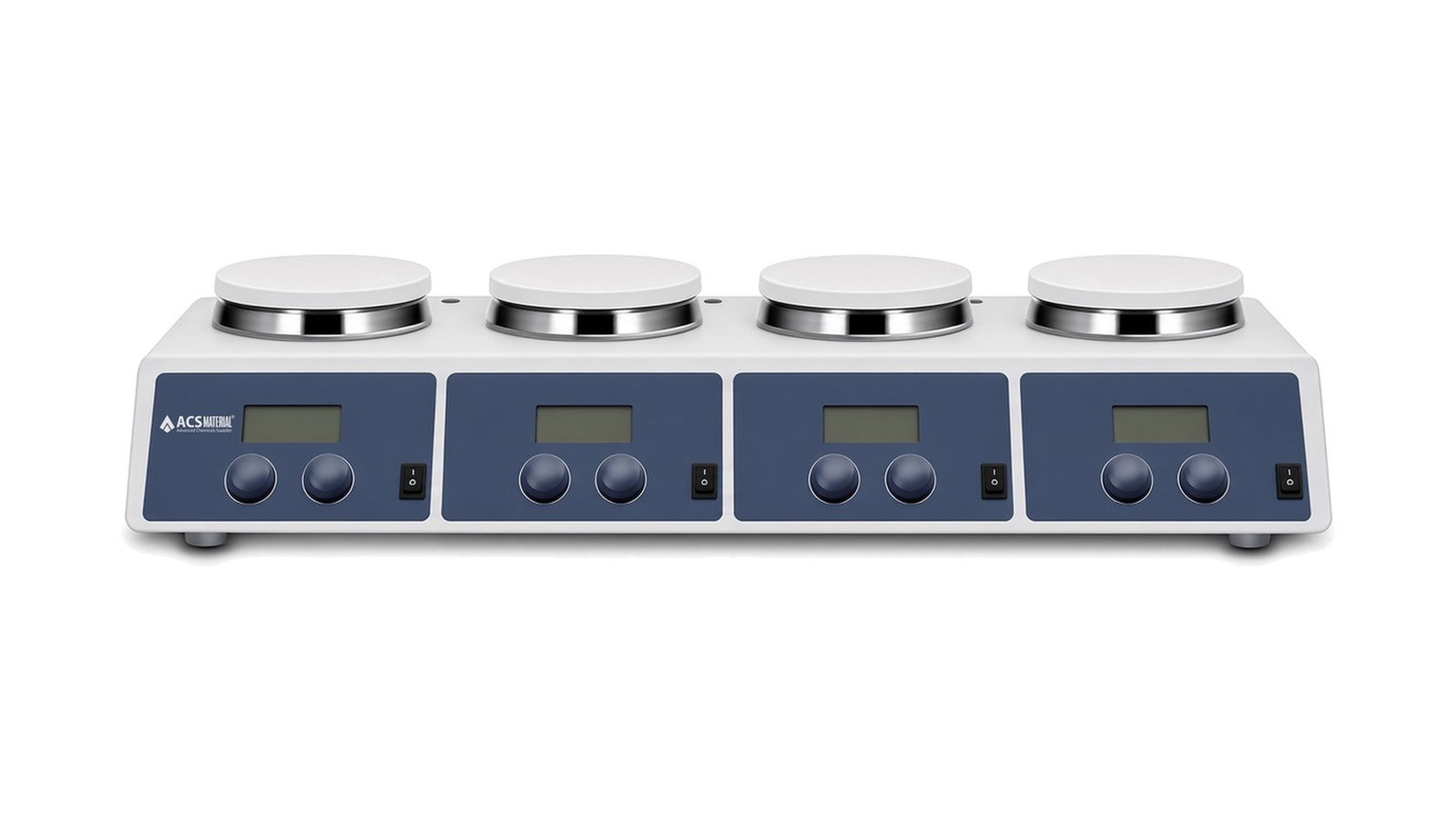
- A different setting in every vessel: independent-channel models. The MS-M-S4 / MS-M-S6 stir only; the MS-H280-S4 / MS-H280-S6 (to 280 °C) and MS-H340-S4 (to 340 °C) heat and stir each channel separately.
- Volume per vessel, for water: the MS-H-S10 and MS-M-S10 are rated at 0.4 L × 10 and the MS-T-S15 at 0.4 L × 15, meaning 0.4 L per position. The MS-H280-S4 / S6 and MS-M-S4 / S6 take 3 L per channel. No capacity is specified for the MS-H340-S4.
- No specification says that all positions behave identically. Centre vessels on their positions and record which position each run used.
1. When a Multi Position Magnetic Stirrer Helps
High-throughput experimentation has been defined as "the workflow of running multiple reactions in parallel", with each set of reactions "rationally designed to answer specific chemical questions" [2]. At the industrial end that means plate formats and automation. A benchtop multi-position stirrer is the manual end of the same idea, and it suits work like this:
- Condition screening. Four to fifteen vessels, each with one variable changed, started and stopped together.
- Repeat runs. Duplicates or triplicates of one recipe, run at the same time so they share the same day, reagent batch and operator.
- Sample preparation. Several identical solutions to dissolve, suspend or keep mixed, for example ahead of an analysis series.
ACS Material names intended applications for these models. The MS-H280-S4 / S6 is designed for parallel experiments and multiple-parameter optimization, such as Kjeldahl nitrogen determination, Soxhlet extraction and parallel synthesis. The MS-H340-S4 is intended for chemical synthesis, physical and chemical analysis and bio-pharmaceutical work. Those are the manufacturer's application lists, not tested methods.
A multi-position stirrer is also a bench-space decision. One housing with several positions replaces several separate stirrers, their cables and their footprints. For how a multi-position unit fits alongside single-plate stirrers, hotplates and baths, see the magnetic stirrer hot plate guide.
2. Shared Plate, Grouped or Independent Channels
The most useful question about a multi-position stirrer is what can differ from one position to the next. The eight ALab™ models fall into three layouts, and Table 1 shows the controls each one has.
Table 1. Control layout of ALab™ multi-position stirrers
| Control layout | Models | Controls |
|---|---|---|
| One plate, knob-and-scale settings | MS-H-S10 10-Position Magnetic Hotplate Stirrer | “Temperature setting”: Knob with scale, RT to 120 °C · “Speed setting”: Knob with scale, 0 to 1100 rpm |
| Independent channels (heat + stir) | MS-H280-S4 / S6 Multi-Position Magnetic Hotplate Stirrer | “Channel control”: Independent start/stop, temperature, speed and display for each channel |
| Independent positions (heat + stir) | MS-H340-S4 4-Channel Magnetic Hotplate Stirrer | “Position control”: Independent heating and stirring control for each position |
| One plate, knob-and-scale setting | MS-M-S10 10-Position Magnetic Stirrer | “Positions”: 10 stirring positions on one work plate · “Speed setting”: Knob with scale, 0 to 1100 rpm |
| Independent channels (stir only) | MS-M-S4 / S6 Multi-Position Magnetic Stirrer | “Channel control”: Independent start/stop, speed and display for each channel |
| Three independent groups | MS-T-S15 15-Position Magnetic Stirrer | “Group control”: 15 positions in 3 independent groups; each group at its own speed and timer setting |
Source: ACS Material product specifications (October 2026). Control layouts are our grouping.
One plate, one set of controls (MS-H-S10, MS-M-S10). Both models have a 180 × 450 mm (W × D) work plate with ten stirring positions. The MS-M-S10 has all ten positions on one work plate, with a single speed knob on a scale. The MS-H-S10 has one speed knob and one temperature knob. Neither model is specified with separate settings for individual positions, so plan on running every vessel at the same setting.
Three groups (MS-T-S15). The MS-T-S15 has 15 positions in 3 independent groups, each with its own speed and timer setting, plus a timer from 1 min to 99 h 59 min and a buzzer at the end of the countdown. This supports a screen with up to three independently controlled group settings, for example three stirring speeds or three different timer settings. The number of positions in each group is not specified, so confirm the layout before assigning vessels to groups. Whether positions inside one group can be set separately is also not specified.
Independent channels or positions (MS-M-S4 / S6, MS-H280-S4 / S6, MS-H340-S4). The MS-M-S4 / S6 has independent start/stop, speed and display for each channel. The MS-H280-S4 / S6 adds independent temperature control for each channel. The MS-H340-S4 has independent heating and stirring control for each position, and each position displays its real-time temperature and speed. These are the models to use when every vessel needs its own setting, or when you want to stop one vessel without stopping the rest.
A simple rule follows. Same condition everywhere: a shared plate is enough. Two or three conditions: groups. A different condition in every vessel: independent channels.
3. Capacity and Stir-Bar Size per Position
A multi-position stirrer's capacity is a per-position figure, and it is specified in two ways. The 10- and 15-position models give a maximum stirring quantity for water as a volume times the number of positions. The 4/6-channel models give a per-channel figure and a per-model figure. Table 2 lists each model separately.
Table 2. Positions, capacity and plate size per model
| Model | Type | Stirring positions | Capacity [H₂O] per model | Maximum stirrer bar length | Work plate |
|---|---|---|---|---|---|
| MS-H-S10 | Heated | 10 | 0.4 L × 10 | 40 mm | 180 × 450 mm (W × D) |
| MS-H280-S4 | Heated | 4 | 3 L × 4; 3 L per channel | 40 mm | Ø134 mm |
| MS-H280-S6 | Heated | 6 | 3 L × 6; 3 L per channel | 40 mm | Ø134 mm |
| MS-H340-S4 | Heated | 4 | — | 40 mm | Ø135 mm (5 inch) × 4 |
| MS-M-S10 | Stirrer only | 10 | 0.4 L × 10 | 40 mm | 180 × 450 mm (W × D) |
| MS-M-S4 | Stirrer only | 4 | 3 L × 4; 3 L per channel | 40 mm | Ø134 mm |
| MS-M-S6 | Stirrer only | 6 | 3 L × 6; 3 L per channel | 40 mm | Ø134 mm |
| MS-T-S15 | Stirrer only | 15 (3 independent groups) | 0.4 L × 15 | 40 mm | 460 × 304 mm (W × D) |
Source: ACS Material product specifications (October 2026). Capacities are for water (H₂O), per position or per channel; no total across positions is given. A dash means the specification is not listed.
Four points about these capacities:
- Read the capacity per position. 0.4 L × 10 on the MS-H-S10 and MS-M-S10 and 0.4 L × 15 on the MS-T-S15 mean 0.4 L at each position. On the MS-H280-S4 / S6 and MS-M-S4 / S6, the maximum stirring quantity of 3 L of water per channel applies to every channel of both models.
- The MS-H340-S4 capacity is not specified. We do not infer one from its plate size or from other models.
- The figures are for water. All the capacity figures are given for water (H₂O). More viscous liquids, slurries or particle suspensions may require a lower working volume or different stir-bar and speed settings. No capacities are specified for those mixtures, so verify the actual stirring performance rather than applying the water rating directly.
- Stir bars. All eight models take stir bars up to 40 mm long. Use the same bar size and type in every vessel of a series (Section 5).
The plates also differ. The MS-H340-S4 has four Ø135 mm (5 inch) plates. The MS-H280-S4 / S6 and MS-M-S4 / S6 have Ø134 mm ceramic-coated aluminum work plates; their layout is not specified. The spacing between positions is not specified for any of these models, so check that your vessels fit side by side before you plan a full set.
4. Heated vs Unheated Multi-Position Stirrers
Three of the six model families are heated and three are stirrers without heating. They are kept apart here because their specifications differ in kind, not only in degree.
Heated models
Table 3. Heated multi-position models: temperature, heating power and speed
| Model | Stirring positions | Heating temperature range | Over-temperature value | Heating power | External temperature sensor | Temperature control accuracy | Speed range | Speed control accuracy |
|---|---|---|---|---|---|---|---|---|
| MS-H-S10 | 10 | RT to 120 °C | 140 °C | 470 W | — | — | 0 to 1100 rpm | — |
| MS-H280-S4 | 4 | RT to 280 °C | 420 °C | 600 W × 4 | PT1000 (accuracy ±0.2 °C) | ±1 °C (<100 °C), ±1% (>100 °C) | 200 to 1500 rpm | ±20 rpm |
| MS-H280-S6 | 6 | RT to 280 °C | 420 °C | 600 W × 6 | PT1000 (accuracy ±0.2 °C) | ±1 °C (<100 °C), ±1% (>100 °C) | 200 to 1500 rpm | ±20 rpm |
| MS-H340-S4 | 4 | RT to 340 °C | 420 °C | 500 W × 4 | PT1000 (accuracy ±0.2 °C) | — | 200 to 1500 rpm | — |
Source: ACS Material product specifications (October 2026). Over-temperature protection is a safety cut-off, not a working temperature. Heating power on the 4- and 6-position models is per position. A dash means the specification is not listed.
- MS-H-S10. Ten positions on one plate, a heating range from room temperature to 120°C and over-temperature protection at 140°C, with temperature and speed set on knobs with scales. External sensor: not specified. It suits gentle warming of many small vessels at one setting.
- MS-H280-S4 / MS-H280-S6. Each channel heats from room temperature to 280°C under PID control, with overheating protection at 420°C and an external PT1000 sensor (accuracy ±0.2 °C). For safety, a HOT warning flashes when the work-plate temperature is above 50°C after the power switch is turned off, there are two independent safety circuits, and heating stops and an alarm sounds when overheating is detected and the sensor malfunctions. ACS Material describes it as compatible with various heating blocks and reaction vessels, without naming which.
- MS-H340-S4. Four positions, a temperature range from room temperature to 340°C, over-temperature protection at 420°C, a PID controller, support for an external PT1000 sensor (accuracy ±0.2 °C), and 500 W of heating power per position.
Stirrer-only models
Table 4. Multi-position stirrers without heating
| Model | Stirring positions | Heating | Power | Timer | Speed range | Speed control accuracy |
|---|---|---|---|---|---|---|
| MS-M-S10 | 10 | None | 20 W | — | 0 to 1100 rpm | — |
| MS-M-S4 | 4 | None | 5 W × 4 (motor rating) | — | 200 to 1500 rpm | ±20 rpm |
| MS-M-S6 | 6 | None | 5 W × 6 (motor rating) | — | 200 to 1500 rpm | ±20 rpm |
| MS-T-S15 | 15 (3 independent groups) | None | 54 W | 1 min to 99 h 59 min | 100 to 1500 rpm | ±10 rpm |
Source: ACS Material product specifications (October 2026). These models have no heating function listed, so Table 4 has no temperature columns. A dash means the specification is not listed.
The MS-M-S10 is a 10-position magnetic stirrer without heating, and the MS-M-S4 / S6 has no heating. No heating is specified for the MS-T-S15, which is a 15-position magnetic stirrer with timer. All three are stirrers only.
When unheated is the right choice. Many screening and preparation steps need stirring without active heating: dissolving, suspending, keeping solutions mixed, or running reactions at ambient temperature. A stirrer-only model has no built-in heating function, although this is not a guarantee that every surface remains at ambient temperature during operation. If heating is required, choose equipment with the appropriate documented heating capability rather than assuming an external heater can be added safely.
5. Speed, Control Accuracy and Position Effects
There are three speed ranges: 0 to 1100 rpm (MS-H-S10, MS-M-S10), 100 to 1500 rpm (MS-T-S15) and 200 to 1500 rpm (MS-H280-S4 / S6, MS-H340-S4, MS-M-S4 / S6). Speed control accuracy is specified for three model families: ±20 rpm (MS-H280-S4 / S6 and MS-M-S4 / S6) and ±10 rpm (MS-T-S15). The MS-H280-S4 / S6 also has a temperature control accuracy of ±1°C below 100°C and ±1% above 100°C. These are speed-control and temperature-control accuracy figures for the named models, not measurements of how closely different positions agree. The MS-H280-S4 / S6 also has a PT1000 sensor accuracy of ±0.2 °C; sensor accuracy is not control accuracy. None of these figures establishes position-to-position uniformity, and no position-to-position uniformity value is specified for any of these models.
Why does position matter? Cherepanova and colleagues (2025) investigated multiple vials arranged from the centre toward the periphery of a conventional magnetic stirrer driven by one magnetic stirring mechanism [1]. The arrangement was not a dedicated multi-position stirrer with independently controlled channels. The authors found that "the nature of the bar rotation changes when it is placed at different positions on a magnetic stirrer, ceasing entirely at specific locations on the stirrer plate." In catalytic cross-coupling reactions, "conversion differences of more than 10% were observed among adjacent vials, with nearly 2-fold variations between nonadjacent positions" [1]. Conversion was highest at the centre and dropped at intermediate positions, despite only 27.5 mm between vial centres [1].
That study tested crowding vials on a single-drive stirrer. It did not test any dedicated multi-position stirrer or any ALab™ model, and it does not show that one design is uniform and another is not. What it does show is that vessel position is an experimental variable. The authors recommend keeping "the same stirrer type/model, stirring parameters (rate, temperature), geometric positions of the reaction vessels, stirring bar size/type, and vessel size/type", documenting them, and confirming key results with a single vessel in the most appropriate position [1]. They consider parallel runs on one stirrer acceptable "for rough routine optimizations" [1].
A practical checklist for any multi-position stirrer:
- Centre each vessel on its marked position.
- Use the same vessel type, fill volume and stir-bar size and type in every position of a series.
- Check that every bar rotates reliably under the intended operating conditions. If a bar loses magnetic coupling or stops, pause the affected run, check the vessel position, stir-bar suitability and speed, and verify stable stirring before continuing.
- Record the position number with each sample.
- When results matter, repeat a run at a different position, or rotate conditions across positions, so position does not hide inside your variable.
6. ALab™ Multi-Position Stirrers Compared
Tables 2, 3 and 4 together cover all eight ALab™ multi-position models in six model families. In short:
- Positions: 4 (MS-H280-S4, MS-H340-S4, MS-M-S4), 6 (MS-H280-S6, MS-M-S6), 10 (MS-H-S10, MS-M-S10) or 15 in 3 groups (MS-T-S15).
- Heating: to 120 °C on the MS-H-S10, 280 °C on the MS-H280-S4 / S6 and 340 °C on the MS-H340-S4. The MS-M-S10, MS-M-S4 / S6 and MS-T-S15 do not heat.
- Capacity per position, for water: 0.4 L on the MS-H-S10, MS-M-S10 and MS-T-S15; 3 L per channel on the MS-H280-S4 / S6 and MS-M-S4 / S6. No capacity is specified for the MS-H340-S4.
- Control: shared plate (MS-H-S10, MS-M-S10), three groups (MS-T-S15), or independent per channel or position (MS-M-S4 / S6, MS-H280-S4 / S6, MS-H340-S4).
Each model's product listing has the full specifications. Single-plate stirrers and hotplates are compared across the full ALab™ range in how to choose a magnetic stirrer.
7. Choosing Among Them
Work through four questions in order:
- Do you need heat? No: the MS-M-S10, MS-M-S4 / S6 or MS-T-S15. Yes: go to question 2.
- How hot? Up to the MS-H-S10's "RT to 120°C" for gentle warming of many small vessels. Higher: the MS-H280-S4 / S6 (RT to 280 °C) or the MS-H340-S4 (RT to 340 °C).
- How much liquid per vessel? For water, the MS-H-S10 and MS-M-S10 are rated at 0.4 L × 10 and the MS-T-S15 at 0.4 L × 15, equivalent to 0.4 L per position. The MS-H280-S4 / S6 and MS-M-S4 / S6 take 3 L per channel. For the MS-H340-S4, ask us for a capacity figure because none is specified. Do not treat these water capacities as validated limits for every liquid or suspension.
- Does every vessel need its own setting? Yes: independent-channel models. Two or three settings: the MS-T-S15 groups. One setting for all: a shared-plate model.
8. Frequently Asked Questions
Can each position run at a different speed?
On the MS-M-S4 / S6, MS-H280-S4 / S6 and MS-H340-S4, yes: each channel or position has independent control. On the MS-T-S15, each of the three groups has its own speed and timer. Individual position settings are not specified for the MS-H-S10 and MS-M-S10.
How much liquid can each position hold?
For water: 0.4 L per position on the MS-H-S10, MS-M-S10 and MS-T-S15, and 3 L per channel on the MS-H280-S4 / S6 and MS-M-S4 / S6. No capacity is specified for the MS-H340-S4.
Do the 10-position models heat?
The MS-H-S10 does, with a heating range from room temperature to 120 °C. The MS-M-S10 is a stirrer without heating.
Are all positions identical?
No ALab™ multi-position model has a specified position-to-position uniformity, and the ± figures are control accuracies. Research on single-drive stirrers shows that vessel position can change results [1]. Keep vessels centred and matched, and record positions.
Can I use heating blocks?
ACS Material describes the MS-H280-S4 / S6 as compatible with various heating blocks and reaction vessels but does not name them. Heating blocks are not mentioned for the other models.
9. Keep Exploring the Stirring & Heating Hub
- How to choose a magnetic stirrer or hotplate stirrer: heating, plate size, maximum temperature, volume and control across the ALab™ range.