
A magnetic stirrer hot plate combines three systems in one housing: a magnetic drive that spins a stir bar inside the vessel, a heated top plate the vessel stands on, and a controller that decides how much power reaches the heater. Each system has its own entries in a specification sheet, and a number only means something once you know which part it describes. This guide explains how the drive, motor, top plate, temperature control, heating power and safety functions work, and what each specification does and does not tell you. Product facts come from the specifications of 43 ALab™ products (October 2026), and each section hands off to a dedicated guide for the detail.
Quick answer: (1) Drive and bar: a rotating magnet under the plate pulls the stir bar round; if the bar cannot keep up, it decouples. (2) Motor: most models with a named motor type have a brushless DC motor; a few have shaded-pole or DC brush motors. (3) Plate: the top-plate material affects heat spreading and chemical resistance. (4) Temperature: without a probe the unit controls the plate, not your liquid; an external PT1000 probe changes the reference. (5) Safety: the plate is an ignition source and stays hot after switch-off; check for any use restriction first.
1. How a Magnetic Stirrer Works: Coupling and Stir Bars
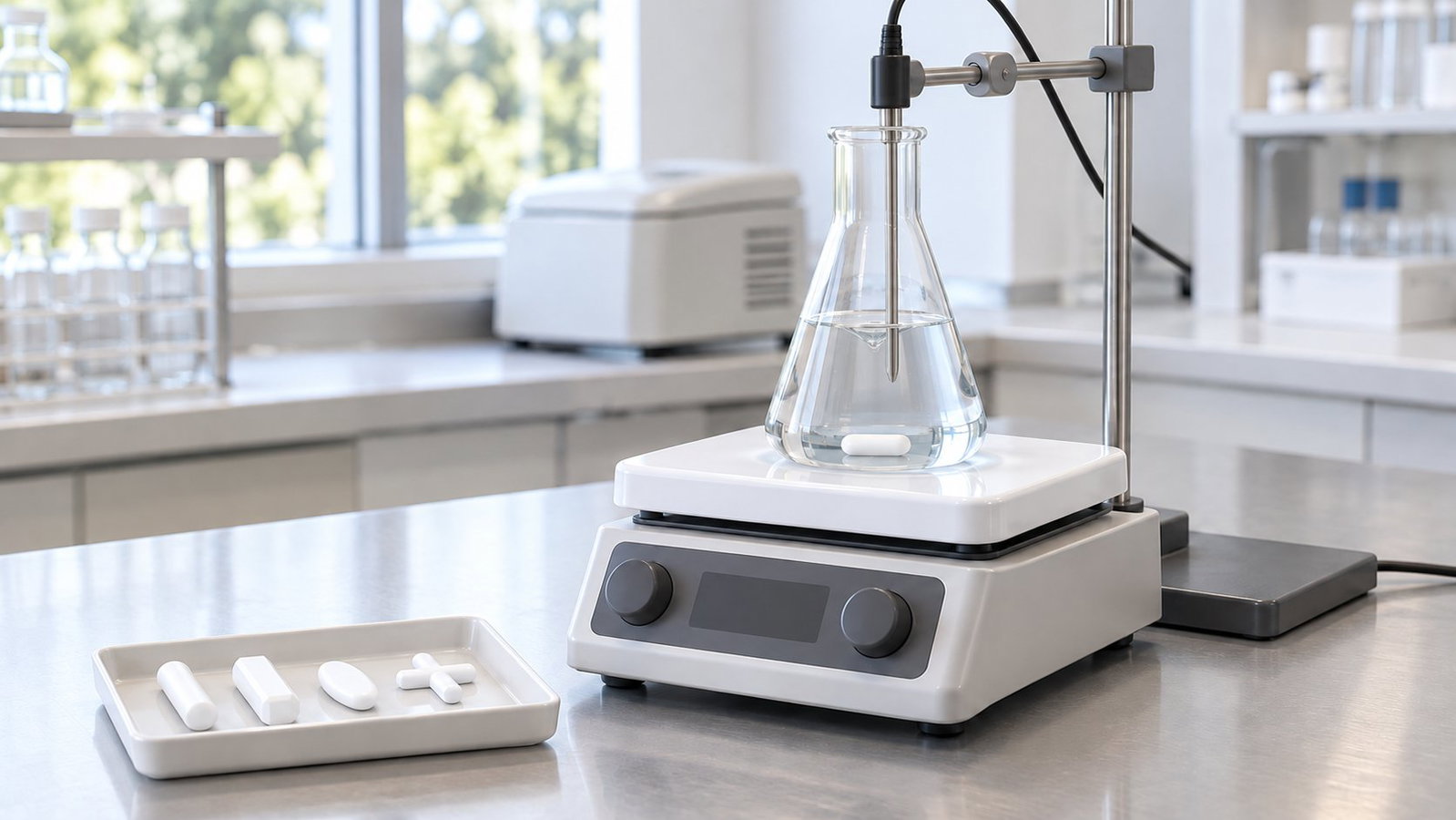
Under the top plate of every magnetic stirrer sits a drive: a magnet, or a set of magnets, turned by a motor. A stir bar is a magnet sealed in a chemically resistant coating. Placed in the vessel above the drive, the bar lines up with the drive's magnetic field and follows it round as it turns [1][2]. Nothing passes through the plate or the vessel wall except the field, which is why magnetic stirring works in a stoppered flask, under a septum or inside a sealed vial, with no shaft, seal or bearing in contact with the sample.
The link between drive and bar is called coupling, and it has limits. The magnetic pull between the drive and the bar weakens quickly with distance, so a thick vessel base, a vessel raised off the plate or a bar sitting off-centre all reduce it. At the same time the bar has to drag liquid round with it: the faster it turns and the more viscous the liquid, the more torque it needs. When the drag exceeds what the coupling can transmit, the bar falls out of step with the drive. It stutters, jumps or rattles at the bottom of the vessel instead of spinning smoothly. This is decoupling, often called spin-out. Starting at low speed and increasing gradually, centring the vessel over the drive, and matching the bar's length and shape to the vessel base all make it less likely [1][2].
Stirring is also an experimental variable, not just a convenience. Cherepanova and colleagues (2025) found that bar rotation changed with the position of a vial on a conventional stirrer, and that bar size, bar type and vessel type affected what happened in the vessel; they recommend keeping these the same for similar experiments and recording them [3].
Three specifications describe the stirring job:
- Speed range. The span of drive speeds the controller can set, in rpm. It describes the drive, not the speed a bar will hold in your liquid.
- Maximum stirring volume. Listed under labels such as "Maximum stirring volume [H₂O]" or "Max. stirring quantity [H₂O]", this is a rating for water. Thicker liquids and suspensions need more torque, so treat it as a ceiling, not a working volume.
- Maximum stir-bar size. 35 of the 43 products have a specified largest bar. The labels differ from model to model, so compare the values, not the wording.
What is not specified is the strength of the coupling itself. None of the 43 products has a specified coupling torque, a drive-magnet field strength or a speed at which a bar will decouple. A few models have their drive described in words, for example as producing a uniform or strong magnetic field, but no quantity is given behind the words. How to size a bar to a vessel, which shapes suit which jobs, and why bars spin out is covered in our guide to stir bar sizes.
2. Motors: Shaded-Pole, Brushless DC and Brushed DC
The motor turns the drive magnet. Its type decides how rotation is produced, how speed is controlled and which parts wear. ALab™ models use three motor types. What follows describes the motor types in general [4], not the measured behaviour of any model.
- Shaded-pole motor. A simple single-phase AC induction motor. Part of each stator pole is surrounded by a short-circuited copper ring, the shading ring, which delays the magnetic flux in that part of the pole. The result is a weak rotating field that turns a cage rotor. Hughes and Drury describe the design as extremely simple, robust and reliable, used for low-power applications [4]. The trade-offs are low starting torque and low efficiency. As an induction motor, its running speed is governed by the supply frequency and the load.
- Brushless DC motor. A permanent-magnet rotor driven by stator windings that the drive electronics switch on in sequence as the rotor turns. Because commutation is done electronically, there are no brushes or commutator to wear, and speed is set by the electronics [4].
- Brushed DC motor. Current reaches the rotating armature through carbon brushes pressing on a segmented commutator, which reverses the current in each coil as the rotor turns. Speed follows the applied voltage, which makes control simple; the brushes and commutator are wear parts [4].
Of the 43 ALab™ products, 36 have a specified motor type. They fall into three groups:
| Motor type | Models | Products |
|---|---|---|
| Brushless DC motor (DC brushless on the MS-T-S15) | 32 products, plus the MS-T-S15 | 33 |
| Shaded-pole motor | MS7-H550-S; MS7-S | 2 |
| DC brush motor | MS7-H380-E | 1 |
Motor types of 36 of 43 ALab™ products. Source: ACS Material product specifications (October 2026). The five hotplates without a stir drive, the FlatSpin and the TB-H240-V1 have no specified motor type.
So most models with a named motor type, 33 of the 36, have a brushless DC motor, but not all of them: two have a shaded-pole motor, and the MS7-H380-E has a DC brush motor. Only the motor type is specified. No torque, noise, lifetime or speed-stability figure is specified by motor type, and none should be inferred from the type. For fit to your work, the stirring specifications in Section 1 say more than the motor type.
One point belongs to safety rather than to motors. Where flammable vapour can be present, sparks can come from switches and controls as well as from a motor, and a listed motor type is not a hazardous-location rating. Section 7 covers ignition sources.
3. Top-Plate Materials
The top plate does three jobs. It carries the vessel, it spreads heat from the element beneath it, and it is the surface that spills land on. Its material affects how evenly and how quickly heat spreads across the plate, how fast the plate responds when the set point changes, how hot the plate can safely run, and which chemicals and cleaning methods it tolerates. In broad terms, a metal plate spreads heat sideways well and responds quickly, while a glass-ceramic plate conducts heat less readily but offers a smooth surface that resists many laboratory chemicals and is easy to wipe clean. A ceramic coating on a metal plate adds chemical resistance to the metal's heat spreading, but a coating is only protective while it is intact.
ALab™ plates are made of: glass ceramic; aluminum, both ceramic-coated and plain; stainless steel with a ceramic coating; microcrystalline glass, on the MS7-H280-G; and, on unheated stirrers, plastics: PET, and nylon with glass fiber. The material is named, but no thermal conductivity, plate thickness or coating chemistry is specified, and not every model has a plate material listed.
Plate size matters as much as material. The base of the vessel should sit fully on the plate, and on a heated model the part of the plate the vessel does not cover still loses heat to the room. How the plate families compare on heat transfer, chemical resistance, maximum temperature and care is covered in hotplate top-plate materials compared.
4. Plate Temperature vs Liquid Temperature and the External PT1000 Probe
A hotplate stirrer regulates whatever its sensor measures. Without an external probe, that sensor sits in or under the top plate, so the set point and the display describe the plate. Heat then has to travel from the element through the plate, across the contact between plate and vessel base, through the glass and into the liquid, and each step adds resistance to heat flow [6]. The liquid therefore warms more slowly than the plate and, once things settle, stays below it, by an amount that depends on the vessel, the volume, the stirring, evaporation from the surface and the room. On plate control, the display tells you about the plate.
An external probe changes the reference. With a probe immersed in the liquid and connected, the controller uses the liquid reading as the value it controls and drives the plate as hot as it needs to bring the liquid to the set point. The liquid then ends much closer to the set point, but two consequences follow. The plate may run well above the set point while the liquid heats, and the liquid can overshoot before it settles, by an amount that depends on the controller and the setup [7]. The probe also has to stay where it is put: if it slips out of the liquid but stays connected, it reads the cooler air, and the controller may keep calling for heat [5]. Clamp the probe with its tip in the liquid, and keep watching a probe-controlled run.
Of the 43 ALab™ products, 28 offer an external temperature sensor, and every one of them is a PT1000, a platinum resistance sensor. Among heated models, the MS-H-S and MS-H-S10 have no external sensor listed, so no probe option should be assumed for them.
Three numbers on a specification sheet are easy to run together, and they describe different things. Sensor accuracy describes the probe itself, for example ±0.2°C for a PT1000. Control accuracy, where specified, describes how closely the controller holds its measured value at the set point. Temperature uniformity, how much temperature varies across the plate surface, is a third property, and it is not specified for any of the 43 products. A tight sensor figure does not make a plate uniform, and a control figure does not describe every point in a liquid. Our process-hot-plate article explains how uniformity and accuracy figures are specified. Why the liquid lags and overshoots, where to place the probe, and what can go wrong is covered in our guide to the hot plate temperature probe.
5. Heating Power and Heat-Up
Heating power sets how fast the plate can deliver energy, and that limits how fast a liquid can warm. Raising a liquid's temperature takes an amount of energy equal to its mass times its specific heat capacity times the temperature rise (m·cp·ΔT), plus everything lost along the way [6]. Those losses grow as the liquid gets hotter. The vessel walls and the liquid surface lose heat to the air, evaporation carries energy away, and heat escapes from the uncovered parts of the plate and through the housing. The power that actually enters the liquid is therefore less than the rated heating output, and the shortfall widens as the liquid approaches its target. A larger volume, a higher target, an uncovered vessel or a poor fit between vessel and plate all lengthen the heat-up.
Read the power figures with care. Some models have a specified heating output, which is the power of the heating element. Others have only a total power figure for the whole instrument, which also covers the motor and the electronics and is not a heating-output figure; the DMS5-120 and MS7-H380-E, for example, list total power only. Compare heating output with heating output, and do not read a total power figure as heater power.
Heat-up time itself is almost never specified. For 42 of the 43 products there is no heat-up time or ramp rate at all. The one exception, for the TB-H240-V1, describes a bath under its own test conditions, not a hotplate, and does not transfer to a beaker on a plate.
Estimate from the energy balance, allow for losses, and confirm on your own setup. How to make that estimate, which factors matter most, and why the last few degrees take the longest is covered in our article on hotplate heat-up time.
6. Multi-Position Stirrers, Heating Mantles and Baths
A single-position hotplate stirrer handles one vessel. When several samples have to run side by side, as in a catalyst screen, repeat runs or a set of standards, a multi-position stirrer puts several stirring positions in one housing. Six ALab™ model families are multi-position units, with 4 to 15 positions, some heated and some not. They differ most in how the positions are controlled. Some run every position from one set of controls on a shared plate, some split the positions into groups with their own settings, and some give each position or channel independent controls. No position-to-position uniformity figure is specified, and research on crowded single-drive stirrers shows that vessel position can change results [3], so centre each vessel on its position and record which position each run used. Shared versus independent layouts, capacity per position and heating are covered in our guide to the multi position magnetic stirrer.
A flat plate is made for flat-bottomed vessels such as beakers, Erlenmeyer flasks and media bottles. A round-bottom flask, by contrast, touches a flat plate over a very small area, so heat transfer is poor and the flask is unstable without a support. The usual alternatives are a heating mantle, a cup-shaped heater that follows the flask; a water, oil or sand bath on a hotplate; or a heating block shaped for the flask [8]. A mantle has no bath fluid to spill but needs a good fit; a bath adds hot liquid that can spill or, for oil, smoke and burn if overheated (Section 7); a block works only with the flask sizes it was made for.
Among ALab™ products, two are magnetic stirrers with an integrated heating mantle and one a heated magnetic stirring bath; none is a heating block, although the MS-H280-S4 / S6 is described as compatible with various heating blocks. The fourth product in this group is the TB-H240-V1 constant-temperature bath, a stand-alone bath with optional magnetic stirring. How mantles, baths and blocks compare for round-bottom flasks, and where each ALab™ unit fits, is covered in our comparison of heating mantle vs oil bath and heating block.
7. Safety: Over-Temperature, Residual Heat, Flammable Solvents and Use Restrictions
A hotplate stirrer is an ignition source. Prudent Practices in the Laboratory lists hotplates among the hot surfaces that can ignite the vapour of the most flammable laboratory substances, such as diethyl ether and carbon disulfide, without any flame, and notes that on/off switches and rheostat-type speed controls with exposed contacts can produce a spark whenever they are adjusted [5]. Most flammable vapours are heavier than air, so they can sink, collect at low points and travel along a bench to the base of an instrument [5]. The plate can also be hotter than you expect: investigations of laboratory fires have found plates far hotter than their displays or settings suggested [9][10].
Read four features for exactly what they are:
- Over-temperature protection. Most heated models have a specified value at which over-temperature protection acts, under names such as overheating protection or safety temperature. It is an instrument-protection specification. Where it is measured is not specified, and it is not a certification, a solvent-use limit or permission to heat a flammable liquid. Vapour can ignite at plate temperatures well below it.
- The HOT residual-heat warning. Where fitted, the display shows HOT while the plate is above 50 °C, on many models even after the heater is switched off. That is a warning threshold, not a safe-to-touch temperature.
- Switched off is not unplugged. Penn EHRS notes that turning a hotplate off does not disconnect the heater from the electrical supply and recommends unplugging hotplates that are not in use [11]. Whether the power switch isolates the heater is not specified.
- The probe. A probe that is out of the liquid reads low, and the controller may keep heating (Section 4).
For flammable solvents, the conservative rules apply whatever the instrument. Check the SDS and follow your institution's risk assessment. Do not heat highly flammable liquids, or liquids above their flash point, in open vessels on a hotplate. A water or sand bath may be appropriate for a specific setup, but indirect heating does not remove vapour or ignition hazards, and an oil bath adds a combustible liquid of its own [5]. Do not leave heating unattended unless the operation has been specifically approved under your institution's procedures. No ALab™ model has an explosion-proof, intrinsically safe or hazardous-location rating, so none should be used where a flammable atmosphere can form around the instrument [12]. IEC 61010-2-010 sets particular safety requirements for laboratory equipment that heats materials [13]; a list of product safety features is not a statement of compliance with it.
Finally, check for any use restriction before anything else: the HP380-Pro, MS-H380-Pro and MS-H280-Pro are each marked as not available for chemical fields, so do not use these three models for chemistry, synthesis or work with flammable solvents. Other products that list these models as related products are not thereby restricted, and a product without such a restriction is not thereby rated for any particular chemical or solvent.
Ignition sources, flash point and autoignition temperature, what over-temperature values do and do not protect against, residual heat and a pre-heating checklist are covered in our guide to hot plate safety.
8. Selection Overview: Five Equipment Groups
The 43 ALab™ products fall into five editorial groups: 18 single-position hotplate stirrers, 10 unheated magnetic stirrers, 6 multi-position stirrers, 5 hotplates without stirring, and 4 heating mantles and baths. The groups describe what the equipment does; they are not a ranking. Our selection guide's comparison table covers 42 products, because the TB-H240-V1 is a stand-alone constant-temperature bath and is covered in our comparison of mantles, baths and blocks instead. Start from the job, then follow the group to the detailed comparison:
- Hotplate stirrers, single position: heat and stir one vessel on a flat plate, comparing plate size, temperature range and probe option; see how to choose a magnetic stirrer
- Magnetic stirrers, no heating: mix at room temperature with no hot surface on the bench; see how to choose a magnetic stirrer
- Multi-position stirrers: run several vessels side by side, heated or unheated; see how to choose a magnetic stirrer
- Hotplates, no stirring: heat only, for vessels that need no stir bar; see how to choose a magnetic stirrer
- Heating mantles and baths: heat round-bottom flasks or work in a bath, with or without integrated stirring; see how to choose a magnetic stirrer
9. How This Guide Fits With Our Hot Plate Process Articles
This series is about stirring and heating liquids in vessels: beakers, flasks, vials and baths. A second set of articles on our site deals with hot plates used to process substrates and films, where the sample sits directly on the plate and the surface temperature and its uniformity are the point. If your work involves wafers, coated substrates or thin films, start there:
- How uniformity and accuracy figures are specified: what the temperature figures on a process hot plate's datasheet describe.
- Soft bake, post-bake and annealing steps: what each thermal step does to a coated film.
- Annealing air-sensitive films under nitrogen: inert hot plates for films that degrade in air.
- Hot plates that reach 600 °C for calcination and oxide films: high-temperature plates and where their limits lie.
10. Frequently Asked Questions
How does a magnetic stirrer hot plate work?
A motor under the top plate turns a drive magnet, and its rotating field pulls a stir bar round inside the vessel, so no shaft passes through the plate or the vessel. A heating element under the same plate warms the vessel base. A controller regulates the heater to hold either the plate temperature or, with an external probe in the liquid, the liquid temperature at the set point.
Why does my stir bar spin out?
The bar has lost coupling with the drive: the drag from the liquid exceeds what the magnetic field can transmit. High speed, a viscous liquid, a thick or raised vessel base, an off-centre vessel or a bar that does not suit the vessel all make it more likely. Lower the speed, centre the vessel and increase speed gradually; Section 1 links to the full stir-bar guide.
What is the difference between a shaded-pole and a brushless DC motor in a stirrer?
A shaded-pole motor is a simple single-phase AC induction motor. A brushless DC motor uses a permanent-magnet rotor and stator windings that are switched electronically, with no brushes to wear. Of the ALab™ models with a specified motor type, 33 of 36 have a brushless DC motor, two a shaded-pole motor and one a DC brush motor. No torque, noise or lifetime figures are specified by motor type.
Is the temperature on the display the temperature of my liquid?
Not on plate control. Without an external probe, the set point and display refer to the plate, and the liquid settles below it. With an external probe immersed and secured in the liquid, the controller regulates the liquid reading instead, while the plate may run hotter. When the liquid temperature matters, measure it in the liquid.
Does an over-temperature cut-off make it safe to heat flammable solvents?
No. An over-temperature protection value protects the instrument. It is not a solvent-use limit or a certification, and where it is measured is not specified. A hot surface or a spark can ignite vapour at plate temperatures below that value. Check the SDS, follow your institution's risk assessment and see Section 7.
Can I heat a round-bottom flask directly on a hotplate?
Not well. A flat plate touches a round base over a very small area, so heat transfer is poor and the flask is unstable. Use a heating mantle, a bath or a heating block that fits the flask; Section 6 compares the options.
11. Keep Exploring the Stirring & Heating Hub
- How to choose a magnetic stirrer or hotplate stirrer: five decisions in order, with a static comparison of 42 ALab™ products.
- Plate vs liquid temperature and the external probe: why the liquid lags and what an external PT1000 probe changes.
- Stir bar size and decoupling: bar shapes, sizes and why bars spin out.
- Heating round-bottom flasks: heating mantle, oil bath, heating block or hotplate.
- Hotplate top plates compared: glass ceramic, aluminum, coated steel and more.
- Multi-position magnetic stirrers: parallel stirring for screening and repeat runs.
- Hotplate and stirrer safety: ignition sources, over-temperature values and residual heat.
- Hotplate heat-up time: estimating how long a liquid takes to reach temperature.
Browse all ALab™ magnetic stirrers and ALab™ hotplates.