
“Uniformity ≤±1 %” looks precise, but without its definition it can mean several different things. This short guide separates resolution, accuracy, precision and uniformity, works through what a percentage can mean in degrees, and lists the questions to ask a supplier.
In one paragraph: Resolution, accuracy, precision and uniformity answer different questions [1]. A percentage is interpretable only after its reference quantity, units and deviation statistic are specified; the examples below are hypothetical arithmetic. Probe, points, edge exclusion, stabilisation and airflow all change the result [3]. Ask the supplier how the value was obtained, verify uniformity by temperature mapping, and qualify your process separately at representative substrate positions [2].
1. Four Numbers That Answer Different Questions
A hot plate data sheet usually lists several temperature numbers. They answer different questions, and a good value for one says nothing about the others.
| Term | The question it answers | What it does not tell you |
|---|---|---|
| Resolution | What is the smallest step the display or setpoint can show? (The metrology definition: the smallest change in a quantity that causes a perceptible change in the indication [1].) | Whether the displayed value is correct, or the same across the plate |
| Accuracy | How closely does a temperature measurement represent the quantity being measured? (Closeness of agreement between a measured and a true value [1].) | How steady it is over time, or how it varies across the plate |
| Measurement precision | How closely do replicate measurements agree under specified conditions? (Closeness of agreement between replicate measurements [1].) | Whether the measurements are accurate, or how temperature varies across the plate |
| Uniformity | How much does temperature vary across the specified area and sampling interval? | The film temperature on your substrate, which also depends on contact and substrate [2] |
The bracketed measurement definitions follow the VIM [1]. Measurement precision is not synonymous with temperature stability over time; a supplier’s control specification needs its own definition.
The VIM also notes that accuracy is a qualitative concept and is not itself a number [1]; when a data sheet gives an accuracy in °C, it is usually quoting a tolerance, and the conditions behind it are what make it meaningful. For coating and baking, uniformity is often a key number, because it contributes to how differently the centre and the edge of a substrate are baked.
2. What “±1 %” Can Mean in Degrees
A percentage needs a stated reference. The following hypothetical calculations apply a 1 % multiplier to different reference quantities at a 200 °C setpoint; they are not documented supplier definitions.
| Hypothetical reference quantity | Calculation | Result at 200 °C, ±1 % |
|---|---|---|
| Setpoint in °C | 1 % of 200 | ±2 °C |
| Rise above room temperature (25 °C assumed) | 1 % of (200 − 25) | ±1.75 °C |
| Absolute temperature in kelvin | 1 % of 473.15 K | ±4.7 K (equal to ±4.7 °C) |
Hypothetical arithmetic only. None of these definitions is attributed to ACS Material or Levon™; obtain the supplier’s formula rather than selecting an interpretation.
Changing the reference changes the result, so if a specification does not state its reference quantity, you cannot convert it to degrees with confidence.
With or without “±”
The symbols alone do not identify the statistic. Peak-to-peak spread is the maximum minus the minimum temperature. For extrema symmetric about a reference at ±a, the spread is 2a; symmetry about a setpoint or spatial mean cannot be assumed. Maximum deviation and standard deviation are different quantities. Ask for the formula rather than treating “≤±1 %” and “≤1 %” as interchangeable.
Over what temperature range
Heat losses change with temperature and surroundings [3], but the resulting uniformity also depends on heater layout and control. Obtain values for the relevant temperature range rather than assuming a particular trend. A single value for the full range may refer to one setpoint or to the worst case; the data sheet should say which.
3. Where and How It Was Measured Changes the Answer
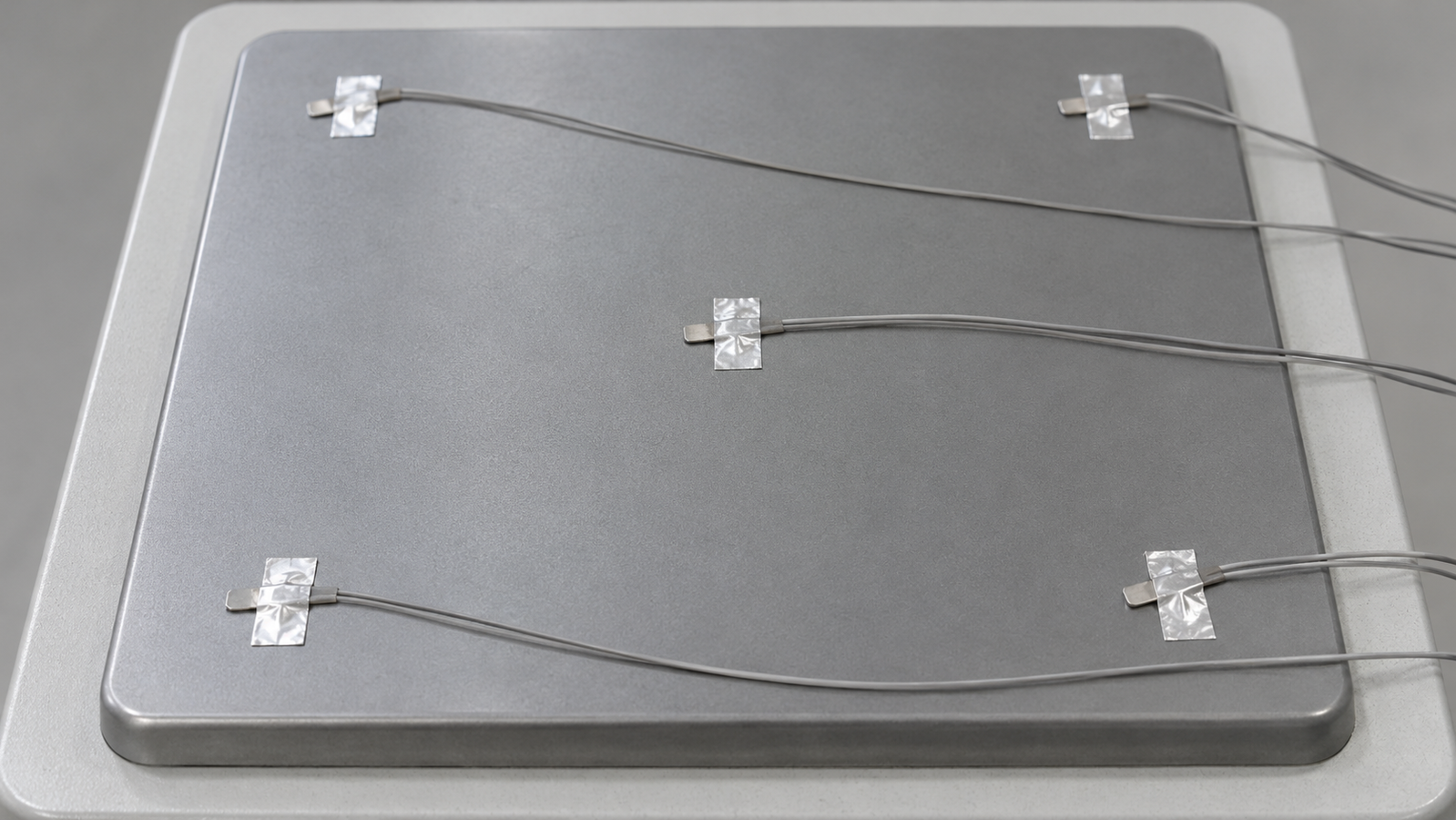
Two suppliers can test identical plates and publish different numbers, simply by measuring differently. These are the conditions that change the answer:
- Probe type. Surface contact thermocouples, resistance thermometers, an infrared camera and an instrumented wafer with embedded sensors each measure something slightly different. An infrared reading depends on the emissivity of the surface, and contact probes depend on how well they touch the plate.
- Number and position of points. A sparse sampling pattern can miss local hot or cold regions. Confirm that the measurement points cover the area used by your samples.
- Edge exclusion. Excluding outer regions changes the evaluated area and can omit important edge gradients [3].
- Stabilisation time. A reading taken soon after reaching setpoint differs from one after long stabilisation.
- Lid, airflow and enclosure. A lid, a draft from a fume hood or a glovebox circulation changes convective losses from the surface [3].
- Empty plate or loaded. A substrate on the plate changes the heat flow. The film temperature also depends on contact, gap and substrate material, which an unloaded plate map does not by itself establish [2].
- Setpoint. Which temperatures were tested, and whether the published value is typical or a maximum.
None of these makes a specification wrong. It means a uniformity value is only comparable with another one measured the same way.
4. What to Ask the Supplier, and What to Test Yourself
When uniformity matters to your process, ask the supplier these questions, and keep the answers with the quotation:
| Question | Why it matters |
|---|---|
| What reference quantity, units and calculation define the percentage? | Sets how to convert it to degrees |
| Is it deviation either side (±), total spread, or a standard deviation? | These statistics cannot be interchanged without their definitions |
| What probe, calibration and measurement uncertainty were used, and where were the points? | Sets what was actually measured |
| What edge exclusion applies? | Defines the tested area, not automatically the qualified process area |
| At which setpoints, after what stabilisation time? | Tells you whether it covers your process temperature |
| With or without a lid, in still air or under airflow? | Your fume hood or glovebox may differ |
| Is the value typical or guaranteed per unit? | Tells you what to expect from your unit |
Verify temperature uniformity using a defined mapping method and stated measurement uncertainty. Separately qualify coating results at representative substrate positions. Empirical bake optimisation can be useful when film thermometry is difficult [2], but process results do not directly measure temperature uniformity. How bakes depend on temperature is covered in Soft Bake, Post-Bake and Annealing on a Hot Plate: What Each Step Does.
5. Levon™ Hot Plate Values as Published
The table quotes the uniformity, resolution and control values on each Levon™ hot plate page exactly as published. The pages do not state the basis of the percentage, the probe, the measurement points, the edge exclusion or the test conditions. Ask the supplier for these before comparing values.
| Hot plate | Temperature uniformity, as published | Control value, as published | Resolution | Basis and measurement method |
|---|---|---|---|---|
| HP5 | ≤±2 % | Accuracy ≤±1 °C | 0.1 °C | Not stated |
| HP10 | 300 °C configuration: <±2 %; 400 °C configuration: ≤±2 % | 300 °C configuration: precision ±1 °C; 400 °C configuration: precision ≤±1 °C | 0.1 °C | Not stated |
| HP6 | ≤1 % | Precision ±0.2 °C (after the temperature is stable) | 0.1 °C | Not stated |
| HP100 | SE: ≤±1.5 %; PE: ≤1 % (RT to 300 °C) | SE: accuracy ≤±0.2 °C; PE: ±0.2 °C | 0.1 °C | Not stated |
| HP200 | RT to 200 °C: ≤±1 %; 200 to 300 °C: ≤±1.5 % | SE: accuracy ±0.2 °C; PE: ≤±0.2 °C | 0.1 °C | Not stated |
| HP100-SA | RT to 200 °C: ≤±1 %; 200 to 300 °C: ≤±1.5 % | Accuracy ≤±0.2 °C | 0.1 °C | Not stated |
| HP100-HT | ≤±4 % | Precision ≤±0.2 °C | 0.1 °C | Not stated |
Values as published on the Levon™ hot plate product pages on 22 October 2026, including the use or absence of ±. “Not stated” means the page does not give the value. The supplied configuration and its specification are confirmed in the quotation.
How this connects to the guide: several pages use “≤±” and two use “≤” without ±; Section 2 explains why that difference may or may not matter. The pages label the control values as accuracy or precision but do not define the measurement location or method. Do not reinterpret them as spatial uniformity or temporal stability. Use the questions in Section 4 when you contact the supplier.
6. Keep Exploring the Bake and Anneal Knowledge Hub
Start here
- Spin Coating Explained: Stages, Physics and Film Thickness — how the film is formed before it is baked
- Heated Spin Coating: How Substrate Temperature Changes Evaporation and Thickness — why substrate temperature matters during coating
Process guides
- Soft Bake, Post-Bake and Annealing on a Hot Plate: What Each Step Does — what each bake step does
- Annealing Under Nitrogen: Inert Hot Plates for Air-Sensitive Films — annealing under nitrogen
- High-Temperature Hot Plates to 600 °C: Calcination, Oxide Films and Uniformity Limits — uniformity limits at 600 °C
Links will be added as each article is published.
Equipment
- HP6 Precision Vacuum Hot Plate — vacuum chuck, close-contact baking
- HP200 Programmable Hot Plate — uniformity quoted in two temperature ranges
- Levon™ Hot Plates — all hot plates
Questions about a specific hot plate can be sent through the contact form.
7. FAQ
Is ±0.2 °C accuracy the same as uniformity?
No. Measurement accuracy, temporal temperature stability and spatial uniformity are different properties; confirm which property and test conditions the quoted value specifies [1].
How do I convert a uniformity percentage to degrees?
Only after the supplier identifies the reference quantity, units and deviation statistic. Section 2 gives hypothetical arithmetic examples, not conversions of a Levon™ specification.
Can uniformity change with temperature?
Yes, but the direction and size of the change depend on the heater, controls, loading and heat losses [3]. Check the measured specification over the temperature range you need.
Does plate uniformity equal film temperature uniformity?
No. Contact, air gap and substrate material change the film temperature [2]. Qualify your process at representative substrate positions, including the centre and the edge.