
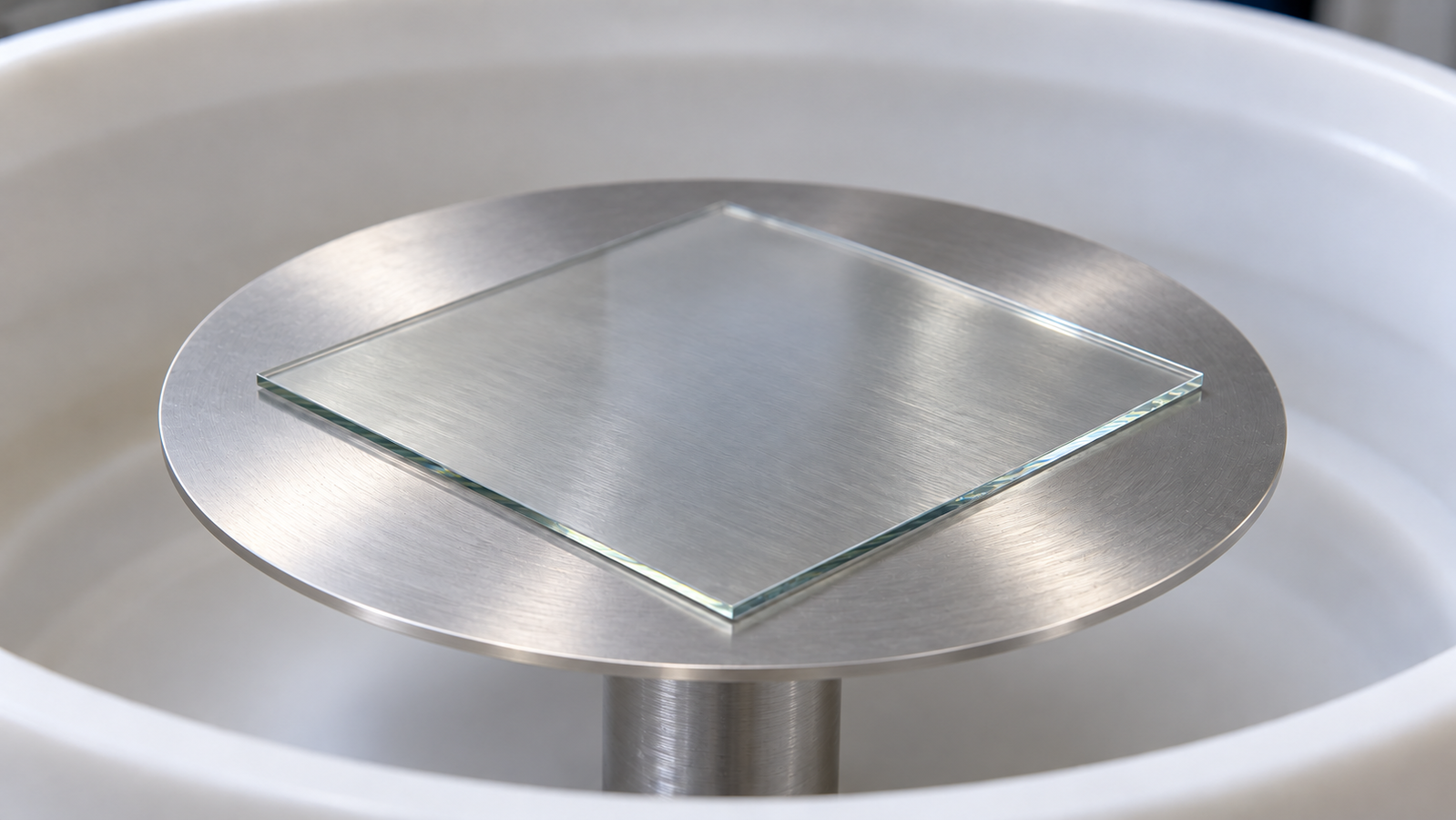
A heated spin coater holds the substrate on a temperature-controlled stage while it spins, so the solution dries on a warm surface instead of at room temperature. Heating is used to speed up drying, to coat inks that are only soluble or only spread well when warm, and in hot-casting routes for perovskite and other crystallising films. Temperature changes two of the quantities that set the final thickness of a spin-coated film, the evaporation rate and the viscosity, and it changes them in opposite directions. This guide covers what substrate temperature does to evaporation and thickness, why the table set point is not the liquid temperature, how to build a heated recipe, solvent safety, and what is published for Levon™ heated spin coaters.
In one paragraph: warming the substrate generally raises the solvent evaporation rate and lowers the solution viscosity. In the classic evaporation model of spin coating the first tends to make the film thicker and the second thinner, so the net effect of a temperature change on thickness has to be measured, not assumed. Faster drying sets the film earlier, which also changes skin formation, striations and, for crystallising inks, grain growth. The temperature published for a heated spin coater is the temperature of the spin table; the substrate surface and the liquid on it can be cooler, especially just after dispense, so let the substrate stabilise, keep dispense and timing identical, and build a separate spin curve at each set point. Treat warm solvents as a fire and vapour hazard.
1. Why heat the substrate?
In ordinary spin coating, the substrate, the solution and the air in the bowl are all at or near room temperature, and the film dries at whatever rate the solvent evaporates under those conditions. A heated spin coater adds one more process variable. Common reasons for using it include:
- Faster or more complete drying during the spin. A warm substrate drives off more solvent before the run ends, which can shorten or simplify the bake that follows.
- Inks that need warmth. Some solutions have limited solubility at room temperature, gel or become very viscous as they cool, or wet the substrate better when warm. Holding the substrate warm keeps the solution in its workable state while it spreads.
- Controlling when the film sets. The film stops flowing when enough solvent has left, so temperature shifts that moment, and with it thickness, texture and, for some materials, crystallisation.
- Hot casting. In perovskite research, a heated solution cast onto a heated substrate has been used to grow films with large crystalline grains; one well-known example is discussed in section 5.8
Heating does not change the stages of spin coating described in Spin Coating Explained; it changes the balance between flow and evaporation within them.
2. Which temperature are we talking about?
A heated spin coater controls the temperature of a part of the instrument, usually the spin table or chuck. The process depends on the temperature of the liquid film, and that is not the same thing. Several temperatures are involved in every heated run:
- Set point and table temperature. The value entered on the controller and the temperature the controller holds at its sensor. Product pages normally publish this one.
- Substrate surface temperature. Heat has to pass through the chuck interface and the substrate. A thick glass substrate or a poor or small contact can leave the top surface cooler than the table.
- Solution temperature. Room-temperature liquid cools the surface it lands on; a warmed solution may cool in the pipette before it lands.
- Air temperature above the film. The air in the bowl may be cooler than the substrate, and spinning moves it across the film.
During spinning, the substrate exchanges heat with the moving air above it, while evaporation removes heat from the liquid film. In the one-dimensional model of Bornside, Macosko and Scriven, for an ambient-temperature process, the film temperature during coating varied negligibly from the ambient.2 On a heated table the differences can be larger, and neither product page states how far the film runs below the table temperature. Birnie and colleagues showed that thickness variations associated with the vacuum chuck depend on the thermal properties of the substrate, the evaporation of the solution and the design of the chuck,7 which is a reminder that the heat path under the substrate can show up in the film.
In practice: report the set point as the set point, not as the film temperature; if the surface temperature matters, measure it on a representative substrate; and keep substrate type, thickness and time on the table constant.
3. Temperature, evaporation and viscosity
Two textbook effects of temperature act on a spinning solution at the same time.
Evaporation increases. The vapour pressure of a liquid rises steeply with temperature (the Clausius–Clapeyron relation describes this for a pure liquid). Evaporation from a spinning film is driven by the difference between the solvent vapour pressure at the film surface and its partial pressure in the air above, and by how fast the moving air carries vapour away. A warmer film therefore loses solvent faster at the same spin speed and air conditions. The size of the increase depends strongly on the solvent: a temperature step that barely affects a high-boiling solvent can greatly speed up a volatile one.
Viscosity decreases. The viscosity of most solvents and dilute solutions drops as temperature rises, so the liquid flows outwards more easily during spin-off. For polymer solutions the effect can be larger, and it interacts with concentration: as solvent evaporates, concentration and viscosity rise again.
A widely used photoresist application note states both effects: towards higher temperatures, the evaporation rate of the solvent increases and the viscosity of the resist drops, and the two effects act in opposite directions on the attained film thickness.4 The same note points out that the solvent concentration of the atmosphere in the spin coater also matters: the more saturated the air, the lower the evaporation rate.4 On a heated table, the vapour leaving the film also warms and enriches the air in a closed bowl, so the evaporation rate can drift during a session.
Birnie and Manley showed with laser interferometry that both viscous flow and evaporation contribute to thinning on a spinning disc, and extracted both the viscosity and the evaporation rate from thickness-versus-time data.3 Temperature acts on both terms, not on evaporation alone.
4. What happens to film thickness
Emslie, Bonner and Peck described how a viscous liquid thins on a rotating disc by outward flow alone.9 Meyerhofer added uniform solvent evaporation and derived a much-quoted scaling for the final thickness h:1
where f is the spin speed, ν0 is the initial kinematic viscosity of the solution and e is the evaporation-rate parameter used in the model; Meyerhofer also found e to be proportional to f1/2 under his conditions.1 The model is a simplification: it treats evaporation as uniform and the solution properties as simple, and it was compared with positive photoresists. It is still useful for seeing the direction of a temperature change:
- A higher evaporation rate makes the film set earlier, while it is still thicker, so e pushes h up.
- A lower initial kinematic viscosity lets more liquid flow off before the film sets, so ν0 pushes h down.
At fixed spin speed and initial solids volume fraction, the idealized scaling gives
where ν0 is the initial kinematic viscosity and e is the evaporation-rate parameter used in the model. Kinematic viscosity is dynamic viscosity divided by density, ν0 = η0/ρ0. Replacing the kinematic-viscosity ratio with a dynamic-viscosity ratio assumes that density is unchanged. The table applies this relation to assumed factors; they are not data for any solvent, solution or instrument.
| Assumed evaporation-rate factor e2/e1 | Kinematic viscosity unchanged | Kinematic viscosity ×0.7 | Kinematic viscosity ×0.5 |
|---|---|---|---|
| ×1.5 | 1.14 | 1.02 | 0.91 |
| ×2 | 1.26 | 1.12 | 1.00 |
| ×3 | 1.44 | 1.28 | 1.14 |
Illustrative sensitivity calculation using assumed multipliers, not measured temperature-dependent properties. Spin speed, initial solids volume fraction and the other model assumptions are held fixed. The table does not map a heater setpoint to film thickness and does not predict a Levon™ instrument’s performance. Heating can also change concentration, wetting, crystallization and the validity of the model, so the actual response must be measured.
Two things follow. First, the cube-root dependence damps both effects: in this simple picture, even a doubled evaporation rate changes the predicted thickness by roughly a quarter. Second, the two effects can largely cancel, which matches the observation in the application note that a change of a few degrees often does not change resist thickness much.4 Larger temperature steps, volatile solvents and solutions whose viscosity changes steeply with temperature or concentration can behave very differently. In practice, a heated recipe can come out thicker, thinner or about the same as the room-temperature recipe, and only a measured spin curve at the new temperature tells you which.
Temperature can also change the thickness distribution across the substrate. If the edge of the substrate is cooler than the centre, or a chuck under the centre conducts heat differently from the surrounding area, local evaporation differs and the film can follow the pattern.7 The temperature uniformity published for a heated table describes the table, not the film; check uniformity on the substrate you use. Building a spin curve is covered in Spin Speed vs Film Thickness.
5. Drying, skins, striations and crystals
Heating matters for more than the average thickness, because the speed of drying changes how the film solidifies.
Skin formation. Bornside, Macosko and Scriven predicted that as solvent leaves, a region of very low solvent concentration and high viscosity can form at the free surface, a solid “skin”, and that coating defects can occur if flow underneath has not stopped when the skin forms. They also noted that partly saturating the gas above the film with solvent, or using mixed solvents of high and low volatility, can delay skin formation.2 Solvent-vapour control of this kind is a coating-design choice, not something to improvise on a heated coater (see section 7). Haas and colleagues studied the effect of solvent evaporation rate on skin formation during spin coating of complex solutions.6 A heated substrate raises the evaporation rate, so the conditions that favour an early skin are worth watching, particularly for thick films and concentrated solutions.
Striations. Birnie explained striations as a result of solvent evaporation depleting the more volatile components at the surface; when that change raises the surface tension, the surface can become unstable to convective motion, and solvent choice guided by vapour pressure and surface tension can reduce the risk.5 Faster evaporation on a warm substrate makes surface depletion faster too, so a solution that coats cleanly at room temperature may need re-checking for striations when heated. Striations and other defects are diagnosed in Spin Coating Defects.
Crystallisation and grains. For inks that crystallise as they dry, the drying rate and the temperature together influence how many crystals start and how large they grow. Nie and colleagues used a hot-casting technique to grow continuous, pinhole-free organometallic perovskite films with millimetre-scale crystalline grains and reported planar solar cells with efficiencies of about 18%.8 Those are the authors' results for their composition, solvent and conditions; they show that substrate and solution temperature are strong variables for such films, not that a given temperature transfers to another ink or instrument.
Edges and corners. Air turbulence can speed up drying at edges and corners,4 and heating does not remove that difference. Corners and small pieces are covered in Spin Coating Small, Square and Fragment Substrates.
6. Building a heated recipe
A heated recipe is a normal spin recipe with one more variable to control. The following sequence keeps the comparison fair and makes it possible to tell temperature effects from other changes.
- Start from a working room-temperature recipe and measure its thickness and uniformity as the reference.
- Choose a set point with a reason. Base it on the solvent, the solubility of the ink and the literature for the material, and keep well below the boiling point and flash point of the solvent unless the process specifically requires otherwise and the safety assessment allows it.
- Let the table and substrate stabilise. Wait until the controller reading is steady, then place the substrate and give it a fixed, recorded time to warm. The accuracy published for the Levon™ heated tables applies after the temperature is stabilized.
- Fix the dispense. Dispense volume, solution temperature, the delay between placing the substrate and dispensing, and static or dynamic dispense all change how much the liquid cools and dries before spinning. Keep them identical between runs. The two dispense modes are compared in Static vs Dynamic Dispense in Spin Coating.
- Build a spin curve at the set point. Coat at several speeds and measure the thickness. Do not reuse the room-temperature curve; the speed needed for a given thickness can move in either direction.
- Revisit ramps and steps. Because the film sets earlier on a warm substrate, a slow spread step or a long first step may let it dry before the main speed is reached. Short spread steps, a faster ramp or a change of step order may be needed. Ramps and multi-step programs are covered in Spin Coating Acceleration and Multi-Step Recipes.
- Check uniformity and defects: centre and edge thickness, striations, skins, haze or uneven crystallisation.
- Decide on the bake. A heated spin may reduce the residual solvent, but it does not automatically replace the bake on a hot plate. Keep the time between coating and bake fixed. A separate bake may be required by the coating recipe. The HP6 precision vacuum hot plate is one Levon™ hotplate option to evaluate; confirm the required temperature, substrate support and process compatibility.
- Record everything: set point, warm-up time, dispense conditions, room temperature and humidity, and results.
Two further points. First, the bowl warms and solvent vapour builds up over a session, so early substrates can differ from later ones; the dummy runs the application note suggests after cleaning or idle periods4 are even more useful here. Second, a set point at or near room temperature is not a controlled condition on a heater that only heats: if the room is warmer than the set point, the controller cannot bring the table down.
7. Safety with warm solvents
Heating a spinning film of solvent increases the rate at which vapour is released and can bring a flammable solvent closer to its flash point. Treat a heated spin coater with at least the care of an unheated one, plus the following:
- Know the solvent. Check the safety data sheet for flash point, autoignition temperature, exposure limits and decomposition products, and choose the set point with them in mind.
- Extract the vapour. Use the coater in a fume hood or with suitable local exhaust, as required by your laboratory's assessment.
- Mind hot surfaces. The table, chuck and substrate can be hot enough to burn; use tools or heat-resistant gloves to load and unload, and let parts cool before cleaning.
- Clean with care. Do not apply flammable cleaning solvent to a hot table or bowl.
- Keep the lid closed and interlocks active, and stay within the rated speed of the instrument and of the fitted chuck.
- Gloveboxes change the hazards and the heat transfer; confirm the instrument suits that use first.
The published heater range is an equipment specification, not an approved processing-temperature range for every solvent or formulation. Confirm the intended chemical, temperature, exhaust, waste-handling and holder configuration with the equipment supplier and your laboratory’s safety procedure. “Low-voltage heating elements” does not establish suitability for a flammable atmosphere. Maintain the required guards and interlocks, and do not improvise solvent-vapour enrichment or reduce required exhaust to slow evaporation. These points do not replace the manual or your laboratory's safety procedures.
8. Levon™ heated spin coaters: what is published
Two Levon™ spin coaters are listed with a heated spin table: the IC5000-S and the IC8000-S. Both pages describe a newly designed stage for simultaneous temperature-controlled heating and spin coating, a thermal insulation design and low-voltage heating elements. The table lists the values as published and marks what the pages do not state. It is a selected comparison, not a complete catalogue.
| Item | IC5000-S (as published) | IC8000-S (as published) |
|---|---|---|
| Spin table heating range | RT to 150 °C | RT to 200 °C |
| Temperature resolution | 0.1 °C | 0.1 °C |
| Temperature control accuracy | ≤±0.5 °C (after temperature is stabilized) | ≤±0.5 °C (after temperature is stabilized) |
| Spin table temperature uniformity | ≤±2% | ≤±2% |
| Uniformity test basis | Not stated on the product page checked on 22 October 2026 | Not stated on the product page checked on 22 October 2026 |
| Substrate surface or film temperature | Not stated | Not stated |
| Heating rate or time to set point | Not stated | Not stated |
| Cooling below room temperature | Not stated | Not stated |
| Spin speed; acceleration | 100–5,000 rpm; 100–5,000 rpm/s | 100–8,000 rpm; 100–5,000 rpm/s |
| Programs | Up to 100 recipes of 100-step programs; more can be expanded. Maximum single-step spin time 3,000 s at 0.1 s resolution (both models) | |
| Substrates | 10–35 mm square or circular substrates (other specifications customizable) | Glass fragments/substrates and 6-inch glass wafers or semiconductor wafers |
| Chuck or holder | Adjustable jaw chuck stage | Not listed |
| Substrate thickness limit | Not stated | Not stated |
| Glovebox use | Not stated | Not stated (separate spin chamber 260 × 500 × 350 mm and control box 310 × 420 × 200 mm) |
| Option | Precise metering automatic dispensing function (upgrade) | Precise metering automatic dispensing function (upgrade) |
From the Levon™ IC5000-S and IC8000-S product pages as listed on 22 October 2026, in the pages' own wording. “Not stated” or “not listed” means the page does not give the value. “RT” is room temperature; the pages give no numeric value for it. The measurement basis of the uniformity figure is not stated; this is an observation about the published information, not a claim that no test method exists. These are published spin-table specifications, not measured wet-film temperatures. Temperature resolution, stabilized control accuracy and spatial uniformity describe different properties. The published uniformity percentage must not be converted into a sample-temperature tolerance without its reference basis and test conditions. Substrate-surface and wet-film temperatures require separate validation under the actual mounting, rotation and dispensing conditions.
Reading the table for a heated process:
- Temperature. Choose the model by the highest set point you need: up to 150 °C on the IC5000-S and up to 200 °C on the IC8000-S. Both figures are spin table temperatures; as section 2 explains, the substrate surface and the film can be cooler, and neither page states a surface temperature. Neither page states cooling, so a set point near or below room temperature should not be assumed to be controllable.
- Substrate size. The IC5000-S jaw chuck takes 10–35 mm square or circular substrates; a rectangular piece is not stated as covered, so confirm it before ordering. The IC8000-S is listed for glass fragments and substrates up to 6-inch wafers; its chuck or tray is not listed on the page.
- Speed. The IC8000-S page lists up to 8,000 rpm and the IC5000-S page up to 5,000 rpm. Whether the speed range applies at every table temperature is not stated.
- Glovebox. Neither page mentions glovebox use. Neither page states that one model combines glovebox use, a large substrate and a high temperature.
- Thick substrates. No thickness limit is stated on either page, and thick substrates take longer to warm through.
Unheated Levon™ spin coaters, including models with glovebox-compatible or recessed-installation designs, are on the Levon™ spin coaters page.
Before you request a quote
- Temperature: the set point or range you need, how quickly it must be reached, and whether the substrate surface temperature has to be verified.
- Substrates: material, shape, size, thickness, the smallest and largest pieces, and the holder or chuck you need.
- Solution: solvent or solvents, volatility and flash point, dispense volume, and whether the solution is also heated.
- Recipe: speed and ramp window, number of steps and any dispensing during the spin.
- Environment: fume hood, air or glovebox (with the glovebox’s inner and antechamber dimensions), available space, and how the bake after coating will be done.
Send these through the contact form or the Get Quote request on the product page.
9. Keep Exploring the Spin Coating Knowledge Hub
This article is part of the spin coating section of the ACS Material thin-film library.
Start here
- Spin Coating Explained: Stages, Physics and Film Thickness — the four stages of spin coating and the models behind film thickness.
- Solution-Processed Thin Films: Choosing Spin, Dip, Slot-Die or Blade Coating — when spin coating is the right method at all.
Coming soon in this series
- Spin Speed vs Film Thickness: How to Build and Use a Spin Curve
- Spin Coating Acceleration and Multi-Step Recipes
- Static vs Dynamic Dispense in Spin Coating
- Spin Coating Defects: Comets, Striations, Pinholes and Edge Beads Diagnosed
- Spin Coating Small, Square and Fragment Substrates: Chucks, Vacuum and Corners
Spin coating equipment
- IC5000-S heated spin coater — spin table heating RT to 150 °C, 10–35 mm square or circular substrates.
- IC8000-S heated spin coater — spin table heating RT to 200 °C, glass fragments to 6-inch wafers.
- HP6 precision vacuum hot plate — for the bake after coating, wafers up to 6 inches.
- Levon™ spin coaters — compact, programmable, servo and heated spin coaters.
10. FAQ
What does a heated spin coater do?
It holds the substrate on a temperature-controlled spin table while it spins, so the solution flows and dries on a warm surface. This mainly changes the evaporation rate and viscosity of the solution during the run.
Does heating the substrate make the film thicker or thinner?
It can do either. Faster evaporation tends to make the film thicker and lower viscosity tends to make it thinner, and the two can largely cancel. Build a spin curve at each set point and measure.
Is the set point the temperature of my film?
No. Published values are spin table temperatures. The substrate surface and the liquid can be cooler, particularly with thick substrates, poor contact or a cool dispense. Measure the surface if it matters.
Can I reuse my room-temperature spin curve?
Not reliably. Temperature changes both terms that set thickness, so the speed needed for a target thickness can move either way. Recalibrate at the new set point.
What is hot casting?
Depositing a heated solution onto a heated substrate, usually followed by spinning. It has been used to grow perovskite films with large grains; results depend on the composition, solvent and conditions.
Can the IC5000-S or IC8000-S be used in a glovebox?
Neither product page mentions glovebox use, so it is not part of either model’s published specification. For glovebox work, the checklist under “Before you request a quote” in section 8 lists the details to include.