
Heating can accelerate degradation reactions, making atmosphere control important during annealing as well as transfer and storage. This guide explains why, compares a hot plate in a glovebox with a nitrogen-purged plate on the bench, and shows how gas flow can change the film temperature.
In one paragraph: Atmosphere requirements are material- and process-specific [2][3][4][5]. Compare a suitably equipped glovebox with a qualified local purge, including transfer and cooling. Verify the contaminants relevant to the process under representative sample conditions. Cooler purge gas can increase heat loss [6], so qualify the anneal with the intended flow.
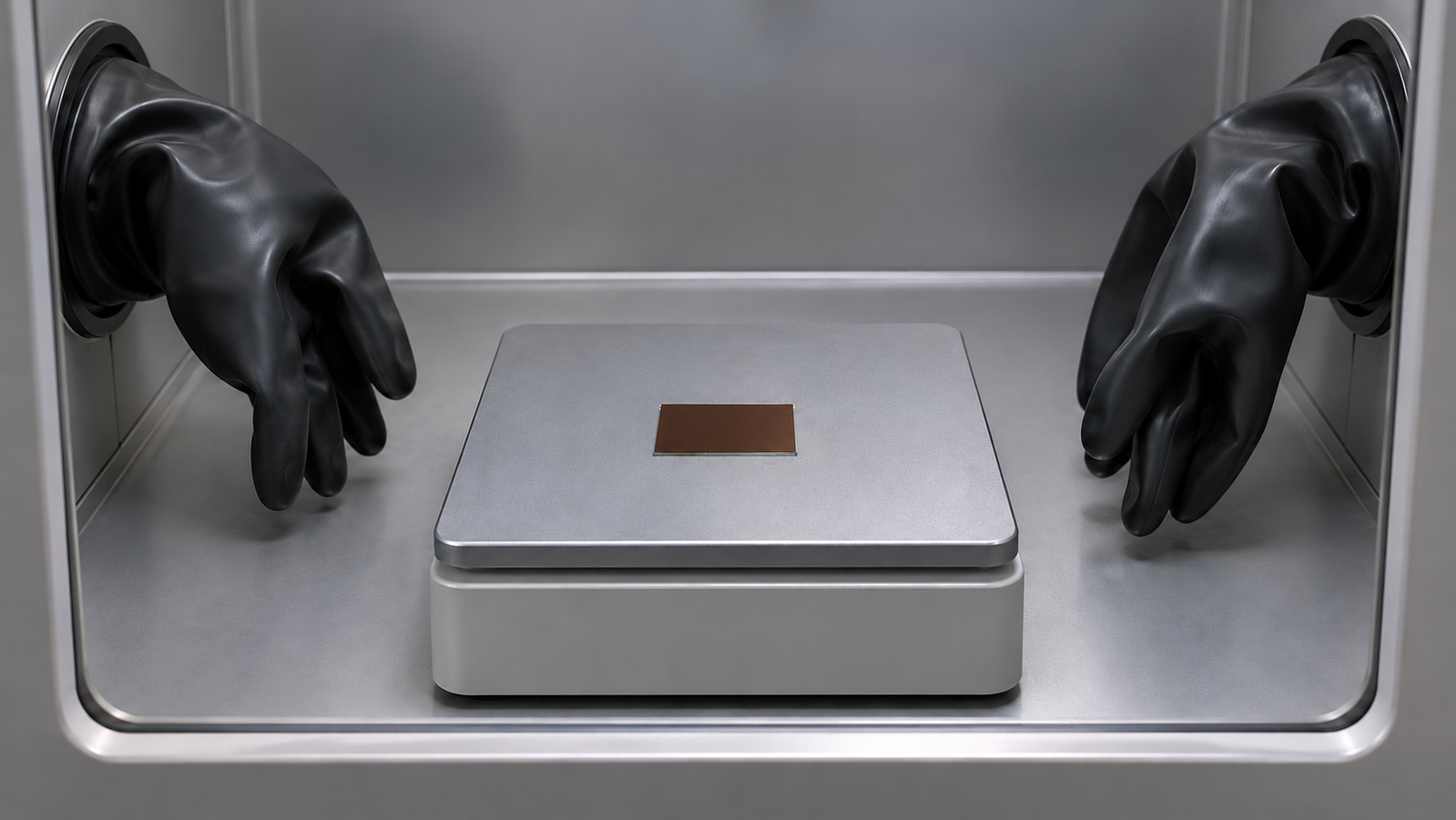
1. Why Atmosphere Matters During Annealing
For a thermally activated reaction with positive activation energy, increasing temperature increases the rate constant [1]. This does not establish one temperature dependence for every oxygen- or water-related process, or identify the most sensitive stage of every film’s preparation.
The following studies establish specific atmosphere sensitivities, not a universal temperature dependence:
- Conjugated polymers. Oxygen interacts with poly(3-alkylthiophenes) to form a charge-transfer complex, which changes the film’s electronic properties [2].
- Halide perovskites. Aristidou and co-workers studied how light and oxygen together degrade methylammonium lead iodide layers [3], and Leguy and co-workers showed that the same material hydrates with water, and that this hydration can be reversible [4].
But “inert is always better” is not a safe rule either. You and co-workers reported that annealing perovskite precursor films in a humid environment, such as ambient air, improved film quality, grain size and carrier lifetime in their process [5]. The atmosphere is a process variable to control and record, not a box to tick.
The practical question is not “nitrogen or air?” but “which atmosphere does my process need during the anneal, and how well do I need to control it?”
2. Glovebox, Purged Hot Plate or Enclosure
There are three common ways to anneal away from room air. They differ in how well they exclude oxygen and water, in what they do to the process, and in how they fit the rest of your line.
| Approach | How the atmosphere is set | Strengths | Limits |
|---|---|---|---|
| Hot plate inside a glovebox | Purification and monitoring where installed and qualified for the process | Coating, annealing and storage can all happen without air exposure | The plate adds heat and must fit through the antechamber and inside; working through gloves; confirm that monitored levels represent the loaded sample environment |
| Nitrogen-purged hot plate on the bench | A nitrogen flow displaces air around the substrate | No glovebox needed; the plate stays on an ordinary bench or in a fume hood | The residual oxygen and moisture depend on flow, purge time, sealing and leaks; the substrate is exposed to air while it is loaded |
| Nitrogen flow over a plate in an enclosure | An equipment-compatible, safety-reviewed enclosure with a controlled inlet and suitable outlet | Local atmosphere control where qualified | Confirm venting, heat and solvent-vapour handling; qualify the atmosphere by measurement |
A qualitative comparison. Actual oxygen and moisture levels must be measured in your own setup.
Two points are easy to overlook. First, the transfer counts. A film that is spin coated in air, carried across the lab and then annealed under nitrogen has already been exposed; if the process is air-sensitive, the coating and the anneal may both need to be inside the glovebox, which is one reason spin coaters and hot plates are often specified for glovebox use (see How to Choose a Lab Spin Coater: Speed, Acceleration, Substrate Size and Glovebox Fit). Second, cooling counts too. Maintain the qualified atmosphere through cooling and any required storage; cooling alone does not make an air-sensitive film air-stable.
3. Gas Flow Can Change the Film Temperature
A gas flow over the plate is not necessarily thermally neutral. With gas cooler than the surface, increased flow can increase convective heat loss; the effect depends on gas temperature, flow pattern and the heating arrangement [6]. Two consequences follow for annealing:
- The film can run cooler than in still air. With cooler purge gas, the substrate surface can lose more heat, so its temperature can sit further below the plate temperature, particularly for thick or poorly conducting substrates, which are already slower to heat [6][7].
- Uniformity can change. Where the gas enters and leaves affects the local heat transfer.
The practical rule: qualify the anneal with the gas flow at the setting you will use. A recipe developed in still air will not necessarily give the same film once the purge is switched on. For how bake temperature, gap and substrate interact, see Soft Bake, Post-Bake and Annealing on a Hot Plate: What Each Step Does; for what a uniformity specification does and does not tell you, see Reading Hot Plate Specs: Temperature Uniformity, Accuracy and What ±1% Means.
4. Setting Up a Nitrogen Anneal: A Checklist
A nitrogen anneal is only as good as the procedure around it. A checklist for setting one up:
| Step | What to decide | Why |
|---|---|---|
| Gas quality | Nitrogen purity and moisture specification from your gas supplier; clean, dry lines | The purge cannot be cleaner than the gas and the lines |
| Supply pressure | Use the confirmed inlet specification and approved regulator | Inlet pressure does not specify gas flow, chamber pressure or residual oxygen |
| Purge and recovery | Qualified initial purge and recovery after loading or opening | Loading can reintroduce air; verify the required atmosphere before the atmosphere-sensitive step |
| Loading | How quickly and how the substrate is placed; time since coating | Air exposure during transfer may matter more than the anneal atmosphere |
| Flow during the anneal | A fixed, recorded flow | Flow can change convective heat transfer and the film temperature [6] |
| Cool-down | Required atmosphere, support and transfer conditions | Cooling does not necessarily remove air sensitivity |
| Verification | Measure relevant contaminants using representative sampling suitable for the process temperature | Verify sample conditions rather than inferring them from supply settings |
A planning checklist; the values come from your own qualification.
On the last point: no general rule converts a nitrogen flow into an oxygen level. It depends on the volume, the leaks, the flow pattern and how air is drawn back in. If residual oxygen or moisture matters, measure or validate it at a representative sample location during loading, heating and cooling. A glovebox sensor reading alone does not establish those local conditions.
Safety. Nitrogen displaces oxygen. Released into a small or poorly ventilated room, it can create an oxygen-deficient atmosphere without any warning smell. Vent the exhaust gas safely, and follow your institution’s rules on compressed gas and oxygen monitoring.
5. Choosing an Approach for Your Film
Choose the approach from what the film needs, not from habit:
| If your process… | Consider |
|---|---|
| Is known to be damaged by a short air exposure, and coating is already in a glovebox | A compact hot plate inside the same glovebox |
| Needs less oxidation during the anneal but tolerates a brief transfer in air | A nitrogen-purged hot plate on the bench, qualified with an oxygen measurement if needed |
| Needs a controlled amount of humidity, as in some reported perovskite routes [5] | An environment with the specified humidity and carrier-gas composition; record both |
| Is not atmosphere-sensitive | A standard hot plate, with the atmosphere still recorded |
Whichever you choose, write the atmosphere into the recipe alongside temperature and time: gas, flow, purge time, where the substrate was coated, and how long it was in air.
6. Levon™ Nitrogen-Filled and Glovebox Hot Plates
The tables quote the Levon™ product pages; “Not stated” means the page does not give the value.
Nitrogen-filled programmable hot plates
| Specification | HP100-SA | HP200-SA |
|---|---|---|
| Configurations | HP100-SA; HP100-PA | HP200-SA |
| Heating plate | Hard-anodized aluminum; size not stated | Hard-anodized aluminum; size not stated |
| Temperature range | RT to 300 °C | RT to 300 °C |
| Control accuracy | ≤±0.2 °C | ±0.2 °C |
| Temperature uniformity | RT to 200 °C: ≤±1%; 200 °C to 300 °C: ≤±1.5% | RT to 200 °C: ≤±1%; 200 °C to 300 °C: ≤±1.5% |
| Nitrogen input requirement | 0.04–0.4 MPa (supplied by the user) | 0.04–0.4 MPa (supplied by the user) |
| Nitrogen function as listed | Nitrogen charging listed as an additional customization function | Ventilation and nitrogen charging listed as additional customization functions |
| Residual oxygen or moisture level | Not stated | Not stated |
| Control | 7-inch touchscreen, PLC; PA: linear control 0.5–10 °C/min, vacuum adsorption, 100 recipes × up to 30 stages | 7-inch touchscreen, PLC; linear control; vacuum adsorption |
| Proximity baking | Auto-lift; pins 0–30 mm | Automatic lift; pins 0–30 mm |
| Dimensions (W × D × H) | 350 × 500 × 320 mm | 450 × 620 × 320 mm |
Specifications as published on the Levon™ nitrogen-filled hot plate product pages on 22 October 2026. Both pages list nitrogen charging as an additional customization function, so confirm the gas configuration in the quotation.
Compact hot plates for glovebox use
| Specification | HP5 | HP10 | HP6 |
|---|---|---|---|
| Heating plate | 150 × 150 mm square, anodized aluminum | 220 × 220 mm square, anodized aluminum | Ø170 mm circular, hard-anodized aluminum; wafers up to 6 inches |
| Temperature range | RT to 300 °C | 300 °C configuration: RT to 300 °C; 400 °C configuration: RT to 400 °C | RT to 250 °C |
| Resolution | 0.1 °C | 0.1 °C | 0.1 °C |
| Control accuracy / precision | Accuracy ≤±1 °C | 300 °C: precision ±1 °C; 400 °C: precision ≤±1 °C | Precision ±0.2 °C (after the temperature is stable) |
| Temperature uniformity | ≤±2% | 300 °C: <±2%; 400 °C: ≤±2% | ≤1% |
| Controller | Precision digital temperature controller | Digital temperature controller | Digital temperature controller with optional linear control function |
| Substrate hold-down | Not stated | Not stated | Manually activated vacuum chuck; close-contact resist baking mode; vacuum input 0.04–0.09 MPa |
| Glovebox | Recessed heating structure for glovebox applications | Recessed heating structure for use inside a glovebox | Recessed heating element design for glovebox integration |
| Lid | Not stated | Not stated | Thermal-radiation-sealed lid |
| Power input | AC 220 V, 800 W | 300 °C: AC 220 V, 1,000 W; 400 °C: AC 220 V, 2,000 W | 220 V, 1,000 W |
Specifications as published on the Levon™ hot plate product pages on 22 October 2026. The supplied configuration is confirmed in the quotation.
How this connects to the guide: the HP100-SA and HP200-SA take a user-supplied nitrogen input of 0.04–0.4 MPa, for the bench-top approach in Section 2; the pages list nitrogen charging as a customization function and do not state a residual oxygen or moisture level, so measure it if your film is sensitive. The HP5, HP10 and HP6 pages describe a recessed heating structure for glovebox use, for the glovebox approach. Confirm fit, heat load, clearances, electrical supply and solvent-vapour handling with the glovebox supplier.
7. Keep Exploring the Bake and Anneal Knowledge Hub
Start here
- Spin Coating Explained: Stages, Physics and Film Thickness — how the film is formed before it is annealed
- How to Choose a Lab Spin Coater: Speed, Acceleration, Substrate Size and Glovebox Fit — spin coaters for glovebox use
Process guides
- Soft Bake, Post-Bake and Annealing on a Hot Plate: What Each Step Does — what each bake step does
- Reading Hot Plate Specs: Temperature Uniformity, Accuracy and What ±1% Means — reading uniformity specifications
- High-Temperature Hot Plates to 600 °C: Calcination, Oxide Films and Uniformity Limits — oxide films at higher temperature
- Perovskite Film Fabrication: Spin Coating, Antisolvent Timing and Annealing — perovskite film fabrication
Links will be added as each article is published.
Equipment
- HP100-SA Nitrogen-Filled Programmable Hot Plate — nitrogen input 0.04–0.4 MPa, RT to 300 °C
- HP200-SA Nitrogen-Filled Programmable Hot Plate — larger nitrogen-filled unit
- HP6 Precision Vacuum Hot Plate — recessed design for glovebox integration
- Levon™ Hot Plates — all hot plates
Questions about a specific hot plate can be sent through the contact form.
8. FAQ
Is a nitrogen-purged hot plate as good as a glovebox?
Not necessarily. A suitably equipped glovebox can protect the whole sequence, while a local purge protects a smaller region. Qualify the required atmosphere, including loading and cooling, for either arrangement.
What oxygen level does a nitrogen purge reach?
There is no general answer; it depends on the volume, flow and leaks. If your film is sensitive, measure or validate it at a representative sample location during loading, heating and cooling.
Does the nitrogen flow change my anneal?
It can. A purge cooler than the substrate can increase convective heat loss [6], so the film may run cooler than in still air. Qualify the recipe with the flow on.
Should perovskite films always be annealed in nitrogen?
Not always. Oxygen with light and water can degrade them [3][4], but one reported route anneals in a humid environment to improve film quality [5]. Follow your process.
Is nitrogen hazardous?
It can displace oxygen in a poorly ventilated room. Vent exhaust safely and follow your institution’s compressed gas rules.