
A round-bottom flask's shape is exactly what makes it awkward to heat. On a flat plate it touches only a small area; a mantle, bath or matching block can transfer heat across more of its curved surface, although this does not guarantee uniform temperature within the flask. Labs therefore choose between a heating mantle, an oil bath, an aluminium heating block on a hotplate stirrer, or a hotplate used under a bath or block. This guide compares heating mantle vs oil bath vs heating block vs hotplate on what decides the choice: how heat gets into the flask, what sets the maximum temperature, how each responds, how you read the temperature, and what each leaves behind. It ends with a table of the methods and a separate table of specifications for five ALab™ mantles, baths and a hotplate stirrer.
Quick answer:
- Heating mantle: a matching round-bottom flask, direct heating without a bath fluid, and an operating range determined by the particular mantle and setup. Match the mantle or interchangeable sleeve to the flask; do not assume every mantle can operate above every oil bath.
- Oil bath: heated liquid surrounds the immersed portion of a suitably supported flask, providing broad thermal contact. The usable temperature is constrained by the specific bath fluid, bath equipment and vessel limits, not simply by the heater's setting range; glassware comes out oily.
- Aluminium heating block on a hotplate stirrer: an oil-free set-up, if you have an insert that matches your flask. Blocks stay hot long after switch-off.
- Hotplate on its own: flat-bottomed vessels, or as the heater under a bath or block; not a bare round-bottom flask.
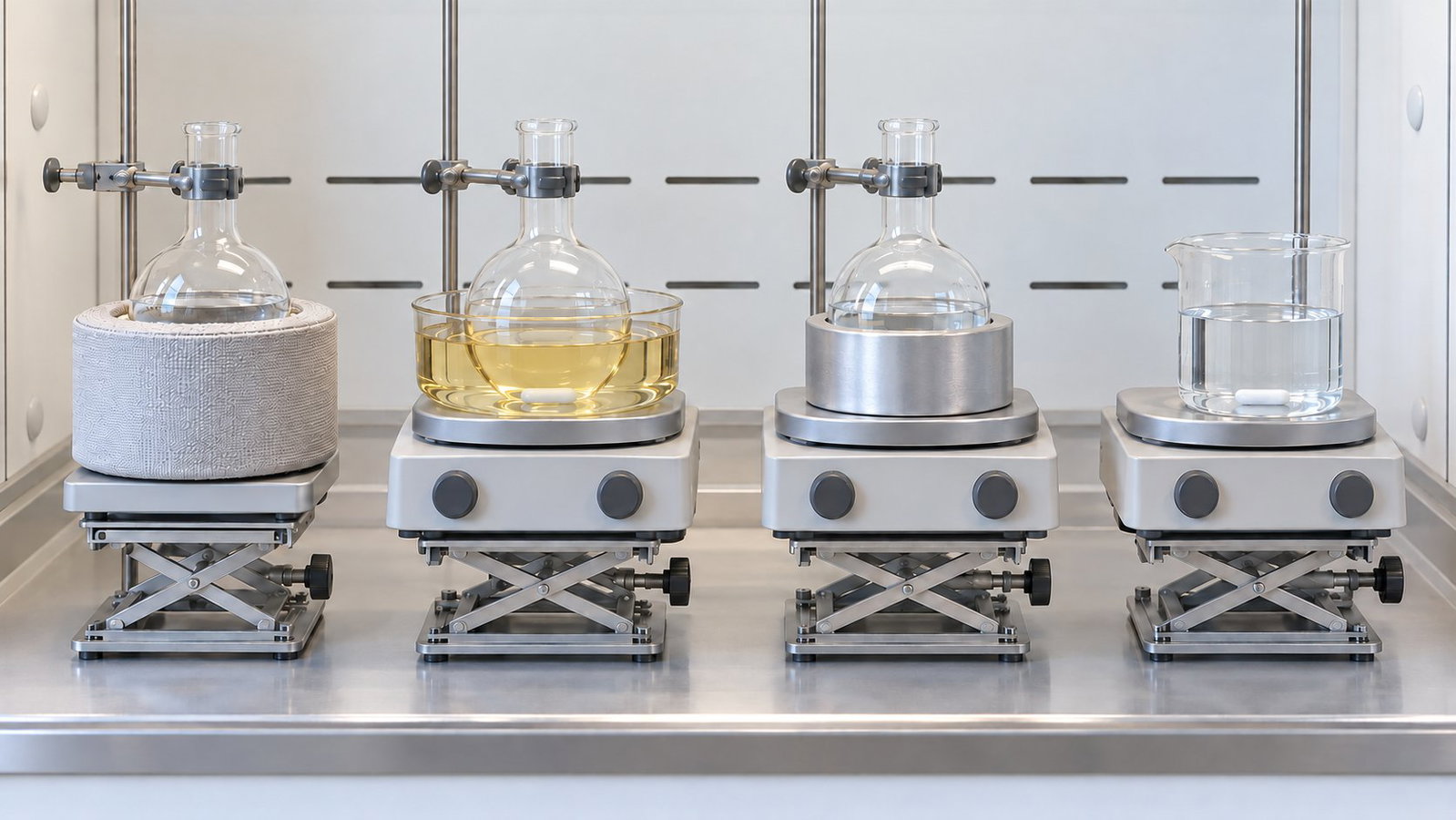
1. Four Ways to Heat a Round-Bottom Flask
Heating mantle. A cup-shaped heater built for a round-bottom flask. Prudent Practices in the Laboratory describes mantles as "commonly used to heat round-bottom flasks, reaction kettles, and related reaction vessels", with the element enclosed "in layers of fiberglass cloth" [1]. The cup follows the flask, so heat reaches much of the glass directly, with no bath fluid to spill or clean off. Nichols calls mantles "a relatively safe way to heat flammable organic liquids in a round bottomed flask"; a spill onto a hot mantle is the main hazard [2]. Both ALab™ mantles discussed below also stir magnetically.
Oil bath. The flask sits in heated oil up to the oil level. Prudent Practices notes that oil baths "are often used to heat small or irregularly shaped vessels or to maintain a constant temperature with a stable heat source" [1]. The bath is heated by a hotplate stirrer underneath or by its own heater. Its weaknesses come from the oil: a ceiling set by the fluid, smoke and fire risk if overheated, and oily glassware [1][4].
Aluminium heating block. A machined block with an insert shaped for a given flask sits on a hotplate stirrer and conducts heat into the glass. York's teaching labs name "an electric stirrer hotplate with an aluminium heating block" as the most commonly used heat source for reflux [3]. Glassware stays clean, but the insert must match the flask and the metal stays hot long after switch-off [3][5].
Hotplate. A flat heated surface: right for beakers, Erlenmeyer flasks and other flat-bottomed vessels, and the usual heater under a bath or block [2]. On its own it is a poor heater for a round-bottom flask (Section 6).
At 100 °C or less, Prudent Practices notes that steam-heated devices are "generally preferred" because they present no shock or spark risk [1]. Sand and molten-salt baths are outside the scope of this comparison.
2. How Heat Gets Into the Flask: Contact, Fit and Stirring
- Direct contact that follows the flask. A mantle and a block rely on the glass touching a heated surface shaped for it; a poor fit leaves insulating air gaps. Nichols notes that if a mantle "does not fit a round bottomed flask perfectly, sand can be added to ensure good thermal contact" [2], and York stresses that a block must be "of the correct size for the flask, so that there is a good contact" [3].
- A liquid envelope. In a bath, the liquid wraps around the flask whatever its shape. Penn's Environmental Health and Radiation Safety (EHRS) fact sheet calls oil baths "the most commonly employed method for heating a reaction as they provide the best heat transfer from the heat source to the reaction mixture" [4]. A manufacturer-authored block guide claims the opposite for blocks [5]; in practice it depends on fit, fill level and stirring.
- Point contact. A round-bottom flask on a flat plate touches over a tiny area, so most heat must cross an air gap.
What the thermometer is telling you. A bath reading stands in for the flask contents but is not the same: Nichols notes that "the bath is often slightly hotter than the liquid in the flask" [2]. A mantle or block reading likewise describes the heater. When the reaction temperature matters, measure it in the contents; see our guide to plate vs liquid temperature.
Stirring twice. A stir bar mixes the reaction, but a bath fluid also needs mixing: Prudent Practices says oil baths "must be well mixed to ensure that there are no hot spots around the elements" [1], and Nichols notes that stirring the bath helps it respond [2]. A stirred bath does both; ACS Material calls this secondary stirring on one ALab™ bath (Section 5).
Response and stored heat. Mantles are slow to warm and to cool, so to stop heating quickly you separate flask and mantle [2]. A bath responds at a pace set by its fluid volume and stirring. A block holds heat for a long time: the block guide warns that a large block used at high temperature can stay "hot enough to cause a burn even after over half an hour", and recommends leaving a heated block for at least an hour if you have no probe in it [5].
3. Oil Baths: Choosing the Oil and Its Temperature Limit
The oil bath max temperature is not determined by the heater alone. The permitted operating temperature depends on the specific fluid's working range, the heater and bath assembly, the vessel material and the laboratory procedure; the most restrictive applicable limit governs. A specified heating range or over-temperature protection value does not certify a bath fluid or vessel for operation at that temperature. Literature values vary widely because "mineral", "paraffin" and "silicone" oil each cover many grades:
| Source | Paraffin or mineral oil (as named by the source) | Silicone oil |
|---|---|---|
| Prudent Practices [1] | Saturated paraffin oil "for temperatures below 200 °C" | "for temperatures up to 300 °C, a silicone oil should be used" |
| Nichols, citing Lange's Handbook [2] | Mineral oil "can be heated to 300 °C" | "can be heated to 250 °C" |
| Penn EHRS, "useful range" [4] | Mineral oil 25–100 °C | Silicone oil 25–230 °C |
These are source-specific guidance values, not certified limits for every oil of the named type. Grades and formulations differ. Confirm the maximum working temperature with the specific fluid's supplier and consult its safety data sheet (SDS) for hazards; also follow the limits of the bath equipment and vessel.
Penn adds a rule of thumb: "Most oil baths are good for heating reactions <200 °C"; above that it points to mantles and sand or salt baths [4]. Other habits [1][4]:
- Keep water out. Water or volatiles in hot oil spatter.
- Do not overfill. Penn advises never filling a bath more than halfway [4].
- Replace tired oil. Penn advises discarding discoloured oil [4].
- Mind the container. Prudent Practices recommends holding heated oil "in either a metal pan or a heavy-walled porcelain dish" and warns that a glass dish or beaker can break and spill hot oil if struck by a hard object [1]. This is general laboratory safety guidance, not a product-specific finding about the glass-bath assemblies described in Section 5. For a manufactured glass bath, follow its operating manual and confirm the approved fluid, fill level, vessel-temperature limits and containment arrangements. Support the assembly securely, avoid unstable ring supports and provide appropriate secondary containment [1].
Safety in one paragraph. Keep the oil-bath temperature well below the specific oil's flash point, check its SDS and supplier guidance, and monitor the bath with a suitable thermometer or temperature sensor [1]. Secure the controlling probe in the medium it is intended to measure: if it becomes displaced and reads cooler surroundings, the controller may continue demanding heat. Prudent Practices recommends independent sensors for normal temperature control and over-temperature shutdown [1]; do not assume an ALab product provides that independence unless its documentation confirms it. Do not leave a bath heating unattended without institutional approval and the required monitoring and protective measures; NFPA 45's additional shutoff provisions apply according to their stated scope [1][6]. Where the equipment and procedure permit, arrange stable support and a separately clamped flask so heat can be removed promptly without disturbing the glassware [1]. For flammable solvents, ignition sources and residual heat, see our guide to hot plate safety.
4. Heating Mantles: Match the Mantle to the Flask
A mantle or interchangeable heating sleeve is selected for the flask size and shape; the flask should sit as the equipment manufacturer specifies rather than perch on the rim or be forced into an undersized opening [2]. Nichols describes adding sand to improve contact in a loose conventional mantle [2], but that is not a general instruction for these ALab systems: confirm the permitted fit and any filler material in the specific operating manual. Two other points matter:
- Set it up for quick removal. Prudent Practices recommends "placing the heating mantle on a laboratory jack and holding the flask ... by clamps attached to a separate ring stand", which "allows for rapid removal of heat in the case of overheating or exothermicity" [1].
- Control the mantle, then watch the contents. Older mantles are often run from a variac. Prudent Practices notes that "temperature controllers with built-in safety interlock capability are available from commercial sources and are preferred to variable autotransformers" [1]. When a mantle has its own controller, follow its manual rather than adding a variac. Do not assume that a mantle setpoint or display is the temperature of the flask contents: confirm which measurement controls the unit, and use a correctly placed, compatible probe when the liquid temperature matters.
The MS-H380-F magnetic stirrer heating mantle comes in five sizes for 100 mL to 2000 mL flasks; it has a glass-fiber inner sleeve, aluminum silicate wool insulation and a dual-side bracket that holds the reaction flask and the PT1000 sensor from different angles. The MS-H280-B/F magnetic stirrer with electric heating mantle uses interchangeable heating sleeves made of "aluminum silicate fiber cotton", for 100 mL to 1000 mL flasks (F versions; the B versions take flat-bottom beakers), and can be used "as one heating magnetic stirrer, or as one heating sleeve plus one magnetic stirrer". Sizes:
| Round-bottom flask | MS-H380-F size | MS-H380-F mantle inner diameter | MS-H380-F heating power | MS-H280-F size | MS-H280-F mantle inner diameter | MS-H280-F heating power |
|---|---|---|---|---|---|---|
| 100 mL | F100 | 70 mm | 110 W | F100 | 72.75 mm | — |
| 250 mL | F250 | 90 mm | 150 W | F250 | 89.75 mm | — |
| 500 mL | F500 | 115 mm | 330 W | F500 | 118.75 mm | — |
| 1000 mL | F1000 | 142 mm | 430 W | F1000 | 144.75 mm | — |
| 2000 mL | F2000 | 181 mm | 630 W | — | — | — |
Source: ACS Material product specifications (October 2026). A dash means the specification is not listed. The table reports the listed inner diameters only and does not judge the fit of any particular flask; check your flask against the mantle before heating.
5. Stirred and Constant-Temperature Baths
The MS-H220-V3/V5 is a stirring bath "for water or oil", with "a high borosilicate glass liner on a stainless steel base" and a "high-temperature resistant outer shell" that "prevents direct contact with the hot glass". The versions take 3 L or 5 L flasks and list RT to 220 °C. Its drive stirs the bath liquid, and "stirring the bath liquid also stirs the liquid sample in the flask". At the end of the timer countdown, "heating stops, stirring continues".
The TB-H240-V1 constant-temperature bath heats a liquid in a Ø150 × 100 mm glass tub from RT to 240 °C, with PID control and an external PT1000 sensor. Its controller sits on a cable of up to 1 m, so it can "stay outside a fume hood or other narrow space", and "a protective guard mounted on a stand keeps the heating vessel away from the heating tube". For stirring, the only specification is an optional magnetic stirrer for improved temperature uniformity within the bath. ACS Material also reports a heating rate of 3.1 °C/min for 1 L of silicone oil at a set temperature of 120 °C and a stirring speed of 500 rpm; that figure describes that one bath under that one test condition, not other fluids, volumes or set points.
For any self-heated bath:
- The bath's range is not the fluid's limit. Apply the fluid, vessel and equipment limits discussed in Section 3. Neither bath has a specified maximum working temperature for a particular bath fluid. The MS-H220-V3/V5 can be used with water or oil, but no oil grade is named; for the TB-H240-V1, silicone oil is named only as the fluid used in its heating-curve test, not as a general fluid recommendation.
- The over-temperature value is not a working limit. Each model has an over-temperature protection value above its setting range; it protects the instrument and is not a safe temperature for any oil.
- Glass vessels need care. Both baths use a glass vessel by design, with the shell or guard described in their specifications; the general advice in Prudent Practices on hard objects, support and secondary containment still applies [1].
6. Hotplate Plus Block, Bath or Flat-Bottom Vessel
A hotplate is built for flat contact; Nichols lists beakers, Erlenmeyer flasks and hot baths as what it heats [2]. A round-bottom flask set on a plate heats unevenly from one spot and is easy to knock over. With a round-bottom flask, the hotplate's job is to heat something that fits the flask: a bath or a block [3][4]. A hotplate stirrer also drives the stir bar, and the same unit heats beakers directly on other days. Rules from the literature:
- Raise the block without stress. York warns that the lab jack should bring the block into contact "but the glassware must not be placed under any stress", because "glassware placed under stress is potentially dangerous, and can cause glassware to crack" [3].
- Avoid trapping the flask as the block cools. A published heating-block guide describes lowering its block slightly during cooling to reduce the risk of a tight flask fit [5]. Treat that as guidance for the specified block arrangement, not a universal adjustment: follow the block manufacturer's instructions and avoid placing stress on hot glassware.
- Measure the medium your procedure needs controlled. An external temperature probe may be used in the bath, a suitable block-probe pocket or the flask contents when the equipment, probe and operating manual permit that configuration. Verify immersion depth, chemical and temperature compatibility, and the supported control mode; clamp the probe securely [1][4][5] (see plate vs liquid temperature).
None of the five ALab™ products in this article is a heating block. As an example of a hotplate stirrer that a bath or block can stand on, the MS7-H550-Pro has a 184 × 184 mm glass-ceramic plate, a setting range of RT to 550 °C and an external PT1000 sensor (accuracy ±0.2 °C) "for control of the sample temperature", with an RS232 data connector. That range describes the plate, not a limit for a bath fluid or block (Section 3), and no block or bath accessory is listed for it.
7. Side-by-Side Comparison
Table 1 summarises the four methods from the cited literature. It contains no product values.
| Heating mantle | Oil bath (on a hotplate or self-heated) | Aluminium block on a hotplate stirrer | Hotplate on its own | |
|---|---|---|---|---|
| Vessel | Round-bottom flask matched to the mantle or sleeve [1][2] | Suitably supported flask or vessel, including small or irregular shapes [1] | Flask matched to the block insert [3][5] | Flat-bottomed vessels directly; a round-bottom flask via a suitable bath or block [2][3] |
| Contact | Direct, follows the flask; fit matters, sand if loose [2] | Liquid surrounds the flask up to the oil level [2][4] | Direct conduction through the insert; fit matters [3] | Very small contact area with a round-bottom flask [2] |
| What constrains the operating temperature | Mantle rating, flask and sample suitability [1][2] | Fluid working range, bath construction and heater limits [1][2][4] | Block and hotplate ratings, flask fit and sample requirements [3][5] | Plate rating, vessel and sample requirements [1][2] |
| Response and stored heat | Can be slow to warm and cool [2] | Depends on bath volume, heating arrangement and mixing [1][2] | Retains heat after switch-off; cooling depends on the block and setup [5] | Heated plate retains residual heat after switch-off [1] |
| Temperature reading | Measure flask contents when reaction temperature matters [1] | Bath reading is not identical to flask contents [2] | Measure contents or use a compatible block-probe arrangement [5] | Plate reading is not necessarily the sample temperature; measure contents when applicable [1] |
| Clean-up | No bath fluid | Oily glassware; oil to replace and dispose of [4] | No bath fluid [5] | No bath fluid |
| Main hazard (one line; see Section 3) | Spill onto a hot mantle [2] | Hot-oil spill, spatter or smoke; oil overheated past its flash point [1] | Burns from retained heat; glass stress or jamming [3][5] | Hot surface and ignition sources near vapour [1] |
Table 2 lists the specifications of the five ALab™ products above. It contains no literature values.
| Model | Type | Vessel / capacity | Temperature range | Over-temperature protection value | Stirring | External temperature sensor | Timer · data port |
|---|---|---|---|---|---|---|---|
| MS-H280-B/F | Magnetic Stirrer with Electric Heating Mantle | Compatible containers: B: 100, 250, 500, 1000 mL flat bottom beakers; F: 100, 250, 500, 1000 mL round bottom flasks | RT to 280 °C | 420 °C | 200 to 1500 rpm | PT1000 (accuracy ±0.2 °C) | Timer: — · Data port: — |
| MS-H380-F | Magnetic Stirrer Heating Mantle | Compatible containers: Round-bottom flasks of 100, 250, 500, 1000 or 2000 mL (see the model table) | RT to 380 °C | 500 °C | 100 to 1500 rpm | PT1000 (accuracy ±0.2 °C) | Timer: 1 min to 99 h 59 min · Data port: RS232 |
| MS-H220-V3/V5 | LCD Digital Heating Magnetic Stirring Bath | Maximum flask volume: 3 L / 5 L; Bath size: Ø220 × 105 mm / Ø240 × 135 mm | RT to 220 °C | 350 °C | 100 to 1500 rpm | PT1000 | Timer: 1 min to 99 h 59 min · Data port: — |
| TB-H240-V1 | Constant Temperature Bath | Glass bath tub size: Ø150 × 100 mm | RT to 240 °C | 280 °C | “Optional magnetic stirrer for improved temperature uniformity within the bath” | PT1000 | Timer: — · Data port: — |
| MS7-H550-Pro | LCD Digital Magnetic Hotplate Stirrer | Work plate dimension: 184 × 184 mm (7 inch); Maximum stirring volume [H₂O]: 20 L | RT to 550 °C, increment 1 °C | 580 °C | 100 to 1500 rpm, resolution ±1 rpm | PT1000 (accuracy ±0.2 °C) | Timer: — · Data port: RS232 |
Source: ACS Material product specifications (October 2026). A dash means the specification is not listed. Over-temperature protection is a safety cut-off for the instrument, not a working limit for any fluid or sample. The PT1000 accuracy of ±0.2 °C is the specified accuracy of the external sensor; it is not a statement of temperature uniformity.
8. Frequently Asked Questions
Heating mantle or oil bath for reflux?
Both are widely used. A correctly matched mantle avoids bath fluid and may be suitable for temperatures beyond the working range of a particular oil, subject to the mantle and flask limits. An oil bath provides broad contact around the immersed flask but requires a compatible fluid, vessel and heating arrangement. Use stable support and separate flask clamping where appropriate so the heat source can be removed safely [1][2][3].
What is the maximum temperature of an oil bath?
The answer depends on the particular fluid and bath assembly. Published guidance varies: Prudent Practices discusses paraffin oil below 200 °C and silicone oil up to 300 °C, Nichols (citing Lange's Handbook) gives silicone oil 250 °C and mineral oil 300 °C, and Penn EHRS gives useful ranges of 25–100 °C for mineral oil and 25–230 °C for silicone oil [1][2][4]. These are not interchangeable specifications for every oil grade. Verify the supplier's maximum working temperature, consult the SDS, keep the bath well below the fluid's flash point, and respect the equipment and vessel limits.
Can I heat a round-bottom flask directly on a hotplate?
It is a poor match: the curved base barely touches the plate, so heating is uneven and the flask unstable. Use the hotplate under a bath or a matching block, or use a mantle [2][3].
Do I need a different heating mantle for each flask size?
Yes. Use the mantle or sleeve made for your flask size; sand can improve a slightly loose fit [2]. The ALab™ mantles have a specified inner diameter for each size.
Is an aluminium heating block better than an oil bath?
It depends. A block avoids oil and oily glassware but needs a matching insert and stays hot for a long time; an oil bath fits any vessel but is limited by the oil and needs cleaning. Sources disagree on which transfers heat better [4][5].
9. Keep Exploring the Stirring & Heating Hub
- Magnetic stirrer hot plate guide: how the drive, plate and controller work, and what each specification means.
- Plate vs liquid temperature and the external probe: why the heater runs hotter than the liquid and what an external PT1000 probe changes.
- Hotplate and stirrer safety: flammable solvents, over-temperature cut-offs and residual heat.