
A hotplate stirrer is one of the most familiar instruments on a lab bench, and that familiarity is part of the risk. Laboratory safety offices keep reporting the same pattern: a flammable solvent heated directly on a plate, a temperature probe that slipped out of the liquid, a heat knob turned instead of the stir knob, or a plate that was "off" but still hot. This guide to hot plate safety explains why a hotplate can ignite solvent vapour, how flash point and autoignition temperature differ, what an over-temperature cut-off does and does not protect against, and why residual heat matters after you switch off. It ends with a pre-heating checklist and a summary of the safety functions of ALab™ models.
Quick answer: (1) A hotplate is an ignition source. A hot surface can ignite flammable vapour without any flame, and the plate can run hotter than the temperature you set or see on the display; older designs can also spark. (2) An over-temperature cut-off protects the instrument against overheating. It is not a solvent-use limit, and it does not make heating an open flammable solvent safe. (3) The plate stays hot after you switch it off. Many models show a HOT warning above 50 °C, which is a warning threshold, not a safe-to-touch temperature. Check the SDS and follow your institution's risk assessment. Do not heat highly flammable liquids, or liquids above their flash point, in open vessels. A water or sand bath may be recommended for a specific setup, but indirect heating does not remove vapour or ignition hazards. Do not leave heating unattended unless the operation has been specifically approved under institutional procedures.
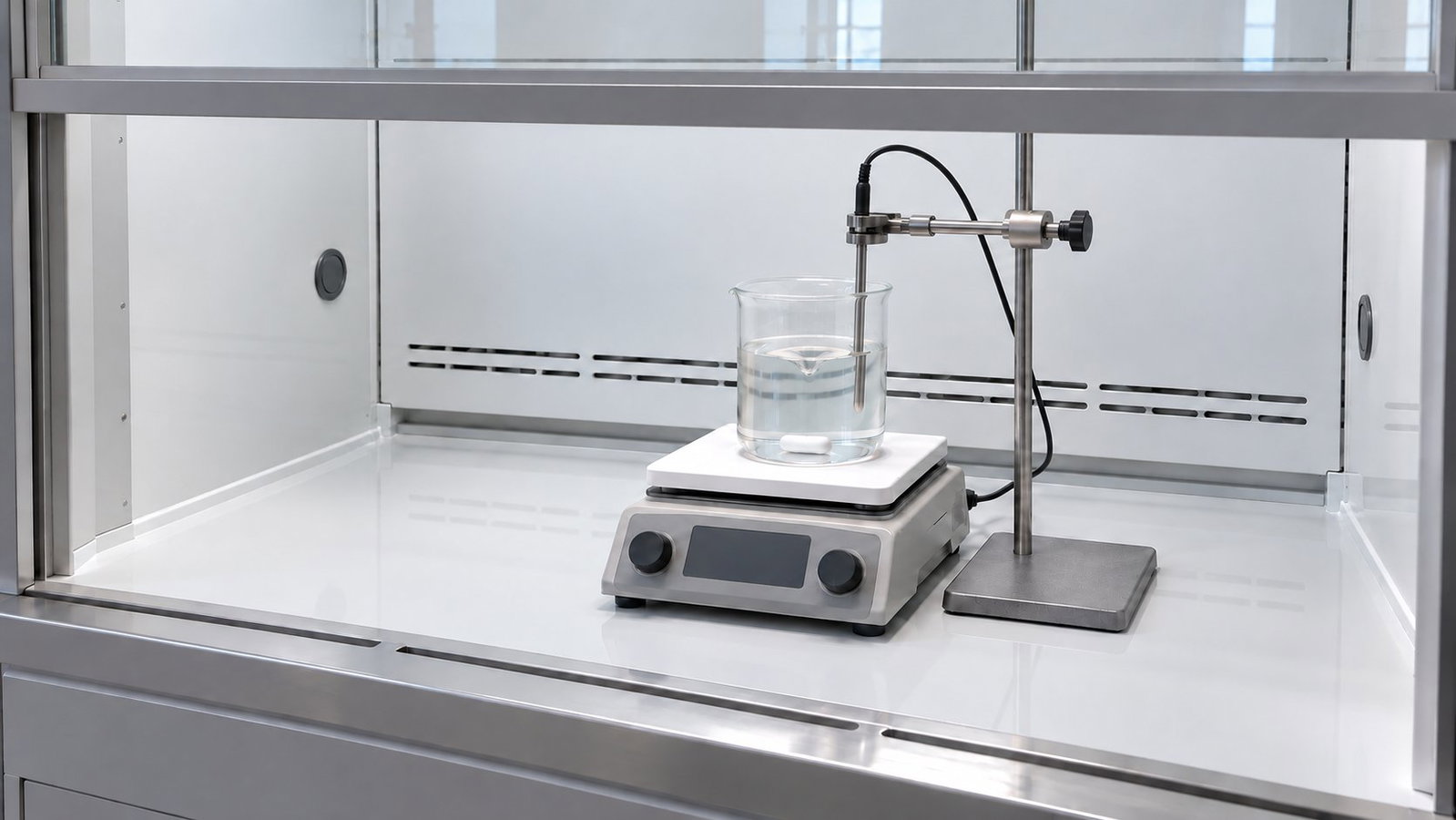
1. Why a Hotplate Can Ignite Solvent Vapour
Fire needs fuel, oxygen and an ignition source. In a lab the fuel is usually vapour from a solvent, and a hotplate offers two kinds of ignition source. The first is a hot surface. Prudent Practices in the Laboratory lists hotplates alongside static discharge, steam lines and other hot surfaces as low-level ignition sources that are still energetic enough to ignite the most flammable substances, such as diethyl ether and carbon disulfide [1]. A sufficiently hot surface can ignite vapour without a flame or spark. The AIT values in Section 2 are test-method-dependent screening values, not guaranteed hot-surface ignition thresholds.
The second is a spark. Prudent Practices notes that older hotplate designs placed the on/off switch and a bimetallic thermostat in the lower housing, and that switches and speed controls on stirring equipment can spark [1]. That location matters because most flammable vapours are heavier than air. They sink, collect at low points and can travel along a bench to an ignition source some distance away [1]. Solid-state controls reduce the spark hazard, and Prudent Practices advises against household hotplates in the lab [1].
Incident reports show both routes:
- Spark, not heat. The University of Minnesota's Joint Safety Team describes ether vapour that ignited, probably from sparks in an old, recently repaired hotplate that was only "just lukewarm" afterwards [10].
- Hot surface at a modest setting. The University of Waterloo Safety Office reports 5 mL of carbon disulfide heated directly on a hotplate at a 75 °C setting; "after a short period of time a flame erupted" and the fume hood contained the fire [4]. Its lesson: do not heat low-boiling flammable solvents directly on a hotplate; use a water or sand bath.
- Stirring only. Prudent Practices Vignette 6.3 describes about 500 mL of carbon disulfide in a beaker on a magnetic stirrer in a hood that caught fire; the stirrer was identified as the probable ignition source, and the fire re-ignited after it was first put out [1].
2. Flash Point vs Autoignition Temperature
Two numbers on a safety data sheet (SDS) describe how easily a liquid burns, and they answer different questions [1]:
- Flash point is the lowest temperature at which a liquid gives off enough vapour to form an ignitable mixture with air near its surface. At or above its flash point, vapour may form an ignitable mixture with air; an ignition source, such as a spark or hot surface, can then ignite it.
- Autoignition temperature (AIT), also called ignition temperature, is the test-method-dependent temperature at which a substance can self-ignite without an external spark or flame. It is a screening value, not a guaranteed hot-surface ignition threshold.
Prudent Practices gives two examples that matter here: carbon disulfide has an ignition temperature of 90 °C, and "diethyl ether has an ignition temperature of 160 °C and can be ignited by a hot plate" [1].
The table below places values from two published handbook sources side by side. They do not always agree, and the differences are left visible.
Educational screening values from published handbooks. Values vary by source and test method. This is educational screening, not a safety certification, and it is not a substitute for the SDS of the material you are using or your institution's risk assessment.
| Solvent | Flash point, °C (Prudent Practices Table 4.4) | Flash point, °C (ICSC, closed cup) | Autoignition temperature, °C (Prudent Practices Table 4.4) | Autoignition temperature, °C (ICSC) |
|---|---|---|---|---|
| Carbon disulfide | −30 | −30 | 90 | 90 |
| Diethyl ether | −45 | −45 | 180 (text: 160) | 160–180 |
| Pentane | < −40 | −49 | 260 | 260 |
| Hexane | −22 | −22 | 225 | 225 |
| Heptane | −4 | −7 | 204 | 220 |
| Cyclohexane | −20 | −18 | 245 | 260 |
| Acetone | −20 (text: −18) | −18 | 465 | 465 |
| Tetrahydrofuran | −14 | −14.5 | 321 | 321 |
| Methanol | 11 | 9 | 464 | 440 |
| Ethanol | 13 | 12.0 | 363 | 400 |
| Toluene | 4 | 4 | 480 | 480 |
| Dimethyl sulfoxide | 95 | 87 | 215 | 215 |
Sources: National Research Council, Prudent Practices in the Laboratory (2011), Table 4.4, which cites the NFPA Fire Protection Guide to Hazardous Materials, 13th ed. (2001) [1]; ILO/WHO International Chemical Safety Cards [11]. "Text" values are the figures given in the Prudent Practices §4.D.1.2 text, which differ from its own Table 4.4. ICSC lists ethanol as anhydrous and pentane, hexane and heptane as the n-isomers. Dichloromethane is not in Table 4.4; its ICSC card lists no flash point, describes it as "flammable under specific conditions" and gives an AIT of 605 °C [11].
Three things stand out, and none of them depends on which source you pick:
- Most of these flash points are below room temperature. At the bench, the vapour above an open beaker of ether, pentane, hexane or acetone is already ignitable; heating only produces more of it.
- Several AIT values are low relative to common hotplate settings. The listed AIT values for carbon disulfide (90 °C), diethyl ether (160–180 °C), heptane (204–220 °C), dimethyl sulfoxide (215 °C) and hexane (225 °C) fall within the maximum setting ranges of many laboratory hotplates. This comparison is a screening warning only: it does not establish the actual plate-surface temperature at a given setting or predict ignition in a particular setup.
- The handbook numbers are not precise limits. They come from standard test methods that differ from real lab conditions, and Prudent Practices states plainly that "large safety factors should be applied" [1]. Use the SDS for the material in your bottle, and treat any single value as approximate.
3. Plate Temperature Is Not Liquid Temperature
The temperature you set, and often the temperature you see, is not the temperature of every surface. When the controller regulates the plate, the plate surface runs hotter than the liquid it is heating; when it regulates an external probe in the liquid, the plate can run hotter still while it drives the liquid up to temperature. The University of Washington EH&S office describes a fire from December 2024 in which "the temperature displayed on the hot plate's panel at the time of ignition was below the ignition point for the chemicals involved", but post-incident testing showed the plate "far exceeded the intended temperature and ignition point" [5]. The procedure had called for an independent thermometer in the mixture, and it was not used. A probe that slips out of the liquid creates a related hazard: it reads a temperature that is too low, so the controller keeps heating. Prudent Practices calls this "an extremely hazardous situation" and insists that temperature-sensing devices be securely clamped [1], and Penn EHRS warns that a hotplate whose probe reads ambient temperature "will continue to heat beyond desired temperature" [7]. Why the plate and the liquid differ, and how an external probe changes control, is covered in our guide to plate vs liquid temperature.
4. What an Over-Temperature Cut-Off Does and Does Not Do
Every heated ALab™ model has a specified over-temperature protection value, under names such as overheating protection, over-temperature protection or safety temperature. It helps to separate two functions that are easy to blur:
- The temperature controller holds the plate, or the liquid via an external probe, at the temperature you set.
- An over-temperature protection value is a separate instrument-protection specification. Its measuring point, whether its sensor is independent of the control sensor, and its reset behaviour are not specified.
Prudent Practices says electrical heating devices should have a controller or a sensing device that cuts power above a preset limit, and that the controller and the shut-off should use independent temperature sensors [1]. Where NFPA 45 applies, it goes further for laboratory practice: heating operations, attended or not, should have an independent high-temperature alarm and an automatic shutdown with manual reset, and electrically heated constant-temperature baths should have over-temperature shutoff switches in addition to their normal temperature controls where overheating could cause a fire [2]. These are expectations for how a laboratory runs heating operations. They are not product ratings, and ACS Material does not claim compliance with NFPA 45 or any other standard for ALab™ models.
An over-temperature value is not a solvent-use limit. Across the 27 products in Section 7, each over-temperature value is above that model's maximum setting. That comparison does not establish the temperature of the plate surface when protection acts: the measuring point is not specified. Nor does the value establish that a solvent operation is safe. Vapour may ignite from a spark or a sufficiently hot surface, and the flash-point and AIT figures in Section 2 are screening data, not operating limits. Treat the over-temperature value as an instrument-protection specification only, never as permission to heat a flammable solvent.
A second failure mode is not about temperature settings at all. In an incident at Oak Ridge National Laboratory on 2 April 2014, a fume hood was destroyed in an unattended lab where a stirring hotplate, with heat control off and stirring on, held a closed 250 mL flask of hexane [3]. Forensic analysis found that the plate had heated by itself because a solid-state power switch failed closed and sent full power to the element regardless of the controller. The authors' review lists similar events at several institutions from 2005 to 2017, including heat turned on in place of the stirrer [3]. UC Agriculture and Natural Resources reports plates that overheated with the heat control "off" and identifies power switch failure as the apparent root cause of many such incidents [9]. A controller cannot correct a fault in the switch it commands, which is why the safety offices recommend independent shutdown and, above all, unplugging when not in use [3][7][9].
What to ask before you buy or use a hotplate for heated work:
- Is the over-temperature limit measured by a sensor independent of the control sensor?
- Does it latch off and need a manual reset, or does heating resume when the temperature falls?
- Which point does it measure: the plate surface, the heating element or an internal location?
- Can the user set a lower safety limit, and over what range?
- What happens when the sensor fails, or when an external probe is intact but out of the liquid?
- Does the power switch disconnect the heater from mains?
- Does the unit carry any listing for use in a hazardous (flammable) location?
The ALab™ specifications do not answer most of these questions; Section 7 lists what they do state.
5. Residual Heat and the "HOT" Warning
A hotplate does not become safe the moment it is switched off. The plate, the vessel and any oil bath hold heat, and that heat causes two different problems.
- Burns. A plate that looks idle can still burn a hand or melt a glove, a plastic bottle or a cable dropped on it.
- Re-ignition. Hot oil and hot surfaces can re-ignite a fire that seemed to be out. In Prudent Practices Vignette 7.1, an oil bath caught fire after its thermocouple fell out, and the fire re-ignited because the oil was still above its autoignition temperature [1]. UC Berkeley EH&S reported on 31 March 2013 that a researcher turned an older hotplate's dial past "OFF" to "HI" while believing it was off; about 30 minutes later the mineral-oil bath ignited, re-ignited after a CO₂ extinguisher was used, and splattered when liquid nitrogen was poured on it, burning the researcher [6].
Many ALab™ models have a residual-heat warning. On 23 of the 27 products in the table in Section 7, the display flashes HOT when the plate is above 50 °C. The condition is worded differently from model to model, and the difference is worth reading. Most say the warning shows even after the power is switched off. For the MS-H280-B / F the warning applies as long as the power cable is connected; for the MS-H380-F, after heating is turned off; the HP550-S and MS7-H550-S have the 50 °C threshold without a specified off-condition. Four products in the table have no residual-heat warning listed at all.
Two cautions apply. First, 50 °C is a warning threshold, not a safe-to-touch temperature; treat any plate as hot until you have checked it. Second, a warning that works after switch-off shows that some electronics stay powered. Whether the power switch disconnects the heater from mains is not specified for any of these models. Penn EHRS is explicit about hotplates in general: "Turning the hot plate power to 'off' does not disconnect the heater from the electrical source," and disconnecting the plug "is the only way to ensure that a processor glitch will not result in spontaneous heating" [7]. Penn, UC ANR and the Oak Ridge review all recommend unplugging hotplates when they are not in use [3][7][9]. No cool-down time is specified, and none is given here.
6. Before You Heat: A Pre-Heating Checklist
Work through these points before each heated run. They summarise published laboratory guidance; your institution's procedures and the SDS take precedence.
- Read the SDS. Note the flash point, autoignition temperature, boiling point and decomposition hazards of every component [1][8].
- Choose the heating method through a risk assessment. Prudent Practices advises against heating highly flammable liquids, or liquids above their flash point, in open vessels [1]. For the specific low-boiling-solvent incident, Waterloo recommends a water or sand bath [4]; that example is not a universal guarantee of safety. Heating mantles, oil baths and heating blocks are compared in our guide to heating round-bottom flasks. For an oil bath, monitor the bath so it does not exceed the oil's flash point, and check the oil's SDS [1].
- Use a fume hood and keep the work area clear. Keep unnecessary flammable and combustible materials, plastics and paper away from the hotplate; leave only materials required by the approved procedure in the hood workspace [1][7][8].
- Make the plug reachable. Plug in outside the hood, or where you can disconnect the unit without reaching into the vapour space [1][3].
- Know which knob is which. Label the stir and heat controls; turning up the heat instead of the stirring is a recurring cause of fires [1][3][7].
- Clamp the probe. Secure the temperature probe in the liquid, and check the liquid temperature independently if your procedure calls for it [1][5][7][8].
- Set a safety limit where the unit offers one, and use a timer that stops heating where available [7][8].
- Contain larger volumes. Where NFPA 45 applies, glass apparatus holding more than 0.25 L of a flammable or combustible liquid heated to its flash point needs containment, such as a tray, in case the vessel breaks [2].
- Stay with it. Prudent Practices advises against operating heating devices unattended [1]. If your institution specifically authorizes an unattended operation, follow its documented risk assessment and surveillance plan and the applicable NFPA 45 requirements, including an independent high-temperature alarm and automatic shutdown with manual reset where NFPA 45 applies [2][7]. Do not assume any feature is present unless the product documentation confirms it.
- Stir only when you only need to stir. A non-heating stirrer removes the hot surface entirely [3][7].
- Test "off". From time to time, switch the heater off and confirm that the plate actually cools [9].
- Unplug after use [3][7][9].
If a fire starts, follow your laboratory's emergency procedure. If it is safe to do so, disconnect power from outside the hood and lower the sash, and never use liquid nitrogen or other cryogens on a burning bath [6].
7. Safety Features of ALab™ Pages
The table below summarises the safety-related features of 27 heated ALab™ products (October 2026). It records what is specified for each product; it does not rate a model for any solvent or use, and it is not a substitute for the operating manual. Where one entry covers more than one model (for example V3 / V5), it applies to all of them.
| Model | Over-temperature value | HOT residual-heat warning | Other safety functions |
|---|---|---|---|
| DHP4-550 | 580 °C | Above 50 °C, also after switch-off | Two independent safety circuits; sensor failure → error, heating stops; settable safety temperature; timer stops heating; safety lock |
| DHP7-550 | 580 °C | Above 50 °C, also after switch-off | Two independent safety circuits; sensor failure → error, heating stops; settable safety temperature; timer stops heating; safety lock |
| DMS4-550 | 580 °C | Above 50 °C, also after switch-off | Two independent safety circuits; sensor failure → error, heating stops; settable safety temperature; safety lock |
| DMS5-120 | 320 °C | Above 50 °C, also after switch-off | None specified beyond the values at left |
| DMS5-280 | 320 °C | Above 50 °C, also after switch-off | None specified beyond the values at left |
| DMS5-340 | 420 °C | Above 50 °C, also after switch-off | Two independent safety circuits; sensor failure → error, heating stops; settable safety temperature; timer stops heating; safety lock |
| DMS5-340M | 420 °C | Above 50 °C, also after switch-off | Two independent safety circuits; sensor failure → error, heating stops; settable safety temperature; safety lock |
| DMS7-550M | 580 °C | Above 50 °C, also after switch-off | Two independent safety circuits; sensor failure → error, heating stops; settable safety temperature; safety lock |
| HP500-Pro | 540 °C | Above 50 °C, also after switch-off | None specified beyond the values at left |
| HP550-S | 580 °C | Above 50 °C (off-condition not specified) | Separate safety circuits |
| MS-H-Pro+ | 420 °C | Above 50 °C, also after switch-off | Safety circuits (independence not specified) |
| MS-H-ProA | 420 °C | Above 50 °C, also after switch-off | Safety circuits (independence not specified) |
| MS-H-ProM | 420 °C | Above 50 °C, also after switch-off | Safety circuits 1 and 2; sensor failure → error, heating stops; timer stops heating |
| MS-H-ProT | 420 °C | Above 50 °C, also after switch-off | Safety circuits (independence not specified) |
| MS-H-S | 420 °C | — | Safety circuits (independence not specified) |
| MS-H-S10 | 140 °C | — | None specified beyond the values at left |
| MS-H220-V3 / V5 | 350 °C | Above 50 °C, also after switch-off | Two independent safety circuits; sensor failure → error, heating stops; timer stops heating; safety lock; dry-burn protection; overcurrent and ground-fault protection |
| MS-H280-B / F | 420 °C | Above 50 °C, when turned off "as long as the power cable is connected" | Two independent safety circuits; sensor failure → error, heating stops |
| MS-H280-S4 / S6 | 420 °C | Above 50 °C, after the power switch is turned off (listed under safety) | Two independent safety circuits; sensor failure → error, heating stops |
| MS-H340-S4 | 420 °C | — | None specified beyond the values at left |
| MS-H380-F | 500 °C | Above 50 °C, after heating is turned off | Two independent safety circuits; sensor failure → error, heating stops; safety lock; overcurrent and ground-fault protection |
| MS10-H500-Pro | 540 °C | Above 50 °C, also after switch-off | None specified beyond the values at left |
| MS7-H280-G | 340 °C | Above 50 °C, also after switch-off | None specified beyond the values at left |
| MS7-H380-E | 410 °C | Above 50 °C, also after switch-off | Dry-burn protection; overcurrent and ground-fault protection; spill protection |
| MS7-H550-Pro | 580 °C | Above 50 °C, also after switch-off | None specified beyond the values at left |
| MS7-H550-S | 580 °C | Above 50 °C (off-condition not specified) | None specified beyond the values at left |
| TB-H240-V1 | 280 °C | — | Sensor failure → error, heating stops; overcurrent and ground-fault protection |
Source: ACS Material product specifications (October 2026). A dash means no residual-heat warning is listed.
Three ALab™ models—the HP380-Pro, MS-H380-Pro and MS-H280-Pro—are marked as not available for chemical fields; they are excluded from the 27-product table above.
Reading across the 27 products:
- Over-temperature values range from 140 °C to 580 °C. Two models give the value as a safety temperature. Six models (DHP4-550, DHP7-550, DMS4-550, DMS5-340, DMS5-340M, DMS7-550M) also offer a settable safety temperature, a user limit that is separate from the fixed over-temperature value; the setting range is not specified.
- Safety circuits: 10 products have two independent safety circuits, and the MS-H-ProM and HP550-S are described in similar terms. On four products, safety circuits provide the over-temperature protection, but they are not described as independent.
- Sensor failure: On 12 products, the unit reports an error and stops heating when the sensor fails.
- Other functions: a timer that stops heating at the end of the countdown (5 products), a safety lock against accidental changes to the settings (8), dry-burn protection (2), overcurrent and ground-fault protection (4), and spill protection that keeps liquids out of the unit (1).
What is not specified. Independent safety circuits is ACS Material's own description. It is not specified whether the over-temperature limit uses a sensor separate from the control sensor, whether it latches or needs a manual reset, or which point it measures. It is also not specified what happens when an external probe is intact but out of the liquid, or whether the power switch isolates the heater from mains. No model has a specified standard or certification behind its over-temperature value, a maximum plate temperature for flammable liquids, or a cool-down time. No ALab™ model has an explosion-proof, intrinsically safe or hazardous-location rating, so none should be used where a flammable atmosphere can form around the instrument; NFPA 45 addresses motors in such locations [2]. If any of these points matters for your procedure, ask us in writing before you rely on it.
8. Frequently Asked Questions
Can a hotplate ignite ether or carbon disulfide?
Yes. Prudent Practices states that diethyl ether "can be ignited by a hot plate", and gives carbon disulfide an ignition temperature of 90 °C [1]. Both have flash points far below room temperature, so their vapour can form ignitable mixtures at the bench. Do not heat them directly on a hotplate. Follow the SDS and institutional risk assessment; Waterloo's water- or sand-bath recommendation applies to its specific incident, not every solvent-heating setup.
Does over-temperature protection make heating a solvent safe?
No. The over-temperature value protects the instrument and sits above the unit's own setting range. Several common solvents have autoignition temperatures below most of these values, and vapour above its flash point can be ignited by a spark or hot spot regardless of the cut-off.
What does the "HOT" warning mean, and when is the plate safe to touch?
On models that have the warning, HOT flashes while the plate is above 50 °C. That is a warning threshold, not a safe-to-touch temperature. Treat the plate as hot until you have checked it; no cool-down time is specified.
Should I unplug my hotplate after use?
Yes. Laboratory safety offices recommend it, because switching off may not disconnect the heater from mains, and a failed switch or controller can heat a plate that is "off" [3][7][9]. Fit the plug where you can reach it without reaching into the hood.
Can I leave a hotplate on overnight?
Do not assume that a timer or over-temperature value makes unattended operation acceptable. Follow your institution's specific approval, risk assessment and surveillance requirements, including the independent alarm and automatic shutdown requirements where NFPA 45 applies [2][7]. Several reported hood fires involved plates left on, or left plugged in, unattended [3][7].
9. Keep Exploring the Stirring & Heating Hub
- Magnetic stirrer hot plate guide: how the drive, plate and controller work, and what each specification means.
- Plate vs liquid temperature and the external probe: why the plate runs hotter than the liquid and what an external PT1000 probe changes.
- Heating round-bottom flasks: heating mantle, oil bath, heating block or hotplate.
Browse all ALab™ magnetic stirrers and ALab™ hotplates.