
A stir bar that chatters, hops against the wall or sits still while the stirrer hums is a familiar sight in any lab. Usually nothing is broken. The bar has lost its grip on the drive magnet, because it is the wrong length, the wrong shape for the vessel, too far from the magnet, or asked to spin too fast in too thick a liquid. This guide covers stir bar sizes and vessel fit, the common bar shapes, why a bar spins out and how to recover it, and how to read the stir-bar figure in a stirrer's specifications. Product figures come from ALab™ product specifications. The explanations of coupling and decoupling come from published stir-bar guides and research, cited at the end. For where magnetic stirring fits among hotplates, baths and heating mantles, see the magnetic stirrer hot plate guide.
Quick answer:
- Size: the bar has to suit the vessel (neck and base) and the stirrer. Stay within the largest bar specified for your stirrer; ALab™ stirrers take bars up to 40 mm, 50 mm or 80 mm, and one specifies 80 × 10 mm.
- Shape: octagon for flat-bottomed vessels, oval ("egg shaped") for round-bottom flasks, micro bars for vials and tubes [2][3].
- Spin-out: the bar loses its coupling with the drive magnet because of speed, viscosity or a badly matched bar length [1]. Stop, re-centre, and restart slowly.
- What spec sheets do not say: no ALab™ stirrer has a specified coupling torque, decoupling speed, drive-magnet size or viscosity limit.
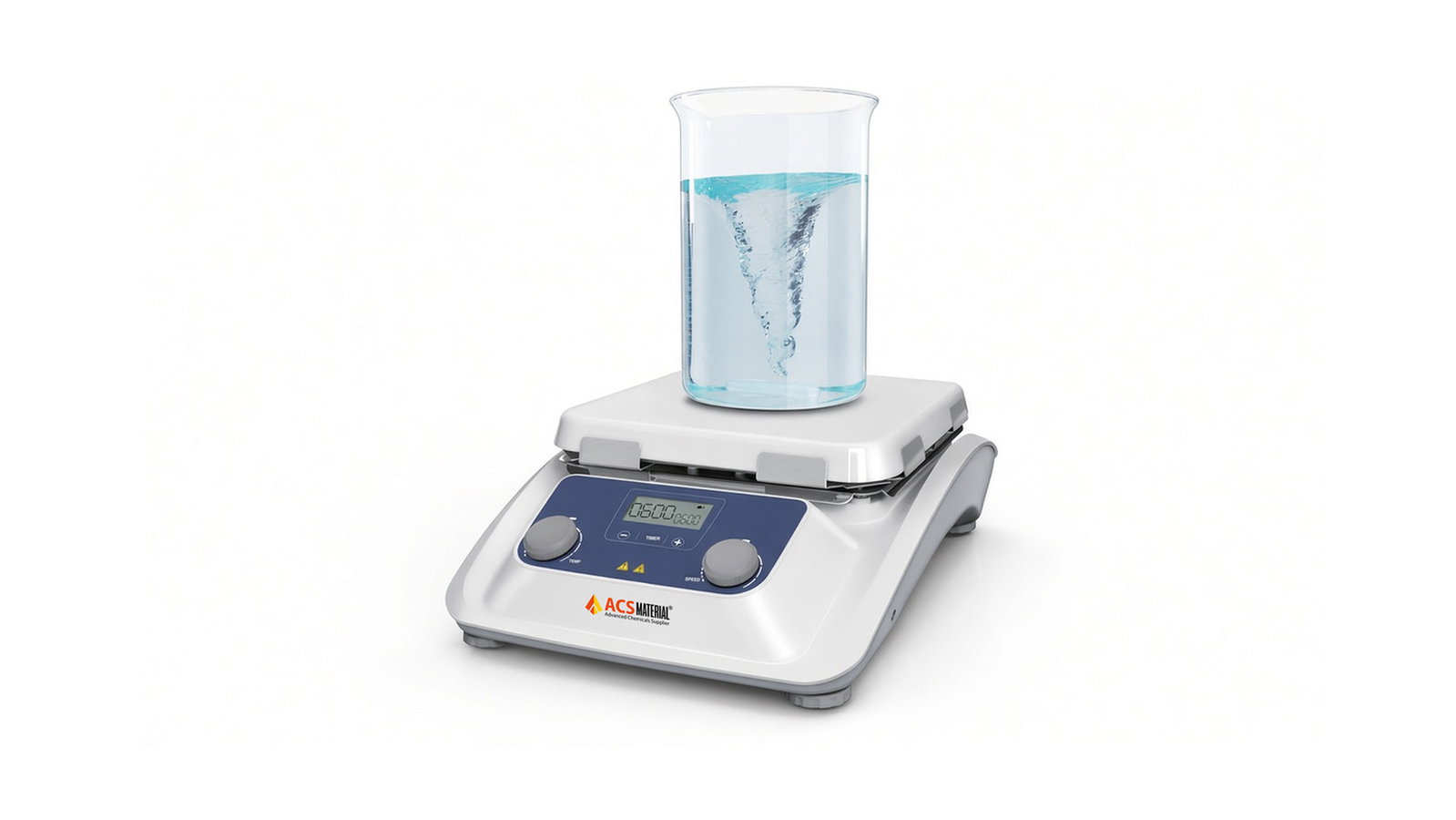
1. Stir Bar Sizes and Vessel Fit
Choosing among stir bar sizes is a matching exercise with three parts: the drive magnet under the plate, the vessel and the liquid.
The drive magnet. A magnetic stirrer turns a magnet under the work plate, and the bar in the vessel follows it. A widely used manufacturer data sheet states the rule plainly: "For optimum magnetic coupling, the distance between the magnetic poles of the drive magnet and the length of the stirring bar should be equal" [1]. Bars "too long or too short in proportion to the drive magnet will not have optimum coupling which is important to reduce spinout" [1]. Cole-Parmer's guide makes the same point: "Selecting bars that are too long or too short can cause decoupling" [2]. The difficulty is that few users know the size of the magnet inside their stirrer. The drive-magnet size and pole spacing are not specified for any ALab™ stirrer. What is specified is the largest bar each stirrer takes (Section 4).
The vessel. The same data sheet lists "vessel shape (including the opening of the vessel that the stirbar has to fit through)" among the things to consider [1]. In practice that means three checks:
- The neck. A bar that suits a wide beaker may not pass the neck of a flask.
- The base. A flat-bottomed beaker suits a straight bar; a curved base suits a bar shaped to it (Section 2). One guide describes elliptical "egg shaped" bars as "particularly well suited for round bottom flasks", because "Their shape mimics that of a flask" [3].
- The distance. "Vertical distance between the drive magnet and the stirring bar should be kept to a minimum for the best coupling and stirring efficiency. Therefore, the containing vessel should be as thin as practical" [1]. A thick base, a cork ring or anything else between vessel and plate adds distance.
The liquid. Volume and viscosity decide how hard the bar has to work. Cole-Parmer notes that "a powerful magnet may be required to stir large volumes or viscous liquids" [2]. A longer bar does not necessarily move more liquid. Effective stirring depends on how the bar couples to the drive magnet, as well as the vessel, liquid viscosity and operating speed [1][2].
A working rule. Start with a bar that suits the vessel base, stays within the maximum size specified for the stirrer, and runs reliably at the intended speed. Chattering or off-centre movement can indicate an unsuitable bar length or shape, excessive speed, high liquid drag, poor centring or too much distance from the drive magnet [1][2].
2. Stir Bar Shapes and What Each Is For
Stir bars come in many shapes, and the guides agree that the shape should follow the vessel. Cole-Parmer is candid that "It is difficult to pinpoint which stir bar shape is most effective" [2], so read Table 2 as a fit guide, not a ranking.
Table 2. Common stir bar shapes and the vessels manufacturer guides pair them with
| Shape | Vessel the guides pair it with | What the guides say |
|---|---|---|
| Cylindrical | No particular vessel type specified in the cited sheet | "excellent centering and smooth running characteristics" [3] |
| Octagon | Flat-bottomed vessels, general purpose [2] | For octagonal bars with an integral pivot ring, SP Scienceware describes an "interrupted profile" with "greater surface area and added turbulence when compared to the smooth surface of cylindrical bars" [3] |
| Pivot ring (a ring at the centre of the bar) | Curved-bottomed vessels [2] | Cole-Parmer describes "Smooth stirring, reduces friction from contact with the vessel" [2]. SP Scienceware's chattering statement specifically concerns octagonal bars with an integral pivot ring [3]. |
| Oval / elliptical ("egg shaped") | Round-bottom flasks [2][3] | "Their shape mimics that of a flask" [3] |
| Micro ("flea") | Vials and tubes [2][3] | For "stirring small volumes" [3] |
| Cross-shaped ("+") | Various vessels [2] | "stable stirring with deep vortex" [2] |
Source: manufacturer guidance (Cole-Parmer; SP Scienceware Spinbar data sheet), not ALab™ specifications. ACS Material does not recommend a particular bar shape for ALab™ stirrers.
Two points from the guides carry straight into practice. First, profile changes the flow: the SP Scienceware data sheet notes that "multi-sided shapes may be more efficient in moving solutions", and that some shapes give "a tailored fit in specialty vessels such as test tubes, cuvettes, spectrophotometer cells and round bottomed boiling flasks" [1]. Second, contact matters. For cylindrical bars fitted with a small removable pivot ring, SP Scienceware says the ring "minimizes the contact area of the bar to the vessel" and "reduces friction" [3]. This is a description of that bar design, not a performance guarantee for every pivot-ring bar.
Bar materials
Most bars are "ALNICO (an alloy of aluminum, nickel, iron and cobalt) magnets encapsulated in FDA approved Teflon®" [1]. Two alternatives matter for demanding work. The first is samarium cobalt (rare-earth), which the data sheet says "increases strength of coupling with a drive magnet and helps to reduce spinout when mixing viscous solutions or mixing at high speeds" [1]. The second is glass encapsulation. SP Scienceware describes its Pyrex®-glass-encapsulated Alnico bars as "useful for high temperature applications up to 274˚C (525˚F) where Teflon® PTFE is not stable" [3]. This is a supplier-specific statement, not a general temperature rating for every glass-encapsulated bar. Cole-Parmer adds a caution: a powerful magnet, "especially rare earth magnets, can increase generation of particulate matter due to grinding effects of the stir bar on the base of the container" [2]. No bar material or coating is specified for ALab™ stirrers.
3. Why the Bar Spins Out (Decoupling)
What decoupling is. The drive magnet pulls the bar round, and the liquid drags against it. While the magnetic pull wins, the bar turns in step with the magnet. When the drag wins, because the magnet turns faster, the liquid is thicker, the bar is a poor match for the magnet or it sits too far away, the bar falls out of step. It then twitches, rattles, hops along the base or stops while the drive keeps turning. The SP Scienceware data sheet defines it: "Should the magnetic stirring bar lose its coupling with the drive magnet because of the speed of the drive magnet, viscosity of the fluid, or an improperly selected stirring bar length, it is said to have 'spun-out'" [1].
Related magnetic-rotation studies illustrate why loss of synchronous motion deserves attention. A neodymium bead in a rotating field "naturally follows the field" at slow rates but can reverse direction at higher rates [4]. Micron-size magnetic wires can "undergo a hydrodynamic instability between a synchronous and an asynchronous regime", a phenomenon used in viscosity measurements [5]. Beads and wires are not laboratory stir bars: neither study establishes a spin-out threshold, viscosity limit or critical speed for a stir bar or any ALab™ product. For practical stir-bar decoupling, use the manufacturer guidance in [1][2].
Four common causes, as the guides list them [1][2]:
- Speed too high, or raised too fast. "The stirring speed should be increased slowly, until the desired vortex pattern is achieved" [1].
- Viscosity. Thick liquids, slurries and mixtures that thicken as a reaction proceeds all increase drag.
- Bar length mismatched to the drive magnet. A bar much longer or shorter than the drive magnet's pole spacing couples poorly [1][2].
- Distance and position. A thick vessel base, anything between vessel and plate, or a bar that is not "positioned directly over the center of the drive magnet" [1]. Cole-Parmer also names the vessel type among the causes [2].
Off-centre vessels. Vessel position can affect stirring in a crowded experimental arrangement. Cherepanova and colleagues (2025) investigated 15 vials placed across three levels, from the centre toward the periphery of a conventional single magnetic stirrer, and found that "the nature of the bar rotation changes when it is placed at different positions on a magnetic stirrer, ceasing entirely at specific locations on the stirrer plate" [6]. For the position farthest from the stirrer's centre in one specific setup, "the bar remained immobile for more than 35% of the observed duration once acceleration was factored out" [6]. The result also depended on the arrangement's geometry, including vessel height. The authors also report that "the size of the bars affects the reaction kinetics", and that bar movement "can change when different bar types are used, as well as when the vessel type is varied" [6].
That study tested crowding vials on a single-drive stirrer. It did not test any ALab™ model, and it gives no decoupling speed for any stirrer. What it does show is that bar size, bar type, vessel and position are experimental variables. The authors recommend keeping the "stirring bar size/type, and vessel size/type" the same for similar experiments, together with the stirrer, stirring parameters and vessel positions, and documenting them [6].
How to recover a spun-out bar:
- Stop stirring and allow the bar to settle before repositioning the vessel. If the stirrer is heating or the vessel is hot, follow the equipment's safe-handling and cooling procedures; do not handle hot glassware directly.
- Centre the vessel so the bar sits directly over the centre of the drive magnet [1].
- Restart at low speed and increase it slowly [1][2].
- If it spins out again below the speed you need, change the bar: a different length, a shape that suits the vessel base, or a samarium cobalt bar for viscous liquids or high speeds [1].
- Reduce the distance: use a thinner, flat-bottomed vessel and remove anything between vessel and plate [1].
No decoupling speed or coupling torque is specified for any ALab™ stirrer, so there is no figure to look up. The threshold depends on the bar, the vessel, the liquid and the drive together.
4. Reading Maximum Stir Bar Length and Volume on a Spec Sheet
Some manufacturers publish the largest stir bar a stirrer takes. Of the 43 ALab™ hotplate, stirrer, heating-mantle and bath products, 35 do, covering 39 models. The figure is labelled in one of three ways:
- Maximum stirrer bar length: 31 products.
- Maximum stirrer size (length): three products, the DMS4-550 (40 mm), DMS5-340M (80 mm) and DMS7-550M (80 mm).
- Maximum stirrer bar size: one product, the MS7-H380-E (80 × 10 mm), the only one with a diameter as well as a length.
Table 1 groups the 35 products by the largest bar each one takes, with its water volume alongside.
Table 1. ALab™ stirrers grouped by the largest stir bar they take
| Largest stir bar | Pages | ALab™ products, with each one’s maximum stirring volume or quantity for water |
|---|---|---|
| 40 mm | 15 | Hotplate stirrers: DMS4-550† — 10 L · DMS5-120 — 5 L · DMS5-280 — 5 L Magnetic stirrers (no heating): DMS4 — 10 L · EcoStir (square plate) — 1.5 L · EcoStir-E — 2 L · FlatSpin — 0.8 L · MS6-Pro — 5 L Multi-position stirrers: MS-H-S10 — 0.4 L × 10 · MS-H280-S4 / S6 — MS-H280-S4: 3 L × 4; MS-H280-S6: 3 L × 6; 3 L per channel · MS-H340-S4 — volume not specified · MS-M-S10 — 0.4 L × 10 · MS-M-S4 / S6 — MS-M-S4: 3 L × 4; MS-M-S6: 3 L × 6; 3 L per channel · MS-T-S15 — 0.4 L × 15 Stirred bath: MS-H220-V3 / V5 — MS-H220-V3: 3 L; MS-H220-V5: 5 L |
| 50 mm | 3 | Hotplate stirrers: MS-H280-Pro — 3 L (“Use restriction”: Not available for chemical fields) · MS-H380-Pro — 5 L (“Use restriction”: Not available for chemical fields) Magnetic stirrers (no heating): MS-PA / MS-PB — 3 L |
| 80 mm | 16 | Hotplate stirrers: DMS5-340 — 20 L · DMS5-340M† — 20 L · DMS7-550M† — 20 L · MS-H-Pro+ — 20 L · MS-H-ProA — 20 L · MS-H-ProM — 20 L · MS-H-ProT — 20 L · MS-H-S — 20 L · MS10-H500-Pro — 30 L · MS7-H280-G — 20 L · MS7-H550-Pro — 20 L · MS7-H550-S — 10 L Magnetic stirrers (no heating): DMS5 — 10 L · DMS7 — 20 L · MS-S — 20 L · MS7-S — 10 L |
| 80 × 10 mm | 1 | Hotplate stirrers: MS7-H380-E‡ — 20 L |
Source: ACS Material product specifications (October 2026). † Specified as a maximum stirrer size (length); ‡ specified as a maximum stirrer bar size; all others as a maximum stirrer bar length. Volumes are the maximum stirring volume or quantity for water, per model, per position or per channel; none is summed. Any use restriction is noted in the same cell.
How to read these figures:
- It is a maximum, not a recommendation. A maximum stirrer bar length of 80 mm is the largest bar specified for that stirrer. It does not say that an 80 mm bar suits every vessel or volume, and smaller vessels need shorter bars.
- Bar length and volume are separate specifications. No ALab™ specification pairs a bar length with a volume, a vessel or a speed. Read 20 L as the water figure; it is not tied to an 80 mm bar.
- The volumes are for water. Every volume is given for water (H₂O). Viscous liquids are a different job (Section 5), and no viscosity limit is specified.
- A longer listed bar says nothing about coupling strength. No coupling torque or magnetic field strength is specified, so the bar length says nothing about how firmly a bar is held.
- Multi-position models take 40 mm bars across all six model families, with volume per position or per channel.
- No specification, no figure. The eight products without a stir-bar specification are five hotplates without stirring, two stirring heating mantles and one constant-temperature bath; we do not assign them a bar length. The MS-H340-S4 takes stir bars up to 40 mm long, but its stirring volume for water is not specified.
For plate size, maximum temperature, control and the full model-by-model selection table, see how to choose a magnetic stirrer.
5. Viscous Liquids: Stronger Magnets, Slower Ramps or an Overhead Stirrer
Viscous liquids can make magnetic coupling more difficult because they increase resistance to bar rotation. The manufacturer guides offer several practical measures [1][2]:
- Ramp slowly. Increase speed gradually while checking that the bar continues to rotate reliably. If coupling is lost, stop and restart at a lower speed after checking the setup [1][2].
- Consider a different magnetic bar. SP Scienceware says samarium cobalt bars can help "to reduce spinout when mixing viscous solutions" [1]. Cole-Parmer notes that a powerful magnet "may be required" for viscous liquids, but greater magnetic strength does not necessarily produce more effective mixing and may increase abrasion-related particles [2].
- Choose the profile. One guide describes a fluted, tapered octagonal rare-earth bar as "especially well-suited for viscous solutions" [3].
- Keep the distance short. A thin, flat base keeps the bar close to the drive magnet [1].
Some stirrers have magnets intended for viscous work. The DMS4-550, DMS5-340M and DMS7-550M use selected high-temperature-resistant strong magnets for strong stirring of viscous liquids, and the MS-H-ProM has enhanced magnets and a powerful motor for viscous liquids, with smooth acceleration and deceleration. These are ACS Material's own descriptions. No field strength, coupling torque or viscosity limit is specified for these models, so the description is not a viscosity rating and not a promise that a bar will never decouple. Magnet strength and listed bar size are separate specifications: the DMS4-550 has strong magnets but a maximum stirrer size (length) of 40 mm.
When the bar still spins out at the lowest useful speed, or the mixture is closer to a paste than a liquid, magnetic stirring has reached its limit. An overhead stirrer drives an impeller on a shaft directly, so there is no magnetic coupling to lose.
6. Frequently Asked Questions
What stir bar size should I use for a 1 L beaker?
There is no single number. Choose a bar that suits the beaker's flat base, sits centred and turns freely without striking the wall, and is no longer than the largest bar specified for your stirrer. If it spins out, ramp up more slowly or try a different length [1][2].
Why does my stir bar jump or rattle?
It has decoupled from the drive magnet. The usual causes are speed raised too fast, a viscous liquid, a bar length that does not match the drive magnet, or too much distance or an off-centre vessel [1][2]. Stop, re-centre and restart slowly.
Can I use an 80 mm bar on any stirrer?
No. Of the 35 ALab™ products with a stir-bar specification, 16 list 80 mm and one lists 80 × 10 mm; 15 list 40 mm and three list 50 mm. Stay within the maximum specified for your stirrer.
Does a bigger bar stir more volume?
Not necessarily. Usable stirring volume depends on the stirrer, bar, vessel and liquid, not bar length alone [1][2]. SP Scienceware describes its Giant Polygon bars as suitable "for stirring substantial volumes in large vessels" [3], but that is a supplier-specific bar description. ALab™ water-volume specifications are separate from their maximum bar sizes.
Which stir bar shape suits a round-bottom flask?
An oval or elliptical ("egg shaped") bar, which both guides pair with round-bottom flasks [2][3]. For other curved bases, Cole-Parmer pairs pivot-ring bars with curved-bottomed vessels [2].