
Both techniques boil a liquid and condense the vapor, and there the resemblance ends. Simple distillation is a separation: it exploits differences in volatility to pull one component out of a mixture. Rotary evaporation is, in almost every laboratory use, a concentration: it removes a solvent that you already know you do not want, as gently and as quickly as the equipment allows. Confusing the two produces the two classic disappointments — a rotary evaporator that will not resolve a mixture no matter how carefully it is run, and an atmospheric distillation selected for a task that required only gentle bulk-solvent removal.
In one paragraph: use rotary evaporation when the goal is to remove bulk solvent from a thermally sensitive residue — it trades pressure for temperature, spreads a thin renewed film that transfers heat quickly and can boil more steadily, and recovers the solvent in a receiving flask. Use simple distillation when the goal is to separate two liquids by volatility and collect a purified distillate, when no vacuum is available or wanted, or when the batch is large and the solvent is the product. The decision is not about which apparatus is better; it is about which stream you care about, how much thermal exposure the material tolerates, and whether the components differ enough in volatility for separation to be possible at all. For the underlying theory in full, see the complete guide to rotary evaporation.
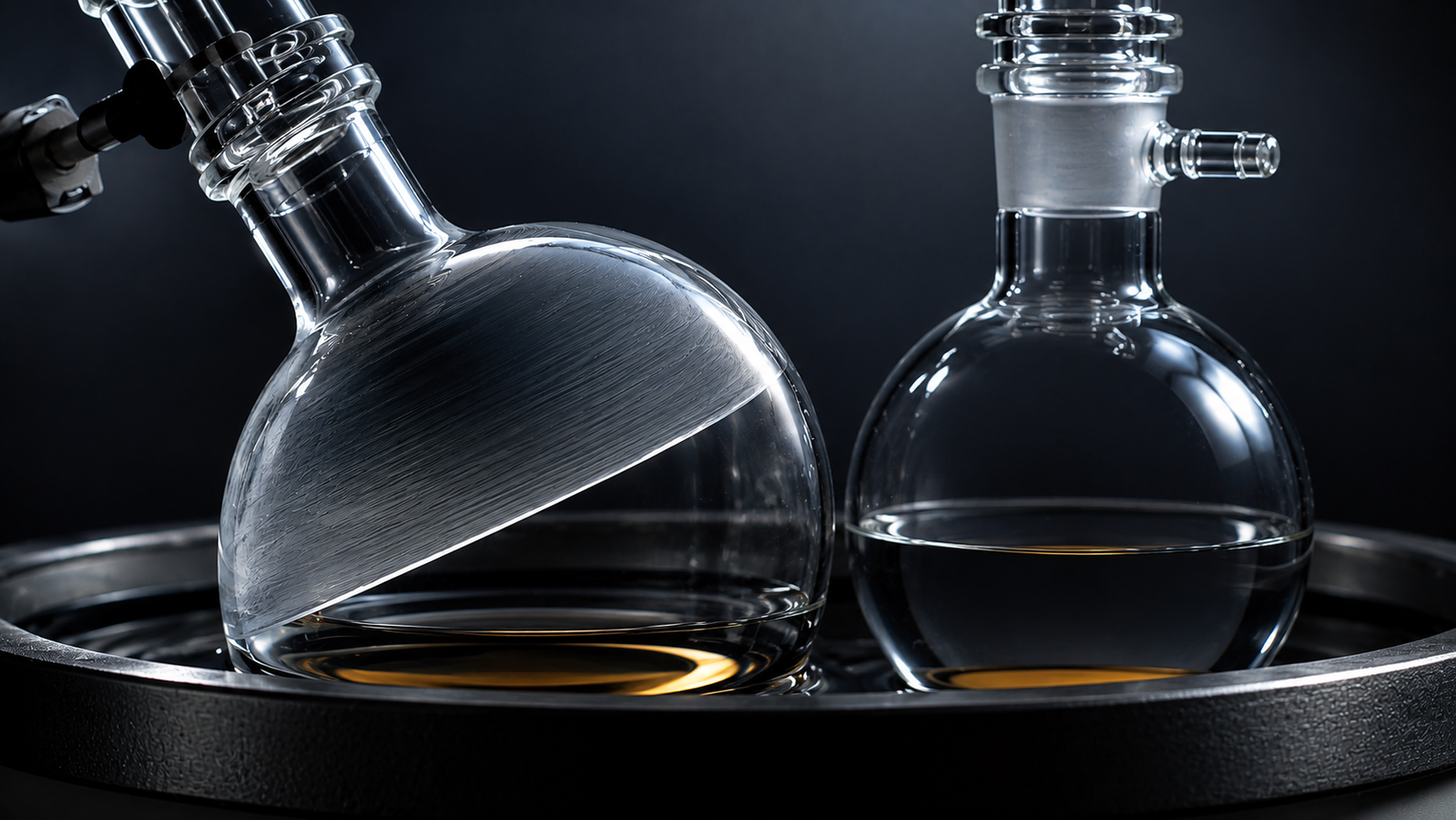
What each technique is actually for
Distillation in all its forms is the workhorse of chemical separation, and it is expensive in a way that is easy to overlook at bench scale. Thermally driven separations dominate industrial energy use, and a widely cited analysis in Nature placed chemical separations at roughly 10–15% of global energy consumption, arguing that displacing heat-driven purification would be among the highest-leverage moves available to the chemical enterprise.1 That framing is useful at the bench too, because it names the real cost of a decision that usually feels free: every hour a flask spends at its boiling point is energy spent and thermal exposure accumulated.
Simple distillation heats a mixture in a still pot at atmospheric pressure, and the vapor — enriched in the more volatile component — is condensed and collected as distillate. The valuable stream is usually what comes over. Resolution depends on relative volatility. Throughout this article the comparison is with the atmospheric simple-distillation case; simple distillation can also be run under reduced pressure, which shifts the temperatures but not the single-stage limitation.
Rotary evaporation lowers the pressure so the solvent boils at a temperature the sample can survive, spins the flask so the liquid forms a thin renewed film, and condenses the vapor into a receiving flask. The valuable stream is usually what stays behind. It is a superb concentrator and a poor separator: for comparison purposes it behaves approximately like a single equilibrium stage, and it has no fractionating column or controlled reflux, so it will not resolve two solvents of similar volatility no matter how patiently it is operated.
Stated that way, most laboratory questions answer themselves. The complications arise in the middle ground — when the residue is thermally fragile, when the solvent itself is worth recovering cleanly, or when the mixture contains a component whose volatility sits uncomfortably close to the solvent’s.
What reduced pressure buys
The boiling point is a setting, not a property
A liquid boils when its saturated vapor pressure equals the pressure above it. Lower the pressure and the boiling point falls — steeply at first, then less so, because the relationship is logarithmic. Over the laboratory range this is well described by the Antoine equation, whose form and fitting were reviewed comprehensively in the classical literature and whose constants are valid only within the interval over which they were regressed.2 High-accuracy modern work extends the range with Wagner-type correlations fitted to ebulliometric measurement; acetonitrile, for instance, has been determined from 4.3 kPa upward with a separate Antoine form quoted for the sub-atmospheric region that laboratory evaporation occupies.3
The practical difference is stark. Ethanol boils at 78 °C at atmospheric pressure but near 40 °C at roughly 178 mbar; water boils at 100 °C but near 40 °C at roughly 74 mbar. A simple distillation exposes the entire charge to the higher figure for the whole run. For many of the molecules chemists actually care about — natural products, intermediates with labile stereocenters, biologically active compounds — that difference decides whether the isolated material is what the reaction produced.
Gentleness is not only about the peak temperature
Thermal exposure is temperature and time. Removing a litre of solvent quickly at 40 °C is a different thermal history from removing the same litre slowly at 78 °C, even before the peak temperatures are compared (illustrative, not a performance benchmark). The thin film is what makes the rate possible: heat crosses it mainly by conduction, and the resistance scales with thickness, so a thin renewed film transfers heat far faster than a deep pool at the same driving temperature difference.
The arithmetic behind “gentler”
It is worth making the comparison concrete rather than rhetorical. Removing one litre of ethanol requires the same latent heat whichever technique is used — roughly 840 kJ/kg, so about 660 kJ for a litre. What differs is the temperature at which that heat is delivered and how long the delivery takes. A simple distillation supplies it at 78 °C through the fixed surface area of a pool; a rotary evaporation supplies it at 40 °C through a film spread across a large fraction of the flask wall. The latent heat required to evaporate the same mass of ethanol is essentially the same either way. Total system energy is not necessarily the same, because bath losses, condenser and chiller duty, vacuum-pump power and run time all differ. The thermal history of the residue is different as well.
The same arithmetic sets the cooling requirement, and this is where the two techniques diverge in a way that surprises people. Condensing duty is latent heat, so a rotary evaporation running three times faster demands three times the cooling. Water carries roughly 2260 kJ/kg against ethanol’s 840 and dichloromethane’s 330, so at the same volumetric rate an aqueous concentration can demand three to six times the cooling of an organic one. A condenser and chiller sized for a lower vapor rate may not keep up with a faster rotary evaporation of the same solvent, and vapor that passes the condenser is lost material, a pump problem and an exhaust problem at once. Note too that a chiller’s capacity is specified at a stated coolant temperature; the capacity available at your intended setpoint must be verified from published model data or confirmed with the manufacturer.
What rotation adds
Rotation is the feature that separates a rotary evaporator from a vacuum distillation, and it contributes three things at once.
It multiplies evaporating area, replacing a flat pool surface whose area is fixed by the flask cross-section with a film spread over a large fraction of the inner wall. It shortens the conduction path, which is one of the principal ways to reduce liquid-side resistance without raising the bath temperature. And it can reduce localized superheating by continuously renewing the surface, which can reduce localized superheating and may lower bumping tendency under otherwise comparable conditions; it does not eliminate bumping.
The behavior of thin liquid films — thickness, stability, the waves that develop and the way those waves enhance transport — constitutes a substantial physics literature.4, 5 On the engineering side, how much heat a thin falling film transfers, and how that depends on film Reynolds number, heat flux and surface condition, has been reviewed critically for the tube geometries used in industrial evaporators.6, 7 These studies provide a useful qualitative analogy, although the geometry and hydrodynamics differ from a rotating flask: transfer improves as the film thins, degrades sharply wherever the film breaks and leaves a dry patch, and depends on how the liquid is distributed rather than on how much of it there is.
A static vacuum distillation captures the pressure advantage but not this one. In a smooth flask under reduced pressure a quiescent liquid can heat well above its boiling point before nucleation begins, and the release when it does is abrupt. Under comparable conditions, rotation can reduce localized superheating and may lower the tendency to bump by continuously renewing the liquid film — though overall safety still depends on the equipment, glassware, solvent, operator practice and protective measures.
Where simple distillation still wins
The comparison is not one-sided, and treating the rotary evaporator as a universal tool causes its own failures.
When you want the distillate, purified. If the product is the volatile component, a distillation with a fractionating column and reflux delivers what a single-stage rotary evaporation cannot. A rotovap collects the vapor, but it does not fractionate it.
When two volatiles must be separated. Resolution requires a difference in relative volatility and, usually, multiple theoretical stages. Rotary evaporation offers roughly one. Two solvents with similar boiling points will simply come over together, and the receiving flask will hold a mixture.
When the mixture is azeotropic. At an azeotropic composition the equilibrium vapor and liquid compositions are equal at the specified pressure, so neither technique separates the components by boiling alone. Pulling deeper vacuum is not a reliable general solution: some azeotropes are pressure-sensitive, while others require an entrainer, a different separation method or a change of process design.
When no vacuum is available, or is undesirable. Vacuum strips volatile analytes indiscriminately, and for some samples that loss is the dominant concern. Atmospheric operation may change the extent of co-distillation, but it does not eliminate loss of volatile analytes. Where the analyte is volatile, neither technique should be treated as selective without method-specific validation.
When the solvent is the product and the batch is large. Bulk solvent purification is a distillation problem, not a concentration problem.
What a distillation setup asks of the operator
The two techniques also differ in what they demand while running. A simple distillation needs nucleation management — boiling chips or a stir bar, added before heating, never to a hot liquid — because a static pool at its boiling point can develop localized superheating. It needs a thermometer positioned so that it reads the vapor at the take-off rather than the liquid, since the vapor temperature is the quantity that tells you what is coming over. It needs the heating rate controlled so that the distillation proceeds at a steady drop rate rather than surging, because a surge carries liquid over mechanically and destroys the separation the column was there to provide. And it needs the pot never taken to dryness, both because residues concentrate and because a dry pot overheats immediately.
A rotary evaporation replaces most of those demands with equipment behavior: rotation can reduce localized superheating by continuously renewing the liquid film, the pressure setting manages the temperature, and the bath controls the heat input. What it adds instead is the vacuum system — a seal to maintain, a pressure trajectory to control, and a condenser whose capacity has to match the rate. Both require supervision in accordance with the laboratory SOP and risk assessment; they simply fail in different ways.
Side-by-side comparison
| Attribute | Rotary evaporation | Simple distillation |
|---|---|---|
| Primary purpose | Concentration — remove bulk solvent | Separation — resolve components by volatility |
| Valuable stream | Often the residue in the flask | Often the distillate collected |
| Pressure | Reduced; boiling point is a setting | Typically atmospheric |
| Thermal exposure | Lower temperature, often shorter time | Normal boiling point, for the duration |
| Effective stages | Approximately one for comparison; no column or controlled reflux | One, or many with a column |
| Heat transfer | Thin renewed film, large wetted area | Deep pool, fixed surface area |
| Boiling behavior | Continuous film renewal; may reduce localized superheating during pressure pull-down | Prone to superheat without agitation or boiling chips |
| Solvent recovery | Collected in the receiving flask; often a single solvent when the feed is dominated by one | Collected as fractions; can be purified |
| Poor fit for | Resolving similar-volatility mixtures; final drying | Thermally fragile residues; fast bulk solvent removal |
Recovery, waste and the green-chemistry case
Whichever technique is used, the solvent has to go somewhere, and that destination has become the center of gravity of green-chemistry practice. Solvents typically dominate process mass intensity in pharmaceutical manufacturing, and the industry adopted PMI precisely because it makes that dominance visible rather than hiding it inside yield calculations.8 The E-factor literature reaches the same conclusion from the waste side: the mass of waste per mass of product in fine chemicals and pharmaceuticals is measured in tens to hundreds, and solvent is the largest single contributor.9
Life-cycle and process-metric analyses consistently identify solvent selection and handling as the dominant environmental levers,10 and the framework for acting on that is unusually mature. Major manufacturers publish solvent selection guides that rank solvents on safety, health and environmental criteria,11, 12, 13 and those guides have converged enough to be surveyed and compared side by side.14 The CHEM21 guide extended the approach to less classical and bio-derived solvents using criteria aligned with the Globally Harmonized System,15 broader frameworks assess “greenness” against full life-cycle impact rather than single attributes,16 and the field has repeatedly cautioned that a solvent scoring well on one axis may score poorly on another.17, 18 Surveys of what chemists actually use show how slowly practice follows guidance,19 and metric work continues to argue for holistic rather than single-number assessment.20
For the technique comparison this has one concrete implication. Rotary evaporation produces a receiving-flask stream that is typically a single solvent and therefore relatively easy to reuse in earlier, less demanding operations — provided it is analyzed rather than assumed. Distillation of a mixed waste stream produces fractions whose value depends entirely on how well the separation went. Keeping streams separate at the point of collection is, in both cases, one of the highest-value habits available. Where thermal recovery is unattractive — high-boiling or thermally sensitive solvents in particular — membrane approaches such as organic solvent nanofiltration are an active alternative, and recent work demonstrates recovery of high-boiling green solvents without a thermal step.21
Choosing between them
Four questions settle almost every case.
| Question | If yes | If no |
|---|---|---|
| Is the material you want left behind in the flask? | Rotary evaporation | Consider distillation — you want the distillate |
| Is the residue thermally sensitive? | Rotary evaporation, and stop short of dryness | Either; choose on convenience and scale |
| Do two volatile components need resolving? | Distillation with a column | Rotary evaporation is sufficient |
| Is a volatile analyte part of what you are measuring? | Neither, without care — expect losses | Rotary evaporation |
The loss that catches people out
Concentration is not selective, and this is documented rather than theoretical. A study of metabolomic extracts concentrated on a rotary vacuum evaporator demonstrated the unavoidable loss of non-dissociating volatile metabolites such as acetone and ethanol, showed that retention of dissociating species such as organic acids depends on solution pH and buffer content, and traced how precipitating buffer salts at the end of drying form a matrix that traps residual analytes.22 If a volatile component of the sample is part of what you are trying to measure or isolate, Either technique can lose a volatile component. The extent depends on vapor-liquid equilibrium, pressure, temperature, composition and endpoint, so recovery should be validated under the selected method.
One hazard that outranks the comparison
Concentrating peroxide-forming solvents is one of the highest-consequence, well-documented hazards in either technique. Ethers such as diethyl ether, tetrahydrofuran and 1,4-dioxane autoxidize on contact with air to form hydroperoxides and peroxides; the process is accelerated by light and heat and begins as soon as a container is opened.23 The laboratory-safety literature classifies such materials by whether they are hazardous on storage alone or specifically on concentration,24, 25 and the reason is straightforward physics: peroxides are far less volatile than the parent solvent, so any evaporation concentrates them in the residue. Published incident accounts repeat the same sequence of an aged ether, a routine concentration and a flask that fails violently.26
Screen peroxide-forming solvents according to the current safety data sheet and your institution’s procedure; test strips have limitations and do not replace container inspection or professional evaluation. Respect both the receipt and opening dates, since inhibitors such as BHT are consumed over time. Never evaporate to dryness. Do not move, open or test a container showing crystals, discoloration, stratification, unusual viscosity, pressure or a stuck cap — contact your EHS team. The hazard is not confined to ethers: forensic work on consumer-aged 2-propanol has characterized spontaneous acetone peroxide formation in ordinary stored material,27 and bio-derived oxygenates raise the same question, where the peroxide number has been argued as the practical safety metric.28 Solvent substitution can reduce risk — 2-methyltetrahydrofuran has been examined as a bio-derived THF alternative with process advantages in some applications29 — but it remains a peroxide-forming ether and does not remove the requirement for SDS review, dating, storage limits and pre-concentration screening.
- ALab™ RE100-S LED Digital Rotary Evaporator — 50–3000 mL flasks, manual plus auxiliary lift, 1200 cm² condenser, 5 L bath usable on its own.
- ALab™ RE100-Pro Digital Rotary Evaporator — 150 mm motorized lift, 20–280 rpm, 1700 cm² vertical condenser.
- ALab™ C410 Chemistry-Design Diaphragm Vacuum Pump — oil-free vacuum source with a published pressure/flow table.
Frequently asked questions
Can a rotary evaporator separate two solvents?
Only if their volatilities differ substantially, and even then imperfectly. A rotary evaporator behaves approximately like a single equilibrium stage and has no column or controlled reflux, so the receiving flask generally holds a mixture. If resolution matters, use a distillation with a fractionating column.
Is a rotary evaporator just a vacuum distillation?
It is a vacuum distillation plus rotation, and the rotation is not cosmetic: it multiplies evaporating area, shortens the conduction path through the liquid and continuously renews the surface. A static vacuum distillation gets the pressure benefit without the film benefit, and is correspondingly more prone to superheating.
Which is faster?
For small-batch bulk solvent removal under otherwise comparable conditions, rotary evaporation is often faster — because of the thin film and the large wetted area rather than because of the vacuum alone. For separating two volatiles, speed is not the relevant axis; a rotary evaporator will not do the job at any speed.
Does reduced pressure always protect the sample?
It reduces the temperature required, which is usually the dominant factor. But it also strips volatile components of the sample indiscriminately, and it does not eliminate exposure at the end of a run when the film is thinnest and the wall temperature closest to the bath. End at the point of interest rather than at dryness.
Can I use a rotary evaporator to dry my product completely?
Not reliably. It is primarily a concentration device rather than a drying device. Residual solvent held in a lattice, adsorbed on a solid or dissolved in an oil is removed by a further step at deeper vacuum, such as a vacuum oven or a lyophilizer.
Should I still use boiling chips?
Boiling chips belong to static distillation setups, where they supply nucleation sites; they may become ineffective once fully wetted, must never be added to a hot liquid, and should not be reused. In a rotary evaporator, rotation can reduce localized superheating by continuously renewing the liquid film, but it is not identical to adding nucleation sites — follow the instrument manual and your laboratory SOP.
References
ALab™ is a trademark of ACS Material, LLC. This article is provided for general educational purposes and discusses rotary evaporation and distillation of laboratory solvents in general terms; it is not a substitute for the operating manual of any specific instrument, for the safety data sheet (SDS) of any specific solvent, or for your laboratory’s own risk assessment. Boiling points, enthalpies of vaporization and other physical properties cited here are approximate reference values that vary with purity, temperature and pressure. Equipment specifications summarize the manufacturer’s current documentation and are confirmed at quotation; always refer to the model datasheet for guaranteed ratings. Any interactive tool on this page is a schematic teaching aid based on the stated model, not predictive design or selection software. Follow your laboratory’s safety procedures for vacuum operation, heated baths, peroxide-forming solvents and solvent handling. ACS Material makes no representations or warranties, express or implied, regarding suitability for any purpose, and will not be responsible for damages resulting from use of or reliance upon this information.