-
Si/C Composites for Battery Materials
Nov 06, 2018 | ACS MATERIAL LLCSilicon can store roughly ten times more lithium than the graphite inside today's batteries — and it tears itself apart doing so. Si/C composite anode materials exist to resolve that contradiction: nanoscale silicon delivers the capacity, an engineered carbon framework absorbs the punishment. This guide walks through the physics of why bare silicon fails, the composite architectures that tame it, the practical silicon-graphite blending math used in real cells, and where silicon-carbon batteries actually stand in phones and EVs today — with interactive simulators and the primary literature behind every number.
Quick answer: A Si/C composite anode material disperses nanoscale silicon (theoretical capacity ~3,579 mAh/g at room temperature) inside a carbon matrix that buffers silicon's ~300% lithiation swelling, maintains electrical contact, and hosts a more stable SEI — capturing a large share of silicon's energy advantage over graphite (372 mAh/g) without its catastrophic fade. It is not silicon carbide (SiC), a ceramic that stores almost no lithium. Silicon-containing anodes already appear in commercial EV cells, while Si/C materials are now powering advanced consumer devices and moving rapidly through EV qualification and scale-up.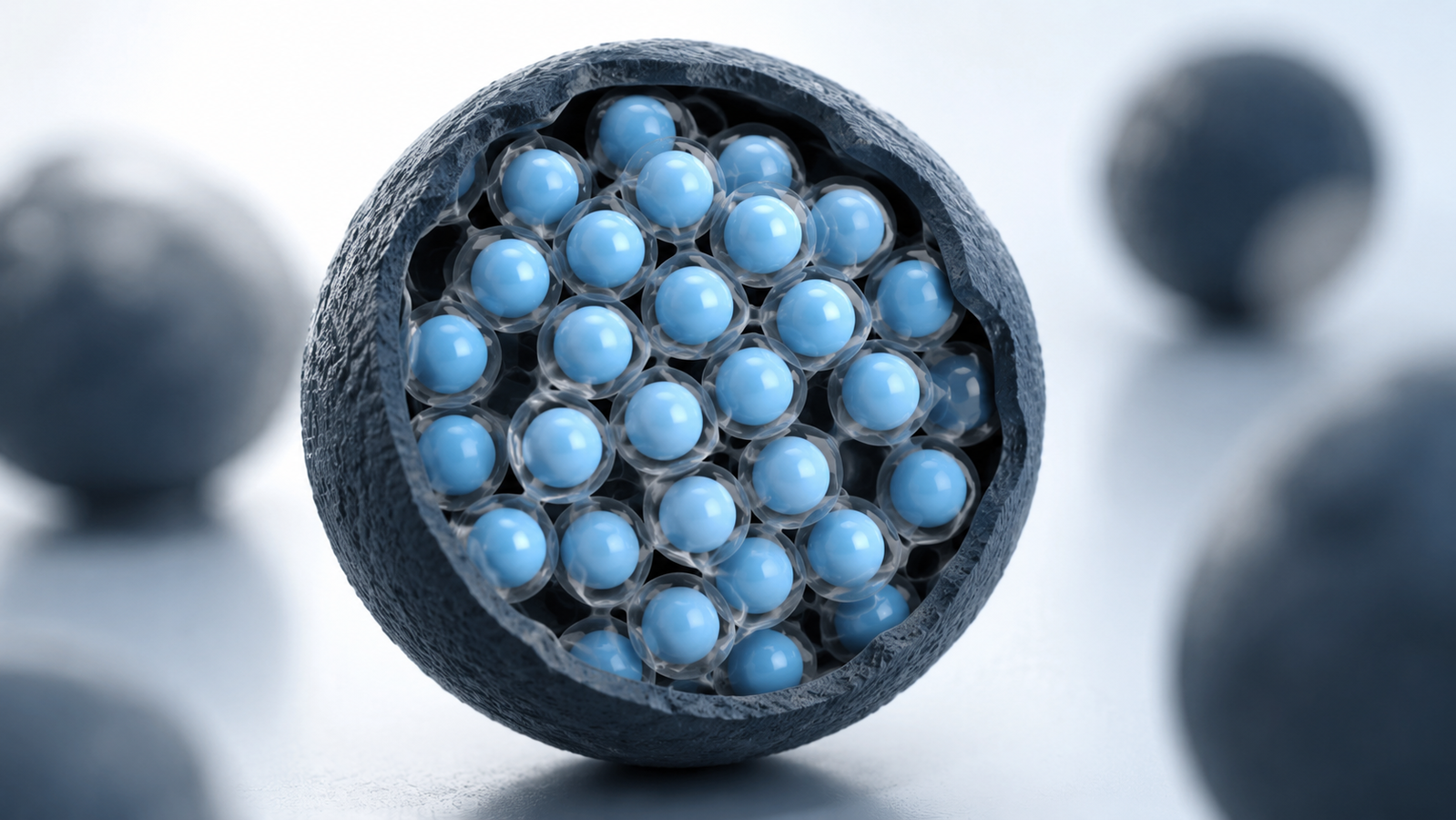
Inside a Si/C composite particle: nanoscale silicon domains sit within a conductive carbon framework that leaves room for expansion — the structural idea behind nearly every successful silicon anode. Why Silicon Anodes Matter: The Capacity Math
Every graphite anode in every commercial lithium-ion battery is bounded by the same number: 372 mAh/g, the theoretical capacity of LiC6, in which six carbon atoms host a single lithium ion. Silicon rewrites that stoichiometry. Each silicon atom alloys with up to 3.75 lithium atoms at room temperature, forming the crystalline phase Li15Si4 and delivering a theoretical capacity of about 3,579 mAh/g — nearly ten times graphite — at an attractively low working potential below ~0.4 V versus Li/Li+.1 The often-quoted 4,200 mAh/g figure belongs to Li22Si5, a phase that only forms at around 415 °C; for a battery operating at room temperature, 3,579 mAh/g is the honest ceiling.
At the full-cell level the payoff is substantial rather than tenfold, because the cathode, electrolyte, foils, and packaging still weigh what they weigh. Paired with an NCM811 cathode, cells built on SiOx or Si/C anodes have demonstrated gravimetric energy densities around 471 and 493 Wh/kg respectively, and a pure-silicon anode pushes the same stack to roughly 520 Wh/kg1 — figures far beyond the ~250–300 Wh/kg of today's best graphite-based EV cells. Silicon is also the second most abundant element in the Earth's crust, mined and refined at enormous scale for the semiconductor and solar industries, so the raw material is neither exotic nor supply-constrained.
The catch is mechanical. Packing 3.75 lithium atoms around every silicon atom swells the host by roughly 280–300% of its original volume, and the swelling reverses on every discharge.2 Graphite, by comparison, breathes by about 10%. That difference in mechanical violence is the entire reason Si/C composites exist — and the subject of most of this article.
First, the Name: Si/C Is Not Silicon Carbide (SiC)
The slash matters. Si/C (read "silicon-carbon") denotes a composite — two distinct materials, elemental silicon and carbon, engineered together while each keeps its own identity. SiC (silicon carbide) is a single covalent ceramic compound in which silicon and carbon atoms are chemically bonded one-to-one. The distinction is not pedantic: silicon carbide is electrochemically inert toward lithium under normal anode conditions and stores essentially no charge, which is precisely why a good Si/C anode powder is checked by X-ray diffraction to confirm that no SiC phase formed during carbonization. ACS Material's own Si/C composite products show silicon reflections at 28.5°, 47.5°, 56.2°, and 76.5° with no detectable SiC — the silicon stays metallic, dispersed, and lithium-active.
The confusion is everywhere, including in spec sheets and tech journalism: "silicon-carbon battery" (a lithium-ion cell whose anode contains a Si/C composite) gets shortened to "SiC battery," which readers then conflate with the silicon carbide power semiconductors used in EV inverters and onboard chargers. Both technologies may sit in the same vehicle — SiC chips switching the current, Si/C particles storing it — but they share nothing beyond two element symbols. Throughout this article, Si/C means the composite anode material.
What ~300% Volume Expansion Actually Breaks
Silicon's swelling does its damage through three coupled failure modes, and understanding them separately explains why every successful Si/C design looks the way it does.
Fracture and pulverization. When lithium alloys into crystalline silicon, a sharp reaction front sweeps inward, leaving an expanded amorphous Li-Si shell wrapped around a shrinking pristine core. The mismatch builds enormous tensile hoop stress in the surface layer. In situ transmission electron microscopy on individual nanoparticles revealed a remarkably clean threshold: particles below a critical diameter of about 150 nm strain elastically and survive first lithiation intact, while larger particles crack at the surface and then fracture outright.3 This single experiment set the design rule for the whole field — the silicon in a serious Si/C composite is nanoscale not for fashion but because fracture mechanics demands it. Going extremely small carries its own tax, though: 10 nm silicon shows the highest charge capacity but poor Coulombic efficiency and retention from its huge reactive surface, both of which recover sharply once a carbon coating is applied.4
The unstable SEI treadmill. Every anode below ~1 V grows a solid electrolyte interphase (SEI), a passivating film built from sacrificed electrolyte and lithium. On graphite the SEI forms once and largely persists. On bare silicon, each expansion stretches and cracks the film and each contraction exposes fresh surface, so the cell rebuilds SEI every cycle — permanently consuming the lithium inventory the cathode supplied and thickening a resistive crust around the particle. This treadmill, more than fracture itself, is what ends full-cell cycle life, because a full cell has no lithium reservoir to waste.
Quiet losses at rest. Damage continues even when nothing is cycling. Storage studies comparing silicon-rich and graphite electrodes find that the chemical pathway — continued SEI growth and lithium consumption during rest — dominates silicon's calendar aging, outweighing mechanical contributions.5 Scanning electrochemical microscopy adds a mechanistic detail: the SEI on silicon measurably loses its passivating quality during delithiated storage, leaving the surface more reactive than before.6 Calendar life, not just cycle count, is now recognized as a frontline obstacle for silicon-heavy cells — an EV battery must survive a decade of parking lots, not only 1,000 equivalent cycles.
The simulator below makes the contrast concrete: watch a bare silicon particle and a Si/C composite particle live through the same charge-discharge cycles.
The Carbon Half of the Partnership
Carbon earns its place in the composite by doing four jobs at once. It is a mechanical buffer: an elastic or rigid carbon framework absorbs and redirects silicon's expansion so the electrode's outer dimensions barely move. It is the electrical highway: silicon is a modest semiconductor, and isolated silicon fragments that lose electronic contact become dead weight, so a continuous carbon network keeps every silicon domain wired to the current collector through thousands of breathing cycles. It is the SEI's preferred host: a complete carbon skin presents the electrolyte with a familiar, graphite-like surface, confining SEI formation to a stable outer interface instead of the restless silicon underneath. And it is the dispersion scaffold: carbon keeps nanosilicon from aggregating into exactly the large clusters the 150 nm fracture rule forbids.
The blueprint for combining these roles arrived in 2010 with a hierarchical "bottom-up" granule: silicon nanoparticles decorated onto carbon black, then assembled into rigid, micron-scale spherical granules with internal porosity — nanostructure where mechanics demands it, micron-scale powder where electrode coating machinery demands it.7 Fifteen years of refinement have not changed that logic, only sharpened it: modern designs control the silicon-carbon void space with near-atomic precision, using graphene cages and carbon nanofiber webs so the empty volume is exactly where the expansion will go and nowhere else.8
An Architecture Gallery: Core-Shell to Pomegranate
Four architectures dominate the Si/C literature and, increasingly, the market. Each answers the same question — where does the expansion go? — differently.
Core-shell is the simplest: a conformal carbon coat carbonized directly onto each silicon particle. It wires the silicon and tames its surface chemistry, but a snug shell must stretch with every breath, so on its own it suits low silicon fractions and small particles best. Yolk-shell fixes the squeeze by deliberately leaving a void: the silicon "yolk" expands freely inside a roomy carbon "shell" whose outer surface — where the SEI lives — never moves. The original demonstration delivered ~2,800 mAh/g at C/10, 74% retention over 1,000 cycles, and a late-cycle Coulombic efficiency of 99.84%, fabricated from commodity silicon nanoparticles at room temperature.9 Pomegranate scales the yolk-shell idea up a level: hundreds of yolk-shell units packed into a micron-scale secondary cluster wrapped in one more carbon rind, slashing the surface area exposed to electrolyte by an order of magnitude. The pomegranate anode held 97% of its capacity over 1,000 cycles and reached areal capacities comparable to commercial electrodes10 — the paper that convinced many skeptics silicon could be tamed at practical loadings. Porous scaffold designs invert the construction: build the carbon host first — a porous carbon microsphere or CNT-reinforced framework — then deposit or infiltrate silicon into its pores. A carbon-nanotube-reinforced Si/C microsphere of this type combined >200 MPa particle strength with only ~40% apparent particle expansion at full lithiation, delivering ~750 mAh/g at a commercial-grade 3 mAh/cm² loading and >92% retention over 500 full-cell cycles against an NMC cathode.11 This scaffold-first logic, executed with silane CVD into porous carbon, is essentially what today's leading commercial silicon-carbon powders do at ton scale.
The architecture race continues at the margins — vertical graphene sheets grown inside yolk-shell voids to wire the yolk to the shell,12 and even corn-starch-derived carbon frameworks that trade petroleum precursors for biowaste without surrendering performance.13 Toggle through the four designs below and lithiate each one to see where the swelling goes.
The Practical Recipe: Silicon-Graphite Blending
Almost no commercial cell uses a 100% silicon-composite anode today. The industrial playbook is blending: keep graphite as the dependable bulk host and fold in a controlled fraction of Si/C or SiOx for the capacity boost. The arithmetic is friendly — because silicon-based additives carry several times graphite's capacity, even single-digit weight percentages move the needle. Blend studies at genuinely commercial electrode conditions — areal capacities near 3.3 mAh/cm² and volumetric capacities around 570 mAh/cm³ — confirm both the gain and its price: every added percent of silicon tightens the demands on porosity, calendering, and lifetime management.14 A practical SiOx or Si/C component contributes on the order of 1,600 mAh/g in real electrodes,15 so a 10 wt% addition lifts a 360 mAh/g graphite electrode toward ~480 mAh/g — a one-third jump in anode capacity for a modest formulation change.
This is exactly the regime real products occupy. Teardowns of the Panasonic 21700 cells that power Tesla vehicles show graphite anodes with embedded SiOx particles,16 and review analyses place the silicon content of such EV cells at roughly 5 wt% in earlier designs and around 10 wt% in Model 3-era cells — worth a reported ~30% gain in energy density.2 The expansion budget explains the restraint: at the electrode level, swelling scales with the silicon fraction, and a pouch or can engineered for graphite's gentle 10% breathing cannot suddenly host an anode that doubles in thickness. Blending lets cell designers buy capacity in increments their mechanical design can afford.
ACS Material's Si/C Composite Anode Material line is built for precisely this workflow: Type A integrates 8 wt% silicon with high-performance graphite for ~450 mAh/g, and Type B carries 18 wt% silicon for ~500 mAh/g, with cycling demonstrated to 1,500 cycles at 80% capacity retention and production already at industrial ton scale — drop-in powders for teams who want the blend math handled inside the particle itself. Use the calculator below to explore the capacity-versus-swelling trade as you turn the silicon dial.
Beyond the Particle: Binders, Electrolytes, Conductive Networks, Prelithiation
A brilliant particle dies in a bad electrode. Four supporting technologies decide whether a Si/C composite's lab numbers survive the trip into a real cell.
Binders that grip. The PVDF binder that suffices for graphite relies on weak van der Waals contact and lets breathing silicon particles slip loose. Carboxyl-rich polymers changed the game: polyacrylic acid (PAA) carries a far higher density of -COOH groups that hydrogen-bond and condense onto the native oxide of silicon, holding the electrode together through repeated expansion.17 The binder is not a passive glue, either — PAA participates directly in building a more protective SEI on silicon surfaces.18 Grafted designs such as sodium-PAA-on-CMC add multi-point anchoring to both silicon and the copper foil,19 and the broader binder literature — alginates, self-healing networks, conductive polymers — consistently shows binder choice swinging silicon cycle life by integer factors.20
Electrolytes that heal. Fluoroethylene carbonate (FEC) is the signature additive of the silicon era: its reduction floods the interface with LiF and compact polymeric species, producing a thinner, tougher, self-repairing SEI on silicon21 — chemistry that carries over directly to Si/C composite anodes, where FEC-derived interphases have been mapped in molecular detail.22 Most silicon-containing cells today simply do not ship without FEC or a descendant of it.
Conductive networks that stretch. Carbon black bridges particles by point contact, which breathing particles repeatedly break. Single-walled carbon nanotubes wrap silicon domains in a flexible, long-range web instead: Kelvin-probe mapping shows SWCNT-equipped silicon anodes lithiating uniformly where additive-free electrodes charge in patches,23 and fractions below one weight percent stabilize the cycling of graphite-SiO blend electrodes at commercial loadings.24 Graphene nanoplatelets play a similar planar role, tiling expansion-tolerant electrical highways across the electrode.
Prelithiation to pay the entry fee. Silicon's first cycle irreversibly consumes lithium — SEI formation plus lithium trapped in the alloy — dragging initial Coulombic efficiency (ICE) far below graphite's and wasting cathode capacity the cell paid for. Prelithiation loads that lithium in advance: chemical treatment of amorphous silicon anodes with lithium naphthalenide lifted full-cell ICE from 74.8% to 97.2% while simultaneously pre-forming a robust SEI,25 parallel strategies attack the same problem in SiOx systems where irreversible lithium silicate formation deepens the deficit,26 and the approach extends into all-solid-state cells, where prelithiated LixSi anodes have reached areal capacities up to 10 mAh/cm².27
Cycle Life vs. Calendar Life: Two Clocks, One Budget
A silicon-containing cell ages on two clocks. The cycle clock ticks with every charge: mechanical fatigue, SEI repair, and the slow electrical isolation of fragmented silicon. Composite architecture, nanoscale silicon, elastic binders, and FEC all push this clock back — which is why a well-engineered Si/C blend now posts four-digit cycle counts where bare silicon collapsed within dozens. The calendar clock ticks even in a drawer: as covered earlier, parasitic SEI growth on silicon's imperfectly passivated surface keeps consuming lithium at rest, and it is this chemical pathway — not mechanics — that dominates storage fade.5 For consumer electronics replaced every three years, the calendar clock barely matters; for an EV warrantied to a decade, it is the binding constraint and the focus of intense current research into surface coatings, electrolyte formulations, and operating-window management.6
The simulator below sketches the cycle-clock story: three anodes, one axis of truth. The curves are illustrative trends synthesized from the cited literature, not a single dataset.
From Lab to Market: Where Si/C Stands in 2026
The silicon anode stopped being a promise and became a product line. The clearest beachhead is the smartphone: the HONOR Magic7 Pro launched in late 2024 with a 5,850 mAh "third-generation silicon battery" built on Group14's SCC55 silicon-carbon material — a porous hard-carbon scaffold loaded with amorphous nanosilicon by silane CVD, the porous-scaffold architecture from our gallery running at factory scale — and flagship designs from Xiaomi, vivo, and OPPO have followed the same silicon-carbon route to pack more watt-hours into thinner bodies.28 By 2026, silicon-carbon batteries had also spread across high-capacity smartphone and foldable designs, with several flagship models using the chemistry to push battery capacity well beyond the levels previously typical for thin phones.
Automotive adoption moves on a slower, heavier clock, but the direction is identical. Sila's Titan Silicon — first commercialized in the WHOOP 4.0 wearable in 2021 — delivers a roughly 20% energy-density gain over the best graphite cells, with automotive customers qualifying anodes in which up to 85% of the graphite is displaced and consumer customers running full replacement; its Moses Lake plant was built out through 2025 to feed contracts including Mercedes-Benz.29 Panasonic Energy, Tesla's long-time cell partner, has signed a silicon-anode material procurement agreement with Sila for U.S. EV battery production30 — a strong signal that the cautious few-percent SiOx blends confirmed in today's 21700 teardowns16 are a floor, not a ceiling. At the aggressive end, development cells pairing high-silicon anodes with nickel-rich cathodes have crossed 470–520 Wh/kg,1 numbers that translate directly into lighter packs, longer range, and faster charging.
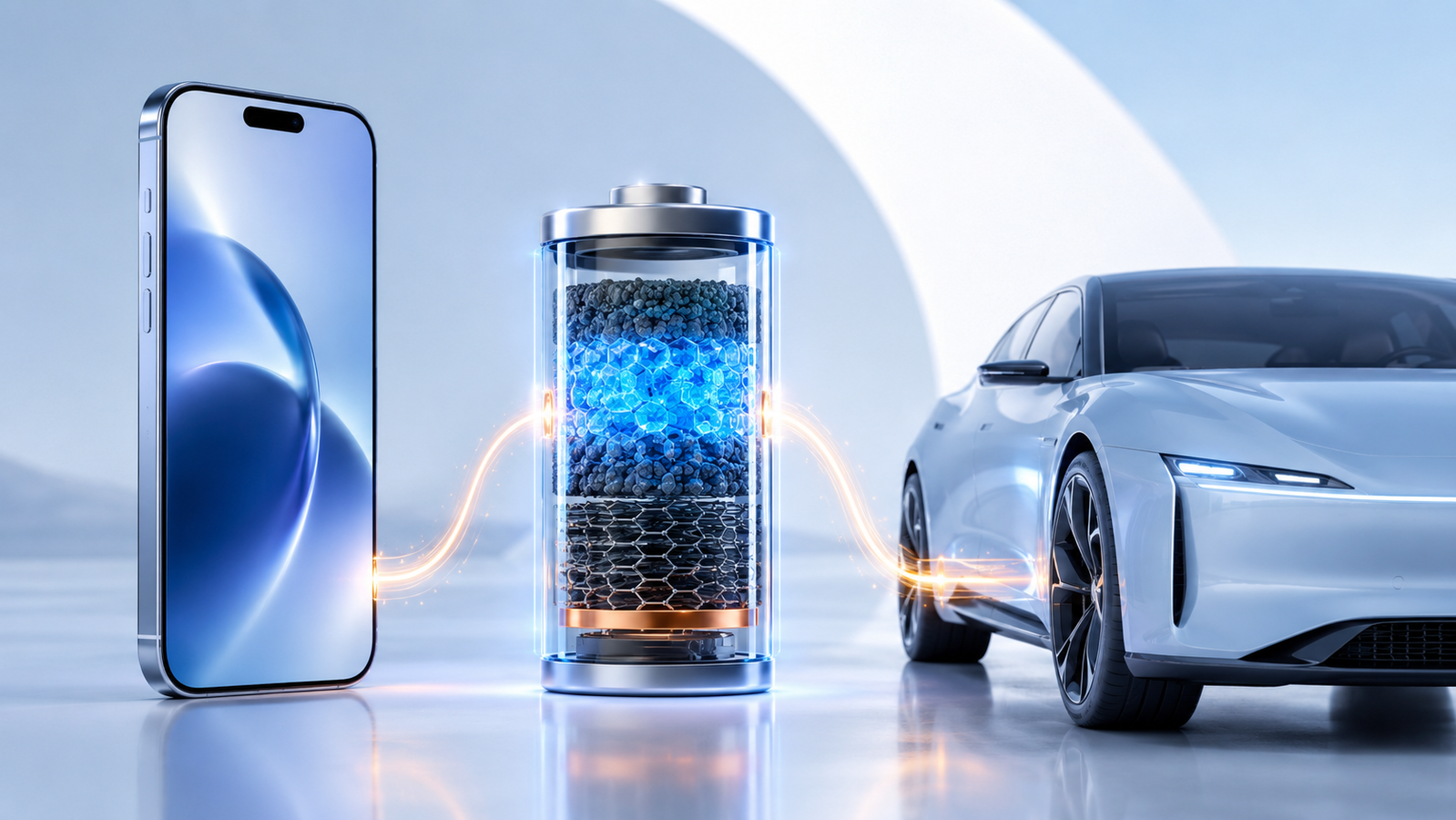
From flagship phones to EV packs: silicon-carbon anodes reached the market first where energy density per gram and per liter pays the most. A Pragmatic Outlook
It is worth stating plainly what Si/C has not yet solved. Cost per kilowatt-hour stored still favors graphite; nanostructured composites carry synthesis steps — CVD silane, sacrificial templates, controlled carbonization — that battery-grade graphite never needed. Calendar aging remains the hardest open problem for silicon-rich automotive cells, precisely because it resists the architectural fixes that conquered cycling fade.5 First-cycle lithium loss makes prelithiation attractive in principle and awkward in practice, since lithiated powders and ultrathin lithium foils both fight the ambient-air realities of electrode factories.25 And every percentage point of silicon tightens tolerances across the whole cell — separator compression, electrolyte reserve, pressure fixtures — so the anode powder is never adopted alone.
None of these are reasons for pessimism; they are the engineering agenda. The trajectory of the past five years — from cautious 5% blends to phones shipping with high-silicon anodes by the hundred million — suggests the question is no longer whether silicon-carbon displaces a growing share of graphite, but how fast each application's mechanical and lifetime budget allows it.
How ACS Material Supports Your Si/C Work
ACS Material supplies the silicon side, the carbon side, and the finished composite. Our Si/C Composite Anode Material comes in two ready-to-coat grades — Type A (8 wt% Si, ~450 mAh/g) and Type B (18 wt% Si, ~500 mAh/g) — validated to 1,500 cycles with 80% capacity retention and manufactured at industrial ton scale, so the same powder that anchors your half-cell study can follow you into pouch-cell scale-up. For teams building their own composites, the catalog covers the component space: Silicon Nanoparticles and Porous Silicon for the active core, Silicon Monoxide for SiOx routes, and a deep carbon bench — Single-Layer Graphene, Graphene Nanoplatelets, and carbon nanotube series — for conductive networks and buffering frameworks. Every lot ships with characterization data, and our applications team is available to discuss formulation questions from binder pairing to blend ratios.
FAQ
Is a Si/C composite the same thing as silicon carbide (SiC)?
No. Si/C is a composite of separate silicon and carbon phases engineered for lithium storage; silicon carbide is a covalently bonded ceramic that is essentially inactive toward lithium in an anode. A quality Si/C powder is verified by XRD to contain no SiC phase at all — if the silicon had reacted into carbide during processing, the capacity would be lost.
How much silicon do today's commercial batteries actually use?
Mainstream EV cells blend silicon (usually as SiOx or Si/C) into graphite at single-digit weight percent — teardowns and reviews indicate roughly 5–10 wt% in Tesla-class cells — while recent "silicon-carbon battery" smartphones run noticeably higher fractions, and development cells from silicon-anode specialists replace most or all of the graphite.
Why does adding silicon shorten cycle life, and what fixes it?
Silicon swells ~300% on lithiation, which fractures particles larger than ~150 nm, repeatedly cracks the SEI, and strands fragments electrically. The fixes are the substance of this article: nanoscale silicon, void-engineered carbon architectures (yolk-shell, pomegranate, porous scaffolds), carboxyl-rich binders like PAA, FEC-based electrolytes, and stretchable conductive networks such as SWCNTs.
Does Tesla use silicon in its batteries?
Yes — in the anode, as SiOx particles embedded in graphite, confirmed by independent cell teardowns. This is separate from the silicon carbide (SiC) power semiconductors Tesla uses in its drive inverters; one stores energy, the other switches it.
What is the "silicon-carbon battery" in new smartphones?
It is a lithium-ion cell whose anode blends a Si/C composite — typically nanosilicon deposited inside a porous carbon scaffold — with graphite, raising energy density enough to fit 5,800 mAh and beyond into bodies that previously held around 4,500 mAh. The cathode chemistry is unchanged; the silicon-carbon anode is the upgrade.
Si/C composite, SiOx, or bare silicon nanoparticles — which should I start with for research?
For drop-in electrode work and blending studies, a finished Si/C composite gives the most graphite-like processing. SiOx trades some first-cycle efficiency for gentler expansion. Bare silicon nanoparticles or porous silicon offer maximum capacity and design freedom but demand your own carbon, binder, and electrolyte strategy — all three material families are available from ACS Material with characterization data.
References
1Sun, L., Liu, Y., Wang, L. & Jin, Z. Constructing Pure Si Anodes for Advanced Lithium Batteries. Accounts of Chemical Research 57 (2024). DOI: 10.1021/acs.accounts.3c003082Feyzi, E., Anil Kumar, M. R., Li, X., Deng, S., Nanda, J. & Zaghib, K. A Comprehensive Review of Silicon Anodes for High-Energy Lithium-Ion Batteries: Challenges, Latest Developments, and Perspectives. Next Energy 5, 100176 (2024). DOI: 10.1016/j.nxener.2024.1001763Liu, X. H., Zhong, L., Huang, S., Mao, S. X., Zhu, T. & Huang, J. Y. Size-Dependent Fracture of Silicon Nanoparticles During Lithiation. ACS Nano 6, 1522–1531 (2012). DOI: 10.1021/nn204476h4Dhattarwal, H. S. et al. Silicon Nanoparticle Ensembles for Lithium-Ion Batteries Elucidated by Small-Angle Neutron Scattering. ACS Applied Energy Materials 2 (2019). DOI: 10.1021/acsaem.9b000715Merrill, L. C. et al. Chemical Contributions to Silicon Anode Calendar Aging Are Dominant over Mechanical Contributions. Frontiers in Batteries and Electrochemistry 2, 1308127 (2023). DOI: 10.3389/fbael.2023.13081276Scanning Electrochemical Microscopy Reveals That Model Silicon Anodes Demonstrate Global SEI Passivation Degradation During Calendar Aging. ACS Applied Materials & Interfaces (2024). DOI: 10.1021/acsami.3c143617Magasinski, A., Dixon, P., Hertzberg, B., Kvit, A., Ayala, J. & Yushin, G. High-Performance Lithium-Ion Anodes Using a Hierarchical Bottom-Up Approach. Nature Materials 9, 353–358 (2010). DOI: 10.1038/nmat27258Zhang, X. et al. Atomic-Scale Control of Silicon Expansion Space as Ultrastable Battery Anodes. ACS Nano 10 (2016). DOI: 10.1021/acsnano.6b045229Liu, N., Wu, H., McDowell, M. T., Yao, Y., Wang, C. & Cui, Y. A Yolk-Shell Design for Stabilized and Scalable Li-Ion Battery Alloy Anodes. Nano Letters 12, 3315–3321 (2012). DOI: 10.1021/nl301481410Liu, N., Lu, Z., Zhao, J., McDowell, M. T., Lee, H.-W., Zhao, W. & Cui, Y. A Pomegranate-Inspired Nanoscale Design for Large-Volume-Change Lithium Battery Anodes. Nature Nanotechnology 9, 187–192 (2014). DOI: 10.1038/nnano.2014.611Xu, Q. et al. Hierarchical Porous Silicon Structures with Extraordinary Mechanical Strength as High-Performance Lithium-Ion Battery Anodes. Nature Communications 11, 1474 (2020). DOI: 10.1038/s41467-020-15217-912Yu, X. et al. Hierarchical Yolk-Shell Silicon/Carbon Anode Materials Enhanced by Vertical Graphene Sheets for Commercial Lithium-Ion Battery Applications. Advanced Functional Materials, 2413081 (2024). DOI: 10.1002/adfm.20241308113Kwon, H. J. et al. Nano/Microstructured Silicon-Carbon Hybrid Composite Particles Fabricated with Corn Starch Biowaste as Anode Materials for Li-Ion Batteries. Nano Letters 20, 625–635 (2020). DOI: 10.1021/acs.nanolett.9b0439514Jo, M., Sim, S., Kim, J., Oh, P. & Son, Y. Micron-Sized SiOx-Graphite Compound as Anode Materials for Commercializable Lithium-Ion Batteries. Nanomaterials 12, 1956 (2022). DOI: 10.3390/nano1212195615SiOx Enhances Prelithiation Kinetics and Homogeneity in Graphite-Based Anodes. Journal of Materials Chemistry A (2025). DOI: 10.1039/D5TA04275E16TechInsights. Graphene or Not? Investigating the Panasonic NCR21700 Powering the Tesla Model 3 (cell teardown: graphite anode with embedded SiOx particles). techinsights.com17Magasinski, A., Zdyrko, B., Kovalenko, I., Hertzberg, B., Burtovyy, R., Huebner, C. F., Fuller, T. F., Luzinov, I. & Yushin, G. Toward Efficient Binders for Li-Ion Battery Si-Based Anodes: Polyacrylic Acid. ACS Applied Materials & Interfaces 2, 3004–3010 (2010). DOI: 10.1021/am100871y18Parikh, P. et al. Role of Polyacrylic Acid (PAA) Binder on the Solid Electrolyte Interphase in Silicon Anodes. Chemistry of Materials 31, 2535–2544 (2019). DOI: 10.1021/acs.chemmater.8b0502019Wei, L., Chen, C., Hou, Z. & Wei, H. Poly(acrylic acid sodium) Grafted Carboxymethyl Cellulose as a High Performance Polymer Binder for Silicon Anode in Lithium Ion Batteries. Scientific Reports 6, 19583 (2016). DOI: 10.1038/srep1958320Zhao, Y. et al. Advances of Polymer Binders for Silicon-Based Anodes in High Energy Density Lithium-Ion Batteries. InfoMat 3, 460–501 (2021). DOI: 10.1002/inf2.1218521Schroder, K. et al. The Effect of Fluoroethylene Carbonate as an Additive on the Solid Electrolyte Interphase on Silicon Lithium-Ion Electrodes. Chemistry of Materials 27, 5531–5542 (2015). DOI: 10.1021/acs.chemmater.5b0162722Li, Q. et al. Identification of the Solid Electrolyte Interface on the Si/C Composite Anode with FEC as the Additive. ACS Applied Materials & Interfaces 11, 14066–14075 (2019). DOI: 10.1021/acsami.8b2222123Spatially Uniform Lithiation Enabled by Single-Walled Carbon Nanotubes. ACS Energy Letters 8 (2023). DOI: 10.1021/acsenergylett.3c0106024Kirner, J., Qin, Y., Zhang, L., Jansen, A. & Lu, W. Optimization of Graphite-SiO Blend Electrodes for Lithium-Ion Batteries: Stable Cycling Enabled by Single-Walled Carbon Nanotube Conductive Additive. Journal of Power Sources 450, 227711 (2020). DOI: 10.1016/j.jpowsour.2020.22771125Quan, L. et al. Integrated Prelithiation and SEI Engineering for High-Performance Silicon Anodes in Lithium-Ion Batteries. National Science Review 12, nwaf084 (2025). DOI: 10.1093/nsr/nwaf08426A Scalable and Effective Strategy for Boosting the Initial Coulombic Efficiency of Silicon Suboxide Anode. Energy Material Advances (2024). DOI: 10.34133/energymatadv.009827Overcoming Low Initial Coulombic Efficiencies of Si Anodes through Prelithiation in All-Solid-State Batteries. Nature Communications 15 (2024). DOI: 10.1038/s41467-024-47352-y28Group14 Technologies. SCC55 Powers the AI-Enabled HONOR Magic7 Pro Smartphone (press release, Nov 2024). group14.technology29Sila Nanotechnologies. Sila Momentum Continues with Its Moses Lake Plant On-Track; Titan Silicon Commercial and Technical Milestones (press release, Apr 2024). silanano.com30Panasonic Energy. Panasonic Energy Partners with Sila for Procurement of Next-Generation Silicon Anode Material for EV Batteries (press release). na.panasonic.com