“Ceramic” covers everything from a coffee mug to a hip implant — but among ceramic 3D printing materials, four structural families are central to engineering selection: alumina, zirconia, silicon nitride, and silicon carbide. Each brings a different bargain of hardness, toughness, temperature capability, and printability, and choosing among them is usually a cleaner decision than it first appears.1 This guide compares the four families the way an engineer actually selects them: by the properties that decide applications, with the printing realities attached.
What “technical ceramic” actually means
Technical (or advanced/engineering) ceramics are dense, engineered inorganic materials specified by measured properties — a different universe from pottery and tile.1 Five property axes do most of the selection work. Hardness: ceramics sit near the top of the engineering scale, which is why they own wear applications. Fracture toughness: the honest weakness — ceramics do not yield like metals, they fracture, and toughness values an order of magnitude below steels are the price of everything else. Temperature capability: selected ceramic grades retain useful properties in temperature, oxidation, or insulation conditions that exclude polymers and challenge many metal systems. Thermal behavior: conductivity spans a huge range across the families — some ceramics insulate, some conduct heat better than many metals. Electrical character: most are excellent insulators, which quietly powers half their industrial use.2 Keep those five axes in mind and the four families sort themselves quickly. One mindset shift matters before any of them: because ceramics fracture rather than yield, ceramic design is flaw management — strength is statistical, surface condition and edge quality move it, and generous radii plus proof-tested coupons are not bureaucracy but the load path itself.2
Alumina (Al2O3) — the workhorse
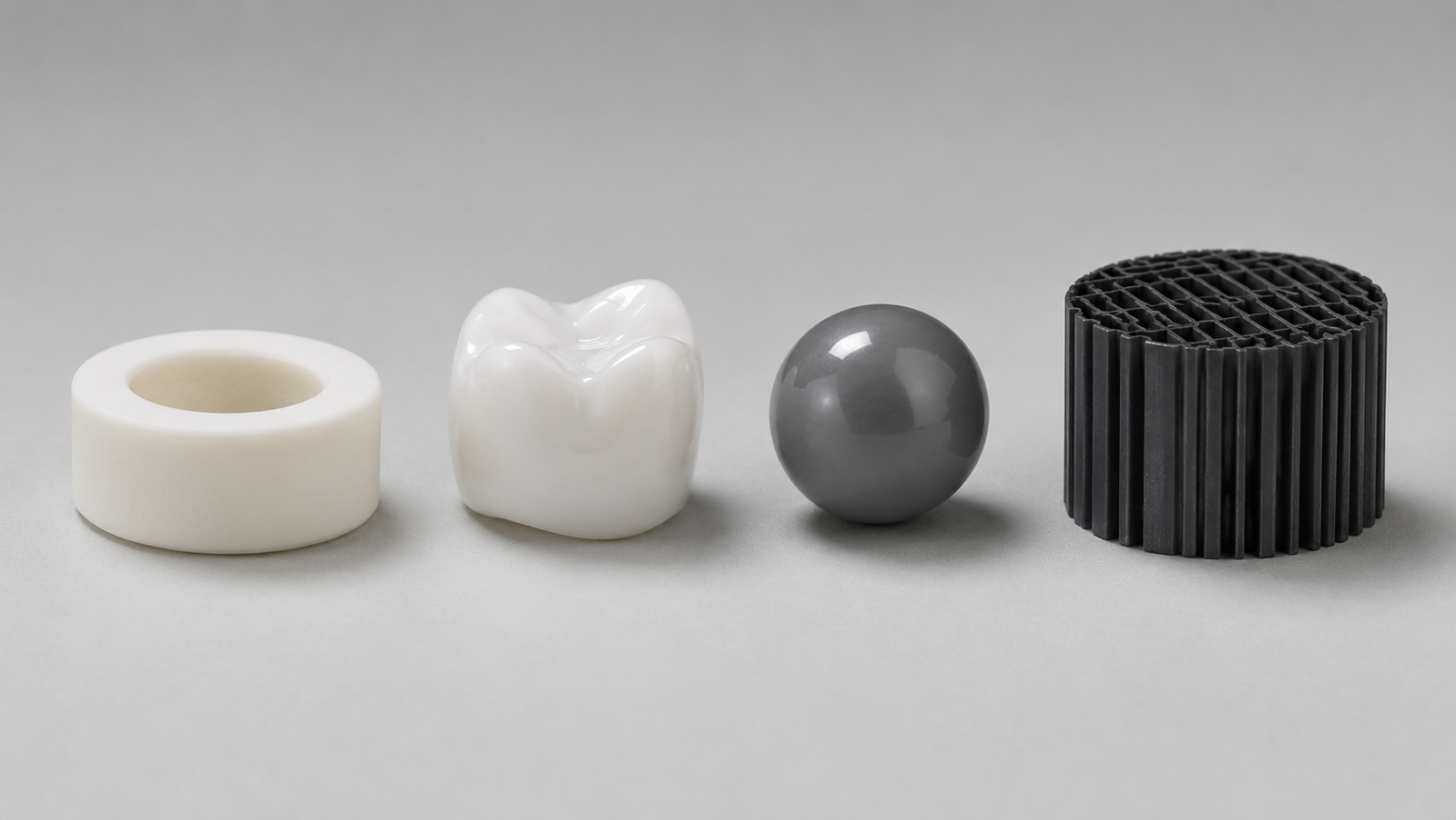
Alumina 3D printing is often the default selection in technical ceramics: hard, stiff, chemically stable, an excellent electrical insulator, and the most economical of the four — the material behind insulators, wear parts, labware, and substrates everywhere.1,2 It is also the best-established ceramic in slurry-based printing: lithography-based ceramic manufacturing demonstrated printed alumina at over 99% of theoretical density with four-point bending strength around 427 MPa — property territory comparable to conventionally formed material.3 Purity grades matter: higher-purity grades (99%+ alumina content) trade cost for cleaner chemistry, higher temperature capability, and better dielectric behavior, while 92–96% grades serve general wear and insulation economically. When no property is extreme but everything must be solid, alumina is usually the first quote. Two working notes: alumina’s hardness makes green-state or as-fired near-net geometry especially valuable (grinding fired alumina is possible but priced accordingly), and its ivory-to-white body is the visual signature of most printed technical-ceramic hardware you have seen.
Zirconia (ZrO2) — the tough one
Zirconia 3D printing is attractive for one headline reason — transformation toughening — the mechanism announced to the field under the memorable title “Ceramic steel?”: stabilized tetragonal grains transform under crack-tip stress, expanding slightly and squeezing the crack closed, giving zirconia the highest fracture toughness and bending strength of the mainstream oxide ceramics.4,5 That toughness, plus a tooth-friendly white aesthetic and a long biomedical track record, made yttria-stabilized zirconia the star of dental restorations — and dental is exactly where ceramic 3D printing of zirconia has advanced fastest.5,6 Engineering honesty requires two caveats: toughened grades are sensitive to their stabilizer chemistry and thermal history, and low-temperature aging in humid environments is a known, managed phenomenon in qualified formulations.5 Choose zirconia when parts see impact, contact stress, or flexure that would retire an alumina part. A hybrid worth knowing exists between the two: zirconia-toughened alumina (ZTA) blends alumina’s economy and hardness with a toughness lift from dispersed zirconia — a reminder that the four families are poles of a composition space, not the whole of it.1
Silicon nitride (Si3N4) — the thermal-shock athlete
Silicon nitride earned its reputation in the ceramic-engine programs: an interlocking elongated-grain microstructure gives it an unusual combination of toughness, strength retention at high temperature, and outstanding thermal-shock resistance — the reason it runs as bearing balls, cutting tools, metal-forming tooling, and hot-section hardware.7 It is a nitride, not an oxide: processing runs in controlled atmospheres with sintering additives, which is part of why it costs more and prints less commonly than the oxides — but where rapid temperature swings plus mechanical load would crack alumina and drive hydrothermal (low-temperature) degradation in susceptible zirconia grades, silicon nitride often offers the most balanced combination of thermal-shock resistance, damage tolerance, and retained strength among the four.7,1 Its printing story is younger than the oxides’ but real: slurry, extrusion, and binder-based routes for Si3N4 are an active development front precisely because the application pull — bearings, tooling, hot hardware — is so strong.1
Silicon carbide (SiC) — the extreme-duty specialist
Silicon carbide plays the extremes: hardness near the top of the engineering table, temperature capability at the top of the four — grade-, atmosphere-, and load-dependent — strong chemical resistance, and — unusually for a ceramic — high thermal conductivity, which is why it shows up in heat exchangers, kiln furniture, semiconductor processing hardware, and abrasives.1,2 It is also the hardest of the four to print densely: strong covalent bonding makes SiC resist conventional sintering, so additive routes lean on reaction bonding, infiltration, or polymer-derived-ceramic (PDC) chemistry. The PDC frontier was demonstrated memorably with photocured preceramic polymers pyrolyzed into silicon oxycarbide (SiOC) lattices — an adjacent silicon-containing ceramic that should not be presented as interchangeable with conventionally processed dense SiC; material identity stays route-specific.8,1 Choose SiC when heat flux, abrasion, or chemistry retire everything else — and plan the manufacturing route with extra care.
The four families, side by side
Swipe horizontally to compare all columns →
| Alumina | Zirconia (Y-TZP) | Silicon nitride | Silicon carbide | |
|---|---|---|---|---|
| Signature strength | Balanced economy: hardness, insulation, stability | Highest toughness & bending strength of the oxides | Thermal shock + toughness at temperature | Extreme heat, hardness, thermal conductivity |
| Honest weakness | Modest toughness | Stabilizer/aging sensitivity; temperature ceiling below the non-oxides | Cost; atmosphere-controlled processing | Hardest to densify; route-limited printing |
| Thermal character | Moderate conductor, good insulator electrically | Low thermal conductivity | Moderate; superb shock resistance | High thermal conductivity |
| Electrical | Excellent insulator | Insulator | Insulator | Semiconductive character (grade-dependent) |
| Printing maturity (slurry routes) | Most established | Well established, dental-driven | Emerging, specialized | Emerging; indirect/PDC routes common |
| Classic printed uses | Insulators, labware, wear parts, fixtures | Dental copings, medical research parts, tough structural pieces | High-temp mechanical hardware | Heat-path and harsh-environment hardware |
Entries are qualitative synthesis of the family sections and the review literature on printable technical ceramics; within any family, specific grades move the numbers meaningfully — datasheets and test coupons settle real projects; process-family terminology follows ISO/ASTM 52900.1,2,9,10
See the trade-offs: the ceramic property map
The map below plots the four families on two property axes at a time — pick the axes that matter to your application and watch the families trade places. Positions are indicative bands, not datasheet values — within each family, purity, stabilizer, grain size, and processing move real numbers substantially.
Printability notes, family by family
Printing changes the selection conversation less than you might fear — and more than a datasheet admits. For binder-based, sintering-densified variants, feedstock formulation, debinding, and firing form one linked chain — the chain our how ceramic 3D printing works guide walks end to end. Other variants — notably many SiC workflows — use infiltration or reaction bonding instead. The ceramic-specific questions are therefore route-specific: how the green body is formed, how organics or pore formers are removed, and what mechanism creates the final density and composition.9,11 Oxides answer kindly — alumina and zirconia dominate slurry-DLP portfolios because white oxide powders scatter light manageably and sinter well.3,11 Dark, covalent non-oxides answer harder: silicon nitride and SiC absorb the very light DLP relies on and resist densification, so their additive routes lean on adapted chemistries, binder jetting, extrusion, and polymer-derived approaches.8,12,13 A practical corollary: if your application permits an oxide, the printing road is shorter — a pattern the AM textbooks and the seven-family map in our 3D printing overview guide both make plain.14
Choosing by application
Electrical insulation and general labware default to alumina — economical, stable, proven.2 Wear against impact and contact stress favors zirconia’s toughness; pure sliding wear at low impact often stays with alumina. Dental and patient-adjacent research is zirconia territory, with additive workflows maturing fast under that demand — and with every clinical use running through its own regulatory qualification, not a blog’s.5,6 Thermal shock plus load — furnace hardware that cycles, metal-contact tooling — points to silicon nitride.7 Extreme heat flux and harsh chemistry point to SiC, route permitting.1 Bioceramic scaffolds and implantable research form their own family conversation (calcium phosphates and friends) beyond these four structural ceramics.15 Where each application lives — and the design rules that keep ceramic parts printable — is the subject of our applications and design-rules guide; when a part is ready to quote in alumina or zirconia, our ceramic 3D printing service runs the slurry-DLP route end to end.
FAQ
1. What is the strongest ceramic for 3D printing?
Define strongest first. For bending strength and fracture toughness among the printable oxides, yttria-stabilized zirconia leads; for hardness and temperature capability, silicon carbide; for balanced everything at the best economics, alumina. Requirements pick the winner — and specific grades, routes, and firing move every number.1,5
2. Alumina vs zirconia — how do I choose?
Alumina when the duty is insulation, chemical stability, sliding wear, or cost-sensitive general service; zirconia when parts see impact, flexure, or contact stress that would fracture alumina, or when the application is dental. Zirconia buys toughness at higher cost, lower temperature ceiling, and stabilizer-chemistry care.4,5
3. Can silicon carbide be 3D printed?
Yes, with route caveats: dense SiC resists conventional sintering, so additive approaches typically use reaction bonding, infiltration, or binder jetting with post-densification rather than the slurry-DLP-and-sinter path that serves the oxides. Polymer-derived routes add an adjacent option — photocured preceramic polymers pyrolyzing to SiOC — whose material identity differs from dense SiC and should be specified as such.8,1
4. Why is zirconia used for dental crowns?
Transformation toughening gives it the flexural strength and damage tolerance the mouth demands, the aesthetics are tooth-compatible, and yttria-stabilized grades carry decades of biomedical history — with every clinical product qualified under its own regulatory framework.4,5,6
5. Are printed ceramics as strong as machined ones?
Well-executed slurry-route parts have reported densities and strengths comparable to conventionally formed material — the alumina demonstration at 99%+ density and ~427 MPa bending strength is the landmark example — but outcomes are workflow-specific, so real projects verify strength on fired material test bars (with attention to orientation, surface state, porosity, and sample statistics) and characterize dimensional capability separately on standardized geometric test artifacts.3,16
References
This article is provided by ACS Material LLC for educational purposes. Family characterizations are qualitative and typical of each material class in general; properties vary substantially by grade, purity, stabilizer system, processing route, and firing, and cited demonstration results reflect the referenced studies rather than guaranteed outcomes. Dental, medical, and implantable uses require qualification under the applicable regulatory framework regardless of material pedigree. The property map is an indicative teaching visualization, not a datasheet. ACS Material operates a slurry-DLP ceramic printing service; coverage of non-oxide routes is educational. Sample images are representative.