
Graphene's relationship with the environment runs both ways. On one side, its enormous surface area, conductivity, and strength make it a tool for cleaning water, breaking down pollutants, storing renewable energy, and making vehicles lighter and more efficient. On the other, the material has a footprint of its own: the chemistry and energy used to make it, and open questions about how graphene particles behave once they reach living systems and the wider environment. This guide takes both sides honestly — where graphene genuinely helps, where its own impact lies, and how the two balance — with two interactive simulators for the mechanisms that matter most.
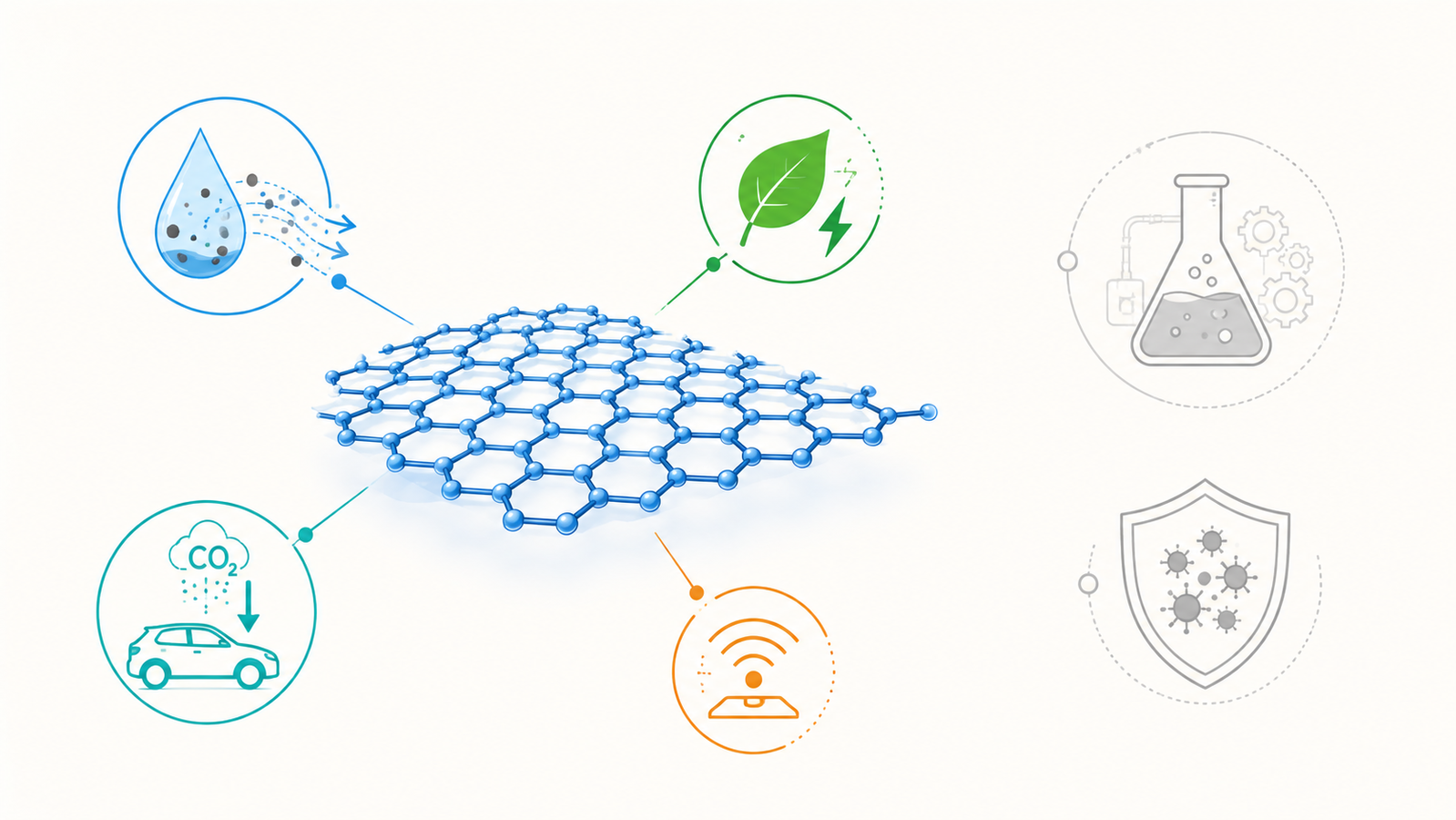
Graphene's two sides for the environment
Graphene is a single layer of carbon atoms in a hexagonal lattice, isolated from graphite in 2004.1 For the structure and properties behind everything below, see our graphene facts overview. Three of those properties drive its environmental uses: an enormous surface area (a single gram can expose hundreds to thousands of square meters), high electrical conductivity, and high stiffness and strength for its weight.2 Surface area is what lets graphene adsorb pollutants and store charge; conductivity is what makes it useful in electrodes, sensors, and catalysts; and strength-to-weight is what enables lighter, more efficient structures.
But a material is only as clean as the way it is made and used. Producing graphene — especially graphene oxide by chemical oxidation of graphite — takes energy and aggressive reagents, and like any engineered nanomaterial its behavior in cells, organisms, and ecosystems has to be understood rather than assumed. A fair view of "what graphene means for the environment" has to hold the benefits and the footprint together, which is what the rest of this article does.
Cleaning up water: adsorption and membranes
Water treatment is graphene's most developed environmental application, and it works in two distinct ways. The first is adsorption: graphene oxide and graphene aerogels bind dissolved contaminants — heavy-metal ions, organic dyes, and oils — to their huge surface, pulling them out of solution.3 Because oxygen groups on graphene oxide attract metal ions, few-layer graphene oxide can take up large amounts of lead, cadmium, and similar species per gram.4 Porous graphene sponges and aerogels go further for oil and solvent spills, soaking up many times their own weight and then being squeezed out and reused.5
The simulator below shows the adsorption physics. Capacity follows the Langmuir model — it climbs with concentration, then levels off as the surface fills — and the ceiling rises with surface area, which is exactly why high-area graphene materials are effective sorbents.
The second route is filtration: stacked graphene oxide assembles into membranes whose nanometer channels pass water while blocking larger species, and tuned versions can sieve ions for desalination.6,7 Membranes are a deep topic in their own right — our dedicated article covers them in detail: graphene and water treatment. Graphene oxide is the form behind most of this work, because its oxygen groups make it disperse in water and stack into films.
Breaking down pollutants: photocatalysis
Adsorption moves a pollutant onto a surface; photocatalysis destroys it. Semiconductor photocatalysts such as titanium dioxide use light to generate reactive species that break organic contaminants down, but they waste much of that energy when the charges they create simply recombine. Pairing the photocatalyst with graphene gives photogenerated electrons a conductive path away from the recombination site, which can raise the rate at which dyes and other organics are degraded.8 The same idea is being explored for cleaning air and for splitting water to make hydrogen fuel, though most of this remains laboratory-scale rather than deployed technology.
Enabling cleaner energy
Graphene's environmental contribution to energy is indirect but large: it helps store and harvest energy more efficiently. As a conductive, high-area additive it improves the rate and life of lithium-ion battery electrodes and supercapacitors, which matters for electric vehicles and for storing intermittent wind and solar power.9 As a transparent electrode it is studied in solar cells, where its flexibility and abundance are advantages over scarce indium tin oxide.10 Our focused articles cover these uses in graphene in organic solar cells and, more broadly, in our overview of the applications and uses of graphene. None of these makes energy clean on its own, but better storage and collection are part of the transition away from fossil fuels.
Lighter vehicles, less fuel
One of the clearest environmental levers is weight. A vehicle burns fuel partly in proportion to its mass, so making structures lighter at equal strength reduces fuel use and carbon dioxide over the vehicle's whole life. Graphene nanoplatelets stiffen and strengthen composites at low loading, which lets parts be made thinner and lighter without losing performance.11 The simulator below turns a mass reduction into the fuel and carbon dioxide saved per car, using the automotive rule of thumb that fuel use drops several percent for every ten percent of mass removed.
This is also where the "life-cycle" view matters most: the energy and emissions saved while a lighter vehicle is driven for years can outweigh the footprint of producing the small amount of graphene it contains — provided the material is made efficiently, which is not guaranteed, as the next sections discuss.
Monitoring the environment
Protecting the environment also means measuring it. Because every atom of a graphene sheet is a surface exposed to its surroundings, adsorbed molecules shift its electrical resistance enough to be detected — graphene can register even single gas molecules landing on it.12 That sensitivity, with easy chemical functionalization, supports compact, low-power sensors for air-quality gases, water contaminants, and humidity, the kind of distributed monitoring that environmental management increasingly relies on.
The other side: graphene's own footprint
Making graphene is not free of impact. The most common route to graphene oxide oxidizes graphite with strong acids and oxidizers, generating chemical waste and requiring purification, and reducing or exfoliating graphene consumes energy. Life-cycle assessments find that graphene's environmental cost depends heavily on the production method: energy source, yield, and solvent and reagent use can swing the footprint of a kilogram of material by a wide margin.13 Comparative studies of different routes reach the same conclusion — there is no single "footprint of graphene," only the footprint of a particular process, and cleaner routes make a real difference.14 This is why production efficiency, not just application performance, decides whether a graphene-enabled product is a net environmental gain.
Safety and ecotoxicity
The honest position on graphene's biological and ecological effects is that they depend on the material and are still being mapped. Graphene-family materials are not a single substance: lateral size, number of layers, surface chemistry, and dose all change how they interact with cells and organisms, and reported effects range from benign to harmful depending on those variables.15 Reviews of the toxicity literature stress this form-dependence and the need for careful, standardized testing rather than blanket claims of safety or hazard.16 The practical implications are ordinary materials-handling ones — control dust and dispersions, follow the safety data sheet, and design products so particles are bound rather than released — and the research-stage status of many environmental uses should be read in that light.
So is graphene good for the environment?
The fair answer is: it can be, and whether it is depends on three things. First, the size of the benefit — cleaning water, cutting vehicle fuel, or improving energy storage are real, measurable gains. Second, how the material is produced — an efficient, low-waste route keeps the footprint small, while a wasteful one can erase the benefit. Third, how it is used and disposed of — particles bound in a membrane, electrode, or composite are very different from particles released into water or air. Used deliberately, in applications where its properties do real work and where it is made responsibly, graphene is a useful environmental tool rather than a magic solution. As with every graphene application, the practical step is choosing the right form for the job.
- Graphene Oxide — water-dispersible, oxygen-rich material for adsorption of heavy metals and dyes, membranes, and photocatalyst composites; the workhorse for water-related uses.
- Graphene Aerogel — ultralight, highly porous graphene for soaking up oils and organic solvents and for high-surface-area adsorption and electrodes.
- Graphene Nanoplatelets — the filler for lightweight, high-performance composites that reduce structural mass and, with it, fuel and emissions.
- Reduced Graphene Oxide — recovers much of graphene's conductivity for electrodes, energy storage, and conductive composites at lower cost.
- Graphene Oxide Dispersion — ready-to-use aqueous dispersions for solution-based membranes, coatings, and treatment work.
- Full graphene series — the complete catalog with grades, specifications, datasheets, and safety data sheets to match a material to your application.
Frequently asked questions
References
This article is provided for educational purposes by ACS Material LLC and surveys graphene and the environment — both its environmental applications and its own footprint. Performance figures cited, including adsorption capacities, single-sheet surface area, and the fuel and carbon-dioxide savings in the simulators, are idealized or assumption-based values for specific conditions; real results depend on the grade, form, dispersion, and process used, and many of the uses described are at the research stage. Nothing here is safety, environmental, or regulatory advice: consult the relevant product datasheets and safety data sheets before purchase, handling, or use. The interactive simulators are schematic teaching tools built on the simplified models stated, not predictive engineering or life-cycle software.