
Take the rotation away from a rotary evaporator and you are left with a vacuum distillation — a flask of solvent boiling in a warm bath at reduced pressure. That apparatus works, and chemists used it for decades. What the rotation adds is not a convenience but three distinct physical effects delivered by a single motion: it multiplies the evaporating area, it shortens the path heat must travel through the liquid, and it can reduce localized superheating and may lower bumping tendency under otherwise comparable conditions. Understanding those three effects is what turns rotation speed from a dial you leave alone into a variable you use.
In one paragraph: rotation does three things at once. Area — a film spread over a large fraction of the inner wall evaporates from far more surface than a flat pool whose area is fixed by the flask cross-section. Conduction path — heat crosses a thin film mainly by conduction and the resistance scales with thickness, so thinning the film is one of the principal ways to raise the rate without raising the bath temperature. Nucleation — continuous film renewal can reduce localized superheating and may lower bumping tendency under otherwise comparable conditions; it does not eliminate bumping, although rotation does not replace appropriate pressure control and protective measures. Speed is a variable, not a maximum: too slow and the film does not form, too fast and you get poor distribution, entrainment or foaming depending on fill level, viscosity and flask geometry. And rotation does not cure foaming, which is an interfacial problem with different remedies. For the full technique, see the complete guide to rotary evaporation.
The question nobody asks
Rotary evaporation is among the most-performed operations in a synthetic laboratory, and the rotation is usually treated as part of the furniture — switched on, set to whatever the last user left, and forgotten. That is a missed opportunity, because within an appropriate speed range, rotation can improve evaporating area, film renewal and nucleation behavior without requiring a hotter bath or a deeper vacuum. Raising the bath temperature increases the rate but also the thermal exposure. Deepening the vacuum may increase the evaporation rate when heat transfer and condenser capacity are not limiting; its primary direct effect is to lower the boiling point. Rotation can raise the rate, can reduce the bath temperature needed for a given rate, and may lower bumping tendency during pressure pull-down — though excessive speed brings entrainment and foaming instead.
The context is worth stating because it explains why the gain matters. Thermally driven separations dominate the energy budget of chemistry, with one widely cited analysis in Nature placing chemical separations at roughly 10–15% of global energy consumption,1 and at bench scale solvents dominate the mass balance of almost every synthesis: process mass intensity was adopted across the pharmaceutical industry precisely because it makes that dominance visible,2 and the E-factor literature identifies solvent as the largest single contributor to waste per unit product.3 Anything that removes that solvent faster and cooler is doing real work.
Effect one: evaporating area
Evaporation happens at a surface, so the first question is how much surface there is. In a static flask the answer is fixed by geometry: the liquid presents a flat disc whose area is set by the flask’s cross-section at that fill level, and it does not change as the run proceeds except to shrink.
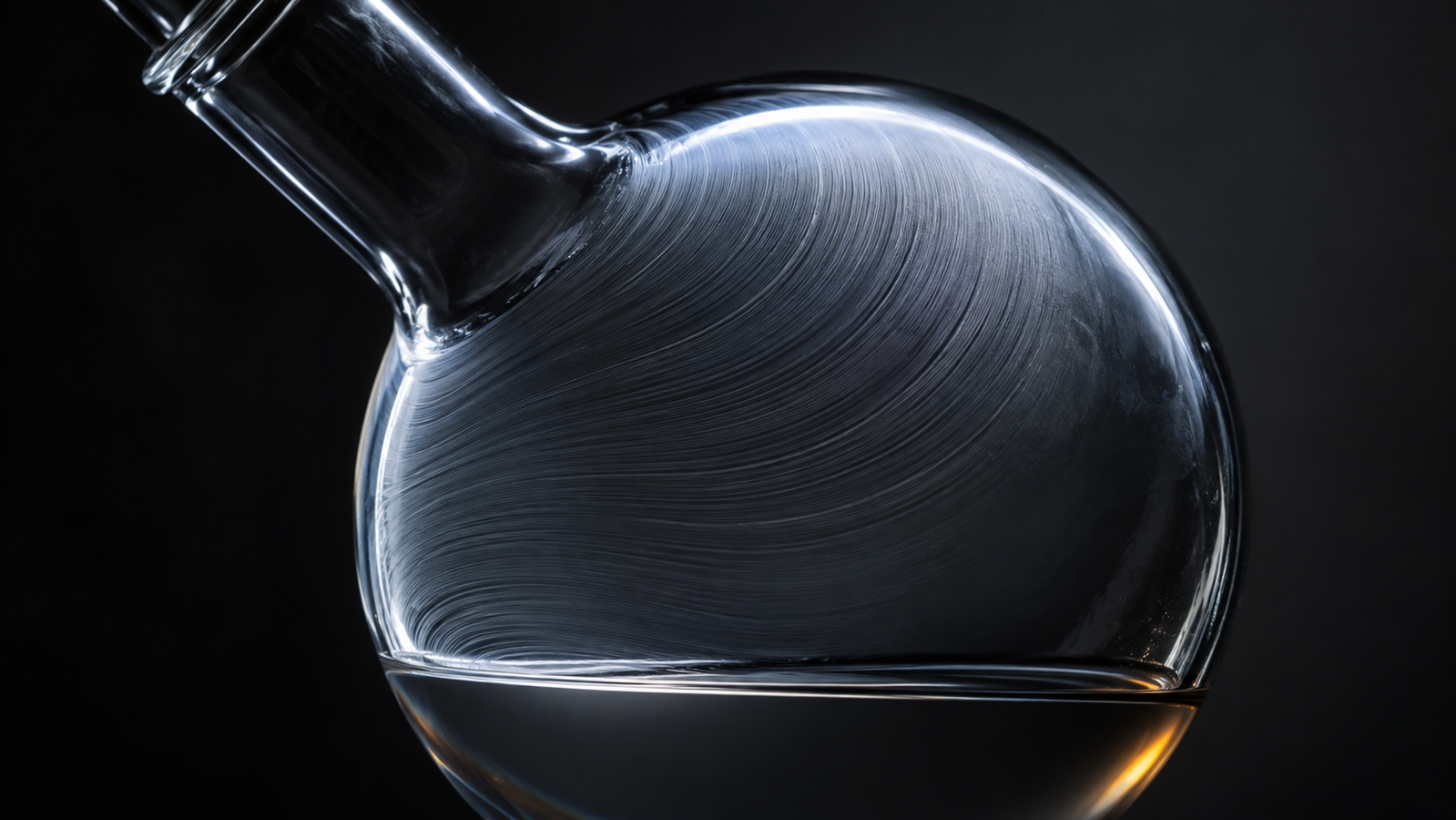
Rotation replaces that disc with a film. Liquid is dragged up the inner wall by viscous adhesion, and because the flask is a sphere or near-sphere tilted into the bath, the wetted region covers a large fraction of the inner surface. Over much of the run the wetted area can remain larger than the surface of a static pool of the same charge, which is why a rotary evaporation tends not to slow down as sharply toward the end. The rate may still fall as volume, composition and viscosity change.
There is a second, subtler benefit. The film is renewed continuously: liquid that has partially evaporated at the wall returns to the pool and fresh liquid takes its place. In a static pool, evaporative cooling and concentration build up at the surface, and the surface layer becomes progressively less representative of the bulk. Renewal keeps the evaporating surface in contact with the bulk composition and the bulk temperature.
Effect two: the conduction path
Heat has to reach the evaporating surface from the bath, and in a rotary evaporator it does so through three resistances in series: bath to glass, glass to liquid, and through the liquid itself to the interface. The third is the one rotation controls.
In a thin film, convection is suppressed and heat crosses the liquid mainly by conduction, so the thermal resistance is roughly proportional to film thickness. Halving the film thickness roughly halves that resistance. This is why a rotating flask can evaporate quickly with a modest bath differential, and why raising the bath temperature is the wrong first response to a slow run — the problem is often the film, not the heat available.
It also explains a familiar observation: an over-filled flask evaporates slowly for its size. Above a certain charge, rotation forms a less effective film and more sloshing, with a thin skin above a deep pool. The apparatus is then behaving like a stirred flask, with a stirred flask’s heat-transfer characteristics and a stirred flask’s tendency to bump. Filling to roughly half the flask volume is the conventional compromise that keeps a genuine film possible while leaving headspace for a disturbance.
Effect three: superheat and nucleation
Boiling requires nucleation sites — microscopic pockets of trapped vapor or gas, usually at surface imperfections, from which a bubble can grow. Clean borosilicate glass is unhelpfully smooth, and under reduced pressure a quiescent liquid can heat appreciably above its boiling point before nucleation begins. When it finally does, the stored superheat is released at once, and the result is the eruption chemists call bumping: sample thrown up the vapor duct into the condenser, mass balance destroyed, and in the worst case a broken flask.
Rotation attacks this at its root. Continuous mechanical renewal of the surface can reduce localized superheating and may lower bumping tendency under otherwise comparable conditions; it does not eliminate bumping. A bump trap between flask and vapor duct is strongly recommended for bump-prone, valuable, contamination-sensitive or limited-volume samples.
The comparison with boiling chips is instructive. Boiling chips provide nucleation sites in a static flask. They may become ineffective once their pores are fully wetted, they should not be added to a hot liquid, and they should not be relied on for reuse after a run. Rotation works by a different mechanism — not by supplying sites but by continuously renewing the liquid film so that superheat has less opportunity to accumulate. The two are not equivalent, and the instrument manual and laboratory SOP govern which is appropriate.
What the film literature says, and where the analogy ends
Thin liquid films are a well-developed field in their own right. Their thickness, stability, the waves that develop on their surfaces and the way those waves enhance transport have been reviewed at length in the physics literature.4, 5 Two results carry over usefully to a rotating flask. First, a film is not a passive layer: interfacial disturbances increase both the interfacial area and convective transport near the interface, so a wavy film transfers more heat than a smooth one of the same mean thickness. Second, films have stability limits — below a certain thickness, or on a poorly wetted surface, a continuous film breaks into rivulets and dry patches.
On the engineering side, how much heat a thin falling film actually transfers, and how that depends on film Reynolds number, heat flux and surface condition, has been reviewed critically for the tube geometries used in industrial evaporators.6, 7 Three qualitative lessons transfer: transfer improves as the film thins; it degrades sharply wherever the film breaks and leaves a dry patch; and it depends on how the liquid is distributed rather than on how much of it there is.
The analogy has limits, and they should be stated plainly. Falling-film studies concern liquid draining under gravity over horizontal or vertical tubes, with a defined feed distribution and a steady flow rate. A rotating flask has a curved, non-uniform wall, a film thickness set by rotation and viscosity rather than by a feed rate, and a liquid inventory that is being consumed as the run proceeds. The published correlations should not be applied numerically to a rotovap; they inform the direction of the effects, not their magnitude.
Why a faster, cooler evaporation is worth engineering for
It is fair to ask why any of this deserves attention: the flask spins, the solvent goes, the chemistry continues. The answer is that solvent removal is not a peripheral step but one of the largest single consumers of both energy and material in laboratory practice, and rotation is one of the most readily adjustable operating variables.
Solvent selection and handling are consistently identified as the dominant environmental levers in fine-chemical and pharmaceutical work,8 and mature selection guides now rank solvents on safety, health and environmental criteria.9, 10 The complete guide covers that framework and the recovery question in full, including membrane alternatives such as organic solvent nanofiltration where thermal recovery is unattractive.11 Two consequences bear directly on rotation: a faster evaporation at a lower bath temperature widens the set of solvents that can be used at all, and a well-run rotary evaporation yields a receiving-flask stream that is often a single solvent and therefore easier to reuse — provided it is analyzed rather than assumed.
Why the film matters beyond speed
A better film is not only faster; it changes what the residue experiences. Thermal exposure is temperature multiplied by time, and a film that transfers heat efficiently lets the same solvent be removed at a lower bath temperature in less time — two reductions at once. That matters because concentration is the step at which thermally fragile material is most at risk, and because it is not selective: a study of metabolomic extracts concentrated on a rotary vacuum evaporator demonstrated the unavoidable loss of non-dissociating volatile metabolites such as acetone and ethanol, showed that retention of dissociating species depends on solution pH and buffer content, and traced how precipitating buffer salts trap residual analytes at the end of drying.12 A faster-renewed film does not make the operation selective. Volatile-analyte recovery still depends on vapor-liquid equilibrium, pressure, temperature, composition and endpoint.
The same reasoning applies to the solvent stream. Solvents dominate the mass balance of most syntheses — process mass intensity was adopted across the pharmaceutical industry precisely because it makes that dominance visible2 and the E-factor literature identifies solvent as the largest single contributor to waste per unit product3 — so the efficiency of the step that removes it is not a detail. Guides that rank solvents on safety, health and environmental criteria have been surveyed and compared,13 extended to less classical and bio-derived solvents,14 set against full life-cycle frameworks,15 and repeatedly qualified with the caution that a solvent scoring well on one axis may score poorly on another.16, 17 Surveys of actual usage show how slowly practice follows guidance,18 and metric work continues to argue for holistic assessment.19 Rotation cannot change which solvent you chose. It can change how quickly and at what thermal exposure the solvent is removed; recovery completeness also depends on the condenser, coolant conditions, downstream capture and system tightness.
The pressure side of the same problem
Rotation sets how fast heat reaches the interface; pressure sets the temperature at which the interface boils. The two are complementary, and the second is governed by the Antoine equation, whose form and fitting were reviewed comprehensively in the classical literature and whose constants are valid only within the interval over which they were regressed.20 High-accuracy modern work extends the range with Wagner-type correlations fitted to ebulliometric measurement — acetonitrile, for instance, has been determined from 4.3 kPa upward with a separate Antoine form quoted for the sub-atmospheric region.21 A well-formed film at the wrong pressure still evaporates slowly; the right pressure with no film can still bump. Both have to be right.
Choosing a rotation speed
Typical benchtop drives cover roughly 20–280 rpm, and the useful range for a given run is narrower than that.
| Situation | What tends to help | Why |
|---|---|---|
| Slow evaporation, bath already warm | Increase speed moderately | Thinner, better-distributed film lowers liquid-side resistance |
| Foaming sample | Lower speed; larger flask; lower bath | Reduces gas entrainment and gives foam room to collapse |
| Viscous concentrate at end of run | Lower speed; accept a slower rate | Thick liquid does not form a thin film; forcing it entrains air |
| Bumping on start-up | Establish rotation before pulling vacuum; ramp pressure | Film renewal can reduce localized superheating |
| Large charge in a small flask | Move to a larger flask rather than change speed | No speed produces a film from an over-filled flask |
Faster is not automatically better. Excessive speed can lead to poor film distribution, entrainment or foaming, depending on fill level, viscosity and flask geometry. The discipline that works is to change one variable at a time and let the condensation front on the condenser report the result: if it moves up the condenser, the vapor load has risen and the cooling side is being asked for more.
Order of operations matters
Establish rotation before pulling the vacuum. Starting rotation on a flask that is already at a low pressure means the liquid spends the pull-down period static, which is a condition in which localized superheating can develop. Rotating first means the film is already forming and being renewed when boiling begins.
Bumping and foaming are different problems
They look similar in the flask — liquid climbing where it should not — and they have different causes and different cures.
Bumping is a nucleation problem: superheated liquid releasing suddenly. It is provoked by rapid pressure drops, a bath much hotter than the boiling point, an over-filled flask and a stationary or slowly rotating flask. Its cures are the ones described above: ramp the pressure, keep the bath differential modest, fill to about half, and let rotation do its work.
Foaming is an interfacial problem: gas stabilized within the liquid by surfactants, proteins or fine solids. Rotation does not fix it and high speed can make it worse by entraining more gas. The remedies are different — lower speed, a larger flask, a lower bath temperature, a slower pressure ramp, and in some systems a change of solvent or an antifoam where the chemistry tolerates it.
The diagnostic is behavioral rather than visual. Bumping is episodic: quiet, then a sudden surge. Foaming is progressive: a steadily rising column that does not subside on its own. Treating one with the other’s remedy is a common way to lose an afternoon and a sample.
The hazard that no amount of rotation addresses
Concentrating peroxide-forming solvents is one of the highest-consequence, well-documented hazards associated with rotary evaporation, and it is entirely independent of how well the film behaves. Ethers such as diethyl ether, tetrahydrofuran and 1,4-dioxane autoxidize on contact with air to form hydroperoxides and peroxides, accelerated by light and heat and beginning as soon as a container is opened.22 The laboratory-safety literature classifies such materials by whether they are hazardous on storage alone or specifically on concentration,23, 24 because peroxides are far less volatile than the parent solvent and evaporation concentrates them in the residue; incident accounts repeat the same sequence of an aged ether, a routine concentration and a violent failure.25 Screen according to the current safety data sheet and your institution’s procedure, respect both receipt and opening dates, never evaporate to dryness, and do not move, open or test a container showing crystals, discoloration, stratification, unusual viscosity, pressure or a stuck cap. The hazard extends beyond ethers: spontaneous acetone peroxide formation has been characterized in consumer-aged 2-propanol,26 and for bio-derived oxygenates the peroxide number has been argued as the practical safety metric.27 Substitution can reduce risk — 2-methyltetrahydrofuran has been examined as a bio-derived THF alternative28 — but it remains a peroxide-forming ether and does not remove the requirement for screening and storage control.
And one loss the film cannot prevent
A better film evaporates faster; it does not evaporate selectively. A study of metabolomic extracts concentrated on a rotary vacuum evaporator demonstrated the unavoidable loss of non-dissociating volatile metabolites such as acetone and ethanol, showed that retention of dissociating species such as organic acids depends on solution pH and buffer content, and traced how precipitating buffer salts at the end of drying form a matrix that traps residual analytes.12 Where volatile analytes matter, the answer is to stop short of dryness and work colder, not to spin faster.
At pilot scale the surface-to-volume ratio falls and film behavior has to be re-optimized rather than transferred from the bench.
- ALab™ RE100-Pro Digital Rotary Evaporator — 20–280 rpm drive with 150 mm motorized lift and a 1700 cm² vertical condenser, for flasks from 50 mL to 3 L.
- ALab™ RE100-S LED Digital Rotary Evaporator — 20–200 rpm with manual plus auxiliary lift and a 5 L bath that can be used on its own.
- ALab™ RE200-Pro 20 L Industrial Digital Rotary Evaporator — 10–150 rpm, 20 L evaporating flask, 1.2 m² two-section triple-coil condenser.
Frequently asked questions
What rotation speed should I use?
There is no universal figure. Start at a moderate or low speed appropriate to the sample, confirm that a continuous film is forming on the wall, and increase one step at a time while observing film formation. Foaming and viscous samples generally want lower speed; clean low-viscosity solvents tolerate higher speed and evaporate faster for it.
Does faster rotation always evaporate faster?
No. Up to a point a thinner, better-distributed film raises the rate; beyond that point you get poor distribution, entrainment or foaming depending on fill level, viscosity and flask geometry. The gain flattens well before the top of the dial.
Can I run a rotary evaporator without rotation?
Mechanically yes, and it becomes a vacuum distillation — slower for a given bath temperature and considerably more prone to superheating and bumping, since nothing is renewing the liquid surface.
Why does my flask bump even though it is rotating?
Most often because the pressure was dropped rather than ramped, or because the flask is over-filled so no real film forms, or because the bath is much hotter than the boiling point. Rotation reduces the tendency to bump; it does not eliminate it, which is why a trap is recommended.
Do I still need boiling chips?
Boiling chips belong to static distillation setups, where they supply nucleation sites; they may become ineffective once fully wetted, must never be added to a hot liquid, and should not be reused. In a rotary evaporator, rotation can reduce localized superheating by continuously renewing the liquid film, but that is not identical to adding nucleation sites — follow the instrument manual and your laboratory SOP.
Does rotation help with foaming?
Not usually, and high speed often makes it worse by entraining gas. Foaming is an interfacial problem: try a lower speed, a larger flask, a lower bath temperature and a slower pressure ramp, and consider an antifoam only where the chemistry tolerates it.
References
ALab™ is a trademark of ACS Material, LLC. This article is provided for general educational purposes and discusses rotary evaporation and distillation of laboratory solvents in general terms; it is not a substitute for the operating manual of any specific instrument, for the safety data sheet (SDS) of any specific solvent, or for your laboratory’s own risk assessment. Boiling points, enthalpies of vaporization and other physical properties cited here are approximate reference values that vary with purity, temperature and pressure. Equipment specifications summarize the manufacturer’s current documentation and are confirmed at quotation; always refer to the model datasheet for guaranteed ratings. Any interactive tool on this page is a schematic teaching aid based on the stated model, not predictive design or selection software. Follow your laboratory’s safety procedures for vacuum operation, heated baths, peroxide-forming solvents and solvent handling. ACS Material makes no representations or warranties, express or implied, regarding suitability for any purpose, and will not be responsible for damages resulting from use of or reliance upon this information.