
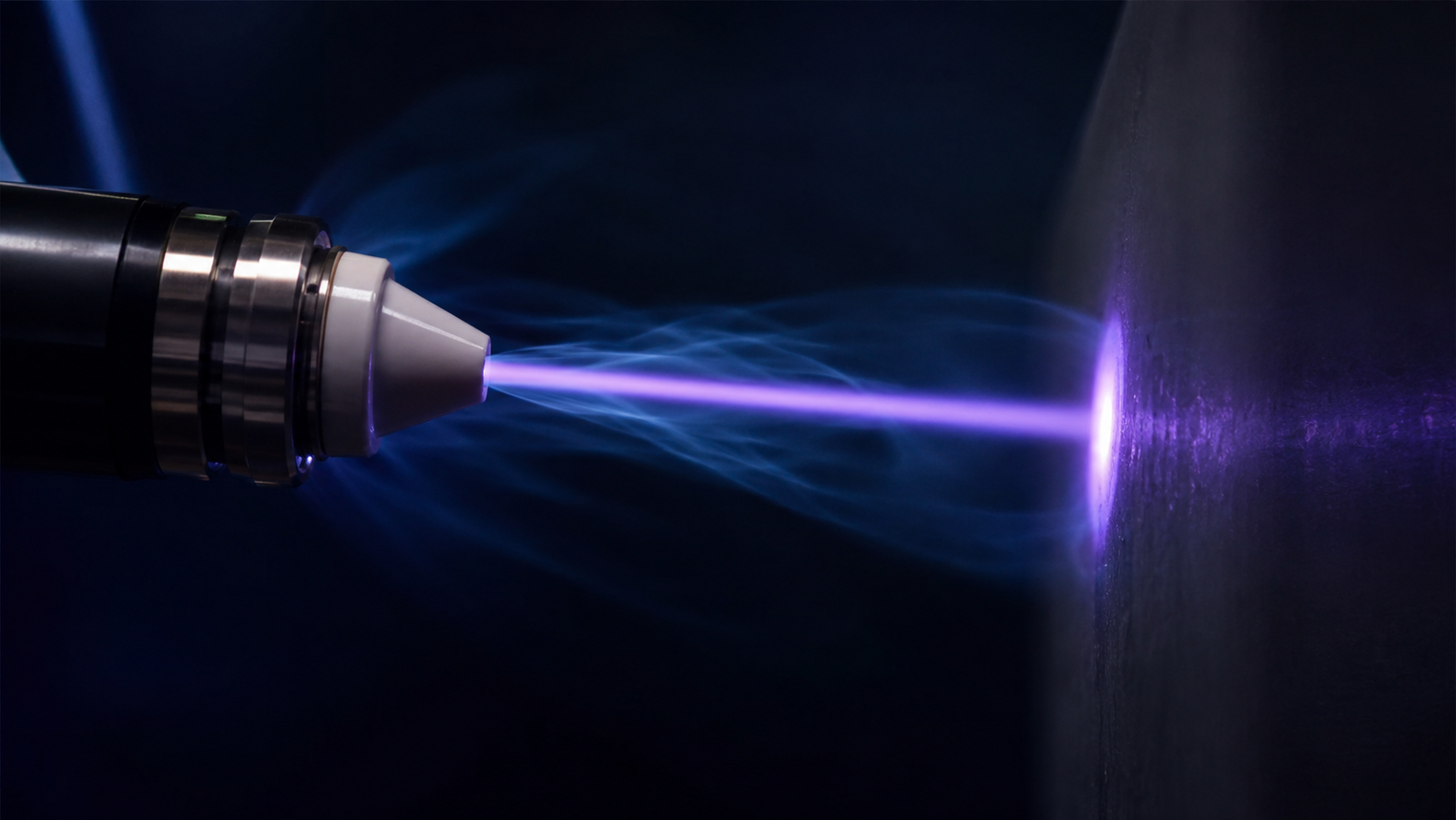
Most plasma lives inside something — a tube, a gap, a vacuum chamber. An atmospheric plasma jet breaks that rule: it launches the plasma out of a nozzle into open room air, as a slim violet plume you can aim at whatever needs treating. No vacuum chamber or pump-down is required, and the workpiece never has to fit inside a machine — though treatment footprint, working distance, and scan speed still set the practical throughput. This guide explains how a jet works — the gas channel, the discharge, the plume and its famous "plasma bullets" — why the plume stays cool enough to touch many samples safely, what sets its free-plume length and how the plume changes as it approaches a target, and how to choose between a focused jet and a wide-coverage system.
In one paragraph: a plasma jet is a small discharge cell plus a flow of gas that carries the discharge out of the nozzle — in the most common dielectric-tube designs, a dielectric-barrier arrangement around the tube; RF, microwave, and single-electrode architectures also exist. In the dielectric-tube, noble-gas jets this guide focuses on, the visible plume rides the laminar gas channel, and what looks continuous is actually a train of fast ionization fronts ("plasma bullets") re-launched every drive cycle. The plume is non-thermal: hot electrons drive the chemistry while the bulk gas can remain comparatively cool — under suitable conditions near ambient — so heat-sensitive surfaces — polymers, electronics, even living tissue in medical variants — can be treated directly. Gas flow sets the reach, but only up to the laminar–turbulent limit: push the flow too hard and the plume abruptly shortens and flickers. Power sets intensity and reactive-species dose. Focused jets treat points and contours; wide-width jets cover webs and panels.
1. Plasma beyond the nozzle
The atmospheric-pressure plasma jet (APPJ) is now a source family in its own right, with a fifty-year history and an enormous diversity of designs — single-electrode and cross-field jets, DBD-based and RF-driven variants, needle jets and jet arrays — surveyed comprehensively in the device literature.1 What unites them is the defining move: generating the discharge in or around a gas-fed tube and letting the flow carry the active plasma out of the device, so that treatment happens in open air, on objects of any size or shape.2 The architectures do not all work the same way, however — this guide develops the physics of the most common family, the dielectric-tube noble-gas jet, and flags where other designs differ.
That move solves the cold-plasma field's oldest logistical problem. Chambered plasmas treat what fits inside; a jet treats what the plume can reach — a weld seam, a molded part, a wound, a moving web. Within the standard taxonomy of plasma generation methods, jets are the branch that traded confinement for access,3 and much of this article is about the physics that trade invokes: a plume in open air must fight entrainment of the surrounding atmosphere, and its reach, stability, and chemistry all follow from that fight.
2. The plume explorer
The simulator puts the two working controls in your hands. Raise the gas flow and the laminar plume extends toward the target — until the channel trips into turbulence and the plume collapses into flicker. Raise the power and the plume brightens and the treated footprint intensifies. The fast bright dots racing along the axis are the ionization fronts — the plasma bullets — that rebuild the plume every drive cycle.
3. Anatomy: channel, discharge, plume
Strip any jet to its skeleton and three parts remain. First, the gas channel: a controlled flow — typically helium or argon, sometimes with a reactive admixture — through a narrow tube, forming a laminar column that persists centimeters into the surrounding air. Second, the discharge cell: in this family a dielectric-barrier arrangement, with ring or needle electrodes around or inside the tube, driven by kHz-AC or pulsed high voltage (RF- and microwave-driven jets couple power differently and are not built on this barrier mechanism) — the same self-limiting barrier physics that keeps any DBD cold,4,5 here wrapped into a cylindrical or surface arrangement.6 Third, the plume and effluent: the luminous column beyond the nozzle and the invisible reactive flow around and past it, whose reactive chemistry usually provides much of the treatment effect, together with source-dependent contributions from charged particles, local electric fields, photons, and modest heating; the medical-grade kINPen jet is the best-characterized example of how a plume's physics and effluent chemistry fit together.7
The plume itself holds the field's most famous surprise. In dielectric-tube noble-gas jets photographed with nanosecond cameras, the apparently continuous column resolves into discrete, fast-moving luminous fronts — plasma bullets, guided ionization waves that launch from the nozzle each drive cycle and race along the gas channel at kilometers per second, orders of magnitude faster than the gas itself moves.8 The plume is thus rebuilt continuously, its apparent steadiness an artifact of repetition rate. And on the power side: for dielectric-barrier jets, whose cell is a capacitive load like any DBD, charge–voltage Lissajous analysis is the standard way to estimate energy per cycle9,10 — while pulsed, RF, and microwave jets call for source-appropriate diagnostics such as time-resolved voltage–current integration or forward/reflected-power measurement.
4. Why the plume stays cold
A visible plume in open air looks like a flame, and the most important fact about a plasma jet is that it is not one. The plume is a non-equilibrium plasma: the electric field heats the light electrons to effective temperatures of tens of thousands of kelvin, but elastic collisions transfer that energy to the heavy gas atoms so inefficiently that the bulk gas can remain comparatively cool — under suitable operating conditions, near ambient.11,12 Non-thermal operation at full atmospheric pressure is precisely the achievement the jet inherits from its barrier-discharge ancestry.13 If that two-temperature picture is new, our companion article on electron versus gas temperature develops it fully.
The cold plume is not chemically gentle — that is the entire point. Hot electrons dissociate and excite the gas and entrained air into reactive oxygen and nitrogen species, whose generation and transport to surfaces is the working mechanism of jet treatment,14 the basis of plasma medicine's biological effects,15 and the reason medical-class jets can treat living tissue within engineered dose limits.16 Two honest caveats belong here. The gas temperature your sample feels must be measured — rotational-line spectroscopy is the standard route17 — and the plume's electron population is non-Maxwellian, so any single quoted "electron temperature" is a summary, not a full description,18 with probe-based characterization carrying its own well-documented pitfalls.19
5. Flow, reach & the turbulence limit
Two knobs govern a jet in operation, and they divide the labor cleanly. Gas flow sets the reach: the plume rides the laminar noble-gas channel, and in many noble-gas jets, increasing flow initially extends the protected channel and lengthens the visible plume. But the channel is a jet in the fluid-dynamic sense too, and every fluid jet has a Reynolds limit: push the flow past it and the column trips into turbulence, ambient air folds into the noble gas, the guided ionization wave loses its rail, and the plume can destabilize or abruptly shorten and flicker.1,8 In such jets the longest stable plume often sits just below the transition — a genuinely non-monotonic optimum — though where that optimum falls depends on the nozzle, gas, electrode geometry, drive, and working distance. The target matters too: as the plume approaches or contacts a surface, the surface's conductivity and distance reshape the ionization wave's propagation and the treatment footprint — free-plume length and treating length are not the same number.8
Power and waveform set the dose: brightness, species production, and the energy delivered per bullet. Drive waveform matters in its own right — pulsed excitation of an atmospheric jet has been shown to produce markedly different discharge behavior and efficiency than sinusoidal drive of the same hardware20 — which is why jet systems pair naturally with adjustable and pulse-capable supplies, and why our tuning guide applies to jets as directly as to sealed cells.
6. What jets treat
The jet's portfolio is the cold-plasma portfolio, minus the chamber. Surface activation and adhesion: a scanned plume raises surface energy and grafts polar groups onto polymers and biomaterials, the classic pre-bonding and pre-coating step.21 Plasma medicine: jets are the field's signature instrument — wound care, dermatology, and oncology research all built on the jet's ability to deliver reactive species to living tissue22,23,16 — and food processing extends the same decontamination chemistry to produce and packaging.24 Plasma–liquid work: aim the plume at water and the interface chemistry that results is its own research field, from activated-water agriculture to analytical applications.25 Materials synthesis and modification round it out, from nanomaterial processing in non-thermal plasmas26 to the broader gas-conversion chemistry that cold-plasma reactors — jets included — are being explored for.27
7. Choosing a jet system
The practical decision has three branches. Focused point work — contours, seams, spot activation, small-sample research — calls for a single-nozzle jet: the ACS Material PTS plasma jet generator pairs a jet head with a matched kHz supply for exactly this. Area coverage — webs, panels, batch surfaces — calls for a wide plume: the power-adjustable wide-width jet generator spreads the discharge across a broad slot for uniform swaths. And enclosed, repeatable chemistry — defined atmospheres, packed beds, parameter studies — argues for a sealed cell instead: our guide to DBD reactor geometries maps that territory, including where an open jet and a closed reactor trade places.
Whichever branch you take, the supply is half the system: an adjustable carrier and pulse capability — the CTP-2000K family's territory — is what lets you tune reach, dose, and gas temperature to the sample, and the physics of that drive is the standard reference material of low-temperature plasma engineering.28 The jet field itself is still moving fast — arrays, new gas chemistries, catalysis coupling — with its trajectory tracked in the community roadmap and the plasma-catalysis literature.29,30 Tell us your surface, your geometry, and your throughput, and we will spec the jet, the width, and the drive. One clarification for completeness: ACS Material jet systems are laboratory and industrial research equipment for surface treatment, adhesion, cleaning, and materials work — they are not presented here as cleared medical devices; the plasma-medicine literature above describes that research field and its purpose-built instruments.
Knowledge hub
- Plasma Processing Guide — the pillar overview of plasma, discharges, applications, and power supplies.
- DBD Reactor Design — sealed cells versus open jets: where each geometry wins.
- Frequency & Duty-Cycle Tuning — the drive-side controls that set a jet's dose and temperature.
- PTS Plasma Jet Generator — a focused single-nozzle jet with matched kHz supply.
- Wide-Width Plasma Jet Generator — a power-adjustable broad plume for web and panel coverage.
- CTP-2000K Power Supply — the adjustable kHz supply that drives our jet and DBD hardware.
FAQ
Is an atmospheric plasma jet hot?
The plume of a cold jet is not: electrons are hot, but the gas your sample feels typically stays near ambient to modestly warm, which is why polymers and even living tissue can be treated. But this is a design property, not a guarantee — gas temperature depends on power, flow, and duty cycle, and should be measured for your operating point rather than assumed.
What gas does a plasma jet use?
Most laboratory jets run helium or argon, because noble gases ignite easily at atmospheric pressure and form a stable laminar channel that guides the plume. Small admixtures of oxygen, nitrogen, or water vapor are added when specific reactive chemistry is wanted; the entrained room air contributes reactive oxygen and nitrogen species in any case.
How far can the plasma extend from the nozzle?
Typically on the order of a few millimeters to a few centimeters, set by gas flow, drive power, and nozzle design. In many noble-gas jets the reach grows with flow up to a laminar–turbulent limit, beyond which the channel breaks up and the plume shortens — so the longest stable plume often sits just below that transition, at a point that depends on the specific nozzle, gas, and drive.
What are plasma bullets?
Fast-moving ionization fronts that race from the nozzle along the gas channel each drive cycle — guided ionization waves traveling at kilometers per second, far faster than the gas flows. Nanosecond imaging shows the apparently continuous plume is actually this rapid train of bullets, refreshed every cycle of the drive voltage.
How is a jet different from a corona treater?
A corona treater ionizes the air gap directly over a passing film with a high-voltage electrode — simple, effective for webs, but confined to its own gap geometry. A jet generates plasma in a fed gas channel and projects it outward, giving controlled chemistry (noble gas plus chosen admixtures), a directable plume, and access to three-dimensional parts a corona gap cannot reach.
Can a jet treat 3D parts?
Yes — that is its defining advantage. Because treatment happens in open air at the plume tip, a jet can be scanned over contours, into recesses, and along seams of parts far larger than any chamber, either by hand or on a motion stage. For full-surface coverage of large flat stock, a wide-width jet or an in-line array is the scaling route.