
Plasma — the fourth state of matter — is an ionized gas of free electrons, ions, and reactive species that conducts electricity and drives chemistry ordinary gases cannot. It is one of the most versatile processing tools in modern laboratories and industry: the same broad phenomenon etches microelectronics, generates ozone, activates polymer surfaces, converts CO2 and methane, and is being studied on living tissue in plasma medicine. What makes this possible is one controllable idea — couple electrical energy preferentially into the electrons of a gas while limiting, rather than eliminating, heating of the gas itself — and a power supply built to sustain it. This guide covers what plasma is, how the major discharges work, where they are used, and how to choose a plasma power supply, with four interactive models you can drive yourself.
In one paragraph: many low-temperature laboratory plasmas are weakly ionized, non-equilibrium gases in which the free electrons are far more energetic than the ions and neutrals, while the bulk gas can remain comparatively cool. That separation — a high electron temperature over a modest gas temperature — is what lets cold plasma drive electron chemistry with a reduced thermal load: it makes radicals, reactive oxygen and nitrogen species, ions, and UV photons that clean, etch, functionalize, deposit, convert, and disinfect. The discharge geometry (dielectric barrier, jet, corona, RF, microwave) and the power supply that drives it — frequency, waveform, voltage, and power — tailor that chemistry to a gas, a surface, and a process.
1. What plasma is: the fourth state of matter
For most materials, adding energy walks you up a familiar ladder: a solid melts to a liquid, a liquid boils to a gas. Add still more — through heat, a strong electric field, or energetic collisions — and a fourth step appears. The gas begins to ionize: electrons are torn free from atoms, leaving a mixture of free electrons, positive ions, and remaining neutral particles. This ionized, electrically conductive medium is plasma, and it is not exotic — it makes up the overwhelming majority of the visible matter in the universe, from the interior of stars to interstellar gas.1,2
What sets plasma apart from an ordinary gas is that its charged particles are free and collective. They respond to electric and magnetic fields, carry current, and continuously collide, excite, and recombine — and the light emitted in recombination and de-excitation is the glow we associate with neon signs, fluorescent tubes, and lightning. Two properties matter for everything that follows. First, plasma is quasi-neutral: averaged over any meaningful volume, the negative and positive charges balance, even though locally the charges are separately free to move. Second, a plasma shields electric fields over a characteristic length — the Debye length — so its charged particles act together rather than independently. The model below steps a material from a cold solid all the way to an ionized plasma so you can watch ionization set in.1
Drag the energy slider and watch the lattice melt, vaporize, and finally ionize into a quasi-neutral soup of electrons and ions.
2. Thermal vs non-thermal plasma
The single most important distinction for laboratory and industrial plasmas is whether the electrons and the heavy particles share the same temperature. It is worth being precise about what “temperature” means here: in a plasma each species can have its own temperature, set by how its random kinetic energy is distributed, and the electrons need not be in equilibrium with the ions and neutrals around them.1,3
In a thermal (equilibrium) plasma, sufficiently high power density and collision frequency drive the electrons and heavy particles toward local thermodynamic equilibrium at a common, very high temperature — often several thousand to more than 20,000 K — while the ionization fraction depends on the gas, pressure, and temperature.1 Plasma torches, electric arcs, and plasma cutting systems exploit exactly this: an enormous, concentrated heat flux. When the goal is to melt, spray, cut, or reach extreme process temperatures, a thermal plasma is the tool.
In a non-thermal (non-equilibrium, or “cold”) plasma, energy is coupled preferentially into the light electrons. Their electron temperature is typically on the order of 1–10 eV — roughly 10,000–100,000 K expressed as an equivalent temperature — yet because an electron is thousands of times lighter than an ion, it transfers very little energy per elastic collision, so the bulk gas can remain comparatively cool — in suitable low-power configurations, near ambient temperature.4,5 Why the electrons can run so hot while the gas stays cool — the mass-ratio physics behind this split — is explored in depth in electron temperature vs gas temperature in cold plasma. This separation is the working principle of cold plasma: the fast electrons drive energetic, non-equilibrium chemistry — radicals, excited species, ions — while the reduced thermal load can keep heat-sensitive substrates within their limits, provided power density, exposure time, gas flow, and surface temperature are properly controlled. It is why cold plasma can clean and activate delicate polymer films, and is studied on living tissue, with thermal damage held in check. The model below contrasts the two regimes side by side.3,6
Toggle between thermal and non-thermal to compare the electron and gas temperatures, and note where each sits relative to an illustrative 500 K reference line — real material limits vary widely.
3. How cold plasma is generated: discharge types
Cold plasmas are produced by applying a sufficiently strong electric field to a gas — strong enough to accelerate stray electrons until they ionize neutrals faster than the plasma loses charge to the walls and to recombination. Whether a discharge ignites at all is governed by the balance between this ionization and those losses, which depends on the gas, the pressure, and the electrode spacing; the classic statement of that balance is Paschen’s law, which gives the breakdown voltage as a function of the pressure–gap product.7 Several discharge configurations are in common laboratory use, each with a characteristic geometry and electrical drive.8,3
Dielectric barrier discharge (DBD) is among the most widely used cold-plasma sources, and Section 4 treats it in detail. In brief, one or both electrodes are covered by a dielectric — glass, quartz, or ceramic — and an AC or pulsed high voltage breaks the gas down into a multitude of nanosecond micro-discharge filaments. Charge accumulating on the dielectric self-limits each filament and prevents the collapse into a hot arc, keeping the discharge non-thermal. DBDs typically run at atmospheric pressure, scale easily to large areas, and are the workhorses of ozone generation, surface treatment, and plasma catalysis.8,9
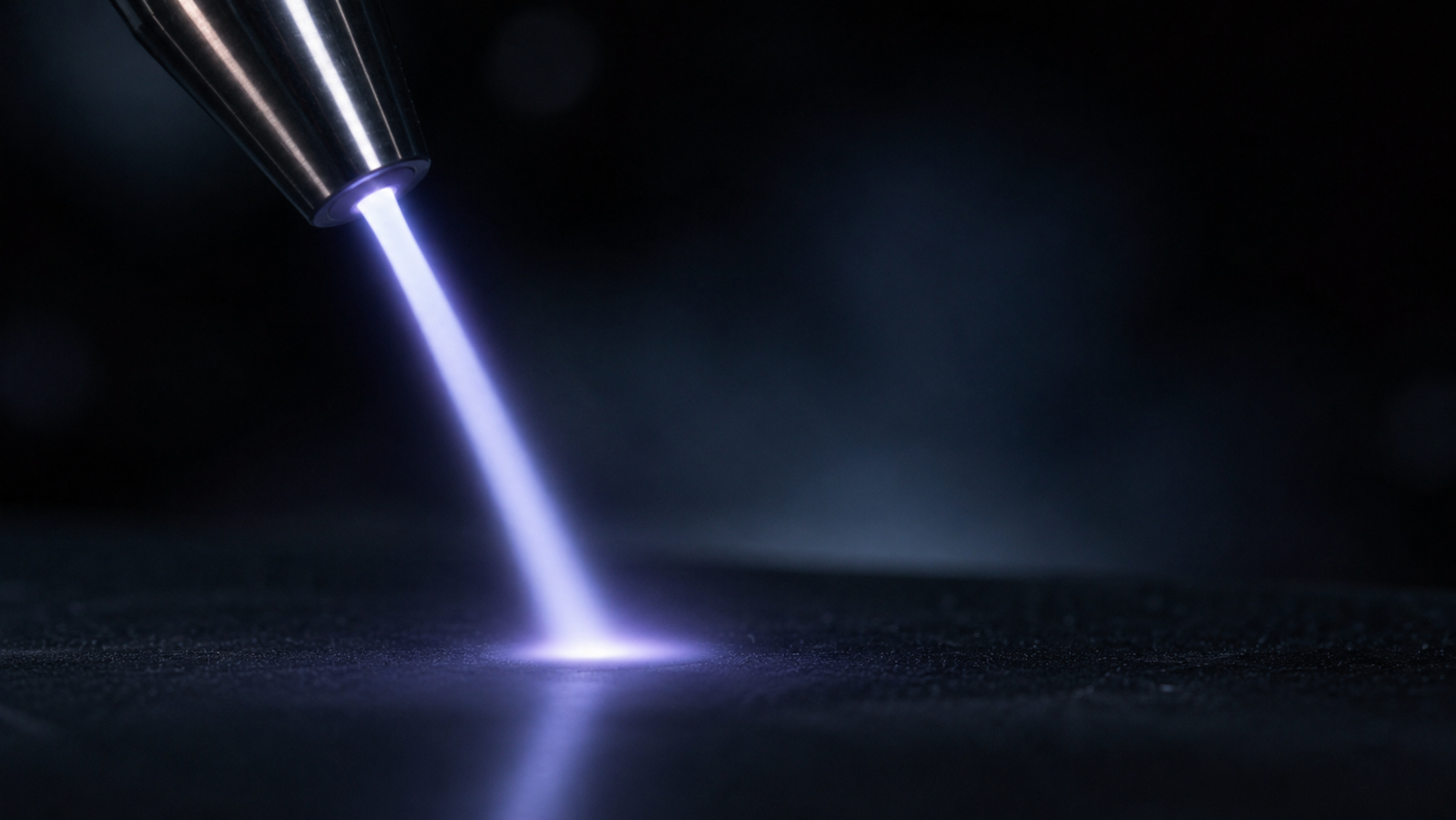
Atmospheric-pressure plasma jets (APPJs) push a noble gas — often helium or argon, sometimes with a reactive admixture — through a discharge so that a thin plasma plume extends out into the open air. Because the active plasma reaches beyond the electrodes, a jet can treat complex three-dimensional surfaces and heat-sensitive targets in the open air.3,10,11,12 Corona discharges form in the strongly non-uniform field around a sharp electrode or thin wire; they are simple and inexpensive but limited in the volume they can treat. Gliding-arc and microwave discharges occupy a middle ground, offering higher power and throughput for gas-conversion work. And at reduced pressure, radio-frequency (RF) and microwave-driven discharges give the fine, uniform control prized in microelectronics fabrication, where etching and deposition must be controlled to the nanometre.2,3 Across all of them, the choice of power supply — its frequency, its waveform (sinusoidal, pulsed, or microsecond-pulsed), and its voltage — is what tailors the discharge to a given gas, geometry, and process, a theme Section 7 develops.
4. Dielectric barrier discharge in depth
Because the dielectric barrier discharge is among the most widely used cold-plasma platforms in materials and chemical laboratories — and the one most ACS Material power supplies are built to drive — it repays a closer look here; a dedicated companion guide goes deeper into reactor geometries and diagnostics. The defining feature is in the name: at least one electrode is covered by a dielectric layer, so no conduction current can flow steadily between the electrodes. When the applied AC voltage rises past the gas’s breakdown value, the gap ionizes — but as soon as current begins to flow, charge piles up on the dielectric surface. That surface charge produces a counter-field that opposes the applied field, collapsing the local voltage below what the discharge needs and self-limiting the filament on nanosecond-to-tens-of-nanoseconds timescales, long before it can heat up into an arc.8,9
The result, in most gases and geometries, is not one uniform glow but a rapid, spatially distributed swarm of micro-discharge filaments, each a self-limited breakdown event, re-igniting in slightly different spots on each half-cycle as the polarity reverses. This is why a DBD stays cold: the energy per filament is tiny and the duty cycle of any given spot is low, so the gas has no chance to reach thermal equilibrium. Under carefully chosen gas, electrode, and waveform conditions — helium-rich mixtures, particular frequencies — the discharge can be coaxed into a more spatially uniform, glow-like mode, but the filamentary regime is the norm and is perfectly effective for most processing.9
Electrically, a DBD behaves like a gas gap in series with the barrier’s capacitance, and the power delivered per cycle is classically read from the charge–voltage Lissajous figure, whose enclosed area equals the energy dissipated per cycle — the standard way to meter a DBD and the basis of the century-old Manley relation for ozonizer power.8,13,14 What the power supply must do is deceptively demanding: raise the gap past breakdown, then keep re-driving it every half cycle without ever letting a filament run away into a hot arc. The model below shows a DBD cell as the drive voltage rises — watch the gas break down into filaments once the voltage crosses the gap’s breakdown threshold, and how a wider gap needs a higher voltage to light.
Raise the voltage until the gap breaks down into micro-discharge filaments; widen the gap and the breakdown voltage climbs — the Paschen-like behaviour, at the fixed pressure represented here, that sets how much drive a supply must deliver.
5. Reactive species: the working chemistry of plasma
The reason cold plasma is so useful across so many fields is the cocktail of reactive species its energetic electrons create. Many stable feed gases are comparatively unreactive under ambient conditions; drive them with fast electrons and new excitation and dissociation pathways open. Electron impact dissociates and excites gas molecules, generating radicals, electronically and vibrationally excited atoms and molecules, positive and negative ions, and ultraviolet photons — and when air, oxygen, or water vapour is present, a rich set of reactive oxygen and nitrogen species (RONS) such as atomic oxygen, ozone, hydroxyl radicals, nitric oxide, and peroxynitrite.15,10
The plasma-generated mixture spans short-lived radicals and excited species as well as longer-lived products such as ozone, hydrogen peroxide, nitrite, and nitrate; in liquids and biological media, downstream reactions can also form species such as peroxynitrite.10,16 Crucially, the mix can be tuned. Changing the feed gas, the power, the frequency, or the exposure time shifts the balance between, say, ozone-dominated and NOx-dominated chemistry, or between ion bombardment and radical grafting. That tunability is what lets one broad technology serve so many ends: the same reactive chemistry that oxidizes a pollutant molecule in an exhaust stream also etches a nanometre of a wafer, grafts an oxygen-bearing group onto a polymer, inactivates a bacterium on a heat-sensitive surface, or activates an otherwise inert molecule for catalysis. Every application in the next section is, at bottom, an exercise in generating the right reactive species and delivering them to the right place.17,10
6. Applications across industry and research
6.1 Surface treatment and activation
Cold plasma is a mature, widely used industrial method for modifying a surface without touching the bulk. A brief exposure cleans away organic contamination, etches at the nanoscale, and grafts new chemical functional groups onto polymers, metals, glass, and textiles. The practical payoff is a dramatic change in wettability, adhesion, and biocompatibility — better adhesion for paint, ink, and adhesives, or surface preparation of biomaterials and implants.2,18,19,20 Because the bulk gas stays comparatively cool, even delicate films and fibres can be treated with the thermal load kept in check. Extended into a growth process, the same physics becomes plasma-enhanced chemical vapour deposition (PECVD), depositing thin functional coatings at temperatures far below those a purely thermal process would need.
6.2 Nanomaterial synthesis
Gas-phase non-thermal plasmas can provide a powerful, solvent-free route to high-purity nanocrystals. The non-equilibrium environment does something a furnace cannot: it selectively heats a growing nanoparticle above the surrounding gas temperature, while particle charging helps suppress agglomeration, and the non-equilibrium chemistry can enable doping that is hard to achieve by other means.4 This has produced silicon and other semiconductor quantum dots, carbon nanomaterials, and a wide range of functional nanoparticles with tight control over size and composition.
6.3 Plasma catalysis and gas conversion
One of the most active research frontiers combines a cold plasma with a catalyst to drive chemical reactions at near-ambient temperature, powered directly by electricity.17,21 Energetic electrons activate otherwise stable molecules through vibrational, electronic, and dissociative excitation, opening reaction pathways that a conventional thermal process would reach only at high temperature.22,23 DBD reactors are among the most common platforms for CO2 conversion into fuels and chemicals, dry reforming of methane into syngas, and nitrogen fixation toward ammonia or NOx — attractive because they can be driven directly by renewable electricity, offering a route to decarbonizing parts of the chemical industry.24,21,22 Industrial adoption still depends on improving energy efficiency, product selectivity, catalyst stability, reactor durability, and scale-up from laboratory demonstrations.
6.4 Plasma medicine and biology
Perhaps the most striking newer field is plasma medicine. Cold atmospheric plasmas delivered by jets or DBD devices bring RONS directly to cells and tissue. Applications under investigation include antimicrobial decontamination, wound care, dermatology, and cancer research; their maturity varies substantially by indication and device, and oncology applications remain largely investigational.25,26,27 The same reactive chemistry inactivates bacteria, viruses, and biofilms — including on heat-sensitive surfaces where steam or dry heat would do damage — which makes cold plasma attractive for disinfection where conventional methods struggle.10,18 Clinical use requires a validated device and treatment protocol and applicable regulatory clearance; the physics is enabling, not a substitute for that validation.
6.5 Environment, food, and agriculture
Cold plasma degrades volatile organic compounds and odours in air, breaks down persistent pollutants and pharmaceuticals in water — often by way of plasma-activated water that carries the reactive chemistry into solution — and is being explored across the food and agriculture chain for surface decontamination, packaging, and seed treatment.17,28,16 Its appeal is that it can reduce or eliminate added liquid reagents in some configurations: the short-lived reactive species are generated in situ from the feed gas and electricity rather than dosed as chemicals that must later be removed.
6.6 Microelectronics and thin films
Finally, one of plasma technology's defining industrial arenas: semiconductor manufacturing. Low-pressure RF and microwave plasmas do the precision etching and deposition that define modern integrated circuits, removing or laying down material with the anisotropy and nanometre control that only ion-assisted, non-equilibrium processing provides. This is the domain where plasma processing was first industrialized at scale, and it remains one of the largest and most mature industrial application areas of plasma technology.2,3
7. Choosing a plasma power supply
Because the power supply defines the discharge, matching it to the reactor is central to any plasma experiment: the electrical source and the discharge geometry must be treated as one coupled system. Four variables dominate the decision. Frequency sets the character of the discharge: line frequency and kHz-range AC for classic DBD and ozone work, higher frequencies and pulsed drive for finer control and efficiency. Waveform — continuous sinusoidal, modulated, or microsecond-pulsed — trades average power against peak field: short pulses reach high instantaneous fields (and efficient, transient chemistry) while keeping the gas cool. Output voltage and power must be high enough to break down the intended gap and sustain the process, with headroom. And the supply must match the electrode and reactor geometry it has to drive — a small jet, a large-area DBD, or a packed-bed reactor present very different electrical loads.8,3
The map below places the major application areas on a frequency–voltage plane and shows which ACS Material supply family lands in each region — a way to see, at a glance, why a given process points to a particular kind of supply. Select an application to highlight the supply that fits.
Two honest limits on the map: region positions are schematic, and a two-axis view is only a first pass — final selection also depends on the gas, pressure, electrode gap, dielectric configuration, load capacitance, waveform, peak current, and target average power. The subsections below walk through those variables one by one.
7.1 Output voltage
The first requirement is simply to break the gas down. The ignition voltage of a cell depends on the gas, the pressure, the electrode gap, and — in a DBD — on the dielectric, which sits in series with the gap and takes a share of the applied voltage before the gas sees any field.7,8 At atmospheric pressure and the millimetre gaps typical of laboratory cells — the right-hand side of the Paschen curve — a wider gap needs a higher ignition voltage, and once lit the discharge sustains at somewhat lower voltage than it ignites. The practical rule: specify a supply with clear headroom above the ignition voltage of your worst-case gap and gas, and remember that a headline maximum-kilovolt rating says nothing by itself about how much of that voltage actually appears across the gas.
7.2 Frequency
Frequency sets how often the gap is re-driven. Classic DBD and ozone work runs from line frequency up to tens of kilohertz: each half-cycle re-ignites the micro-discharges, helped by charge and excited species left over from the previous one — the memory effect.8,9 Because a DBD transfers a roughly fixed amount of charge per cycle, average power often rises approximately with frequency over a limited operating range at fixed geometry and voltage, which is why raising frequency is the usual way to raise throughput without raising peak field.14 The relationship is not universally linear: the transferred charge, load impedance, and discharge mode can themselves shift with frequency. At the other end of the scale, megahertz radio-frequency and microwave drive at reduced pressure trade raw power for the uniformity and fine control that microelectronics demands.2
7.3 Waveform and pulse width
A continuous sinusoid is the workhorse for steady-state DBD chemistry. Modulated (burst) operation keeps the same peak voltage but gates it on and off, controlling average power — and gas heating — through the duty cycle. Short, microsecond-scale pulses go further: they reach high instantaneous fields that favour energetic electrons and efficient, transient chemistry, while the long off-time between pulses lets the gas cool.6,3 This is the territory of microsecond-pulse and parametric pulse supplies, where pulse width, repetition rate, and duty cycle become process knobs in their own right.
7.4 Output power and the load
Electrically, a DBD cell is mostly a capacitive load — the barrier capacitance in series with the gap — so the current a supply must source rises with electrode area, dielectric permittivity, drive voltage, and frequency.13,8 Packed-bed reactors add their own capacitance and local field enhancement. Peak and average power are different questions: a pulsed supply may deliver modest average watts through very high instantaneous power. Matching the supply to the load — and providing arc protection and adequate cooling for long runs — is as much a part of selection as the headline voltage and power numbers.
7.5 A first-pass selection table
| Application | Common plasma source | Key electrical needs | Typical ACS Material direction |
|---|---|---|---|
| Surface activation | DBD / plasma jet | kHz AC, moderate power | CTP-2000K + DBD device or plasma jet |
| Ozone generation | DBD | High voltage, continuous kHz drive | CTP series + DBD reactor |
| CO2 / CH4 conversion | DBD / packed-bed DBD | Higher power into a capacitive load | CTP-2000K/A + coaxial or reactor-style DBD |
| Localized / open-air treatment | Atmospheric plasma jet | Compact HV drive, low thermal load | Plasma jet generator |
| Pulsed / high-field chemistry | Microsecond-pulsed DBD | Pulse width, peak voltage, duty cycle | CTP-2000KM or parametric pulse supply |
| High-temperature processing | Thermal plasma torch | High current, thermal power (DC arc) | PlasmaNova™ 5 kW system |
Initial selection only — the final configuration depends on the gas, pressure, gap, dielectric, load capacitance, peak current, and target power. Send us the process details and we will match the supply and reactor.
ACS Material’s plasma power supply line is built around exactly these needs. The CTP-2000K family provides low-temperature plasma experimental power supplies in several variants — a base unit (a medium-frequency, roughly 10 kHz, 0–30 kV, 0–500 W AC source), a modulated-pulse version (CTP-2000K/P), a differential-output version (CTP-2000K/S), a high-power version (CTP-2000K/A), a microsecond-pulse version (CTP-2000KM), and a high-voltage low-frequency digital supply (CTP-2000KL) — so the excitation can be matched to the chemistry. For the discharge cell itself, ACS Material offers dielectric barrier discharge experiment devices, a DBD reaction kettle, and a DBD coaxial reactor for flow-through gas processing. For open-air and jet work there are plasma jet generators, a wide-width low-temperature jet, and a parametric high-voltage pulse supply. And when intense heat is the goal rather than cold chemistry, the PlasmaNova™ portable 5 kW integrated plasma torch system delivers thermal-plasma power in a compact package.
8. Measuring the discharge — and keeping it reproducible
A plasma process is only as good as its measurement. The standard electrical picture of a DBD is the charge–voltage Lissajous figure: a measuring capacitor in series with the cell records the transferred charge, plotting charge against applied voltage produces a closed, often parallelogram-like loop, and the enclosed area equals the energy dissipated per cycle — multiplied by frequency, that is the average discharge power. This is the century-old Manley method, still the reference way to meter a DBD, and the modern equivalent-circuit reading of the same figure also yields the burning voltage and the effective capacitances of the cell.14,13 A high-voltage probe for the applied waveform and a current probe for the discharge current complete the basic electrical set, while optical emission spectroscopy helps identify the emitting excited species and infer discharge conditions — non-emitting and ground-state species need complementary diagnostics.12
Reproducibility then asks for discipline: record the gas composition and flow rate, electrode gap, dielectric material and thickness, applied voltage, frequency, waveform, duty cycle, treatment time, humidity, and substrate temperature. Small changes in any of these — a little more humidity, a slightly wider gap — can shift the reactive-species balance measurably, so a plasma process is only as repeatable as its logged conditions.
9. Safety
Plasma systems concentrate several hazards in one bench: high voltage, ultraviolet emission, ozone and NOx generation, pressurized or flammable gases, and reactive exhaust. Experiments should be run with proper grounding, shielding, ventilation and ozone extraction, safety interlocks, and gas-compatible materials, following the manufacturer’s safety documentation. None of this is optional — the same reactive chemistry that makes plasma useful is what makes its by-products worth containing.
10. Outlook
Low-temperature plasma sits at the intersection of physics, chemistry, materials, and the life sciences, and its reach is still expanding. The 2022 Plasma Roadmap highlights the electrification of chemical synthesis, plasma-driven CO2 and nitrogen conversion, and plasma medicine as areas of intense growth, alongside the established pillars of microelectronics and surface engineering.3,21,29,30 The common thread is timely: as renewable electricity becomes abundant and intermittent, a technology that turns electrons directly into useful chemistry — often at lower bulk temperatures and with fewer added chemical reagents — is well matched to a grid that has power to spare at unpredictable hours. That positions cold plasma not as a niche laboratory curiosity but as an enabling technology for a more sustainable and more electrified industry, and it is why the humble power supply that drives the discharge is worth understanding in its own right.
The plasma knowledge hub
This guide anchors a growing library on plasma science and processing. Each section below collects the articles and equipment families for one branch of the field — new guides are added here as they are published — a maintained map of the current ACS Material plasma resources.
Fundamentals — how cold plasma works
The physics behind non-thermal plasma: why the electrons run hot while the gas stays cool, and what that separation makes possible.
- Electron Temperature vs Gas Temperature — why cold plasma can have 1–10 eV electrons while the gas stays comparatively cool: the mass-ratio physics, EEDF, and how each temperature is measured.
- Plasma Discharge Types: Corona, Glow, Arc & DBD — the four canonical discharge regimes compared: structure, gas heating, and which regime fits which process.
Power supplies — driving the discharge
How frequency, waveform, and voltage tailor a discharge, and which supply fits which process.
- Plasma Power Supply (full category) — browse the complete line of CTP supplies, pulse supplies, jet generators, and torch systems.
- Plasma Frequency, Duty Cycle & Waveform — how carrier frequency, burst modulation, duty cycle, and pulse shape tune power, gas heating, and reactive-species output.
- HV Pulse vs RF vs Microwave Plasma Sources — the three excitation families compared: timescale, electrode contact, pressure range, and what each drives best.
- Plasma Torches: Transferred vs Non-Transferred — the thermal branch: DC torch anatomy, spraying, cutting, and the 5 kW class.
- Impedance Matching for Plasma Systems — why plasmas are difficult loads, where reflected power goes, and how matchboxes, kHz resonance, and stub tuners deliver the watts.
- Low-Temperature Plasma Power Supply (CTP-2000K) — the flagship medium-frequency, 0–30 kV, 0–500 W AC source for DBD, glow, and arc discharge.
- Parametric High-Voltage Pulse Supply — pulsed high-field drive for transient, efficient plasma chemistry.
- PlasmaNova™ Portable 5 kW Plasma Torch System — integrated thermal-plasma power when heat, not cold chemistry, is the goal.
Reactors — DBD cells and discharge geometry
The discharge cell itself: dielectric barrier devices, coaxial and flow-through reactors, and how geometry shapes the plasma.
- Dielectric Barrier Discharge (DBD): Reactors, Physics & Power — a deep dive into microdischarge physics, reactor geometries, and Lissajous power measurement.
- DBD Reactor Design: Planar vs Coaxial, Surface & Packed-Bed — a selection guide to reactor geometry: field profile, gas handling, electrical load, and which cell fits your sample and process.
- DBD Experiment Device — the benchtop dielectric barrier discharge cell for surface and gas work.
- DBD Coaxial Reactor — flow-through coaxial geometry for continuous gas processing.
Applications — surfaces, gas conversion, and jets
Where plasma is put to work: surface activation and jets, gas-phase conversion, and materials functionalization.
- Atmospheric Plasma Jets: Cold Plasma Surface Treatment — how jets carry cold plasma beyond the nozzle: plasma bullets, plume reach, the turbulence limit, and choosing a jet system.
- Plasma Surface Activation: Wettability & Adhesion — how activation raises surface energy, why it ages, and how to dose it.
- Plasma Cleaning at the Nanoscale — chemical ashing vs sputtering, and low-pressure vs atmospheric cleaning.
- Plasma-Enhanced CVD (PECVD) — how plasma electrons pay the activation energy so films grow on substrates the furnace would destroy.
- Plasma Etching & Nanostructuring — chemical, sputter, and reactive ion etching compared: why only the synergy cuts fast, selective, and straight down.
- Plasma Functionalization of 2D Materials — grafting, doping, and termination tuning on MXenes, h-BN, and TMDs inside the damage window.
- Plasma Ozone Generation — inside the DBD ozonizer: microdischarge chemistry, the heat trade, and the coaxial flow-through reactor.
- Plasma Jet Generator — open-air atmospheric plasma jets for localized cleaning, activation, and adhesion promotion.
- Wide-Width Low-Temperature Plasma Jet — large-area jet treatment with adjustable power.
FAQ
What is plasma in simple terms?
Plasma is the fourth state of matter: a gas energized until some of its atoms lose electrons, leaving free electrons and positive ions that conduct electricity and glow. Stars, lightning, and neon signs are plasmas — and, in controlled laboratory form, it is a versatile tool for treating surfaces and driving chemistry.
What is the difference between thermal and cold (non-thermal) plasma?
In a thermal plasma, electrons and heavy particles share one very high temperature and deliver intense heat — the regime of torches and cutting. In a cold plasma only the electrons are hot, while the gas stays comparatively cool, so it delivers energetic chemistry with a much lower thermal load.
What voltage does a dielectric barrier discharge need?
At atmospheric pressure and millimetre gaps, ignition typically takes several kilovolts to a few tens of kilovolts, rising with the gap and depending on the gas and dielectric. Supplies such as the CTP-2000K provide a 0–30 kV range to give that headroom.
What frequency is commonly used for a DBD?
Line frequency up to tens of kilohertz is the classic band; many laboratory supplies run in the few-to-tens-of-kHz range (the CTP family is centred near 10 kHz). Higher frequency delivers more charge-transfer cycles per second and therefore more average power at a given voltage.
Why does a discharge turn into an arc — and how does a DBD prevent it?
If current is allowed to keep concentrating in one channel, it heats the gas there and collapses into a hot arc. In a DBD, charge piling up on the dielectric cancels the local field and self-limits every filament within nanoseconds, so under normal operating conditions the dielectric strongly suppresses the transition into a sustained thermal arc.
How is DBD power measured?
With a charge–voltage Lissajous figure: a series measuring capacitor records transferred charge, the enclosed area of the charge–voltage loop equals the energy per cycle, and multiplying by frequency gives the average power — the classic Manley method.
Can one plasma power supply drive different reactors?
Often yes, within its voltage, frequency, and power window — the CTP family, for example, pairs with planar DBD cells, coaxial reactors, and jets. What decides it is the load: electrode area, dielectric, and capacitance must stay within what the supply can source and match.
Is cold plasma suitable for heat-sensitive materials?
Often, but “cold” does not mean zero heating. Suitability depends on power density, exposure time, treatment distance, gas flow, and the thermal limits of the specific material — controlled properly, delicate polymers, films, and even tissue can be treated.
References
This guide covers plasma power supplies, dielectric barrier discharge and plasma-jet sources, and cold-plasma processing in general terms for education. Real discharge behaviour, breakdown voltages, reactive-species yields, and treatment outcomes depend strongly on the specific gas, pressure, electrode geometry, dielectric, waveform, and substrate, and can differ substantially from the idealized values and schematic models shown here. The interactive simulators are simplified teaching tools, not quantitative process models or engineering design software. Medical, biological, and food applications are described for context only and require appropriate regulatory clearance and validated protocols. For accurate specifications, safe operating limits, and handling guidance for any ACS Material plasma product, consult the product datasheet and safety documentation, and contact ACS Material with your application requirements.