
Two-dimensional materials are simultaneously the most promising and the most fragile surfaces in materials science: a pristine monolayer of h-BN or MoS₂ offers almost nothing for a composite or device to grip, while an MXene sheet arrives already tiled with reactive surface terminations begging to be engineered — and all of them are thin enough that aggressive chemistry destroys the very lattice being improved. Plasma functionalization threads that needle: a dry, low-temperature, dose-controlled way to graft functional groups, dope the lattice, and engineer terminations, with an adjustable-aggression range no wet method matches. This guide covers what plasma installs on a 2D sheet, how MXenes, h-BN, and TMDs each respond, and the remote and pulsed techniques that keep the treatment inside the window between functionalized and perforated.
In one paragraph: most pristine 2D basal planes — h-BN, the TMDs, graphene — are chemically aloof and hard to wet, disperse, or anchor, while MXenes arrive surface-terminated and reactive, needing termination control rather than first contact; either way, atomic thinness leaves no bulk to absorb damage: overdose does not roughen a monolayer, it perforates it. Plasma functionalization is the leading route because its aggression is tunable across orders of magnitude: reactive species graft oxygen or nitrogen groups, heteroatoms dope the lattice, and controlled defects can even be a feature. MXene terminations, h-BN wettability, and TMD doping each have demonstrated plasma recipes. The craft is the window: remote operation sharply reduces charged-particle bombardment (radicals, metastables, and photons still arrive), pulsed drive meters the dose, Lissajous measurement audits delivered energy — and XPS, Raman, and electrical tests verify that chemistry was added without the lattice being spent.
1. Two starting points, one shared danger
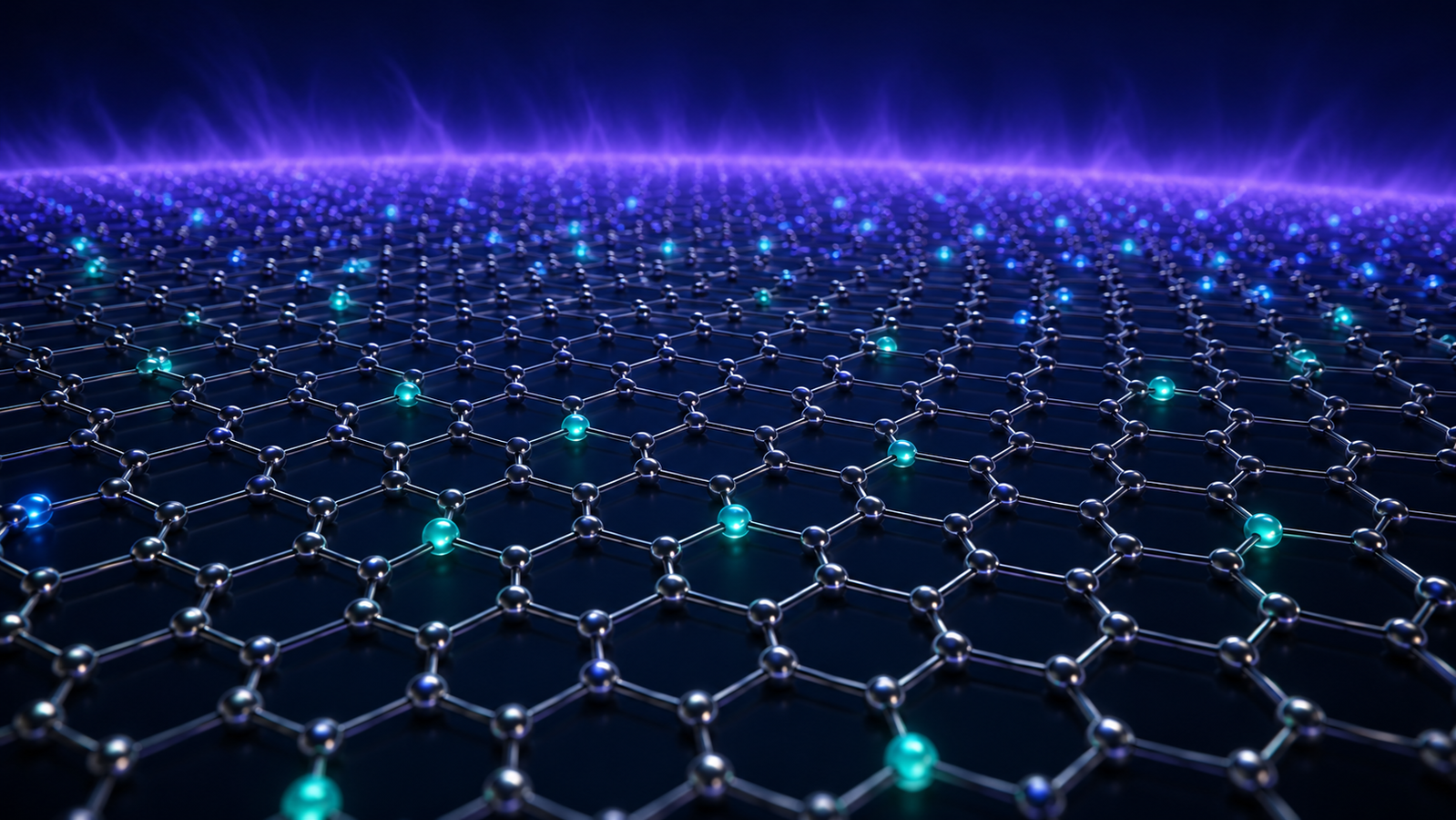
Two-dimensional materials arrive with a paradox built in — but not the same paradox for everyone. The basal planes of hexagonal boron nitride and the TMDs (MoS₂ and relatives) are chemically aloof: they resist wetting, resist dispersion, and offer few anchor points for the composites, sensors, and devices people want to build from them — chemistry must be added. MXenes start from the opposite corner: fresh from synthesis they are already tiled with –O, –OH, and –F terminations — chemically active, oxidation-sensitive, and property-defining — so the task is not adding chemistry but controlling it: which terminations, in what ratio, without degrading the carbide underneath.1 What every 2D material shares is the missing safety margin: there is no bulk beneath the surface to absorb damage, so an overzealous treatment does not roughen a monolayer, it perforates it.2 Plasma processing has become the leading answer across this whole spectrum because it is dose-controlled, dry, and low-temperature, with aggression adjustable over orders of magnitude — from ion-assisted attack down to whisper-gentle remote radical flux.3,4 (Graphene and carbon nanotubes, where this field learned many of its lessons, have their own dedicated guide; this article keeps its focus on the wider 2D family.)
2. The 2D functionalization lab
The simulator below puts a single honeycomb monolayer under three plasma chemistries. Raise the dose in O₂ or N₂ direct exposure and watch functional groups decorate the lattice — then watch vacancy defects open as the dose crosses the damage threshold. Switch to remote / pulsed operation and the same coverage arrives with the damage window pushed far out. The whole discipline of 2D plasma processing lives between those two thresholds.
3. What the plasma installs: groups, dopants, terminations
Plasma functionalization of a 2D sheet is three operations sharing one machine. Grafting: reactive species covalently attach functional groups — on carbon and organic surfaces, oxygen plasmas install hydroxyl, epoxide, and carbonyl while nitrogen and ammonia plasmas add amines and pyridinic/pyrrolic nitrogen; other 2D chemistries take different species by lattice (the table in section 4) — raising surface energy, dispersibility, and chemical anchor density.2 Doping: some of those heteroatoms substitute into the lattice itself, shifting carrier type and work function — plasma is now a standard route to n- and p-type tuning of TMD monolayers.3 Defect engineering: controlled vacancy creation, deliberately used, activates catalytic edge sites and tunes optical response — the same knob that ruins a transistor can build a catalyst, a logic plasma-catalysis research runs on deliberately.3,5 The underlying toolset is ordinary cold-plasma machinery — low-pressure RF and ICP glows with their sheath-directed ion flux, diagnosed and driven exactly as any laboratory discharge is.6,7,8,9
4. Material by material: MXenes, h-BN, TMDs
| Material | What plasma tunes | Primary risk |
|---|---|---|
| MXenes | Termination engineering (–O / –OH / –F ratio), nitrogen doping | Oxidation; degradation of the carbide/nitride core |
| h-BN | Basal-plane and edge activation, wettability, adhesion | B–N bond damage |
| MoS₂ / WS₂ (TMDs) | Doping, vacancy and phase engineering, layer thinning | Chalcogen loss and oxidation |
| Graphene | O/N group grafting, lattice doping, controlled defects | Vacancy formation (growing Raman D band) |
MXenes are the clearest case for termination engineering: their properties are dictated by the –O, –OH, and –F groups tiling their surfaces, and termination-dependent work function is the design variable.1 Plasma reaches that variable directly — nitrogen-plasma treatment dopes Ti₃C₂Tₓ MXene and measurably reshapes its electromagnetic response, a post-synthesis modification no wet route matches for speed and dryness.10 Hexagonal boron nitride, famously inert, yields to atmospheric-pressure cold plasma: BN-based surfaces gain wettability and adhesion from treatments gentle enough to run on coated polymer films in open air.11 TMDs (MoS₂, WS₂, WSe₂) are the current showcase — plasma handles their low-temperature growth, bidirectional doping, phase and defect engineering, and atomic-precision thinning within one processing family.3 Graphene’s own chapter lives in its dedicated guide (linked in section 1); here it serves as the calibration standard the rest of the family is measured against. Roadmaps for plasma science and technology single out exactly this territory, plasma control of atomically thin matter, as a defining frontier.12,13
5. Staying inside the window: remote, pulsed, gentle
The damage threshold is real, so the craft is widening the gap between "functionalized" and "perforated". Three levers dominate. Remote operation parks the sample outside the glow: charged-particle bombardment falls away sharply as ions and electrons recombine en route, while longer-lived radicals — together with metastables and photons — survive the trip, so the surface receives chemistry with far less physical assault; exactly which species arrive depends on distance, pressure, and geometry — the same downstream logic that gentle jet sources package for delicate targets.2,14,15,16 Pulsed drive chops the discharge so reactive species are delivered in metered bursts with cool-down between — duty cycle becomes a dose dial.17 Honest dose accounting closes the loop: at atmospheric pressure the charge–voltage Lissajous method reads delivered energy at the cell — essential where filamentary discharges make dial settings poor proxies for dose — and gas-temperature awareness guards against the thermal side of overdose.18,19,20,21,22 With seconds-scale exposures typical, 2D functionalization is dose control or it is nothing.23,24
6. Proving it worked (and did not overshoot)
Verification in 2D is unforgiving because the signal is the surface. XPS quantifies what was grafted — oxygen and nitrogen content, bonding states, MXene termination shifts — the same surface-analysis practice biomaterial plasma engineering standardized.25 Raman spectroscopy is the damage meter of record for carbon lattices, with defect-band growth reporting vacancies long before a microscope sees them. Contact angle and dispersion tests read the practical payoff — wettability and processability — while electrical measurements report what the trade cost: functionalization that lifts wettability while carrier mobility quietly collapses is a failed recipe for a device, and a fine one for a composite filler. Define which property you are buying before treating, qualify the dose window on sacrificial material, then hold the recipe.
7. Hardware and materials, one bench
This is the rare topic where the same catalog serves both sides of the experiment. On the plasma side: a DBD experiment device provides the uniform atmospheric cell for batch treatment of flakes and films; the CTP-2000K/P pulse-modulated supply puts the duty-cycle dose dial of section 5 on the front panel. On the materials side: the MXene series supplies the termination-tunable sheets of section 4, and the broader graphene-like materials line covers h-BN and its 2D relatives. Start with characterized material, treat with metered dose, verify with the section-6 toolkit — the loop that turns "plasma treatment" from folklore into a recipe.
Knowledge hub
- Plasma Processing Guide — the pillar overview of cold plasma, discharges, and power supplies.
- Functionalizing Graphene & CNTs — the carbon side of this story — where 2D plasma processing learned its rules.
- Frequency & Duty-Cycle Tuning — the drive-side physics behind pulsed, metered dosing.
- DBD Experiment Device — the uniform benchtop cell for batch treatment of 2D flakes and films.
- CTP-2000K/P Pulse Supply — duty-cycle dose control on the front panel.
- MXene Series — termination-tunable 2D carbides, ready for treatment studies.
FAQ
Why functionalize 2D materials at all?
Because pristine sheets are chemically antisocial: they resist wetting, aggregate instead of dispersing, and give composites and coatings nothing to bond to. Grafted polar groups fix dispersion and adhesion; dopants tune electronics; engineered terminations and defects unlock sensing and catalysis. Functionalization is how a beautiful material becomes a usable one.
Does plasma treatment damage graphene and other monolayers?
It can — and past a material-specific dose it will: ion bombardment opens vacancies, and in one atomic layer every vacancy counts. The discipline is dose control: short exposures, gentle chemistries, remote or pulsed operation, and Raman-verified windows. Damage is a dial, not a verdict — and sometimes (catalysis, sensing) a deliberately used one.
Which gas should I use?
It depends on the chemistry you are buying. On carbon and organic surfaces, oxygen installs hydroxyl/epoxide/carbonyl groups — the fastest wettability gain and the most aggressive. Nitrogen and ammonia add amines and lattice nitrogen — the doping route. Noble-gas plasmas modify with almost pure physics. Mixtures and sequences are common; the material and target property choose the recipe.
What is special about plasma treatment of MXenes?
MXene properties ride on their surface terminations, and plasma edits terminations directly — dry, fast, and post-synthesis. Demonstrations include nitrogen doping of Ti₃C₂Tₓ with measurable property shifts; the broader principle — termination engineering as the control knob — is exactly what a tunable plasma delivers.
Remote plasma vs direct plasma — when do I choose which?
Direct exposure (sample in the glow) is fast and effective for robust targets and for recipes that want some ion assistance. Remote exposure (sample downstream) sharply reduces charged-particle bombardment — what arrives is mostly neutral radicals, plus metastables and photons, in proportions set by distance and geometry — slower, far gentler, and the default for pristine monolayers, device-bound material, and anything where Raman must stay clean.
How do I verify a functionalization recipe?
Triangulate: XPS for what was grafted and how much; Raman (for carbon lattices) as the damage meter; contact angle or dispersion tests for the practical payoff; and electrical or optical measurements for what the trade cost. Qualify the dose window once on sacrificial material, write it down, and hold it — 2D windows are narrow and worth respecting.