
Ozone is the chemical industry’s most famous perishable: a powerful oxidant that cannot be bottled, shipped, or stored, because it decomposes back into the oxygen it came from — faster the warmer it gets. So it is manufactured at the point of use, and for over a century the machine that makes it has been the dielectric barrier discharge: cold filamentary plasma that splits O₂ and assembles O₃ without the heat that would destroy it. This guide explains the ozone generator from the physics up — the nanosecond microdischarges where the chemistry happens, the generation-versus-heat ridge every design balances on, the coaxial flow-through reactor geometry, and the application map from drinking water to gas conversion.
In one paragraph: ozone must be made cold and used fresh, and the DBD is the machine evolution picked for the job: self-quenching microdischarge filaments dissociate O₂ with hot electrons while the gas stays cool, and three-body collisions assemble O₃. The design tension is thermal — deposited power also heats the gas, hot gas decomposes ozone, so concentration, yield, and efficiency trade along a ridge managed with narrow gaps, flow, cooling, and drive waveform, and audited honestly by Lissajous power measurement. The natural vessel is the coaxial flow-through reactor — benchtop single tube, industrial bundles of them. Applications anchor on water treatment’s residual-free disinfection — with by-product chemistry such as bromate to manage — and extend through air, bleaching, and the wider DBD gas-conversion family where energy efficiency decides everything.
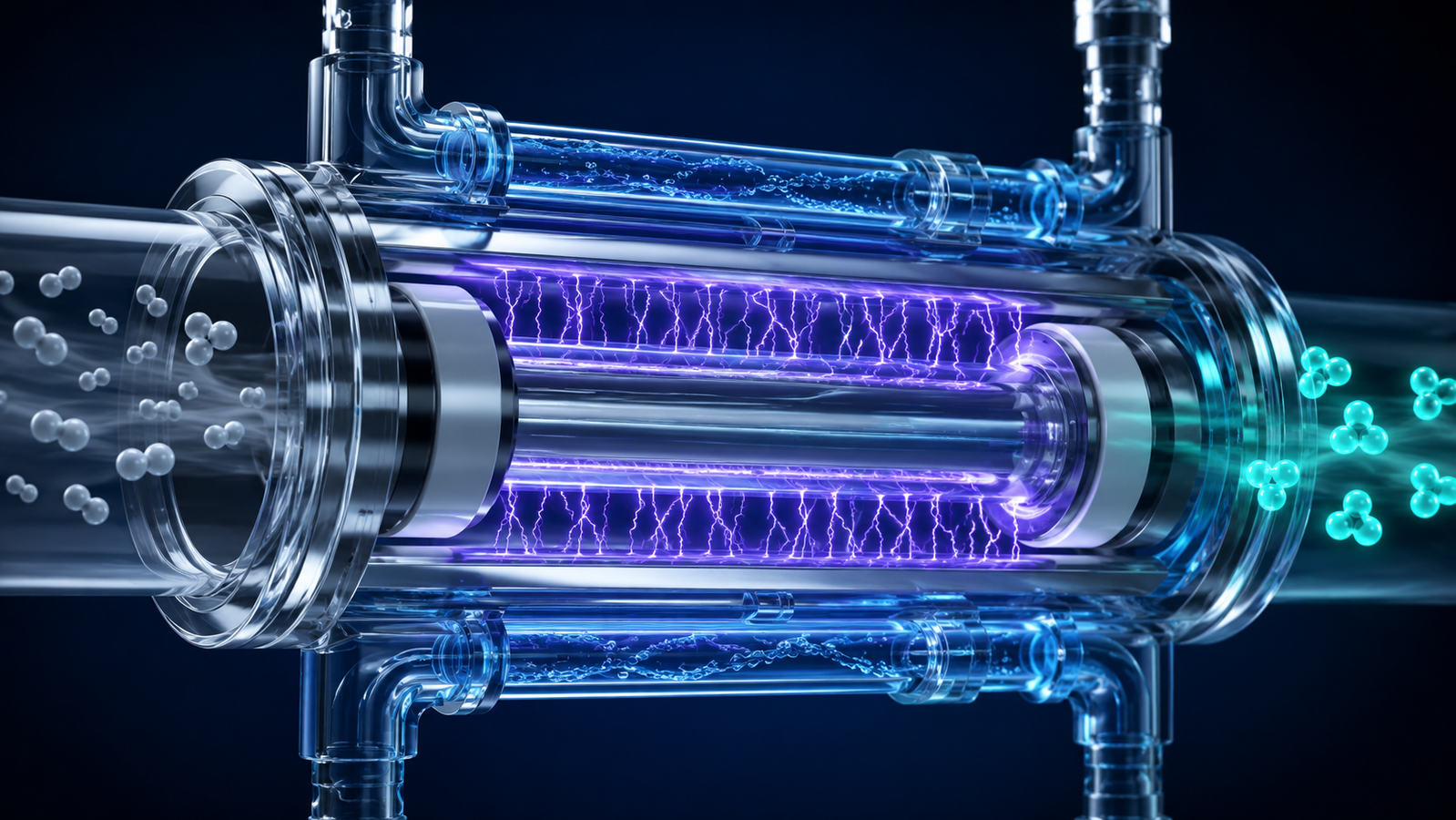
1. Ozone: the barrier discharge’s flagship product
Before "cold plasma" was a phrase, it had a product. Werner von Siemens built the first ozone-generating discharge tube in 1857, and the dielectric barrier discharge has been manufacturing O₃ at industrial scale ever since — the oldest, largest, and most economically important application of non-thermal plasma chemistry, with municipal water plants running ozonizer halls at hundreds of kilograms per hour.1 The reason is a perfect match of tool to task. Ozone cannot be bottled and shipped — it decomposes — so it must be made where it is used; and it must be made cold, because heat destroys it. The DBD delivers exactly that: energetic electrons without hot gas, in a geometry that scales from a benchtop tube to a hall of them.2,3 This guide opens the machine up: the microdischarge chemistry that builds O₃, the heat that unbuilds it, the coaxial reactor that manages the truce, and the application map beyond.
2. The ozone lab
The simulator below runs a coaxial DBD ozonizer in cross-section: oxygen flows through the annular gap, microdischarge filaments flicker between dielectric and electrode, and O₂ leaves as O₃ — some of it. Push the power up and watch generation climb, then watch gas temperature climb after it and start destroying the product. Open the flow and watch the gas run cooler but convert less. The ridge between those failure modes is where every real ozonizer operates.
3. Inside the microdischarge: how O₃ gets built
A DBD in oxygen is not one discharge but a hail of nanosecond microdischarges — thin filaments that strike, transfer a packet of charge, and quench when the dielectric’s surface charge cancels the gap field.4,5 Each filament is a tiny chemical reactor: electrons at a few electron-volts dissociate O₂ into atoms, and the atoms then find a partner in a three-body collision — O + O₂ + M → O₃ + M — where the third molecule carries off the binding energy.6,7 The barrier’s self-quenching is the whole trick: it stops any filament from maturing into a hot arc, keeping the electron energy high and the gas cold — the only regime in which the fragile product survives its own birthplace.1 Reactor research keeps refining the filament statistics themselves; engineered discharge modes have pushed laboratory DBD ozone concentrations well beyond simple designs.8
4. Heat is the enemy: the efficiency ridge
Ozone’s thermodynamic position is precarious — it is an energy-storing molecule that decomposes back to O₂, and the decomposition accelerates steeply with temperature. That single fact writes the ozonizer’s design constraints. Deposited power splits between useful electron chemistry and gas heating; the gas heating raises decomposition; so beyond a reactor-specific operating window, concentration or energy yield can plateau and then fall — the ridge the simulator makes visible, and the reason production units are built around narrow gaps, high-flow gas, and aggressively cooled electrodes.1,9 Drive waveform is a lever too: pulsed and burst-modulated excitation delivers the same chemistry with better heat bookkeeping.10 And measurement keeps the design honest — the charge–voltage Lissajous figure, introduced by Manley on ozonizer discharges specifically, remains the standard audit of energy per cycle actually entering the gas.11,12
5. The coaxial reactor: geometry built for gas
Ozone generation is flow-through chemistry, and the natural vessel is the coaxial DBD: an inner electrode down the axis of a dielectric tube, gas traveling the annular gap, every streamline routed through the annular discharge zone with a residence time set by flow rate. The geometry offers a well-defined, millimeter-scale gap (breakdown voltage stays civilized), a long treatment path in a compact footprint, and an outer surface that lends itself to jacket cooling — though actual flow uniformity, discharge homogeneity, and cooling performance are set by electrode placement, gap, dielectric, and housing design, not by the shape alone. Industrial ozonizers are, at heart, engineered bundles of such tubes.1,2 The same reasoning drives the laboratory version: our companion guide to DBD reactor geometries maps when coaxial beats planar and surface designs, and the DBD coaxial reactor is that logic as benchtop hardware — a flow-through cell for gas-phase plasma chemistry, ozone included.
6. The application map: water, air, and cousins
Where the ozone goes explains why the machine matters. Water treatment is the anchor: ozone is a powerful oxidant and disinfectant whose aqueous chemistry — direct O₃ reactions plus hydroxyl-radical pathways — is mapped in exceptional kinetic detail, and whose great virtue is decomposing without leaving a persistent disinfectant residual — though water chemistry must be managed, because ozonation can form oxidation by-products, bromate in bromide-containing waters chief among them.13,14 (Our materials-side story on graphene and water treatment approaches the same clean-water problem from the adsorbent flank — the two technologies share purification plants today.) Air and odor control, bleaching, and semiconductor cleaning ride the same oxidative chemistry at gas phase. And the ozonizer sits inside a wider family of DBD gas conversion: the same flow-through reactors, often catalyst-packed, are the workhorses of NOₓ and VOC abatement research and of the harder economics of CO₂ conversion — where energy efficiency, exactly the ridge of section 4, decides viability.15,16,17 At the biological boundary, ozone and its reactive-species relatives do gas-phase decontamination work — a field with its own dedicated literature and its own safety rules, noted here only as territory on the map.18,19,20,21,22
7. Ozone safety, monitoring & exhaust destruction
Ozone earns its keep by being aggressive, and the same aggression makes it a respiratory hazard with strict occupational exposure limits in the fraction-of-a-ppm range — you will smell it long before it is comfortable, and comfort is not the standard. A responsible ozone experiment is therefore a system, and the plumbing tells the story:
Gas source → Dryer → Flow control → DBD reactor → Ozone analyzer → Process → Ozone destructor → Exhaust
Each box is load-bearing. Dry feed gas protects both yield and chemistry; ozone-resistant tubing, seals, and fittings keep the plumbing from becoming the experiment; an analyzer turns "the generator is on" into a measured concentration; and a thermal or catalytic destructor on the exhaust converts leftover O₃ back to O₂ before the vent — generator exhaust is a managed stream, never a room emission. Ventilation, ambient monitoring where exposure is plausible, and an interlock or emergency shutoff close the loop; industrial ozone practice has treated destruction and monitoring as standard equipment for decades.1 Consult your institution’s safety office before first light.
8. Building the experiment: supply + reactor
Within that system, the discharge core is two purchases. The cell: the dielectric barrier coaxial reactor, the flow-through geometry of section 5 at benchtop scale. The drive: a mid-frequency high-voltage supply from the CTP family — the CTP-2000K as the base excitation, with the resonant-coupling behavior (and the retune-after-reactor-swap rule) covered in the impedance-matching guide, or pulse-modulated variants when duty-cycle dose control matters. (The analyzer, destructor, and gas handling of section 7 are separate laboratory items — reactor plus supply are the discharge core, not a turnkey ozone plant.) Sizing note, honestly stated: benchtop cells are for studying ozone chemistry — kinetics, dose–response, reactor behavior — not for supplying a treatment plant; scale-up is a bundle-of-tubes engineering exercise the industrial literature documents well.1 One more honest note: microwave and other discharge routes to ozone exist at the research margin, but the DBD’s cold-filament economics keep it the industry’s machine.23,24,25,26
Knowledge hub
- Plasma Processing Guide — the pillar overview of cold plasma, discharges, and power supplies.
- DBD Physics & Power — the microdischarge and Lissajous story in full depth.
- DBD Reactor Geometries — planar vs coaxial vs surface — why gas chemistry picks the tube.
- DBD Coaxial Reactor — the flow-through benchtop cell for ozone and gas-conversion work.
- CTP-2000K Power Supply — the mid-frequency high-voltage drive for barrier discharges.
- Graphene & Water Treatment — the materials-side companion in the clean-water fight.
FAQ
How does an ozone generator actually work?
A high-voltage AC field across a dielectric-lined gap drives thousands of nanosecond microdischarges per second in flowing oxygen. Electrons in each filament split O₂ into atoms; three-body collisions then attach an atom to a molecule, forming O₃. The dielectric quenches every filament before it can heat the gas — which is the entire point, because hot gas destroys ozone.
Why do ozone generators need cooling?
Because ozone decomposes rapidly as temperature rises, and most of the electrical power a discharge absorbs ultimately becomes heat. Without cooling, a generator literally consumes its own product: output falls as the unit warms. Narrow gaps, brisk gas flow, and water-cooled electrodes exist to keep the reaction zone cold.
Air-fed or oxygen-fed — what changes?
Oxygen feed gives substantially higher ozone concentration and cleaner chemistry. Air feed is cheaper but brings nitrogen into the filaments, producing nitrogen oxides alongside ozone and, under humid or off-optimal conditions, unwanted byproducts — one reason serious installations dry and often oxygen-enrich their feed gas.
Why is ozone made on-site instead of delivered?
Instability. Ozone’s half-life is minutes-to-hours in real conditions and shrinks with temperature and contact surfaces, so storage and transport lose the product en route. Generation at point of use is not a convenience — it is the only arrangement the molecule permits.
Is ozone dangerous?
Yes — it is a respiratory hazard with strict occupational exposure limits, and its oxidative power is exactly why it works. Laboratory ozone work belongs in ventilated or destructor-equipped setups with monitoring; treat generator exhaust as a managed stream, never a room emission. Consult your institution’s safety office before operating.
Can I study ozone generation with a benchtop DBD?
Yes — a coaxial DBD cell driven by a mid-frequency high-voltage supply is precisely the laboratory-scale version of the industrial machine, suited to kinetics, dose–response, and reactor-behavior studies with proper gas handling and ozone destruction on the exhaust. What it is not is a production unit: plant-scale supply is a tube-bundle engineering exercise.