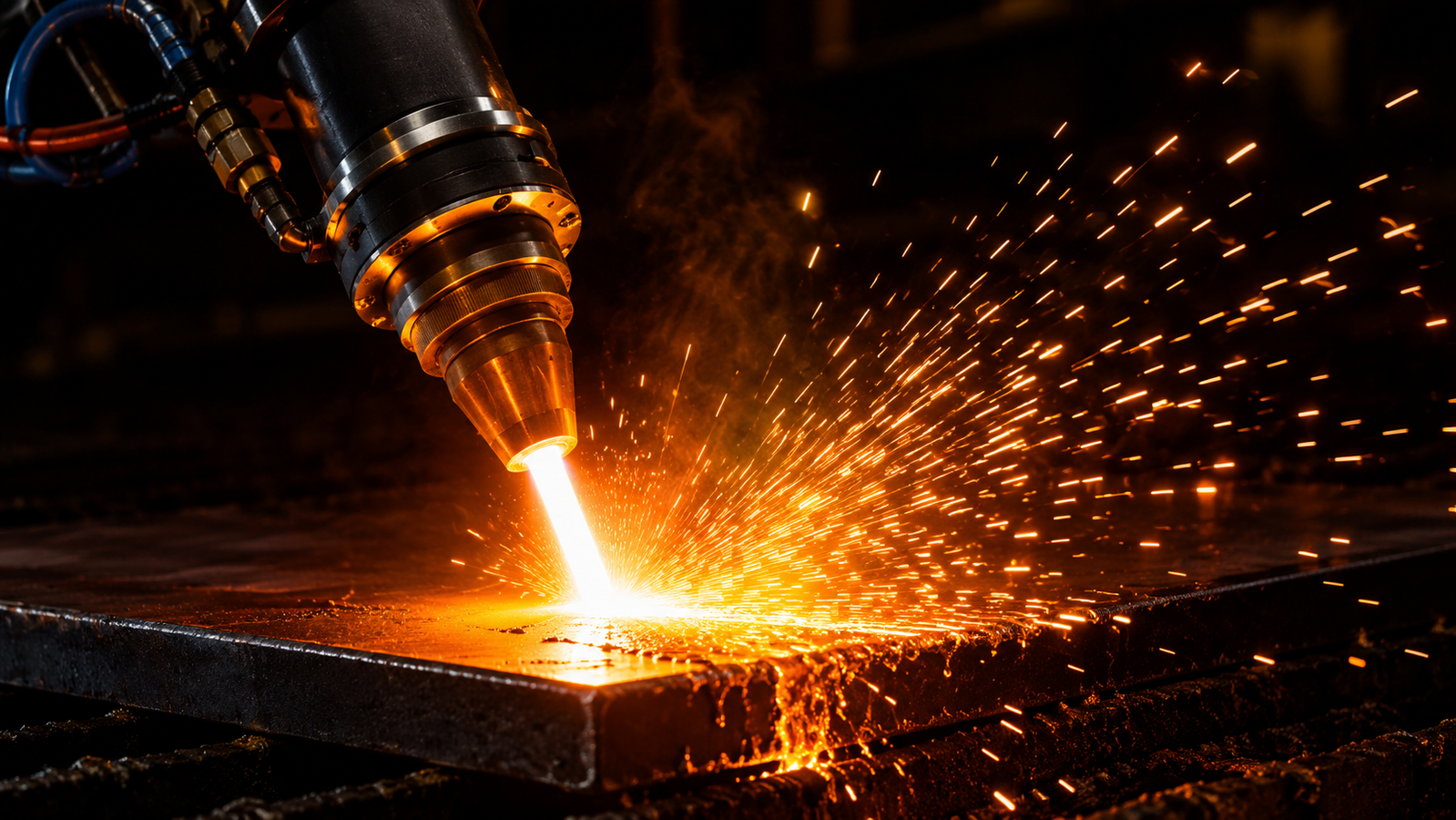
Everything else in this series is engineered to stay cold. A plasma torch is engineered to do the opposite: take an electric arc, stabilize it inside a water-cooled body, blow gas through it, and deliver plasma at temperatures of roughly 10,000 K and beyond — hot enough to melt, cut, vaporize, or process a wide range of metals, ceramics, and feedstocks. This is thermal plasma, the other branch of the plasma family tree, and it obeys a different design logic from the cold discharges used for surface chemistry. This guide explains that split, the anatomy of a DC arc torch, and the single decision that defines what a torch can do: whether the arc stays inside the torch (non-transferred — a hot gas jet for spraying and powder processing) or lands on the workpiece itself (transferred — the geometry of plasma cutting), and where an integrated 5 kW system fits in a materials lab.
In one paragraph: in a thermal plasma the electrons, ions, and gas approach one shared temperature — the arc's enormous power density drives the gas itself to 10,000–20,000 K, so the plasma's product is heat, not selective chemistry. A DC torch stabilizes that arc between a rod cathode and a nozzle, with plasma gas blown through the gap. In a non-transferred architecture the nozzle is the anode: the arc burns entirely internally and only a jet of ultra-hot gas exits — ideal for plasma spraying and in-flight powder treatment, and the target need not be electrically conductive. In a transferred system the workpiece is the anode: the full arc current flows through the part, concentrating extreme heating exactly at the attachment — the geometry of plasma cutting and remelting, which demands a conductive workpiece. Two architectures within one torch family — and the opposite goal from the cold, non-thermal systems that dominate surface treatment.
1. Thermal vs non-thermal: the family splits
Every plasma on this site so far has lived on one trick: keep the electrons hot and the gas cold. In those non-thermal discharges the electron temperature runs tens of thousands of kelvin while the gas stays near ambient, so all the energy goes into selective chemistry instead of bulk heating — the two-temperature physics unpacked in our guide to electron versus gas temperature, and the reason pulsed drives that pour energy into electrons rather than gas are prized for efficiency.1,2
A thermal plasma abandons the trick on purpose. Raise the power density and pressure far enough — an arc at atmospheric pressure is the canonical case — and collisions between electrons and heavy particles become so frequent that the temperatures merge: the plasma approaches local thermodynamic equilibrium, with electrons, ions, and neutrals sharing one temperature of order 104 K.3,4 Now the gas itself is the payload: a fluid hotter than any flame, carrying enormous enthalpy, able to melt tungsten and vaporize ceramics. Diagnostically and conceptually the two regimes are night and day — in one you measure a cool gas beneath hot electrons, in the other a single blazing temperature field — and the engineering follows suit.5,6 Cold plasma changes surfaces without heat; thermal plasma is heat, industrialized.
2. The torch explorer
The simulator below puts the family's two architectures side by side. In the non-transferred arrangement, watch the arc burn entirely inside the body while only a hot-gas plume reaches the workpiece; switch to transferred and watch the arc leap the gap, the part join the circuit, and the melt pool ignite. The power slider is relative — a fraction of whatever a given torch is rated for.
3. Anatomy of a DC torch
Strip any DC arc torch to its bones and three parts remain. A cathode emits the electron current thermionically from a white-hot tip — tungsten-based electrodes serve inert-gas torches, while air- and oxygen-service cutting torches commonly use hafnium or zirconium inserts; the material follows the gas chemistry, polarity, and current. A nozzle, water-cooled copper, surrounds it and constricts the flow; in non-transferred operation it doubles as the anode. And the plasma gas — argon, nitrogen, air, or mixtures with hydrogen or helium — is injected around the cathode, often with swirl, and forced through the nozzle bore. The arc that bridges cathode to anode is squeezed by the cold gas sheath and the nozzle wall; constriction raises its current density and temperature, and the gas that survives passage through it exits as the plasma jet. An arc is the high-current endpoint of the discharge family — the same regime that barrier and glow systems are engineered to avoid, as mapped in our discharge-types guide — here made continuous, stabilized, and put to work.7,8
The apparent steadiness is partly an illusion of averaging. Inside a real torch the arc's anode attachment wanders and re-strikes on the nozzle wall, the jet fluctuates, and electrode erosion paces maintenance schedules — dynamics that modern magnetohydrodynamic torch models resolve in detail and that torch designers spend careers taming.9 For the user, the practical outputs are three numbers: arc power (current × voltage), gas type and flow, and standoff distance — together they set the jet's temperature, velocity, and enthalpy delivered to whatever stands downstream.6
4. Non-transferred: hot gas out
In non-transferred mode the electrical circuit closes entirely inside the torch — cathode to nozzle-anode — and the workpiece receives only the jet: a plume of gas at thermal-plasma temperatures, carrying no current. Two consequences define the mode. First, the target need not be electrically conductive — metal, ceramic, or powder in flight all receive the same jet — though it must still tolerate the thermal load and the process atmosphere. Second, heating is by convection and radiation, intense but indirect, so the operator controls it continuously through power, gas, and standoff.10
This is the geometry of plasma spraying, the flagship industrial use: powder particles injected into the jet melt in milliseconds of flight and splat onto the substrate, building coatings — thermal-barrier ceramics on turbine blades, wear and corrosion layers, biocompatible coatings — layer by molten layer. The process physics of particle heating, acceleration, and splat formation is a mature research field in its own right.11 The same in-flight furnace treats powders directly — spheroidizing irregular particles, densifying agglomerates, driving high-temperature synthesis — wherever a material must pass through extreme temperature briefly and controllably.6,10
5. Transferred: the part is the anode
In a transferred-arc system the workpiece forms part of the main electrical circuit — and the machine changes character. The arc leaps from the nozzle to the part, and the full arc current flows through the workpiece; the pilot arc inside the torch exists only to launch it. Energy delivery is no longer a bath of hot gas but a constricted arc attachment: current crowds into a small root on the metal surface, and Joule heating plus electron condensation at the anode spot deposit power at densities no jet can match. The part does not just get hot; it melts precisely where the circuit closes. And these are two architectures, not a toggle on one device: transferred and non-transferred systems typically differ in electrode design, pilot-arc circuitry, nozzle, cooling, and interlocks, and many commercial torches are built for one arrangement.
This is plasma arc cutting: the constricted arc melts a pool, and the high-velocity gas jet blows the melt through the kerf, severing plate steel, stainless, and aluminum at speeds and thicknesses that made the process an industrial standard — its physics, from kerf formation to dross, mapped in the standard review of what is and is not yet understood about the process.12 The same transferred geometry drives plasma welding, remelting, and surface hardening. The non-negotiable requirement is conductivity: the workpiece must carry the arc current, which is why transferred torches cut metals and non-transferred jets handle everything else.
| Feature | Non-transferred | Transferred |
|---|---|---|
| Main arc path | Cathode → nozzle (inside torch) | Electrode → workpiece |
| Workpiece conductivity | Not required | Usually required |
| Energy delivery | Hot jet (convection + radiation) | Direct arc attachment |
| Typical uses | Spraying, powder treatment, thermal processing | Cutting, welding, remelting |
| Main limitation | Lower surface power density | Conductive circuit and arc control |
6. The application map
Lay the two modes over industry and the map draws itself. Coatings and powders — spraying, spheroidization, in-flight synthesis — belong to non-transferred jets.11 Cutting, welding, and remelting belong to transferred arcs.12 Waste treatment uses both: thermal-plasma furnaces pyrolyze and vitrify hazardous, medical, and even radioactive waste, locking residues into inert slag — a field with its own substantial literature.13 Materials synthesis runs through torch reactors wherever bulk high-temperature chemistry pays — nanopowders, spheroidized feedstocks, refractory processing — a standing theme since the field's turn-of-the-century stocktaking.10
Two boundary notes complete the map. Arc torches are not the only thermal route — microwave-driven torches generate electrode-free thermal and near-thermal plasmas for chemistry and processing, trading electrode erosion for waveguide engineering.14 And nanomaterial synthesis is not exclusively thermal: an entire non-thermal branch grows nanocrystals in cold low-pressure plasmas — a reminder that the two family branches are complements, not competitors.15
7. A 5 kW system in the lab
Classic torch installations are industrial: tens to hundreds of kilowatts, dedicated power cabinets, water plants, and gas farms. The PlasmaNova™ portable 5 kW integrated torch system packages DC-torch physics at laboratory scale — torch, supply, and controls in one movable, water-cooled unit with continuously adjustable power. Its published applications are plasma torch experiments, melting and welding of conventional and specialty materials, and related plasma processing; the launch announcement adds portable cutting of conductive materials. One procurement note applies to any torch, this one included: the transferred/non-transferred comparison in this guide describes the DC torch family and does not imply that every commercial torch supports both arrangements — confirm the delivered arc configuration, and the exact published specifications, on the product page and at quotation. Likewise on temperature: generic industrial arc cores reach order 104 K, but a specific product's own flame figures are the ones on its datasheet, not this guide's family-level numbers.
| PlasmaNova™ — published at a glance | Value |
|---|---|
| System class | Portable, integrated DC plasma torch, 5 kW class |
| Power adjustment | Continuously adjustable |
| Cooling | Built-in water cooling, extended electrode life |
| Published applications | Torch experiments; melting & welding of conventional and specialty materials; related plasma processing |
| Also announced | Portable cutting of conductive materials |
| Full specifications | See the product page and datasheet |
For the surrounding electrical infrastructure and higher-power cold-plasma work, the CTP-2000K/A high-power supply and the broader plasma power supply line cover the non-thermal side of the same bench.
And that split is the honest closing rule: a torch is the wrong tool for surface chemistry. Activating a polymer, cleaning a wafer, functionalizing a nanomaterial, treating anything heat-sensitive — that is cold-plasma territory: barrier-discharge cells16,17 and low-pressure glow systems18 deliver reactive chemistry at near-ambient gas temperature, atmospheric jets carry it into open air,19,20 and the gentlest of them are directed by medical researchers at living tissue.21,22,23 A torch, by contrast, is what you reach for when the job is heat — melting, cutting, vaporizing, spraying. One family, two branches, mapped end to end in the community's roadmaps — choose the branch by asking what you want the gas temperature to do.24,25 Tell us your process and we will tell you which side of the family it lives on.
Knowledge hub
- Plasma Processing Guide — the pillar overview of the whole plasma family and its power supplies.
- Discharge Types: Corona, Glow, Arc & DBD — where the arc regime sits in the discharge family.
- HV Pulse vs RF vs Microwave Sources — the cold-source families on the other branch.
- PlasmaNova™ 5 kW Torch System — integrated, portable thermal-plasma capability at lab scale.
- CTP-2000K/A High-Power Supply — the high-power cold-plasma workhorse on the same bench.
- Plasma Power Supply Line — the full lineup, cold branch to hot.
FAQ
How hot is a plasma torch, really?
Arc-core and jet-core temperatures in DC torches are of order 10,000–20,000 K, decaying steeply along the jet. The number that matters for processing is not the peak but the enthalpy delivered to the material — set jointly by power, gas, flow, and standoff.
Transferred or non-transferred — how do I choose?
Ask whether the workpiece should carry current. Cutting, welding, remelting a conductive part: transferred, for maximum energy density at the surface. Spraying, powder processing, or any nonconductive or loose-material target: non-transferred, because only hot gas — not current — reaches the material.
Is a plasma torch the same as a plasma cutter?
A hand-held plasma cutter is one packaging of a transferred-arc torch, optimized for one job. "Plasma torch" is the broader device family — both modes, all powers, spraying to waste treatment — of which cutting is the most famous member.
Why is a torch plasma "thermal" when a DBD at the same pressure is cold?
Power density and current. An arc pushes enough energy through the gas that electron–heavy-particle collisions equalize the temperatures toward local equilibrium; a barrier discharge deliberately quenches each microdischarge before that can happen, keeping gas cold beneath hot electrons. Same pressure, opposite design goals.
What gases do torches run on?
Argon is the gentle baseline; nitrogen and air raise enthalpy cheaply; hydrogen or helium additions boost heat transfer to particles in spraying; oxygen-bearing gases serve cutting chemistry. Gas choice trades enthalpy, electrode life, and cost, and every serious process qualifies its own mixture.
Can a torch do surface activation or cleaning?
A thermal torch is generally unsuitable for low-temperature activation of heat-sensitive polymers or electronics — that is cold-plasma territory. It can, however, do thermal surface work on compatible metals and refractories: oxide removal, remelting, surface heat treatment. For chemistry-driven, low-thermal-load activation or cleaning, reach for a cold-plasma source.