
Ask what a "plasma" looks like and you will get four honest, contradictory answers: the faint crackle at a charged wire, the soft glow of a neon tube, the blinding channel of a welding arc, and the silent violet shimmer of a lab surface-treatment cell. All are gas discharges — and the differences between them matter more, in practice, than what they share. This guide builds the classification every plasma user eventually needs: four commonly encountered discharge categories — corona, glow, arc, and dielectric barrier discharge (DBD) — what physically separates them, and which one your process actually calls for.
In one paragraph: discharge types are best organized by how much current flows and what that current does to the gas. A corona confines ionization to a thin shell at a sharp electrode and passes only a whisper of current, so the gas stays cold. A glow discharge, typically at reduced pressure, spreads a modest current into an extended, comparatively diffuse column — still a cold, two-temperature plasma. Let the current run away and the discharge constricts into an arc: a thermal channel at thousands of kelvin. The DBD is the engineering trick that holds an atmospheric-pressure discharge on the cold side of that ladder — a dielectric barrier quenches every incipient filament before it can grow into an arc. Corona, glow, and DBD are the non-thermal family; the arc is the thermal outlier — and usually the thing a cold-plasma system is built to prevent.
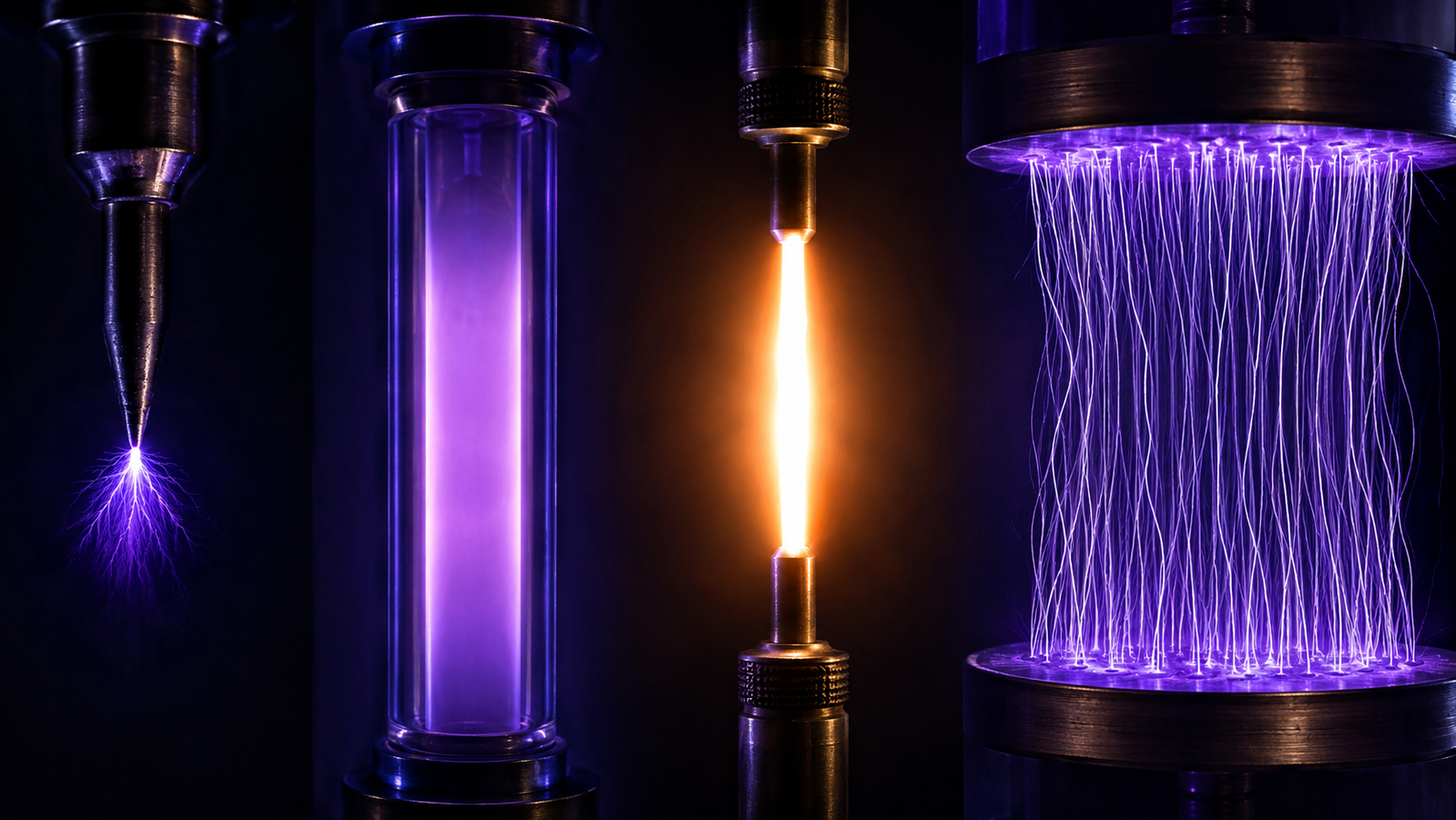
1. One gas, four personalities
Every gas discharge begins the same way: free electrons accelerate in an applied electric field, ionize neutral atoms, and the resulting avalanche makes the gas conduct. What happens next is what defines the discharge type — and the single most useful organizing variable is current. The classic current–voltage characteristic of a discharge gap is a ladder: from the barely conducting dark (Townsend) regime, through the corona and the normal glow, and finally — if the external circuit permits — into the arc, where the voltage collapses and the current soars.1,2 Each rung is a genuinely different physical object, with its own structure, its own gas temperature, and its own uses.
A note on classification before we climb the ladder: corona, glow, and arc are discharge regimes — operating states of the gas — whereas the DBD is a current-limiting source configuration that can host several discharge modes, filamentary or diffuse. They are compared side by side here because, in practice, they are the alternatives a laboratory or process engineer actually chooses between.
The second organizing idea is thermal versus non-thermal. In corona, glow, and DBD plasmas the electrons are hot — typically a few electronvolts, equivalent to tens of thousands of kelvin — while the heavy gas stays far cooler; energy simply cannot transfer efficiently from a light electron to a heavy atom in elastic collisions.3,4 The arc breaks this pattern: at high current density the gas itself is heated toward the electron temperature, and the plasma approaches thermal equilibrium. If the two-temperature idea is new to you, our companion article on electron versus gas temperature in cold plasma builds it from the ground up.
A word on scope: the discharge families and the sources that generate them span an enormous engineering range — from dc glow tubes to RF and microwave systems — and authoritative reviews of that whole landscape exist.5 This guide keeps to the four types you will actually meet around atmospheric-pressure and laboratory cold-plasma work, because they are the ones a process decision usually hangs on.
2. The regime explorer
The simulator below sketches the four discharge types in one frame each: where the plasma forms, whether it is diffuse or filamentary or constricted, and what that means for gas heating. Switch between them and compare — the differences you can see are the differences that matter.6
3. Corona: ionization at a point
A corona forms wherever the electric field is strongly non-uniform — at a needle tip, a thin wire, a sharp edge — and exceeds breakdown only in the small high-field region around that feature. Ionization therefore lives in a thin, faintly glowing shell hugging the electrode, while the rest of the gap is a dark drift region where ions of one polarity migrate to the far electrode, carrying a small unipolar current.7,1 Bulk-gas heating is usually low at the modest average currents involved: the active volume is tiny and the current is limited by the drift region's space charge.
That geometry is a feature, not a bug. Corona is the classic way to produce ions and modest plasma chemistry cheaply, at atmospheric pressure, with the simplest possible hardware — which is why it powers electrostatic precipitators, surface and film chargers, photocopier and printer charging elements, and small-scale ozone generation.7 Its limitation is the same as its virtue: the plasma occupies a small fraction of the volume, so processes needing bulk plasma or high radical fluxes quickly outgrow it. Push a corona harder and it does not simply grow — it transitions, first into streamers and sparks and ultimately, if the circuit allows, toward an arc.1
4. Glow: the diffuse workhorse
Lower the pressure to the millibar range between two plates and the discharge organizes into the most photographed structure in gas physics: the glow discharge, with its dark space at the cathode, a bright negative glow, the Faraday dark space, and a long, softly luminous positive column stretching to the anode.1,5 The current is far higher than a corona's, yet the plasma remains diffuse and uniform — no filaments — because at low pressure electrons diffuse and spread faster than any instability can constrict the channel.
The glow is the archetypal two-temperature plasma: electron temperatures of a few electronvolts sustain ionization and excitation while the gas stays comparatively cool.3 Its electron population is also famously non-ideal — the energy distribution is generally non-Maxwellian, so a single "electron temperature" is a useful summary rather than a complete description,8 and measuring that distribution properly is its own discipline, from Langmuir probe methods with their well-documented pitfalls9 to optical determination of the gas temperature from molecular rotational lines.10
Practically, the glow regime is everywhere: neon and fluorescent lighting, sputtering and thin-film deposition sources, and analytical glow-discharge spectroscopy all live here.5 Under carefully chosen gas and drive conditions, glow-like diffuse discharges can even be sustained at atmospheric pressure — a major research theme, since a uniform discharge treats surfaces more evenly than a filamentary one.6,4
5. Arc: when current runs away
Every regime so far has been current-limited — by space charge, by pressure, by the external circuit. Remove those limits and the discharge finds its final form: the arc. The current concentrates into a single channel; ohmic heating raises the gas temperature; the hot channel conducts better, drawing still more current into itself. The cathode switches from cold secondary emission to thermionic or field emission at a glowing hot spot, the voltage collapses, and the plasma constricts into a blinding column at thousands to tens of thousands of kelvin, with gas and electrons approaching a shared temperature — a thermal plasma.1,2
Arcs are superb where raw enthalpy is the product: welding and cutting, arc lamps, plasma torches and spraying, and high-temperature waste processing. But for treating polymers, biological materials, electronics, or anything heat-sensitive, the arc is the failure mode — the thing every cold-plasma cell, and every regime on this page except the arc itself, is engineered to avoid. The buoyant upward bowing of a horizontal arc channel, familiar from any welding video, is a reminder of just how much the gas is heated.
6. DBD: the barrier branch
The dielectric barrier discharge is best understood as an engineering answer to the arc. Insert an insulating layer — glass, quartz, ceramic — into the current path, drive the gap with AC or pulsed high voltage, and the runaway that creates an arc is strongly suppressed under normal operation: every incipient discharge deposits charge on the dielectric surface, that charge builds an opposing field, and the discharge quenches itself within nanoseconds.11,12 That suppression is an operating property, not an absolute guarantee — insulation failure, surface flashover along the barrier, or a parasitic current path that bypasses it can still let an arc form. In many atmospheric-pressure DBDs what survives is a swarm of short-lived micro-discharge filaments, each individually self-limited, refreshing every half-cycle of the drive — though suitably designed barrier discharges can also run in diffuse, glow-like, or Townsend-like modes. Either way the result is a stable, non-thermal plasma at full atmospheric pressure.6
The DBD's behavior depends on how the barrier and gap are arranged — volume gaps, surface arrangements, and coplanar layouts each shape where the micro-discharges form — and the discharge dynamics across these arrangements have been mapped in detail.13 Because the load is fundamentally capacitive, the honest way to know the power a DBD dissipates is the charge–voltage Lissajous figure, a technique that dates to Manley's 1943 analysis of the ozonizer and remains standard today.14,15 And the drive waveform is a genuine process variable: pulsed excitation channels energy into electrons differently than sinusoidal drive, with measurable consequences for efficiency and chemistry.16
The DBD is the regime our own equipment lives in. The ACS Material CTP-2000K power supply family drives DBD cells, and the deeper physics — streamer formation, Lissajous power, reactor loading — is covered in our companion articles on DBD reactor physics and DBD reactor geometries.
7. Choosing by regime
The comparison that actually drives a decision:
| Regime | Gas heating | Structure | Typical pressure | Best-fit territory |
|---|---|---|---|---|
| Corona | Usually low | Thin shell at a point/wire | Atmospheric | Charging, precipitators, small ozone |
| Glow | Low–moderate | Layered; comparatively diffuse | Usually reduced | Sputtering, lighting, analysis |
| Arc | Very high (thermal) | Single constricted channel | Wide; source-dependent | Welding, torches, arc lamps |
| DBD | Low (self-limited) | Many filaments (or diffuse modes) | Atmospheric | Surface treatment, ozone, lab plasma |
The non-thermal regimes carry the applications this site is about. DBD and related cold discharges activate and functionalize polymer and biomaterial surfaces,17 generate the reactive oxygen and nitrogen species behind plasma medicine18,19,20 and cold-plasma food processing,21 drive gas conversion such as CO2 splitting22 and plasma catalysis,23 and synthesize nanomaterials.24 Extend the discharge out of its cell and you get the atmospheric-pressure plasma jet — a cold plume in open air, itself a family of sources with medical-grade members.25,26,27,28 Where the field is heading — across all these regimes at once — is tracked in the community's decadal roadmaps.29,30
On the hardware side the mapping is direct. The CTP-2000K and its DBD experiment cells put you in the DBD regime; the same supply family drives glow-like and jet discharges within its voltage and frequency window; and the parametric high-voltage pulse supply covers transient, pulse-driven discharges. How the drive itself shapes a discharge — frequency, duty cycle, waveform — is the subject of our practical tuning guide. Tell us your sample and process target and we will match the regime, the cell, and the supply.
Knowledge hub
- Plasma Processing Guide — the pillar overview of plasma, discharges, applications, and power supplies.
- Electron vs Gas Temperature — why corona, glow, and DBD stay cold while the arc runs hot.
- DBD Reactors: Physics & Power — the barrier branch in depth, from micro-discharges to Lissajous power.
- DBD Reactor Design — planar, coaxial, surface, and packed-bed cells compared.
- CTP-2000K Power Supply — the adjustable kHz supply behind our DBD and glow-regime cells.
- DBD Experiment Device — a planar barrier-discharge cell for hands-on regime work.
FAQ
What is the difference between corona and glow discharge?
A corona confines ionization to a thin shell at a sharp electrode in a strongly non-uniform field; the rest of the gap is a dark ion-drift region carrying a small current. A glow discharge, usually at reduced pressure, spreads a much larger current into a diffuse, uniform luminous column filling the gap. Both are cold, but they differ completely in structure and in the volume of plasma they offer a process.
Is an arc a plasma?
Yes — and it is the thermal one. In an arc the current density is high enough that the gas heats toward the electron temperature, approaching a single-temperature (equilibrium) plasma at thousands of kelvin. Corona, glow, and DBD are non-thermal by contrast: hot electrons, cool gas.
Why does a DBD not turn into an arc?
Because the dielectric interrupts the runaway: each incipient discharge deposits charge on the barrier, which builds an opposing field and quenches that filament within nanoseconds, before it can heat the channel. Under normal operation this strongly suppresses any sustained arc — though it is not an absolute guarantee against insulation failure or surface flashover. The discharge is forced to restart elsewhere, so the energy stays distributed in many cold micro-discharges instead of one hot channel.
What discharge type is a neon sign?
A low-pressure glow discharge: the tube's soft light is the positive column of a glow, running at modest current well below the arc regime. Neon and other noble-gas or mercury-containing fills generate the characteristic visible or ultraviolet emission; in fluorescent lamps a phosphor coating on the tube wall — not a gas — converts the ultraviolet into visible light.
Which regime is used for surface treatment?
Mostly the DBD and its relatives, because they deliver reactive, non-thermal plasma at atmospheric pressure without heating the workpiece; corona treaters serve simpler film and web applications. Glow discharges dominate low-pressure surface processing such as sputtering and plasma cleaning. Arcs are avoided for anything heat-sensitive.
Is DBD a discharge regime or a reactor configuration?
Primarily a source configuration: what defines a DBD is at least one dielectric barrier in the current path, not a particular discharge state. Depending on gas, pressure, waveform, and geometry, a DBD can operate in filamentary, diffuse, Townsend-like, or glow-like modes — which is why this article compares it alongside the corona, glow, and arc regimes it can host or resemble.
Can one power supply produce different discharge regimes?
Within limits, yes. A supply like the CTP-2000K drives DBD, glow-like, and jet discharges depending on the cell, gas, and settings, because these regimes share the same non-thermal territory of voltage and current. An arc, however, demands a supply designed to feed high current at collapsed voltage — the opposite of a cold-plasma source's job.