
A benchtop extruder is selected for a compact laboratory setting and a defined teaching or research task: a teaching laboratory, a research group with small quantities of material, or both. This guide separates what a small machine can teach and show from what it cannot, suggests what to log in a demonstration or a small-batch run, and compares the two benchtop pages of the Polytevo Series by ACS Material using only what each page states.
1. The short answer: choose the setting, the user and the record
A benchtop extruder is selected for a compact laboratory setting and a defined teaching or research task. The format alone does not establish installation requirements or how its results transfer to larger equipment. For a teaching laboratory the questions are who will operate it, what the demonstration has to show and how safely it can be installed. For a research group with small quantities of material they are how little material a run needs, how the specimen is formed and how the run is recorded. Both groups share a fourth question: what a small machine's result can be taken to mean on another machine.
The cluster entry point, How to Choose a Laboratory Extruder: Types, Scale and Duty, explains why “benchtop” describes size and not type. This guide takes the benchtop setting on its own: sections 2 to 4 are guidance, with sources where studies exist, section 5 reports what two Polytevo pages say and section 6 turns the comparison into a question for each task. Reading a Screw Specification: L/D, Compression Ratio, Speed explains the screw numbers the pages print, and Recirculating Extruders: How Cycles Differ from Continuous Runs covers the cycle arithmetic for small charges.
2. What a small machine can and cannot show
A small machine can show the effect of conditions on a material, and the literature offers examples of how large those effects can be at small scale. In a polyamide/carbon nanotube study on a small-scale melt mixer, temperature, rotation speed and mixing time were varied, and the mixing conditions influenced the nanotube dispersion and the electrical resistivity strongly.1 In a polycarbonate/carbon nanotube study on a laboratory twin-screw extruder, screw design, speed, throughput, feeding position and filler content were varied, and the dispersion was related to the specific mechanical energy applied.2 Studies like these show students and researchers that a result depends on conditions, which is the point of a demonstration.
An instrumented machine can also show where in the process things happen. A modular instrumented laboratory single-screw extruder was built to follow temperature, mixing, conversion and morphology along the screw and was used to study how screw geometry and operating conditions affect the plasticating sequence of a low-density polyethylene.3 The cited research machine had specific internal measurement capabilities. Do not assume those capabilities for another instrument; distinguish the quantities actually measured from observations and unmeasured internal states. The principle of recording what changes, and when, can still be applied with a stopwatch and a log sheet.
What a small machine cannot do is stand in for a larger one without checking. In one comparison a 0.3 g mini-mixer dispersed polypropylene in polystyrene much worse than a 5 g laboratory extruder and a 16 mm twin-screw extruder until it was modified.4 In another, the morphology development was remarkably similar in an industrial twin-screw extruder, an internal mixer and a miniature mixer, but the miniature mixer did a poor job on high-viscosity uncompatibilized blends unless the conditions were altered.5 A demonstration can illustrate a response under recorded conditions; establishing its mechanism requires appropriate measurements and experimental design. A result for a formulation belongs to the machine that made it and has to be reported with it.
3. Teaching demonstrations: what to show and what to log
A one-variable-at-a-time comparison can be a useful introductory demonstration; it is not the only valid experimental design. The suggestions in this section are this guide’s own guidance for a teaching laboratory, not drawn from a published curriculum, and they use studies only for the idea that conditions matter. A hot-melt-extrusion review describes a single-screw extruder performing operations such as feeding, conveying, melting, devolatilizing, pumping and shaping,6 and textbooks that students can be pointed to are listed under Further reading.
- Show a controlled comparison. For an introductory exercise, compare the same material under two selected conditions while recording feed, temperature, speed, run order and sampling criteria. Compare collected specimens only after they have cooled to a safe handling condition under the laboratory’s approved procedure. Do not touch hot extrudate or moving equipment to assess its “feel.”
- Separate the set temperature from the melt. Heat generated by deforming and rubbing the material contributes to melting, so the temperature of the melt need not equal the set temperature.7 If a melt temperature can be measured, record it; if not, say so.
- Log the run. A log sheet with the material, drying, set temperatures, screw speed, feed rate, time and any observation of the extrudate turns a demonstration into a record students can compare.
- Keep the arithmetic honest. If a class calculates how long a charge takes, state that it is a planning time and not a residence time.
- Plan the output. Decide in advance whether the extrudate is discarded, cooled and kept, or formed into a specimen, and who handles it when it is hot.
4. Small-batch research: the route and the record
In a small-batch research setting the route from material to specimen is part of the experiment. In a polypropylene/organo-clay study, a miniature laboratory mixing extruder blended PP with an organo-clay masterbatch at the reported processing conditions, the blend was pelletized first, and a thin ribbon was extruded for viscoelastic testing; the storage modulus rose with clay content.8 This study provides one example of compounding, pelletizing and subsequent specimen extrusion. Record those operations and their conditions when they form part of the experiment.
The same applies to any machine that forms a specimen directly. The record should include the material and its preparation, the set temperatures and speed, the time, how the specimen was formed and cooled, and the conditions of any later test. If results from the benchtop machine will later be compared with another machine, that comparison is a separate study in its own right, as the mini-mixer comparisons show.4,5
5. What two Polytevo benchtop pages say
The following comparison is limited to the two benchtop product-page snapshots dated 15 November 2026.
Check the stated installation conditions, support requirements and utilities for the exact configuration rather than assuming that the name authorizes placement on any laboratory bench.
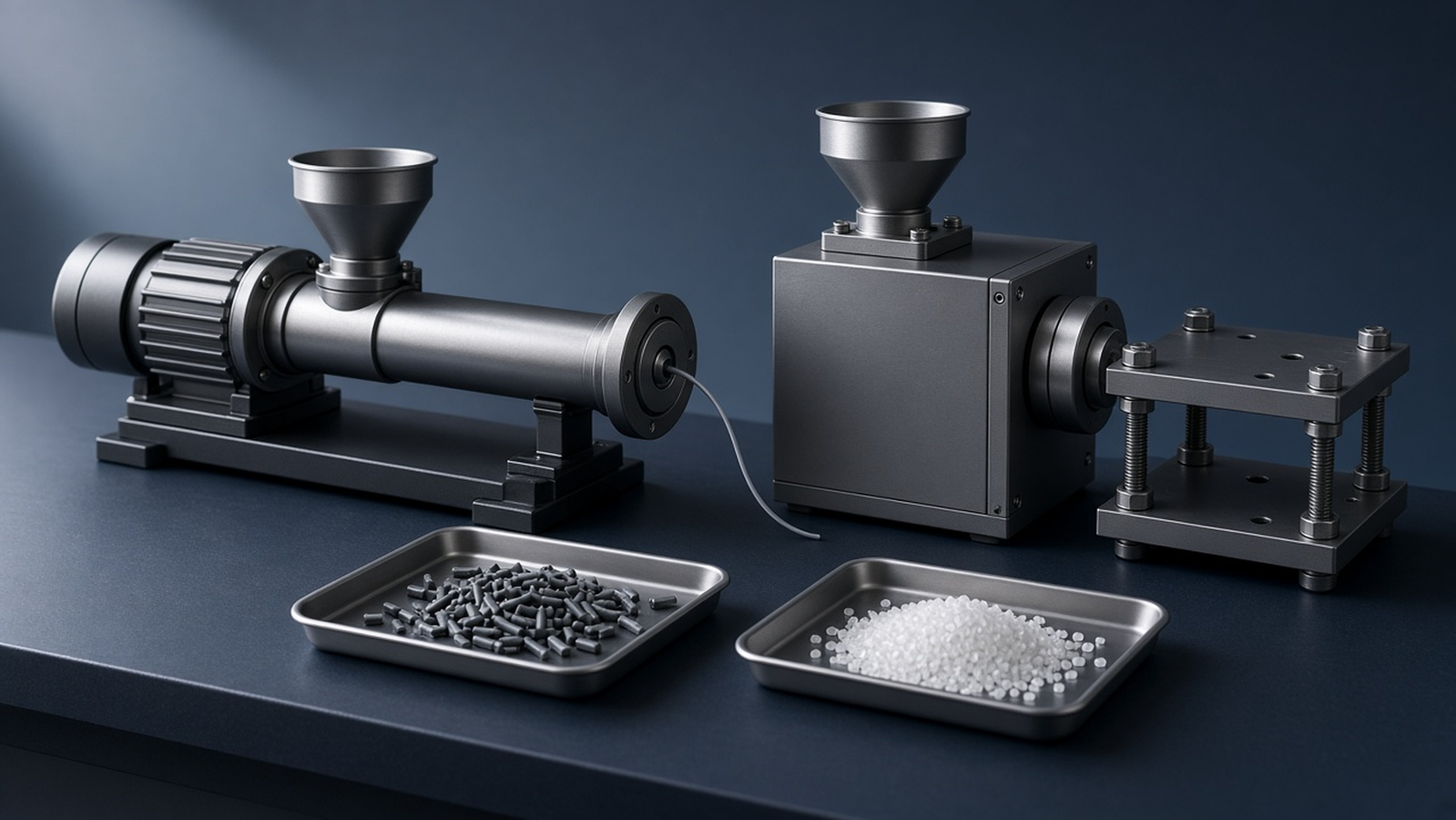
The Polytevo Series Benchtop Single-Screw Extruder page describes a benchtop micro single-screw extruder with a 16 mm screw (L/D 14:1), a rated screw speed of 0.1–20 rpm and temperatures from RT to 380 °C. It describes it as a small, AC 220 V electric single-screw extruder for teaching demonstrations at universities, innovation centers and research units, and for do-it-yourself small-batch extrusion, with a PLC human-machine interface, color touch screen and one-button operation.
The same page shows the machine without a die, and says that a die and downstream equipment are confirmed on the quotation. It lists an operating environment of 0–40 °C ambient temperature and relative humidity of 80% or less, and its installation conditions are a level floor with good ventilation and no corrosive gas, no strong electromagnetic radiation nearby, and suitable maintenance space around the unit. The page lists a weight of about 58 kg and machine dimensions of about 650 × 660 × 745 mm (W × D × H).
The Polytevo Series Benchtop Mini Extruder page describes a compact benchtop extrusion system with a 20 mm screw (L/D 9:1), a servo-driven screw speed of 1–150 rpm and a PLC-controlled mold clamping system with 30 kN clamping force. It lists the product type as a laboratory benchtop extrusion molding system, and says that the system integrates a mechanical frame, a melt injection assembly, a mold clamping mechanism and a heating control system. It describes the machine as designed for compounding new materials and producing small-batch extruded specimens, for R&D and teaching laboratories where material savings, a compact footprint and portability matter.
| Item (page label) | Benchtop Single-Screw Extruder | Benchtop Mini Extruder |
|---|---|---|
| Product type | Benchtop micro single-screw extruder | Laboratory benchtop extrusion molding system |
| Screw diameter; L/D | 16 mm; 14:1 | 20 mm; 9:1 |
| Screw speed | Rated 0.1–20 rpm | 1–150 rpm (servo motor) |
| Maximum temperature | 380 °C (heating zones 1/2/3: RT to 380 °C; die: 380 °C) | 400 °C; accuracy ±0.5 °C |
| Control | PLC human-machine interface with a color touch screen | PLC control system; touch screen fitted |
| Motor power | 400 W (servo motor) | Melt motor: 400 W; clamping motor: 750 W |
| Power supply | AC 220 V ±10% | AC 220 V, 50 Hz |
| Size; weight | About 650 × 660 × 745 mm (W × D × H); about 58 kg | 950 × 470 × 600 mm (L × W × H); 165 kg |
Figures are copied from the pages and keep each page’s own labels; the pages describe different kinds of machine, so the rows are not a ranking.
6. Choosing between the two pages
The two pages describe different jobs in their own words, and those words are the starting point. The Benchtop Single-Screw Extruder page describes teaching demonstrations and do-it-yourself small-batch extrusion; the Benchtop Mini Extruder page describes compounding new materials and producing small-batch extruded specimens in a system that includes mold clamping. The table below turns that into a question for each task. It is this guide’s own guidance, not a published rule.
| If the task is… | The page that describes it | Ask |
|---|---|---|
| A classroom demonstration of extrusion | Benchtop Single-Screw Extruder (teaching demonstrations) | Who operates it, what is the bench and supply, and what is the downstream equipment for the extrudate? |
| Compounding a new material in small quantities | Benchtop Mini Extruder (compounding new materials) | How much material does a run need, and how is the first material discarded? |
| Producing a small extruded specimen | Benchtop Mini Extruder (small-batch extruded specimens) | What mold is needed, and how is the specimen cooled and removed? |
| DIY small-batch extrusion for a project | Benchtop Single-Screw Extruder (do-it-yourself small-batch extrusion) | Which die and cooling route are needed, as a die is confirmed on quotation? |
Specifications are as published on each product page, and final configurations are confirmed on quotation.
7. Before you request a quote
To help identify a suitable configuration, describe the setting rather than a machine. Please tell us:
- the use: teaching demonstration, small-batch compounding or specimen preparation, and how many people will operate it;
- the material and its form, and the polymer family;
- the quantity per run and in total;
- the bench, supply and ventilation available, as the installation conditions are part of the choice;
- the form of output you want and any die or mold you need.
8. FAQ
What does benchtop mean for an extruder?
It describes a compact format for laboratory use. The name alone does not establish installation requirements or how results transfer to larger equipment, so check the stated installation conditions for the exact configuration. It does not describe the type of machine; the two Polytevo benchtop pages describe a single-screw extruder and an extrusion molding system.
Can a benchtop machine give results that transfer to a larger extruder?
Only with checking. A mini-mixer dispersed polypropylene in polystyrene much worse than larger machines until it was modified, so the machine and conditions belong to the result.4
What installation conditions does the benchtop single-screw page list?
A level floor with good ventilation and no corrosive gas, no strong electromagnetic radiation nearby, suitable maintenance space around the unit, ambient temperature 0–40 °C and relative humidity of 80% or less.
Which Polytevo benchtop page describes mold clamping?
The Polytevo Series Benchtop Mini Extruder page describes a PLC-controlled mold clamping system with 30 kN clamping force and a maximum mold stroke of 100 mm.
What should I log in a teaching demonstration?
The material and its drying, the set temperatures, the screw speed, the feed, the time and any observation of the extrudate. The cited studies illustrate sensitivity to particular mixing conditions, and a demonstration is easier to compare when its conditions are recorded.1,2
9. Keep exploring the Lab-Scale Polymer Processing Knowledge Hub
This guide belongs to the extruder cluster of the Lab-Scale Polymer Processing and Testing: A Workflow Guide, which places every machine of the Polytevo Series by ACS Material in the stage of the lab route where it is used. The cluster starts at How to Choose a Laboratory Extruder: Types, Scale and Duty; related guides in the cluster:
- How to Choose a Laboratory Extruder: Types, Scale and Duty. Entry guide to the cluster: choose a laboratory extruder by duty, scale and what has to come out.
- Reading a Screw Specification: L/D, Compression Ratio, Speed. What the screw lines on an extruder page describe, and what they do not.
- Recirculating Extruders: How Cycles Differ from Continuous Runs. How a circulating channel and reversing valve work, and why cycle arithmetic is not residence time.
To discuss a configuration, describe the material and its form, the sample quantity you need to process, whether the run is a batch or continuous, and the form of output you want, then send it through Request a Quote. Specifications are as published on each product page, and final configurations are confirmed on quotation.