
In recirculating batch operation, a charge is retained for a selected processing interval and then discharged; recirculation describes the flow path, not every operating mode the equipment may offer. Batch and continuous modes are planned with different quantities, and mixing the two up can lead to arithmetic mistakes in small-batch work. This guide explains how cycles differ from continuous runs, why a mass per cycle divided by a rate does not establish residence time, and what two Polytevo pages say about their circulating machines, with the batch and material budget calculator for the cycle arithmetic.
1. Batch and continuous modes use different planning inputs
In continuous operation, feed enters and material discharges while the machine runs; the output is described as a rate, mass per unit time. In batch operation, a defined charge is processed for a chosen time and then discharged; the output is a charge, a mass per cycle. A twin-screw review contrasts the short residence time of a continuous twin-screw extruder with a batch process.1 In recirculating batch operation the material is circulated through the screw for a chosen time, so the time it spends in the processing circuit is set by the experimenter, and the batch is then extruded. Recirculation describes the flow path, not every operating mode the equipment may offer.
The Polytevo Series Conical Twin-Screw Extruder page lists a continuous-feeding mode among its experimental modes.
Two consequences follow, and the rest of this guide is about them. First, the arithmetic is different: a continuous run is planned from a throughput and a target mass, a cyclic run from a mass per cycle and the number of cycles. Second, neither a throughput nor a mass per cycle, as printed on a page, establishes a residence time. The cluster entry point, How to Choose a Laboratory Extruder: Types, Scale and Duty, places recirculating machines among the other laboratory types, and Micro Compounders: Conical and Dual Conical Twin Screws covers the conical machines that also circulate their charge.
2. How cycles differ from continuous runs
In a continuous run, feed enters and material discharges during operation, while internal transport can include mixing and backflow, so the operating state is set by feed rate, screw speed, temperature and screw design, and the run has to be long enough for the conditions to settle before a sample is representative.2 In a cyclic run, there is no steady discharge during mixing: the charge circulates and is then extruded, so the controlled variables are the charge, the circulation time, the speed and the temperature.
The literature describes the cyclic idea in conical micro compounders: a conical twin-screw extruder with a backflow channel combines aspects of mixing and extrusion in a batch process.3 Whatever the mechanism, a channel and valve or a backflow channel, the logic is the same. The charge is mixed for a time you choose, and what leaves the machine at the end is one batch. A study of small-scale mixing of carbon nanotubes into polyamides varied mixing time, rotation speed and temperature, and found that the mixing conditions strongly influenced dispersion and electrical resistivity,4 which is why the circulation time has to be recorded as a variable and not treated as a fixed property of the machine.
A cyclic route also changes how the sample is taken. In a study of small mixers, quenching time had a significant effect on blend morphology, and blends had to be quenched well within a minute for the mixing to be evaluated properly.5 For the blends investigated, quenching affected the observed morphology. For another material, define and record the discharge and cooling procedure appropriate to that experiment rather than importing the study’s quench-time requirement.
3. Why mass per cycle divided by a rate does not establish residence time
Dividing a project target or an ambiguously defined cycle mass by a quoted extrusion rate does not establish residence time. The catalogue quantities do not identify the material inventory and corresponding flow required for an internal residence-time calculation. Residence time is the time a particle of material spends in the machine, and because particles take different paths it is described by a distribution, the RTD; a mean residence time is a different description.1 In a twin-screw review, residence time is described as challenging to calculate because the process combines partially and fully filled zones, and the residence times of the filled and unfilled sections can be added to estimate a total;1 that estimate needs defined geometry and flow quantities, which a page label does not supply. Distributions have been measured in twin-screw equipment with tracers, using techniques that also allowed direct determination of the holdup in starved barrels.6
Two further findings show why the flow history needs more than a single division. In a study on a 30 mm co-rotating twin-screw extruder, a residence-time distribution model was validated on polyethylene, and, for a given screw geometry, the axial mixing measured by a tracer was essentially the same for the tested operating conditions.7 In another, local residence time and distributive mixing were measured in conveying sections and kneading blocks, and the mixing was related to residence time and fill in the conveying sections but to the number of screw revolutions in the kneading blocks.8 Neither study was done on a recirculating machine, and neither provides a formula for one. These studies show why the flow history cannot be inferred from the page labels alone. A mean residence time and an RTD are different descriptions; a single planning-time calculation does not establish either for these machines.
For a cyclic run, record loading, recirculation and discharge intervals separately. A selected circulation interval does not, by itself, describe each portion's complete entry-to-exit history or deformation history. The calculator therefore keeps project-time arithmetic separate from residence-time analysis.
4. What two Polytevo pages say about circulating machines
This section reports what two Polytevo pages say on 15 November 2026 and nothing else. No literature appears in it, and the earlier sections are not claims about these machines.
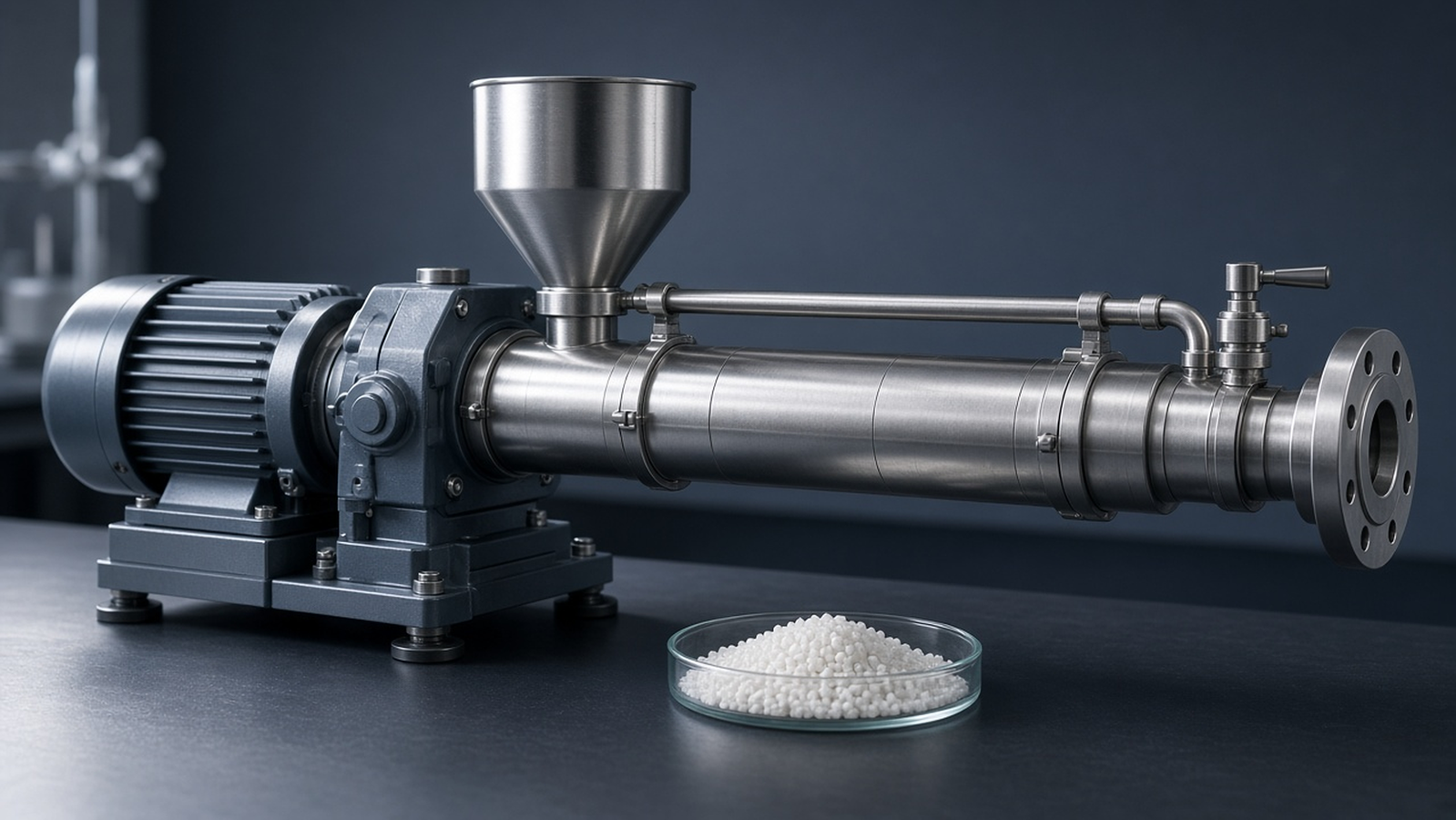
The Polytevo Series Recirculating Single-Screw Extruder page describes a laboratory single-screw extruder in which a circulating flow channel and a reversing valve let the material circulate or be extruded. It lists a Ø20 mm screw, a screw speed of 1–120 rpm, six temperature control zones, a maximum temperature of 380 °C, a hinged barrel that opens by 120°, and manual feeding as standard with automatic feeding as an option.
The page also lists a material mass per cycle of 30 g/cycle and an extrusion rate of 2.5 kg/h, and data acquisition of pressure and temperature. The Polytevo Series Conical Twin-Screw Extruder page describes an internal circulation blending channel in the barrel and lists a material mass per cycle of 40 g/cycle and an extrusion rate of 2.5 kg/h, with five experimental modes: single-cycle, timed-cycle, continuous feeding, constant-speed and constant-torque blending.
| Item (page label) | Recirculating Single-Screw Extruder | Conical Twin-Screw Extruder |
|---|---|---|
| Circulation | Circulating flow channel and reversing valve | Internal circulation blending channel in the barrel |
| Screw | Ø20 mm; effective length 183 mm | One pair of conical screws, Ø10 mm small end, Ø25 mm large end |
| Screw speed | 1–120 rpm | 1–120 rpm |
| Material mass per cycle | 30 g/cycle | 40 g/cycle |
| Extrusion rate | 2.5 kg/h | 2.5 kg/h |
| Temperature control zones; maximum temperature | 6; 380 °C | 4; 400 °C |
| Data acquisition | Pressure, temperature | Torque, pressure, temperature |
| Feeding mode | Manual feeding; automatic feeding optional | Manual feeding; automatic feeding optional |
Figures are copied from the pages and keep each page’s own labels. A mass per cycle and an extrusion rate are different quantities. They are not converted into one another here, and their definitions are confirmed on quotation.
5. Cycle arithmetic with the calculator
The calculator below turns a target mass and an assumed input mass per cycle into a number of cycles, with an optional assumed loss per cycle to estimate usable output and an optional time per cycle. A published per-cycle value should be used only when its definition matches that input. It also computes a run time from a target mass and an assumed throughput, and the mass of a chamber charge from volume, fill and density. It starts empty, it never gives a residence time, and it does not convert a mass per cycle into a rate. The page figures are displayed for reference; use a value in a calculation only after its definition matches the input required by that calculation.
An illustrative example, with numbers that are not page figures: a target of 90 g at 20 g per cycle needs five cycles (4.5 before rounding up), which processes 100 g and leaves 10 g beyond the target. If 4 g per cycle is lost to purge and sampling, the usable mass per cycle is 16 g and six cycles are needed. If each cycle takes 12 minutes, six cycles take 72 minutes. The entered cycle time should include the loading, processing and discharge steps included in your planning definition; other activities remain excluded unless added. A planning time of this kind is not a residence time.
6. A checklist for any cycle-based specification
| Number on the page | What it is | What it is not | Ask |
|---|---|---|---|
| Mass per cycle | Mass associated with a cycle under the stated definition; confirm whether it is input, recovered output or another quantity. | A rate, or a residence time | How is the mass defined: wet or dry, charged or recovered? |
| Extrusion rate | Mass per unit time at discharge | A measure of time in the machine | Under what conditions, with what material and at what speed? |
| Circulation time | The time you choose for mixing | A measured residence time | How is the time counted and recorded? |
| Mode names | The control options the software offers | A statement of mixing quality | Which mode was used for any quoted result? |
The table is working guidance from this guide, not a published rule.
7. Before you request a quote
To help identify a suitable configuration, describe the run rather than a machine. Please tell us:
- the material and its form, and the polymer family;
- the charge size and how many charges you expect to run;
- whether you need circulation, direct extrusion or both;
- the form of output you want: strand, a specimen or a mixed sample;
- whether you need automatic feeding or manual feeding is enough.
8. FAQ
What is a recirculating extruder?
In recirculating batch operation, a charge is retained for a selected processing interval and then discharged; recirculation describes the flow path, not every operating mode the equipment may offer. The Polytevo Series Recirculating Single-Screw Extruder page describes a circulating flow channel and a reversing valve that let the material circulate or be extruded.
Is a cycle the same as a continuous run?
No. A cycle processes a defined charge for a chosen time and is described by a mass per cycle; a continuous run feeds and discharges during the run and is described by a throughput.1
Can I get the residence time by dividing the mass per cycle by the extrusion rate?
Not from those figures alone. An RTD describes the distribution of material residence times, while the mean residence time is a separate summary quantity. The quoted cycle mass and extrusion rate do not establish either without compatible definitions and operating conditions.1,6,7
What do the Polytevo recirculating and conical pages list per cycle?
The Recirculating Single-Screw Extruder page lists a material mass per cycle of 30 g/cycle, and the Conical Twin-Screw Extruder page lists 40 g/cycle, each with its own label and with definitions confirmed on quotation.
How many cycles does a target mass need?
Divide the target mass by the usable mass per cycle and round up. The calculator in section 5 does this for the numbers you enter.
9. Keep exploring the Lab-Scale Polymer Processing Knowledge Hub
This guide belongs to the extruder cluster of the Lab-Scale Polymer Processing and Testing: A Workflow Guide, which places every machine of the Polytevo Series by ACS Material in the stage of the lab route where it is used. The cluster starts at How to Choose a Laboratory Extruder: Types, Scale and Duty; related guides in the cluster:
- How to Choose a Laboratory Extruder: Types, Scale and Duty. Entry guide to the cluster: choose a laboratory extruder by duty, scale and what has to come out.
- Micro Compounders: Conical and Dual Conical Twin Screws. Which small-sample question each conical machine answers, with a batch budget calculator.
- Benchtop Extruders for Teaching and Small-Batch Research. The two benchtop machines compared on what each page states.
To discuss a configuration, describe the material and its form, the sample quantity you need to process, whether the run is a batch or continuous, and the form of output you want, then send it through Request a Quote. Specifications are as published on each product page, and final configurations are confirmed on quotation.