
A micro compounder answers a narrow question: can a formulation be mixed and extruded when only a few grams of material exist? This guide explains what such an instrument is for, what has to be defined and recorded for the experiment to mean anything, and what the Polytevo conical and dual conical twin-screw pages say. A batch and material budget calculator in section 6 turns a target mass into a number of cycles without converting between a mass per cycle and an hourly rate.
1. What a micro compounder is for
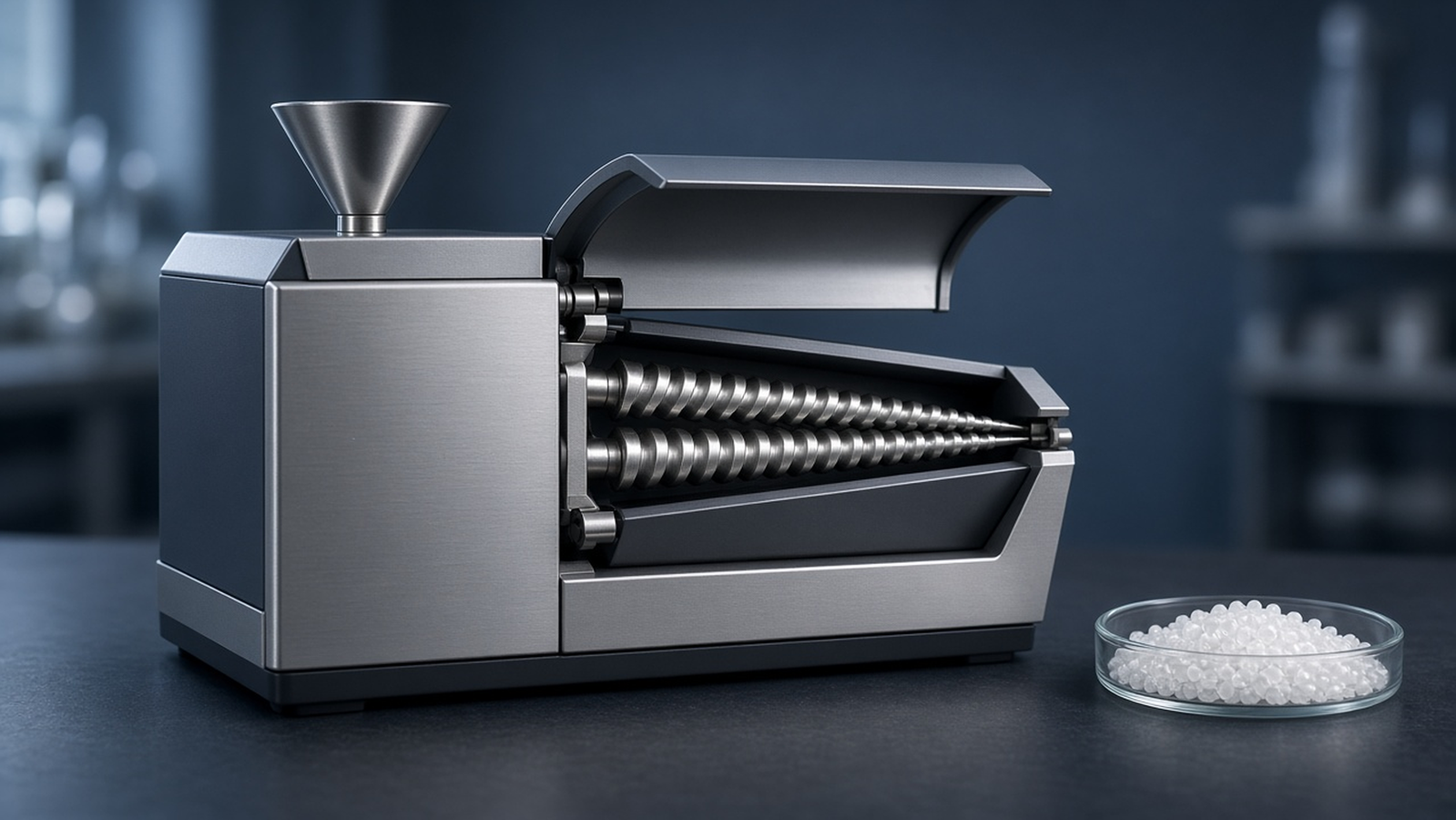
The defining feature of a micro compounder is the size of the charge. An equipment and application report describes one conical twin-screw extruder with a backflow channel that combines aspects of mixing and extrusion in a batch process; the MiniLab instrument had a total filling volume of 7 mL and a built-in slit capillary die, and the report states that its applications focused on compounding and reactions of small amounts of polymers in the molten state.1 The report concerns one instrument and is not independent validation of other instruments. Twin-screw extruders in general have been described as continuous mixers;2 a micro compounder of this kind is the small-charge, batch counterpart, in which a closed circuit retains material within the processing circuit for a chosen time before it is discharged.
Common uses include sample-limited formulation work, screening experiments and studies that vary recirculation duration. These are examples, not an exhaustive list. Continuous systems also allow changes in residence-time history through geometry and operating conditions, although they do not use the same batch-duration control. For continuous work at larger scale, the routes described in Single-Screw vs Twin-Screw Extruders: Which One for a Lab? are the starting point.
The cluster entry point, How to Choose a Laboratory Extruder: Types, Scale and Duty, places micro compounders among the other laboratory machine types. This guide covers what is specific to them: the questions they answer, the variables that have to be recorded, how far results transfer to other machines, how to count grams and cycles, and what two Polytevo pages say.
2. Where a few grams are enough: what the literature shows
Published work shows what small-charge instruments have been used for, and also what they cannot be assumed to do. In a rubber study, a 15 mL twin-screw micro-compounder was used to formulate EPDM/carbon black and EPDM/silica compounds, the same recipes were prepared on a Banbury mixer followed by a two-roll mill, and the rheological and mechanical properties and the filler dispersion were compared. The authors framed the micro-compounder as a possible tool for fast and accurate sample preparation in formulation development.3 The study concerns rubber and the instrument used, and it is a comparison, not a statement that the two routes are interchangeable.
In a polypropylene/organo-clay study, a miniature laboratory mixing extruder blended PP with an organo-clay masterbatch at the reported processing conditions. The material was pelletized and subsequently extruded as a thin ribbon for viscoelastic testing; storage modulus increased with clay content.4 This is one published preparation sequence, not a universal route for sample-limited work. It also shows what has to be reported with a small-batch result: the processing conditions and the form in which the material was tested.
Small mixers of other designs show the same pattern. A study of mixers for polymer blending compared an industrial twin-screw extruder, a laboratory internal mixer and a miniature cup-and-rotor mixer; morphology development was remarkably similar, and at matched maximum shear rates the final dispersions in the twin-screw extruder and the internal mixer were almost identical, but the miniature mixer did a poor job of dispersing high-viscosity uncompatibilized blends until the mixing conditions were altered.5 A later study found that a 0.3 g cup-and-rotor mini-mixer dispersed polypropylene in polystyrene much worse than a 5 g laboratory extruder and a 16 mm twin-screw extruder until three steel balls were added to the cup or the rotor was modified to allow recirculation.6 A small charge is therefore not a small version of a large run; it is its own experiment, and the instrument and its conditions are part of the result.
3. Batch operation: mixing time, speed and sampling
Batch operation adds a selected processing duration; screw geometry and spatial flow remain relevant. Record the charge, temperature, screw-speed history and the defined start and end of the processing interval. A study of small-scale melt mixing of carbon nanotubes into polyamides varied temperature, rotation speed and mixing time and found that the mixing conditions influenced the dispersion of the nanotubes and the electrical volume resistivity strongly, with fewer and smaller agglomerates as the mixing energy input rose.7 In samples with 5 wt% nanotubes in PA6, the resistivity showed a minimum at a quite low energy input and then increased considerably with further input; the authors related this to nanotube breakage during mixing and encapsulation by the polymer chains.7 The study used its own small-scale mixer, and it does not say anything about a particular commercial machine, but it makes the point that more mixing is not always better. A study of polycarbonate with 1 wt% nanotubes in a small-scale microcompounder varied mixing temperature and speed at fixed mixing time and reported large differences in volume resistivity and in the state of agglomerate dispersion; its abstract concludes that mixing at high melt temperature and high speed can give low resistivity and a high dispersion index at low mixing energy input.8
The same caution applies to energy. In a polycarbonate/carbon nanotube study on a laboratory twin-screw extruder, dispersion improved as the specific mechanical energy rose, with no further improvement above about 0.4 kWh/kg, while the nanotubes were shortened with energy input to 44% of their original length.9 Torque alone is not an energy measurement. Estimating mechanical work requires torque and angular-speed histories over a defined time interval, together with the measurement and correction conventions. Specific energy also requires a stated mass basis. Report those definitions when comparing runs; equal specific energy does not establish equal mixing or thermal history.
The way a sample is taken out matters as well. In the study of small mixers, quenching time had a significant effect on blend morphology: to evaluate mixing properly, the blends had to be quenched extremely quickly, well within a minute, because otherwise the morphology that developed during quenching might not be relevant to the mixing.5 For a micro compounder this means the discharge and cooling of the sample are part of the method, and the time between the end of mixing and the end of cooling should be recorded.
In twin-screw machines, mixing is related to the amount of deformation the polymer has experienced as well as to time. In one extruder study, distributive mixing in kneading blocks was related to the local average number of screw revolutions experienced by the polymer.10 That study concerned a continuous extruder, and its measure does not transfer to a micro compounder directly, but it supports a practical habit: record both the screw speed and the mixing time. At constant speed, revolutions equal speed multiplied by elapsed time; with varying speed, integrate the speed history.
4. What to define and record for a micro-compounder experiment
A small-batch experiment is only as informative as its record, and a formulation with a filler that must be broken up depends on dispersive rather than only distributive mixing, the two kinds of element action distinguished in the twin-screw literature.2 The list below is working guidance from this guide, drawn from the studies above, and it is not a published protocol.
- Charge. The mass of each component, the form of the material (pellets, powder, masterbatch), and how it was dried and fed. Record these details so that changes in the feed and loading procedure are visible in comparisons.
- Temperature profile and speed. The set temperatures, the screw speed, and whether the speed was held constant during the run, since temperature and speed were among the variables that changed outcomes in the polyamide study.7 Heat generated by deforming and rubbing the material contributes to melting in internal mixers and co-rotating twin-screw extruders, so a melt temperature, where the instrument reports one, is a separate record from the set temperature.11
- Mixing time. The time the material circulates, counted from a defined start, and the time at which it was discharged.7
- Energy or torque record. Retain torque and speed versus time, the integration interval, mass basis and any drive or no-load corrections used in the calculation.
- Sampling and cooling. How the sample left the machine and how fast it was cooled, because quenching time affected the morphology in the mini-mixer study.5
- Preparation of the test specimen. Whether the batch was pelletized or formed directly, and the temperature of any later step, since the route from batch to specimen is part of the result.4
- Comparison. The machine and its conditions, for any later comparison with another mixer, because the mixers compared in the literature did not always give the same dispersion.6
5. Scale-up and comparability: what carries over
A formulation screened on a few grams will usually be repeated at a larger scale, and the open question is which parts of the result carry over. The literature offers a cautious answer. The morphology development of immiscible blends was remarkably similar in three very different mixers, which suggests that the basic mechanism can be shared;5 on the other hand, the dispersion actually reached depended on the machine and its conditions, and a mini-mixer could be much worse than a larger machine until it was modified.6 For nanotube composites the mixing conditions changed dispersion and resistivity strongly in a small-scale mixer,7 and the screw design, speed and throughput were all relevant on a laboratory twin-screw extruder.9 In a study of twin-screw compounding scale-up, the abstract reports that keeping the degree of fill, expressed as percent drag flow, equivalent in the primary mixing region predicted operating conditions on the large extruder that reproduced the small extruder’s dispersive behaviour better than a volumetric-flow comparison did.12
Scale-up rules exist for some machine types, but they are specific. A set of rules for distributive mixing was developed for partially filled non-intermeshing counter-rotating twin-screw extruders from tracer experiments on two machines, and compared with rules in the literature; it concerns that machine type and fill state.13 No such rule is assumed here for a conical micro compounder. The practical conclusion is to treat a micro-compounder result as a screening result for the formulation, to state the machine, conditions and sample route with it, and to confirm the finding on the machine that will run the material later.
6. Counting grams and cycles: a batch and material budget calculator
A batch instrument processes a defined charge, so planning a project means counting cycles and grams. The calculator in this section does only that arithmetic. It does not convert a mass per cycle into an hourly rate or the reverse, it never gives a residence time, and every field starts empty because no number is a default. The page figures are displayed for reference. Use a value in a calculation only after its definition matches the input required by that calculation.
Three examples, with illustrative numbers that are not page figures, show how to read the results. With a target of 100 g and a mass per cycle of 25 g, four cycles are needed. If 5 g of each cycle is lost to purge or sampling, only 20 g per cycle is usable and five cycles are needed, so the loss moves the answer by a whole cycle. And a chamber that holds 12 mL at 60% fill with a material density of 0.8 g/mL as charged takes a charge of 5.76 g, which sets how many charges a given target needs.
Two cautions go with the arithmetic. First, a run time estimated as a target mass divided by an assumed output rate is a planning interval, not a residence time. An RTD describes how residence times vary across the material; a mean residence time is one statistic of that distribution. The twin-screw literature discusses how screw design and degree of fill affect the RTD.2 A 1975 paper reported techniques for measuring it in twin-screw equipment,14 and later work reported that, for a given screw geometry, the axial mixing measured by a tracer was essentially the same for the operating conditions investigated in a 30 mm co-rotating extruder.15 Second, a mass per cycle is not a throughput, which is why the calculator keeps the two apart. A page’s “material mass per cycle” label does not by itself establish whether the figure is charged mass, recovered mass or another defined quantity. Confirm that basis before using it in a material budget.
7. What the Polytevo conical pages say
This section reports what two Polytevo pages say on 15 November 2026 and nothing else. No literature appears in it, and nothing in the earlier sections is claimed for these machines.
The Polytevo Series Conical Twin-Screw Extruder page describes a compact instrument developed for mixing new materials, for use on laboratory benches or in fume hoods, with one pair of quick-release conical screws and a mixing chamber that opens by 180°. It lists a minimum processing capacity of 10 mL, says that blending experiments can be carried out with only 5–15 g of raw material, and describes an internal circulation blending channel in the barrel.
The same page lists five experimental modes, single-cycle, timed-cycle, continuous feeding, constant-speed and constant-torque blending, together with electronic direct-drive torque measurement of 0–50 N·m and data acquisition of torque, pressure and temperature.
The Polytevo Series Dual Conical Twin-Screw Extruder page describes two sets of conical twin screws in an inverted and staggered layout providing a back-and-forth circulation path, with the rotating speed of each screw group independently adjustable within 1–120 rpm. It lists eight temperature control zones and a maximum temperature of 400 °C, and describes the instrument as suited to formula verification of highly filled and high-viscosity micro samples.
| Item (page label) | Conical Twin-Screw Extruder | Dual Conical Twin-Screw Extruder |
|---|---|---|
| Screw configuration | One pair of conical screws | Two sets of conical twin screws, inverted and staggered layout |
| Screw dimensions | Ø10 mm small end, Ø25 mm large end; effective length 200 mm | Ø10 / Ø25 mm (small end / large end); effective length 200 mm |
| Screw speed | 1–120 rpm | 1–120 rpm (each screw group independently adjustable) |
| Temperature control zones | 4 | 8 |
| Maximum temperature; control accuracy | 400 °C; ±0.5 °C | 400 °C; ±0.5 °C |
| Minimum processing capacity | 10 mL | 10 mL |
| Material mass per cycle | 40 g/cycle | 80 g/cycle |
| Extrusion rate | 2.5 kg/h | 5 kg/h |
| Servo motor power | 400 W | 400 W × 2 |
| Data acquisition | Torque, pressure, temperature | Torque, pressure, temperature |
| Overall dimensions; weight | 660 × 400 × 620 mm; 60 kg | 1050 × 338 × 730 mm; 96 kg |
Figures are copied from the pages and keep each page’s own labels. A minimum processing capacity, a mass per cycle and an extrusion rate are different quantities. They are not converted into one another here, and their definitions are confirmed on quotation.
8. Matching the question to the page
The two pages describe uses in their own words, and those words are a good starting point for the question to put when requesting a quotation. The Conical Twin-Screw Extruder page describes micro-sample blending of new or costly synthetic materials, and the Dual Conical Twin-Screw Extruder page describes micro-sample blending and modification experiments with highly filled and high-viscosity materials.
Both pages describe micro-sample work. The dual-conical page explicitly names highly filled and high-viscosity applications. These are stated application descriptions, not comparative evidence that one machine will perform better with a particular formulation. Recirculating Extruders: How Cycles Differ from Continuous Runs covers how circulating paths differ from continuous runs on the recirculating and conical pages.
9. Before you request a quote
To help identify a suitable configuration, describe the experiment rather than a machine. Please tell us:
- the material and its form, and the polymer family;
- the formulation, including filler type and loading, and any high-viscosity component;
- the sample quantity per run and in total;
- the output you need: strand, a small specimen or a mixed sample for later tests;
- any data you need logged, such as torque, pressure or temperature.
10. FAQ
What is a micro compounder used for?
It is used to mix and extrude a small charge, usually as a batch, when the material is scarce or when several formulations are being screened. An equipment report describing one such instrument, a conical twin-screw extruder with a backflow channel, gives a total filling volume of 7 mL.1
Can results from a micro compounder be transferred to a larger extruder?
Only with care. Morphology development was remarkably similar in three different mixers in one study, but a small mixer dispersed much worse than larger machines until it was modified in another, so the machine and conditions belong to the result.5,6
What should I record for a micro-compounder run?
Record the charge, temperatures, screw-speed history, processing interval, available torque data, discharge/cooling procedure and subsequent specimen preparation. These records document the experiment; the cited studies illustrate sensitivity to particular mixing and cooling conditions, not to every field listed here.7,5
Is the mass per cycle the same as the output rate?
No. An output rate is mass per unit time. A page’s “material mass per cycle” label does not by itself establish whether the figure is charged mass, recovered mass or another defined quantity. Confirm that basis before using it in a material budget. The Polytevo conical pages list both under their own labels, and they are not converted into one another here.
How many cycles does a target mass need?
Divide the target by the usable mass per cycle and round up. The calculator in section 6 does this for the numbers you enter, with an optional loss per cycle.
What minimum capacity do the Polytevo conical pages list?
Both the Conical Twin-Screw Extruder page and the Dual Conical Twin-Screw Extruder page list a minimum processing capacity of 10 mL, and both say that blending experiments can be carried out with only 5–15 g of raw material.
11. Keep exploring the Lab-Scale Polymer Processing Knowledge Hub
This guide belongs to the extruder cluster of the Lab-Scale Polymer Processing and Testing: A Workflow Guide, which places every machine of the Polytevo Series by ACS Material in the stage of the lab route where it is used. The cluster starts at How to Choose a Laboratory Extruder: Types, Scale and Duty; related guides in the cluster:
- How to Choose a Laboratory Extruder: Types, Scale and Duty. Entry guide to the cluster: choose a laboratory extruder by duty, scale and what has to come out.
- Single-Screw vs Twin-Screw Extruders: Which One for a Lab?. How the two screw architectures differ for mixing, feeding and pellets, framed by the task.
- Recirculating Extruders: How Cycles Differ from Continuous Runs. How a circulating channel and reversing valve work, and why cycle arithmetic is not residence time.
To discuss a configuration, describe the material and its form, the sample quantity you need to process, whether the run is a batch or continuous, and the form of output you want, then send it through Request a Quote. Specifications are as published on each product page, and final configurations are confirmed on quotation.