
Whether a laboratory needs a single-screw or a twin-screw extruder depends on the task more than on the machine: what has to be melted, how much mixing the formulation needs, how the feed arrives and how closely the run has to be controlled. This guide compares the two architectures in turn, using published studies for what is known and the Polytevo Series by ACS Material pages for what the machines are said to be.
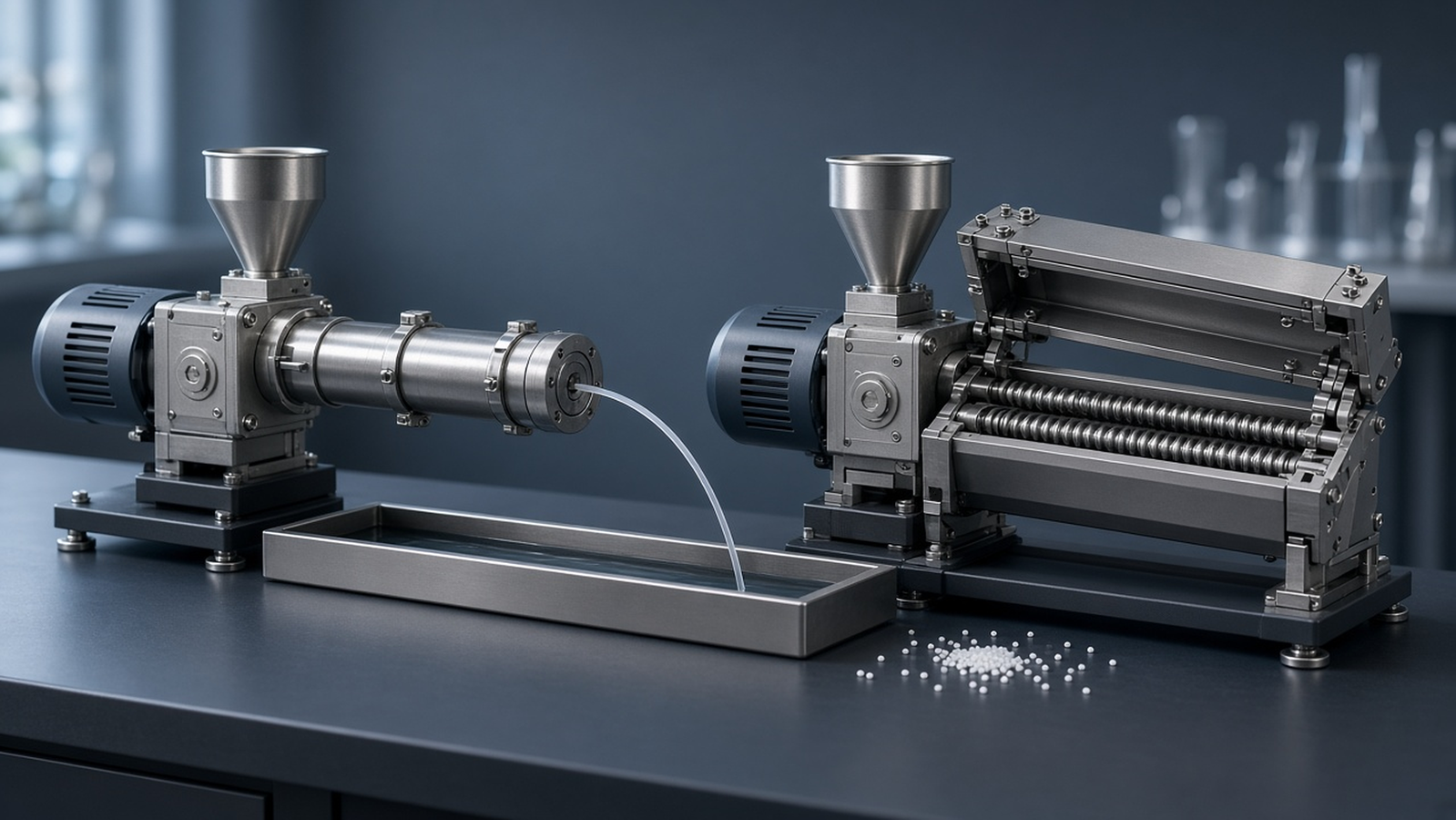
1. The short answer: decide by task, not by screw count
Single-screw and twin-screw extruders are not ranked machines. A single-screw extruder is the simpler of the two; a twin-screw extruder adds a second screw and, in the co-rotating compounding type described in the twin-screw review, screws that are typically segmented and assembled on shafts, so that the mixing can be changed by changing the screw configuration.1 Which of these matters depends on what the laboratory has to do. Four questions settle most of the choice:
- Does the material arrive already mixed? A single grade of pellets that only has to be melted, shaped and cooled is a melting-and-pumping job. A filler, a pigment or a second polymer that has to be spread through the melt is a mixing job.
- How much dispersion does the formulation need? Breaking up agglomerates is a different task from spreading components evenly, and it is a task whose outcome depends on screw geometry, material behaviour and operating conditions.1,2
- How is the feed delivered? A metered, starved feed and a flooded feed fill the screw differently, and the fill affects both conveying and mixing.3,4
- How closely must the run be controlled and described? If a result will be compared between runs or machines, residence time, energy input and screw configuration have to be recorded, because they change the result.5,6
The sections that follow take these in turn. Section 2 describes what a single screw does, section 3 what a second screw adds, and sections 4 to 6 cover mixing, feeding and residence time. Section 7 explains why a small machine cannot simply stand in for a large one, section 8 sets out what three Polytevo pages say, and section 9 turns the comparison into a short guide by task. The cluster entry point, How to Choose a Laboratory Extruder: Types, Scale and Duty, places this comparison among the other machine types.
2. What a single screw does
In a hot-melt-extrusion review, a single-screw extruder performs operations such as feeding, conveying, melting, devolatilizing, pumping and shaping, with mixing possible for less demanding applications,7 and a basic single-screw extruder is described as having feed, compression and metering zones.8 The melting comes partly from heat conducted through the barrel and partly from the mechanical work done on the material, and a mathematical model of the whole plasticating extruder was formulated to predict temperature and pressure profiles along the machine, the solids content everywhere in it and the total power requirement.9 The same split between heat from the barrel and heat from deformation appears in reviews of melting in other equipment: heat generated by deforming and rubbing solid particles contributes to melting in internal mixers and in co-rotating twin-screw extruders as well.10
The screw geometry matters for how the sequence develops. A modular, instrumented laboratory single-screw extruder was built to gather temperature, mixing, conversion and morphology information along the screw axis, and it was used to study how operating conditions and screw geometry, including conventional versus barrier profiles, affect the development of the plasticating sequence of a low-density polyethylene; melting of an immiscible polyamide 6/polypropylene blend was also investigated.11 This is one research extruder, and the study says nothing about any particular commercial machine, but it shows the kind of question an instrumented single screw is used to study.
A flow-visualization study compared how starve-fed solids move in a single-screw extruder and in a modular self-wiping co-rotating twin-screw extruder. In the single screw, material was transported forward on the undersides of the screw; in the twin screw it was conveyed forward in the intermeshing region and in the region near the apex between the screws.3 The same study reports observations of how solid pellets melt in each case, so the two machines differ in how the solid is moved and melted, and not only in how many screws turn.
3. What a second screw adds
“Twin-screw” names a family, not one machine. The screws can turn in the same direction (co-rotating) or in opposite directions, and they can intermesh fully or not at all. A study of scale-up rules, for example, names both the fully intermeshing co-rotating type and the non-intermeshing counter-rotating type, and developed rules for the second.12 The rest of this section concentrates on the co-rotating, self-wiping machine; conical twin-screw micro compounders are covered in Micro Compounders: Conical and Dual Conical Twin Screws.
Self-wiping refers to the interaction of the screw profiles. It is not evidence that every portion of material experiences identical deformation or that all local stagnation is eliminated. In the intermeshing co-rotating configurations discussed here, each screw, to a degree, wipes the other, and the residence time distribution depends on the screw design and on how full the screws are.1 In the same review the screws are typically segmented and assembled on shafts, so the screw can be rebuilt for a different formulation without changing the machine; the review describes twin-screw extruders as continuous mixers.1
Kneading discs show how configuration can matter. In the kneading-disc elements examined in the study, a three-dimensional finite-element simulation of isothermal flow compared the shear stresses and elongational flow components generated by three-lobe discs in one machine with those of two-lobe discs in a smaller one. This is an isothermal-flow simulation of two particular screw-and-disc geometries. It illustrates differences between the modeled flow fields; it does not isolate screw configuration from machine size or establish a general ranking of twin-screw extruders.2
4. Mixing: distributive and dispersive
Two kinds of mixing are worth keeping apart. Distributive mixing spreads components evenly through the melt without breaking them down; dispersive mixing breaks agglomerates and droplets apart. In the twin-screw literature, elements that accentuate extensional mixing and planar shear are described as dispersive, and elements that divide and recombine melt streams as distributive.1 The required mixing depends on the materials, their starting form and the target structure. Miscibility alone does not specify the necessary deformation history.
Measured work on distributive mixing in a twin-screw extruder shows that the answer depends on the section of the screw. In one study, local residence time and distributive mixing were measured in conveying sections and kneading blocks. Distributive mixing in conveying sections was related to the local average residence time and the fill, whereas in kneading blocks it was related to the local average number of screw revolutions experienced by the polymer, and forward-stagger kneading discs achieved the greatest amount of distributive mixing.4 The practical reading is that a single number such as screw speed does not describe the mixing; where the material has been, and in which element, does.
Studies of nanocomposite compounding illustrate the same point. In a polycarbonate/multiwalled carbon nanotube study on a laboratory twin-screw extruder, the screw design, rotation speed, throughput, feeding position and nanotube content were varied. The agglomerate area ratio fell as the applied specific mechanical energy rose, with no further improvement in dispersion above about 0.4 kWh/kg, while the nanotube length fell with energy input to 44% of its original length. The screw profile influenced dispersion, nanotube length and electrical resistance only to a small extent, and distributive screws shortened the nanotubes more than dispersive screws did.6 The finding is specific to that polycarbonate and those nanotubes, but it shows why more mixing energy is not simply better: dispersion and filler damage can move together.
5. Feeding and fill
How the feed arrives sets how full the screw channel is, and the fill changes what the screw can do. In the study above, the feeding position was one of the varied conditions, and feeding the nanotubes into a side feeder led to slightly better electrical and mechanical properties for both types of nanotube studied, while the effect of feeding position on dispersion differed between the two types.6 A feeding position that suits one filler is therefore not evidence for another, and a laboratory comparing fillers has to report the position.
Starve feeding, in which the feed rate rather than the screw sets how much material enters, is the condition under which the flow-visualization work cited above was done.3 In the distributive-mixing study, the fill was one of the quantities related to mixing in the conveying sections.4 A residence-time study on a 30 mm co-rotating twin-screw extruder reported that operating conditions with equivalent specific throughput gave an equivalent residence-volume distribution and residence-revolution distribution.5 Together they suggest a simple rule for reporting: give the feed rate and the screw speed, not only one of them, since the ratio between them is part of what the fill depends on; reporting both does not by itself characterize the mixing.
6. Residence time: why it matters for the comparison
Different portions of material can spend different times in the equipment. An RTD describes that variation, whereas a mean residence time is a single summary value. A 1975 paper reported that techniques had been developed for measuring residence time distributions and characterizing axial flow behavior in twin-screw extruders, and the same work reported that the method also permits direct determination of the holdup in starved barrel applications, with data for 4-in. diameter twin-screw equipment with a variety of rotor configurations.13 The later study on a 30 mm co-rotating extruder validated a residence-time distribution model on polyethylene, and found that for a given screw geometry the axial mixing measured by a tracer was essentially the same for the operating conditions investigated for that screw geometry.5
For choosing between a single-screw and a twin-screw laboratory machine, the useful point is that an RTD cannot be inferred from the machine-type label alone. It depends on the geometry, material state and operating conditions. A comparison between a single-screw and a twin-screw run that does not record the screw configuration, speed and feed rate is a comparison of unknown conditions.
7. Small machines, large machines: what carries over
Scale-up adds another reason to specify the machine architecture, screw configuration and operating conditions. Scale-up rules were developed, theoretically and experimentally, for the partially filled channels of non-intermeshing twin-screw extruders, because earlier theories had concerned mostly fully filled channels; the rules were derived from tracer experiments on two machines of 0.8 and 2 inches in diameter, and compared with rules in the literature.12 The reason to mention it is that a rule derived for one machine type and fill state cannot be assumed for another.
Studies comparing small and large mixers show both agreement and disagreement. Morphology development of polymer blends was remarkably similar in an industrial twin-screw extruder, a laboratory internal mixer and a miniature cup-and-rotor mixer, and the final dispersions in the twin-screw extruder and the internal mixer at matched maximum shear rates were almost identical; however, the miniature mixer did a poor job dispersing high-viscosity uncompatibilized blends unless the mixing conditions were altered.14 In another comparison, a 16 mm co-rotating twin-screw extruder gave somewhat smaller dispersed particles than the laboratory-scale mixers, and the miniature cup-and-rotor mixer dispersed much worse until three steel balls were added or the rotor was modified to allow recirculation.15
Small-scale mixing conditions also change properties that are measured after the run. In a polyamide/carbon nanotube study on a small-scale melt mixer, temperature, rotation speed and mixing time were varied, and the mixing conditions strongly influenced the dispersion of the nanotubes and the electrical volume resistivity.16 The common message of these studies is not that small machines are unreliable but that a result belongs to the machine, the screw or rotor configuration and the conditions it was made under, and should be reported with them.
8. What three Polytevo pages say
This section reports what three Polytevo pages say on 15 November 2026 and nothing else: no literature appears in it, and nothing in the earlier sections is claimed for these machines.
The Polytevo Series Single Screw Extruder page describes a laboratory single screw extruder with a screw of 20 mm or 30 mm and L/D 28:1, four SSR-controlled temperature zones and a PLC control system, supplied with a cooling tank and an air-drying and pelletizing unit.
The Polytevo Series Twin-Screw Extrusion and Pelletizing Line page describes a line built around a co-rotating twin-screw extruder with a modular screw and barrel, in which the screw elements can be re-arranged for the desired mixing, shearing and dispersion. It lists a twin-screw volumetric feeder, a vacuum venting system and water-cooled strand pelletizing, and states raw materials of PE/PP and pellets of approx. 3 × 3 mm.
The Polytevo Series Conical Twin-Screw Extruder page describes a compact laboratory conical twin-screw extruder with one pair of quick-release conical screws and a 10 mL minimum processing capacity, with blending experiments possible with only 5–15 g of raw material. It also describes an internal circulation blending channel in the barrel, and torque measurement with data acquisition of torque, pressure and temperature.
| Polytevo page | Screw as published | Speed as published | Capacity or output as published, with the page’s own label |
|---|---|---|---|
| Single Screw Extruder | 20 mm or 30 mm screw; L/D 28:1 | 0.1–100 rpm (20 mm version) | Output 3–6 kg/h (20 mm); maximum output 5–10 kg/h (30 mm) |
| Twin-Screw Extrusion and Pelletizing Line | Ø22 mm co-rotating twin screws; L/D 42:1; modular screw elements | Maximum screw speed 600 rpm | Output 5–10 kg/h (depends on raw material, formulation and process conditions) |
| Conical Twin-Screw Extruder | One pair of conical screws, Ø10 mm small end, Ø25 mm large end | 1–120 rpm | Min. capacity 10 mL; 5–15 g of raw material; material mass per cycle 40 g/cycle; extrusion rate 2.5 kg/h |
The last column keeps each page’s own label. A capacity, a mass per cycle and an hourly rate are different quantities, they are not converted into one another here, and their definitions are confirmed on quotation.
9. Choosing by task
The table below turns the comparison into working guidance. It is this guide’s own summary, not a published rule, and every row ends with a question to put to any machine before the choice is made.
| If the task is… | Start by considering… | Ask of any machine |
|---|---|---|
| Melt, shape and cool a single grade | A single-screw extruder | What are the temperature settings, screw speed and die, and how will the output be cooled and collected? |
| Disperse a filler or a pigment masterbatch | A co-rotating twin-screw extruder with a configurable screw | Which screw elements are fitted, how is the filler fed, and what energy input does the run apply? |
| Blend two or more polymers | A twin-screw extruder, or a small batch compounder if the sample is limited | How much material does a run need, and can the screw or rotor configuration be reported? |
| Compare formulations on a few grams | A small batch micro compounder rather than a continuous machine | What is the minimum working quantity, and how is the first material discarded or quenched? |
| Produce pellets for later testing | A line with feeding, cooling and pelletizing | Is feeding metered, and what are the pellet size and the conditions behind the output? |
| Study melting or conveying | An instrumented single-screw extruder | Which temperatures and pressures are logged, and along which length of the screw? |
To read the specification of any machine in the middle column, see Reading a Screw Specification: L/D, Compression Ratio, Speed; for small-sample work see Micro Compounders: Conical and Dual Conical Twin Screws.
Three cautions apply to the whole table. First, “start by considering” is not “choose”: the machine has to be checked against the quantity, the form of the feed and the output, which is the purpose of How to Choose a Laboratory Extruder: Types, Scale and Duty. Second, a twin-screw extruder does not ensure a better dispersion; screw configuration and energy input are among the relevant variables, alongside material, feeding, temperature and sampling conditions, and in at least one study the screw profile mattered only to a small extent.6 Third, a result obtained on one machine is a result for that machine, as the mini-mixer studies show.14,15
10. Before you request a quote
For a configuration discussion, describe the formulation, feeding arrangement and required output.
- the material and its form, for example pellets, powder or regrind, and the polymer family;
- the formulation, including any filler or second polymer and its loading, because it sets how much mixing the job needs;
- the sample quantity per run and in total, and whether the run is a batch or continuous;
- the form of output: strand, pellets or an extruded specimen;
- whether feeding will be by hand, by a metered feeder or both, and any need for venting.
11. FAQ
Is a twin-screw extruder always better than a single-screw extruder?
Neither architecture is universally preferable. Both can perform mixing, but the available conveying and mixing geometries differ. Select the equipment from the formulation, feed, required output and evidence for the proposed operating conditions—not screw count alone.
Does a higher screw speed give better dispersion?
Not necessarily. In a polycarbonate/carbon nanotube study the dispersion was related to the specific mechanical energy applied, with no further improvement above about 0.4 kWh/kg, and the nanotubes were shortened as the energy rose.6
Why are the same recipes sometimes different on a small mixer and a larger extruder?
Differences can arise from deformation, thermal and residence-time histories, as well as sampling and cooling. One study found the final dispersions of a twin-screw extruder and an internal mixer almost identical at matched maximum shear rates, while the miniature mixer did a poor job on high-viscosity uncompatibilized blends unless the mixing conditions were altered.14
What does the Polytevo twin-screw pelletizing line page say about its screw?
The Polytevo Series Twin-Screw Extrusion and Pelletizing Line page describes a co-rotating twin-screw extruder with Ø22 mm screws, L/D 42:1 and a maximum screw speed of 600 rpm, with a modular screw and barrel.
Which Polytevo page lists a minimum capacity of 10 mL?
The Polytevo Series Conical Twin-Screw Extruder page lists a 10 mL minimum processing capacity and says that blending experiments can be carried out with only 5–15 g of raw material.
12. Keep exploring the Lab-Scale Polymer Processing Knowledge Hub
This guide belongs to the extruder cluster of the Lab-Scale Polymer Processing and Testing: A Workflow Guide, which places every machine of the Polytevo Series by ACS Material in the stage of the lab route where it is used. The cluster starts at How to Choose a Laboratory Extruder: Types, Scale and Duty; related guides in the cluster:
- How to Choose a Laboratory Extruder: Types, Scale and Duty. Entry guide to the cluster: choose a laboratory extruder by duty, scale and what has to come out.
- Reading a Screw Specification: L/D, Compression Ratio, Speed. What the screw lines on an extruder page describe, and what they do not.
- Micro Compounders: Conical and Dual Conical Twin Screws. Which small-sample question each conical machine answers, with a batch budget calculator.
To discuss a configuration, describe the material and its form, the sample quantity you need to process, whether the run is a batch or continuous, and the form of output you want, then send it through Request a Quote. Specifications are as published on each product page, and final configurations are confirmed on quotation.