
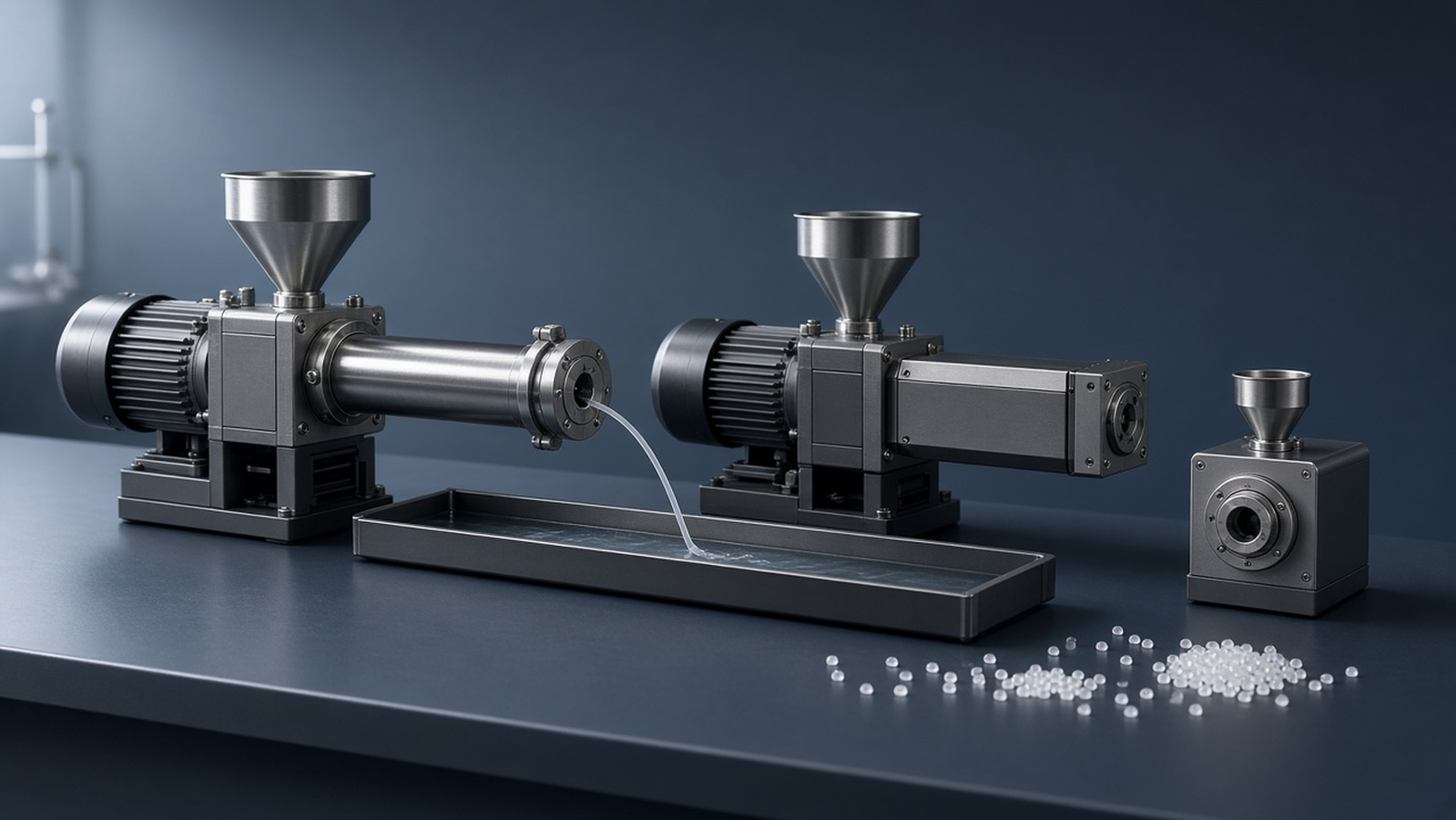
Laboratory extruder types differ in screw architecture, operating mode and format; choose among them by material, sample quantity and required output. In practice that means asking how much material you have, whether the run is a batch or continuous, how hard the mixture has to be worked and what has to come out of the machine. This guide explains five overlapping descriptions of laboratory extruders, from single-screw and co-rotating twin-screw machines to conical micro compounders and recirculating extruders, and sets the seven extrusion pages of the Polytevo Series by ACS Material side by side using only what the pages say.
1. The short answer: choose by duty, then read the specification
The short answer to “which laboratory extruder do I need?” is to answer four questions before looking at any specification sheet, because the answers narrow the field faster than a list of models can.
- How much material do you have? A few grams of a scarce material and several kilograms of a standard grade call for different machines.
- Is the run a batch or continuous? A batch works a defined charge for a chosen time; a continuous run feeds and discharges material while it runs.
- How hard does the mixture have to be worked? Melting a polymer and dispersing a filler in it are different jobs, and machines differ in how much control they give over the second.
- What has to come out? A strand, pellets for later work, or a small extruded specimen each point to different equipment around the extruder.
Section 2 describes five overlapping descriptions of laboratory extruders in general terms, with sources. Section 3 turns the four questions into a short decision guide. Section 4 sets the seven extrusion pages of the Polytevo Series next to each other, and section 5 explains how to read that comparison without over-reading it. The remaining posts in this cluster, listed in section 6, take each decision further.
2. Five overlapping descriptions of laboratory extruders
These descriptions overlap: screw architecture, recirculation and physical format describe different aspects of a machine. A conical twin-screw instrument can also be recirculating and benchtop.
Single-screw extruders
A single-screw extruder has one screw rotating in a barrel. In a hot-melt-extrusion review, operations such as feeding, conveying, melting, devolatilizing, pumping and shaping can be performed in it, and mixing is possible for less demanding applications;1 a basic single-screw extruder is described there and in a second review as having three zones: feed, compression and metering.1,2 Models of the complete plasticating extruder were developed to predict temperature and pressure profiles along the machine, the solids content and the power required.3 A laboratory single-screw extruder can be instrumented to follow the plasticating sequence along the screw; one modular, instrumented design was built to gather temperature, mixing, conversion and morphology information along its axis.4
Co-rotating twin-screw extruders
A twin-screw extruder has two screws side by side. In the intermeshing co-rotating configurations described by the review, the screw profiles interact in a self-wiping motion. The review also discusses how screw design and filling affect the residence-time distribution.5 Self-wiping describes the interaction of the screw profiles; it does not by itself establish that every portion of material receives the same mixing history. In the same review the screws of these machines are typically segmented and assembled on shafts, so the screw configuration, the choice of conveying and mixing elements, can be changed to change the mixing.5 That review describes twin-screw extruders as continuous mixers.5
Conical twin-screw micro compounders
An equipment and application report on one conical twin-screw instrument describes a backflow channel that combines aspects of mixing and extrusion in a batch process, a total filling volume of 7 mL and a built-in slit capillary die.6 It is a report on one instrument, not independent validation of other instruments. Micro compounders of this general kind have been compared with conventional lab mixers: one study used a 15 mL twin-screw micro-compounder for EPDM/carbon black and EPDM/silica recipes and compared the results with a Banbury mixer followed by a two-roll mill.7 That study concerns rubber compounds and shows what such machines have been used for, not what any particular machine will do with your material.
Recirculating extruders
In the general sense used here, a recirculating extruder returns the melt through a channel for a chosen time and then extrudes it. The way the loop is built differs between machines, and the operating modes that the Polytevo pages state are not all batch modes; Recirculating Extruders: How Cycles Differ from Continuous Runs explains the idea and the page-stated modes in detail.
Benchtop machines
“Benchtop” describes size, not type: a benchtop extruder can be a single-screw machine or a different configuration. It matters when bench space, mains supply and teaching use set the limits, and Benchtop Extruders for Teaching and Small-Batch Research compares the two benchtop pages.
How far a small machine can stand in for a larger one
Small mixers can reproduce some behavior of larger ones but not all. In one study of immiscible polymer blends, morphology development was remarkably similar in an industrial twin-screw extruder, a laboratory internal mixer and a miniature cup-and-rotor mixer.8 In another, a 16 mm co-rotating twin-screw extruder gave somewhat smaller dispersed particles than two small laboratory mixers, and the miniature cup-and-rotor mixer dispersed much worse until it was modified.9 Both are studies of particular blends in particular mixers, and neither says anything about the machines in section 4; they are a reason to state the machine and its conditions whenever a result is reported.
3. Choose by duty
Quantity of material
Start with the quantity you can afford to run. One published comparison places a miniature cup-and-rotor mixer at 0.3 g per batch, a small laboratory extruder at about 5 g, and a 16 mm co-rotating twin-screw extruder at about 300 g per hour.9 Use any machine’s published sample quantity as a design input, but compare like with like: a minimum working quantity, a charge per cycle and an hourly output are three different quantities.
Batch or continuous
Batch operation, including recirculating batch operation, processes a defined charge for a selected period. Continuous operation feeds and discharges material during the run. Because start-up takes time, define and record the start-up and sampling criteria used for any comparison. Small, valuable charges point toward batch operation; a run long enough for the feed, melt and output to settle points toward continuous operation.
Mixing demand
Distributive mixing spreads components evenly without breaking them; dispersive mixing breaks agglomerates and droplets apart. In the twin-screw literature, elements that accentuate extensional mixing and planar shear are described as dispersive, and elements that divide and recombine melt streams as distributive.5 How much of each a machine provides depends on its screw design and operating conditions, so a formulation that needs a lot of dispersion points toward machines whose screws or mixing sections can be changed, and toward the screw-comparison guide Single-Screw vs Twin-Screw Extruders: Which One for a Lab?
Form of the output
Define the required output form when comparing equipment. A continuous extrudate is shaped by a die; a later molding operation uses its own mold and preparation procedure. Select cooling, collection and cutting equipment for the intended output. Pellet production requires a cutting operation, whereas a strand may instead be collected or measured.
4. The Polytevo extrusion pages, side by side
The seven pages are described below in six bullets, one for each machine family, and the table that follows gives the figures each page publishes for the screw and its speed. Everything in this section is what the pages say on 15 November 2026; no literature appears in it, so you can always tell what a page states and what the literature suggests.
- The Polytevo Series Single Screw Extruder page describes a laboratory single screw extruder in a 20 mm and a 30 mm screw version, both with L/D 28:1, supplied with a cooling tank and an air-drying and pelletizing unit, for mixing and processing engineering plastics, modified plastics, masterbatch and other polymers.
- The Polytevo Series Benchtop Single-Screw Extruder page describes a benchtop micro single-screw extruder with a 16 mm screw (L/D 14:1) and a PLC color touch screen, for teaching demonstrations at universities, innovation centers and research units, and for do-it-yourself small-batch extrusion.
- The Polytevo Series Recirculating Single-Screw Extruder page describes a laboratory single-screw extruder with a circulating flow channel and a reversing valve, so that the material can be circulated or extruded, with a Ø20 mm screw and six temperature control zones.
- The Polytevo Series Conical Twin-Screw Extruder page describes a compact laboratory instrument with one pair of quick-release conical screws, for micro-sample blending of new or costly synthetic materials, and the Polytevo Series Dual Conical Twin-Screw Extruder page describes two sets of conical twin screws, each with an independently adjustable speed, for micro-sample blending and modification experiments with highly filled and high-viscosity materials.
- The Polytevo Series Benchtop Mini Extruder page describes a compact benchtop extrusion system with a 20 mm screw (L/D 9:1) and a PLC-controlled mold clamping system, for compounding new materials and producing small-batch extruded specimens.
- The Polytevo Series Twin-Screw Extrusion and Pelletizing Line page describes a line that runs from a twin-screw volumetric feeding system through twin-screw compounding to a water-cooled strand pelletizing system, with a co-rotating twin-screw extruder for PE and PP formulations and pellets of about 3 × 3 mm.
The pages also publish a maximum temperature: 380 °C on the three single-screw pages and 400 °C on the conical, dual conical and benchtop mini extruder pages.
| Machine (Polytevo Series page) | Screw as published | Screw speed as published |
|---|---|---|
| Single Screw Extruder | 20 mm or 30 mm; L/D 28:1 | 0.1–100 rpm (20 mm version) |
| Benchtop Single-Screw Extruder | 16 mm; L/D 14:1 | Rated 0.1–20 rpm |
| Recirculating Single-Screw Extruder | Ø20 mm | 1–120 rpm |
| Conical Twin-Screw Extruder | One pair of conical screws, Ø10 mm small end, Ø25 mm large end | 1–120 rpm |
| Dual Conical Twin-Screw Extruder | Two sets of conical twin screws, Ø10 / Ø25 mm (small end / large end) | 1–120 rpm, each screw group independently adjustable |
| Benchtop Mini Extruder | 20 mm; L/D 9:1 | 1–150 rpm (servo motor) |
| Twin-Screw Extrusion and Pelletizing Line | Ø22 mm co-rotating twin screws; L/D 42:1 | Up to 600 rpm |
Figures are copied from the product pages and keep each page’s own labels. The table has no output column on purpose: output figures are defined differently on different pages and depend on material and conditions.
5. Reading the comparison with care
The table is a map, not a ranking. A few cautions keep it honest.
- Screw diameter and L/D are as the pages print them. L/D is the ratio of screw length to screw diameter; Reading a Screw Specification: L/D, Compression Ratio, Speed explains what the number does and does not tell you.
- A speed range is not an output. Screw speed is how fast the screw turns; how much material leaves the machine also depends on the feed, the screw geometry and the material.
- Conical screws have two diameters. A small end and a large end cannot be compared with a single diameter; compare the conical pages with each other.
- A maximum temperature is not a material temperature. Preserve any definition or qualification supplied with a published maximum temperature. Where its meaning is not stated, ask what temperature the limit refers to before using it to plan a run. It is not a recommended material-processing temperature or a measurement of the melt. Record set temperatures and measured material temperatures separately. Mechanical energy dissipation can contribute to melting.10
6. Where each question goes next
Each of the five posts below takes one of the decisions above and goes further than a hub can:
- Single-Screw vs Twin-Screw Extruders: Which One for a Lab?. How the two screw architectures differ for mixing, feeding and pellets, framed by the task.
- Reading a Screw Specification: L/D, Compression Ratio, Speed. What the screw lines on an extruder page describe, and what they do not.
- Micro Compounders: Conical and Dual Conical Twin Screws. Which small-sample question each conical machine answers, with a batch budget calculator.
- Recirculating Extruders: How Cycles Differ from Continuous Runs. How a circulating channel and reversing valve work, and why cycle arithmetic is not residence time.
- Benchtop Extruders for Teaching and Small-Batch Research. The two benchtop machines compared on what each page states.
7. Before you request a quote
To help identify a suitable configuration, describe the duty rather than a machine. Please tell us:
- the material and its form, for example pellets, powder or regrind, and the polymer family;
- the sample quantity you need to process, per run and in total;
- whether the run is a batch or continuous;
- the form of output you want: strand, pellets or an extruded specimen;
- any formulation that needs strong mixing, for example a high filler loading.
Send these through Request a Quote. Specifications are as published on each product page, and final configurations are confirmed on quotation.
8. FAQ
What is the difference between a single-screw and a twin-screw extruder?
A single-screw extruder has one screw in a barrel; a twin-screw machine has two screws side by side. In the co-rotating machines described in the twin-screw review, the screws are typically segmented and assembled on shafts, so the mixing can be changed by changing the screw configuration.5 The next post in this cluster, Single-Screw vs Twin-Screw Extruders: Which One for a Lab?, goes through the decision by task.
Can a laboratory extruder run a batch rather than a continuous stream?
Yes. An equipment and application report on one conical twin-screw instrument describes a backflow channel that combines aspects of mixing and extrusion in a batch process.6
The recirculating-extruder guide separately describes the operating modes stated on the Polytevo product pages: Recirculating Extruders: How Cycles Differ from Continuous Runs.
Does an L/D ratio tell me the output of an extruder?
No. L/D relates a screw length to its diameter; output also depends on the feed, the screw geometry, the speed and the material.1
Which Polytevo page describes a machine for teaching demonstrations?
The Polytevo Series Benchtop Single-Screw Extruder page describes teaching demonstrations at universities, innovation centers and research units. The conical and dual conical twin-screw pages describe research and undergraduate teaching.
Is a die included with the benchtop single-screw extruder?
The Polytevo Series Benchtop Single-Screw Extruder page shows the machine without a die and says that a die and downstream equipment are confirmed on the quotation.
9. Keep exploring the Lab-Scale Polymer Processing Knowledge Hub
This guide is the entry point to the extruder cluster of the Lab-Scale Polymer Processing and Testing: A Workflow Guide, which places every machine of the Polytevo Series by ACS Material in the stage of the lab route where it is used. The five guides listed in section 6 take each decision further.