
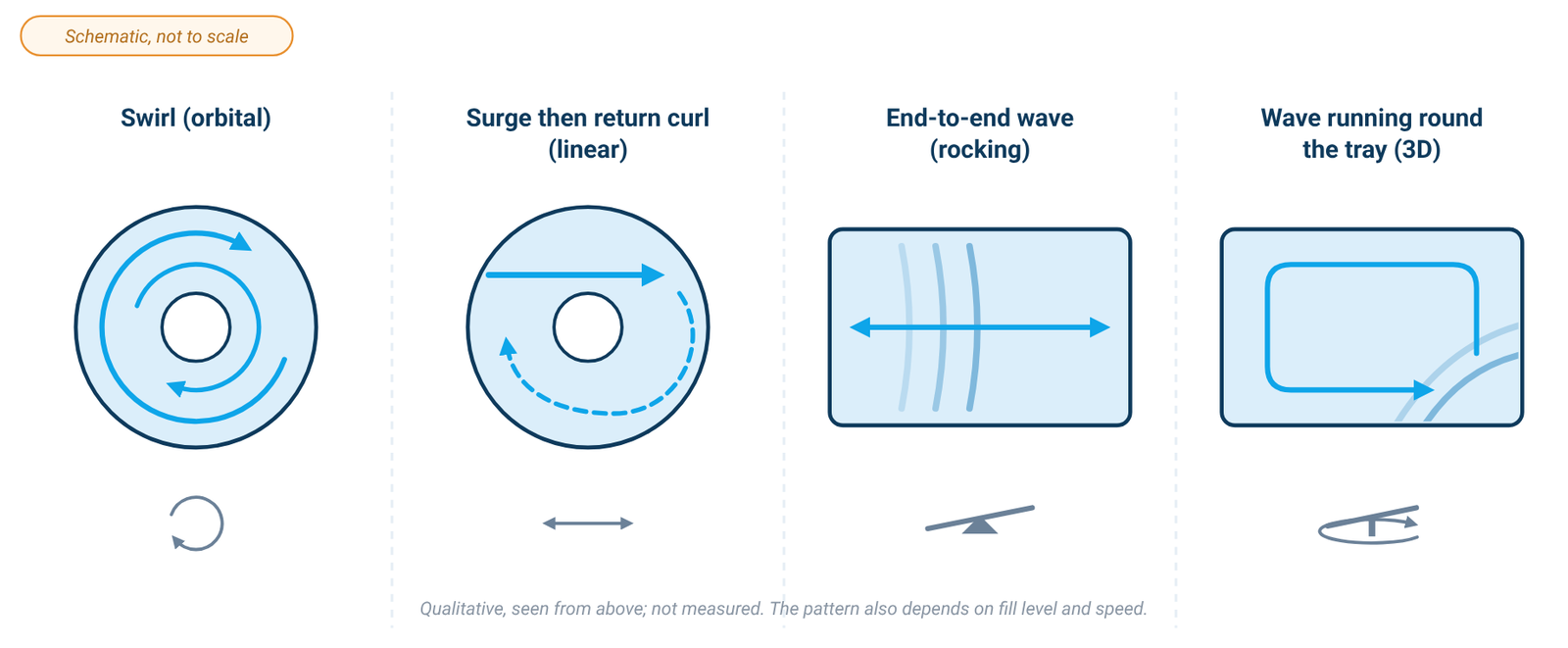
Orbital shaker vs rocking shaker is a common comparison when a gel needs staining or a blot needs washing. Both are gentle bench shakers, but they move in different ways. An orbital platform stays flat and travels round a small circle, so the liquid swirls round the vessel. A rocking platform tilts end to end like a see-saw, so the liquid runs from one end of the tray to the other and back. Two more motions complete the picture: linear (reciprocating) shakers push the platform straight back and forth, and 3D shakers hold the platform at a tilt that keeps turning. This guide explains how each motion moves liquid, how to read the label each type puts on its geometry (orbital diameter, amplitude or tilt angle), what "rpm" means on a rocking shaker, and which motion suits flasks, separatory funnels, gels and blots. The four ALab™ shaker series serve as worked examples, using only ACS Material's specified values. Everything here is written for research laboratory use. For the wider picture, see our guide to laboratory mixing methods.
Quick answer: Choose by motion first, then by vessel. Orbital shakers swirl liquid in flasks, beakers, dishes and trays. Rocking shakers send liquid end to end across flat trays at low speed. Linear (reciprocating) shakers push it back and forth, which is why they are linked with separatory funnels and extraction. 3D shakers move a slow wave round the whole tray. For gels and blots, laboratory protocols accept either a shaker or a rocker [1][2], so orbital vs rocking is a matter of tray, bench space and habit, not of right or wrong.
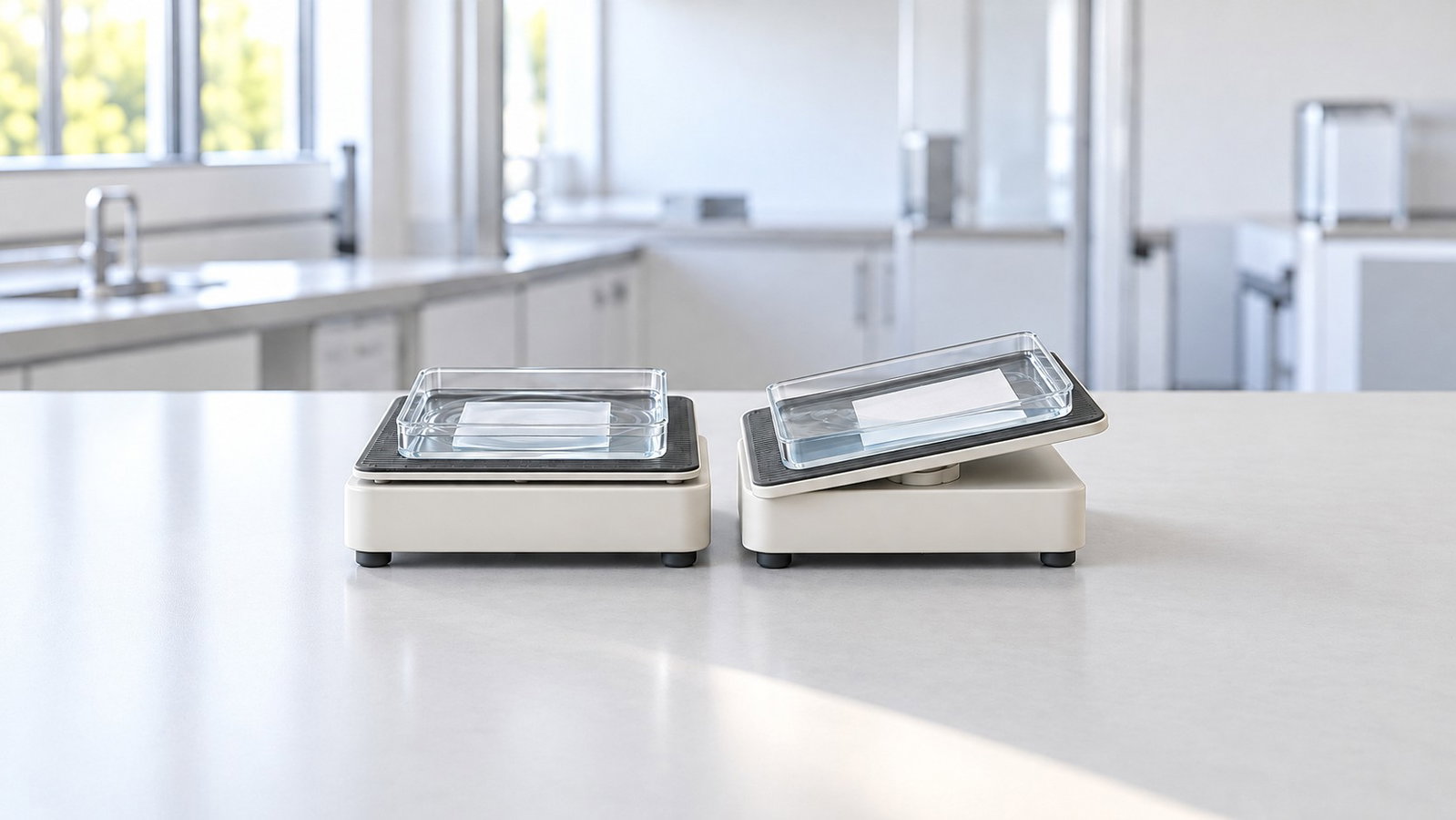
1. Orbital Shaker vs Rocking Shaker: The Short Answer
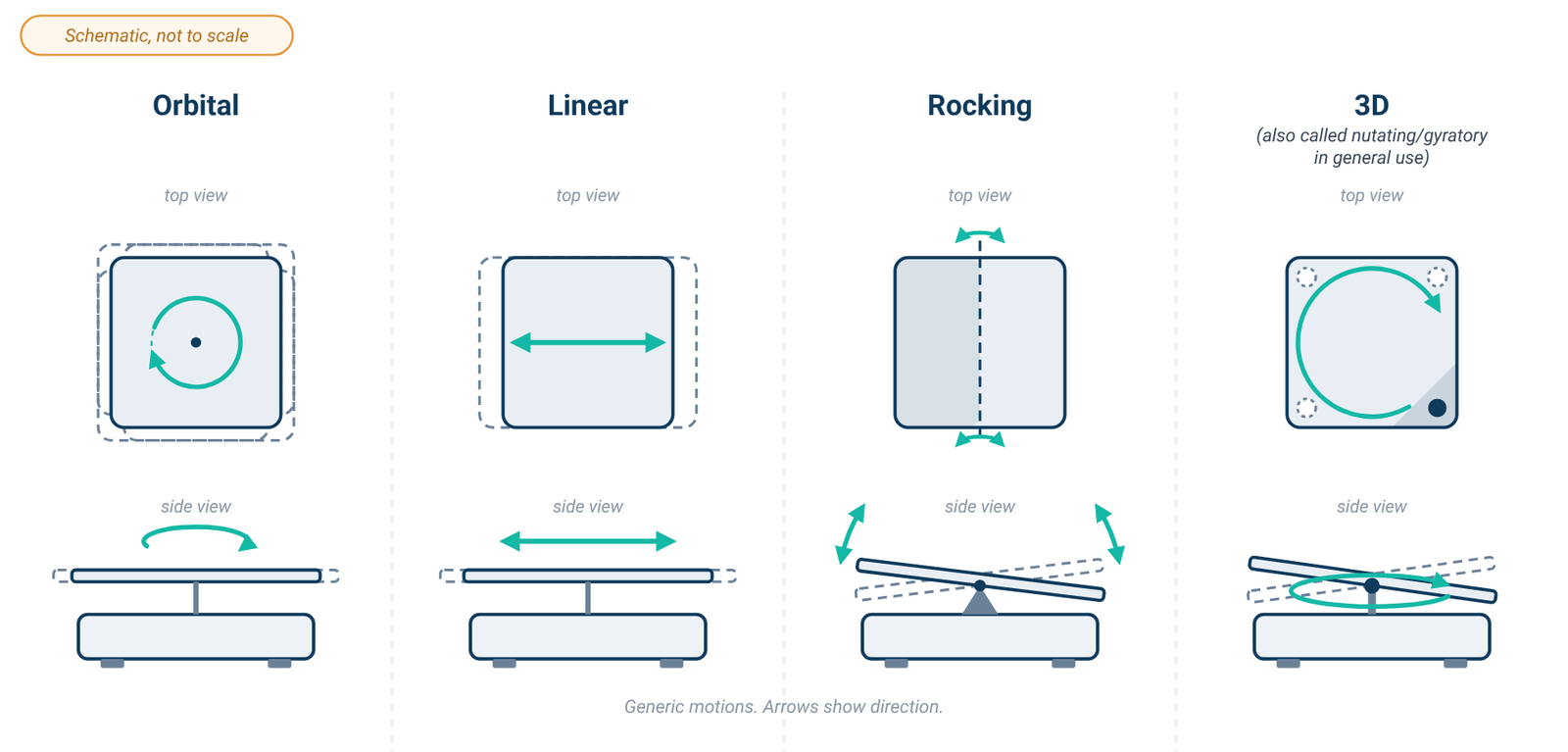
An orbital shaker keeps its platform level and moves it round a small circle. As one shaker manufacturer's application note puts it, "Orbital shakers rotate the platform in a circular motion" [3], and the liquid in a flask or tray follows as a steady swirl. The SK-O Series orbital shaker lists orbital motion and vessels including dishes, flasks, beakers, microplates and tubes.
A rocking shaker tilts its platform about a central axis instead. Rockers "move the platform either in a two or in a three-dimensional see-saw motion about the central point and usually run at low rpms" [3]. Liquid in a tray runs downhill to one end, then back again as the platform tips the other way. ACS Material says the SK-R Series rocking shaker "provides a rocking (see-saw) motion for time-dependent and low-rpm sensitive shaking".
| Orbital shaker | Rocking shaker | |
|---|---|---|
| Platform | stays level, travels round a small circle | tilts up and down about a central axis |
| Liquid path | swirl round the vessel | wave from end to end and back |
| Geometry label | Orbital diameter | Tilt angle |
| Speed figure | rpm (Section 3) | rpm, treated as motion cycles per minute (Section 3) |
| Uses named by ACS Material | flasks, beakers, dishes, tubes, microplates; staining and destaining | gels, Western blots, ELISA washes, hybridization |
For gels and blots, both motions are in everyday use. A Western blotting protocol from one antibody supplier blocks the membrane "with gentle mixing using an orbital shaker" [4]. A substrate manual from another says "Use a shaker or platform rocker when incubating the membrane." [1] A national laboratory SOP for Coomassie staining lists a "Shaker or rocker for agitation during incubations." [2] So the choice comes down to tray size, bench space and what your group is used to. Neither is the wrong tool for a stain or a wash.
2. Four Motions: Orbital, Linear, Rocking and 3D
Platform shakers share one basic idea: "A platform shaker has a table board that oscillates horizontally." [5] What differs is the path that board follows. One manufacturer's basic paper lists shakers "with an orbital (circular), circular vibrating (vortexing), reciprocating (back and forth), wave or rocking movement" [6]. For bench work with flasks, gels and blots, four motions matter:
- Orbital. A level platform travels round a circle. The SK-O motion is given simply as "Orbital".
- Linear (reciprocating). A level platform moves straight back and forth. The SK-L has linear reciprocating motion and lists dishes, flasks and beakers as vessels.
- Rocking. The platform tilts up on one side and down on the other, about a central axis. The SK-R motion is specified as "Rocking (see-saw)".
- 3D. The platform is held at a tilt whose direction keeps turning, so the low edge travels round the tray. The SK-D is described with "gentle three-dimensional shaking at a fixed tilt angle on an anti-slip silicone disc surface".
That last motion has a common general name. One general reference explains: "Nutating mixers are used in gentle three-dimensional (gyrating) agitation of chemical or biological scientific procedures by repetitively moving the vessels holding the liquids." [7] "Nutating mixer" is a generic term for this kind of tilted, gyrating motion [7], not an ALab™ product label. ACS Material describes the SK-D motion only as three-dimensional at a fixed tilt angle and does not use the term.
3. Reading the Label: Orbital Diameter, Amplitude, Tilt Angle and rpm
Each motion has its own geometry figure, and each series lists it under its own label. Keep the label with the number:
- Orbital diameter (SK-O). The width of the circle the platform travels. For the SK-O: "Orbital diameters are 4 mm (SK-O180-Pro), 10 mm (SK-O330-Pro, SK-O330-M) and 20 mm (SK-O180-S, SK-O180-C)."
- Amplitude (SK-L). The size of the back-and-forth movement. For the SK-L: "Amplitudes are 10 mm (SK-L330-Pro), 4 mm (SK-L180-Pro) and 20 mm (SK-L180-S)." It may describe full or half travel, so do not convert it into another figure.
- Tilt angle (SK-R, SK-D). How far the platform leans from level: a tilt angle of 9° or 7° on the two SK-R models and 9° or 10° on the two SK-D models.
Read the speed figure with the same care. On the rocking and 3D shakers, the specified "rpm" is treated as motion cycles per minute. The SK-R lists 10 to 70 rpm (SK-R330-Pro) and 10 to 80 rpm (SK-R1807-S). The SK-D figure is labelled "Rotational mixing speed adjustable from 10 to 70 rpm (SK-D3309-Pro) or 10 to 80 rpm (SK-D1810-S)." Because the motion differs by shaker type, compare speeds within a motion type only, never an orbital figure against a rocking one.
Every load figure for these series is labelled "Max. load capacity (with platform)", so keep that qualifier with the value. And the speed setting is not the whole story. In studies of orbitally shaken cylinders, the free surface moves from a smooth swirl to crested and then breaking waves as shaking speed rises, and which pattern appears depends on fill height and on the orbit relative to the vessel diameter [8]. The liquid can also fall "out-of-phase" with the moving table [9]. Those studies used larger vessels, so they should not be treated as direct evidence for every flask on a bench shaker. They show that liquid motion depends on more than the shaker's speed setting alone [8][9]. The same orbit vocabulary appears on vortex mixers, covered in our vortex mixer guide.
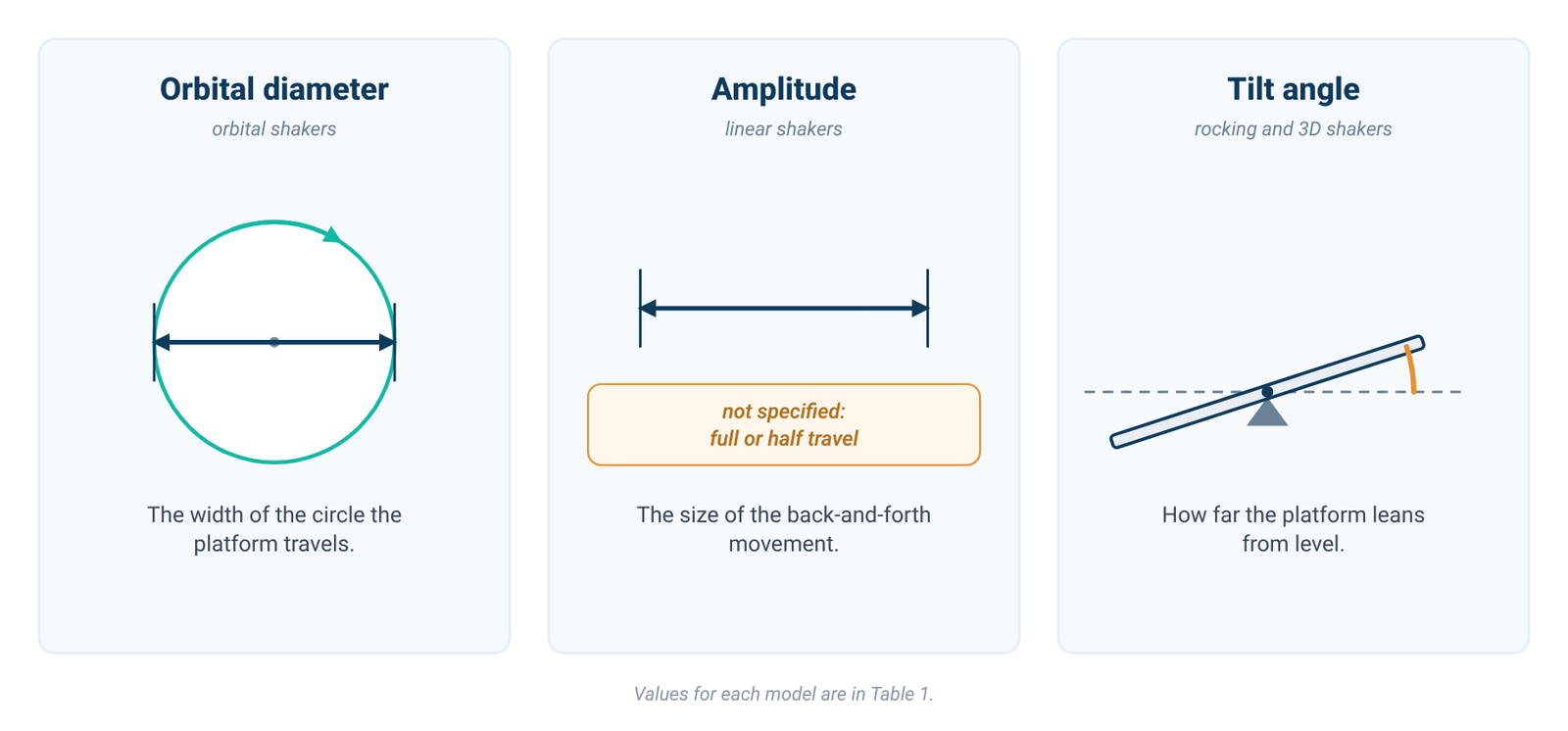
Table 1. The twelve ALab™ platform shaker models
| Model | Motion | Product type | Geometry (label: value) | Speed range | Max. load capacity (with platform) | Speed / timer display | Plate size (series overview) |
|---|---|---|---|---|---|---|---|
| SK-O330-Pro | Orbital | Multifunctional orbital decolorizing shaker | Orbital diameter: 10 mm | 100 to 500 rpm | 7.5 kg | LCD / LCD | 32 × 32 cm |
| SK-O180-Pro | Orbital | Multifunctional orbital decolorizing shaker | Orbital diameter: 4 mm | 100 to 800 rpm | 2.5 kg | LCD / LCD | 25 × 24.5 cm |
| SK-O330-M | Orbital | Orbital decolorizing shaker (multifunctional model, multiple plates optional) | Orbital diameter: 10 mm | 70 to 400 rpm | 3 kg | LCD / LCD | 33.5 × 33.5 cm |
| SK-O180-S | Orbital | Intelligent decolorizing shaker (basic model, fixed plate) | Orbital diameter: 20 mm | 40 to 200 rpm | 2 kg | LED / LED | 26.8 × 26.8 cm |
| SK-O180-C | Orbital | Remote controlled intelligent decolorizing shaker | Orbital diameter: 20 mm | 40 to 200 rpm | 2 kg | LED / LED | 26.8 × 26.8 cm |
| SK-R330-Pro | Rocking (see-saw) | Large multifunctional transference rocking shaker | Tilt angle: 9° | 10 to 70 rpm | 10 kg | LCD / LCD | 30 × 28.5 cm |
| SK-R1807-S | Rocking (see-saw) | Intelligent transference decolorizing shaker | Tilt angle: 7° | 10 to 80 rpm | 2 kg | LED / LED | 26.8 × 26.8 cm |
| SK-L330-Pro | Linear (reciprocating) | Large multifunctional linear decolorizing shaker | Amplitude: 10 mm | 100 to 350 rpm | 7.5 kg | LCD / LCD | 32 × 32 cm |
| SK-L180-Pro | Linear (reciprocating) | Multifunctional linear decolorizing shaker | Amplitude: 4 mm | 100 to 350 rpm | 2.5 kg | LCD / LCD | 25 × 24.5 cm |
| SK-L180-S | Linear (reciprocating) | Intelligent linear decolorizing shaker | Amplitude: 20 mm | 40 to 200 rpm | 2 kg | LED / LED | 26.8 × 26.8 cm |
| SK-D3309-Pro | Three-dimensional, fixed tilt angle | Large multifunctional 3D shaker | Tilt angle: 9° | 10 to 70 rpm | 5 kg | LCD / LCD | 30 × 28.5 cm |
| SK-D1810-S | Three-dimensional, fixed tilt angle | Intelligent 3D shaker | Tilt angle: 10° | 10 to 80 rpm | 2 kg | LED / LED | 26.8 × 26.8 cm |
Source: ACS Material product specifications (October 2026). A dash means the specification is not listed. Geometry labels differ by motion and are not converted. For the SK-R and SK-D models the specified rpm is treated as motion cycles per minute (see Section 3). Load is "Max. load capacity (with platform)". Plate size is taken from each series overview.
4. Orbital vs Reciprocating Shaker (Linear)
A linear, or reciprocating, shaker moves its platform straight back and forth, and the liquid does not settle straight into a swirl. "During reciprocating shaking, fluids movement starts with a surge and usually develops into a return curl before ending up in a swirl." [3] The same note adds that this flow "may get quite turbulent and easily inconsistent depending on fill level and speed" [3]. So check the fill level and speed for each vessel type.
Manufacturers' notes link reciprocating motion with extraction work. One calls it "suitable for different extraction applications" and notes that holding clamps for separatory funnels make the work easier [6]. Another lists "(de)staining of gels, washing blots, solubility studies or mixing of separatory flasks and funnels in chemical extractions" among its applications [3].
The SK-L Series linear shaker fits that pattern. Beyond flasks, beakers and dishes, it lists "optional attachments such as the lengthways roller for separation funnel extraction". The attachment tables also list that lengthways roller for the SK-O330-Pro, SK-O180-Pro, SK-R330-Pro and SK-D3309-Pro. Orbital motion is not wrong for extraction either: ACS Material names "extraction and washing procedures" for the SK-O among its uses.
Whatever the motion, follow the extraction procedure's venting instructions. "Pressure may build up inside the separatory funnel when solutions are mixed" [10]; the cited source explains venting for manual extraction, while shaker-specific handling should follow the applicable procedure and equipment instructions.
So, orbital vs reciprocating shaker: orbital for a steady swirl in flasks, beakers and dishes; reciprocating for funnels, extraction or any method that specifies back-and-forth shaking.
5. 3D Shaker vs Rocking Shaker
Both are slow, tilting platforms built for flat trays. The difference is the axis. A rocker tilts about one axis, so liquid runs end to end and back along one line. A 3D shaker keeps its tilt but turns its direction, so the wave travels round the tray instead of along it. That is a general description of the two motions; ACS Material describes the SK-D motion only as three-dimensional at a fixed tilt angle. One manufacturer's paper groups the two together: "The particularly gentle movement of 2D rocking and 3D wave shakers is used, among other things, for staining membranes after blotting processes." [6]
In the ALab™ range the two series sit close together. The SK-R models rock at a tilt angle of 9° (SK-R330-Pro) or 7° (SK-R1807-S). The SK-D Series 3D shaker models work at a fixed tilt angle of 9° (SK-D3309-Pro) or 10° (SK-D1810-S). Both series print the same speed ranges, 10 to 70 rpm and 10 to 80 rpm. The SK-D description names "gel staining and destaining" and "DNA extraction" among its uses, in flasks, petri dishes and tubes. The SK-R description names "ELISA washes, enzyme immunoassays, protein synthesis, hybridization, staining and destaining of gels, immune precipitation and Western blots".
Neither motion wins in general. A rocker provides end-to-end motion, while a 3D shaker provides three-dimensional motion at a fixed tilt. For gels and blots, choose according to the protocol, tray geometry and handling preference rather than ranking one motion over the other.
6. Matching the Motion to Flasks, Gels and Blots
Table 2. Which motion fits which task, by source
| Task | Orbital (SK-O) | Linear (SK-L) | Rocking (SK-R) | 3D (SK-D) |
|---|---|---|---|---|
| Flasks and beakers (mixing, dissolving) | ✓ (a) | ✓ (b) | — | ✓ (c) |
| Gel staining and destaining | ✓ (d, q) | ✓ (e) | ✓ (f, q) | ✓ (g) |
| Blot blocking, incubation and washes | ✓ (h) | ✓ (i) | ✓ (j) | ✓ (k) |
| Separatory funnels and extraction | ✓ (n); attachment listed (m) | ✓ (l) | attachment listed (m) | attachment listed (m) |
| Dishes and tubes | ✓ (a, o) | ✓ (b) | attachment listed (p) | ✓ (c) |
| Microplates | ✓ (a) | — | — | — |
✓ = a use or vessel named by ACS Material for that series, or a cited protocol or note for that motion; "attachment listed" = the series attachment list includes a suitable holder for that model family; "—" = not named (not a statement that it cannot be done). Nothing is ranked. Microplate wells: see Section 6. Sources: (a) SK-O: orbital motion; vessels include dishes, flasks, beakers, microplates and tubes; (b) SK-L: linear reciprocating motion; vessels include dishes, flasks and beakers; (c) SK-D: vessels include flasks, petri dishes and tubes; (d) SK-O: "hybridization, and staining and destaining"; (e) Reciprocating applications include "(de)staining of gels" [3]; (f) SK-R: "staining and destaining of gels"; (g) SK-D: "gel staining and destaining"; (h) Western blotting protocol: "with gentle mixing using an orbital shaker" [4]; (i) Application note on reciprocating shakers: "washing blots" [3]; (j) SK-R: "Western blots"; (k) Basic paper on platform shakers: "2D rocking and 3D wave shakers" [6]; (l) SK-L: "optional attachments such as the lengthways roller for separation funnel extraction"; (m) Attachment tables: "lengthways roller attachment For separation funnel extraction"; (n) SK-O: "extraction and washing procedures"; (o) SK-O: "from micro-centrifuge tubes through petri dishes and microplates to conical flasks"; (p) Attachment tables: "Silicone mattresses for 16 × 5 to 15 mL or 6 × 50 mL tubes"; (q) Coomassie staining SOP: "Shaker or rocker for agitation during incubations." [2].
Flasks and beakers (mixing, dissolving). The SK-O lists flasks and beakers and names "solubility studies" among its uses; the SK-L and SK-D also list flasks. The flask holders and clips on the attachment tables are listed by flask size and number. They tell you what fits, not what a given method needs.
Gels: staining and destaining. For the SK-R, SK-O and SK-D, ACS Material explicitly names staining or destaining work. For linear reciprocating shaking, the cited application note includes "(de)staining of gels" [3]. Several product types carry the word "decolorizing"; this article treats that as a product label, not as a separate chemical function of the shaker. Protocols accept a "Shaker or rocker" [2], so neither orbital nor rocking is the default. Follow the staining protocol's agitation and timing instructions: "Do not allow the gel to remain in destain for extremely long periods as it will eventually extract dye from the protein bands." [2]
Blots: blocking, antibody incubation and washes. The SK-R description names "Western blots" and "ELISA washes", and the SK-O description itself points to "rocking shakers for see-saw mixing of gels and blots." Orbital shaking is used as well [4]. A typical blocking step runs "with gentle agitation for 1 hr at room temperature." [11] All four series print a timer range of 1 min to 99 h 59 min.
Separatory funnels and extraction. Reciprocating motion plus the lengthways roller attachment (Section 4); follow the extraction procedure's venting instructions [10].
Dishes, tubes and microplates. The SK-O covers vessels "from micro-centrifuge tubes through petri dishes and microplates to conical flasks", and silicone tube mattresses appear in the attachment lists of each series' larger Pro model. Well mixing follows its own rules; dedicated plate shaking, as on the SH-P4 microplate shaker for up to 4 microplates or deep well plates, is covered in our guide to microplate mixing.
7. Speed, Timer, Load and Incubator Notes
Speed and load. Table 1 gives each model's speed range and load with platform. Match the model to your heaviest loaded platform, not just to the vessel.
Timer and modes. All four series print a time settings range of 1 min to 99 h 59 min. The SK-R lists "Continuous or timer" as the operation mode for both models. For the SK-O: "Continuous or timer operation on the SK-O330-Pro, SK-O180-Pro, SK-O330-M and SK-O180-S." The SK-L and SK-D list the timer range without an operating mode, as does the SK-O180-C, so this article claims no mode for them.
Motor, display and data. The SK-O and SK-L list a "Brushless DC motor (all models)"; the SK-R and SK-D list a "DC motor (both models)". The Pro models and the SK-O330-M have LCD speed and timer displays; the S models and the SK-O180-C have LED displays. The SK-O330-Pro, SK-O180-Pro, SK-L330-Pro and SK-L180-Pro have an RS232 data connector; the SK-O also lists "free software for PC control and data logging".
Incubators and environmental chambers. These statements are made model by model, so check the model, not the series. For the SK-O: "The SK-O330-Pro and SK-O180-Pro are listed for use in environmental chambers and CO₂ incubators". The SK-L330-Pro and SK-L180-Pro are covered by ACS Material's SK-L statement on environmental chambers and CO₂ incubators. For the 3D series, for the SK-D, ACS Material says "Both models are incubator compatible, rated for 5 to 40°C ambient and 80% RH." No such statement is made for the other models, so none is made here. Either way, check the chamber against the specified "Permissible ambient temperature and humidity" first.
8. Choosing Among the Four Series
Pick the motion first, then the vessel, then the platform size:
- A steady swirl for flasks, beakers, dishes and general mixing: the SK-O Series orbital shaker, with five models and an orbital diameter of 4, 10 or 20 mm.
- A see-saw wash for gels and blots at low speed: the SK-R Series rocking shaker, with a wide range of platforms on the SK-R330-Pro and a fixed work plate on the SK-R1807-S.
- Back-and-forth shaking for funnels and extraction: the SK-L series.
- A gentle three-dimensional wave across trays: the SK-D series.
Then check size. The 330-size models have the larger plates (32 × 32 cm, 33.5 × 33.5 cm or 30 × 28.5 cm), the 180-size models the smaller ones (25 × 24.5 cm or 26.8 × 26.8 cm). Compare the plate size and the load with platform in Table 1 against your trays and flasks. This is not a ranking.
9. Frequently Asked Questions
Can I use an orbital shaker for gels or Western blots?
Yes. Laboratory protocols use "an orbital shaker" for blocking [4] and accept "a shaker or platform rocker" for membrane incubation [1], and a Coomassie SOP accepts either for staining [2]. Orbital or rocking is a preference, not a rule.
What does rpm mean on a rocking or 3D shaker?
For the rocking and 3D shakers in this article, treat the specified rpm as motion cycles per minute. Compare speed figures only within the same motion type.
Orbital or reciprocating for separatory funnels?
Reciprocating motion is the type usually linked with funnel extraction [6][3], and the lengthways roller attachment holds the funnels. The attachment is also listed for orbital, rocking and 3D models. Follow the extraction procedure's venting instructions [10].
What is a nutating mixer, and is a 3D shaker the same thing?
"Nutating mixer" is a general name for instruments with a gentle, tilted, gyrating motion [7]. Many 3D shakers move this way, but it is a description of the motion, not a product category; check how ACS Material describes each product's motion.
Can a shaker go inside an incubator?
Only where ACS Material says so for that model. Among these series, that is the SK-O330-Pro and SK-O180-Pro, the SK-L330-Pro and SK-L180-Pro, and both SK-D models (Section 7).
Can these shakers hold microplates?
The SK-O lists microplates among its vessels. For mixing inside the wells themselves, see our microplate mixing guide.
Choosing a shaker? See the SK-O Series orbital shaker for orbital mixing of flasks, beakers, dishes and trays, or the SK-R Series rocking shaker for see-saw rocking of gels and blots.
10. Keep Exploring the Mixing Hub
- Laboratory mixing methods guide: every mixing method compared.
- How a vortex mixer works: orbit, speed and modes on a vortex head.
- Microplate shakers and mixing in wells: why plates need their own rules.
- Tube roller vs tube rotator: gentle rolling and end-over-end mixing for tubes.