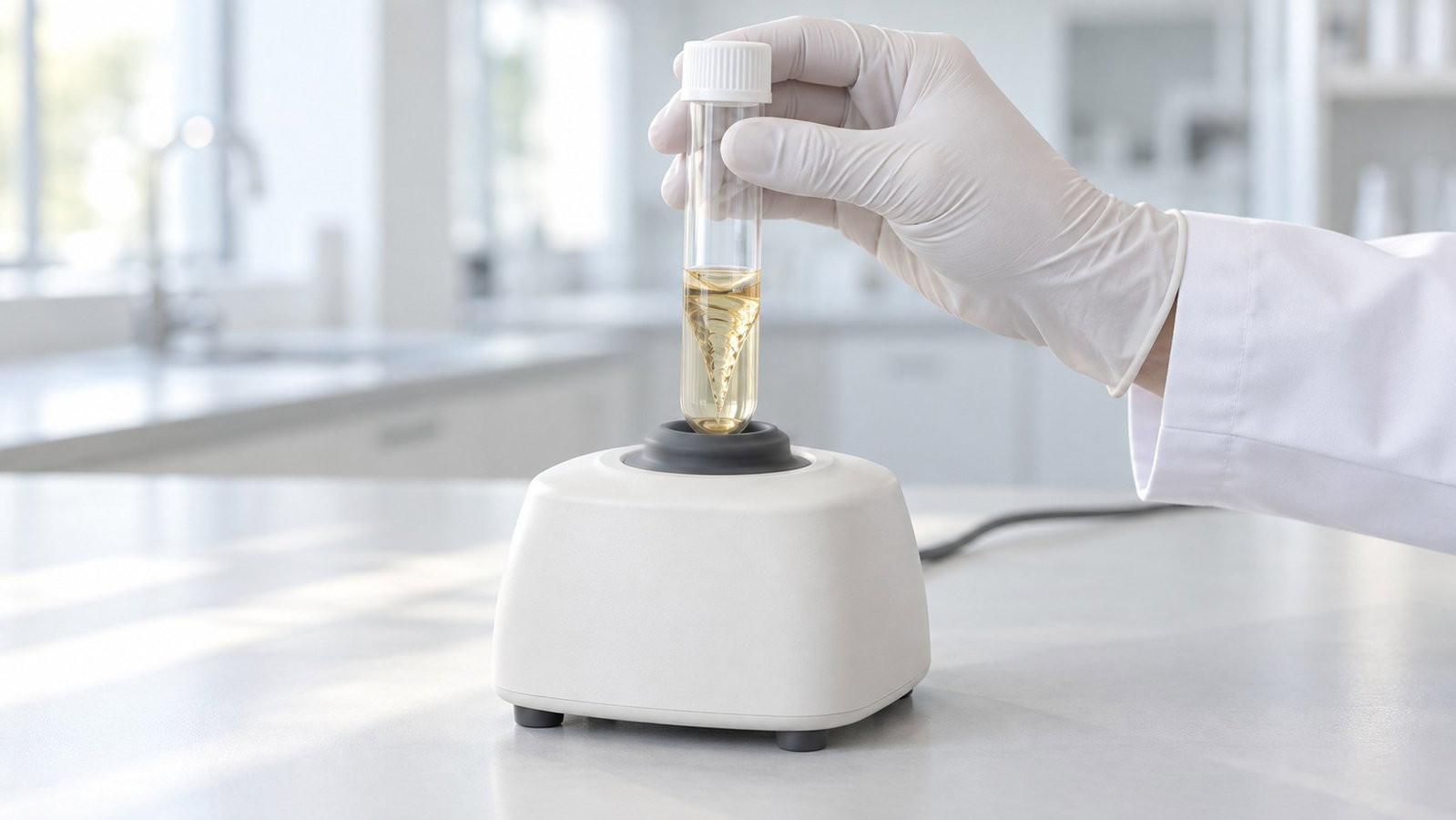
How does a vortex mixer work? A small motor drives an off-centre (eccentric) head around a tight circle only a few millimetres across. Press the bottom of a capped tube onto the head and the base of the tube follows that circle while your fingers hold the top, so the liquid inside swirls and climbs the wall as a vortex. What changes from one vortex mixer to the next is how the circle is labelled, how fast the head turns, how a run starts and stops, and what can be fitted on top. This guide explains those labels (orbit, speed, and touch, infrared and continuous modes) using the eight ALab™ vortex mixer series as worked examples, including a static table that turns speed and orbit into a nominal head acceleration. It ends with vortexing technique and the cases where you should not vortex at all. All of it is written for research laboratory use. For the wider picture, see our guide to laboratory mixing methods.
Quick answer: A vortex mixer turns motor rotation into a small orbit of its cup or platform. A tube pressed onto the cup is driven at its base and held at its top, so it gyrates and the liquid forms a vortex [1]. Speed and orbit size describe how the head moves; the operating mode (touch, continuous or, on one model, infrared tube detection) decides how a run starts and stops. Keep tubes capped, use the lowest speed that mixes, and do not vortex samples that must not be sheared or that could release hazardous aerosols [2][3].
1. How Does a Vortex Mixer Work?
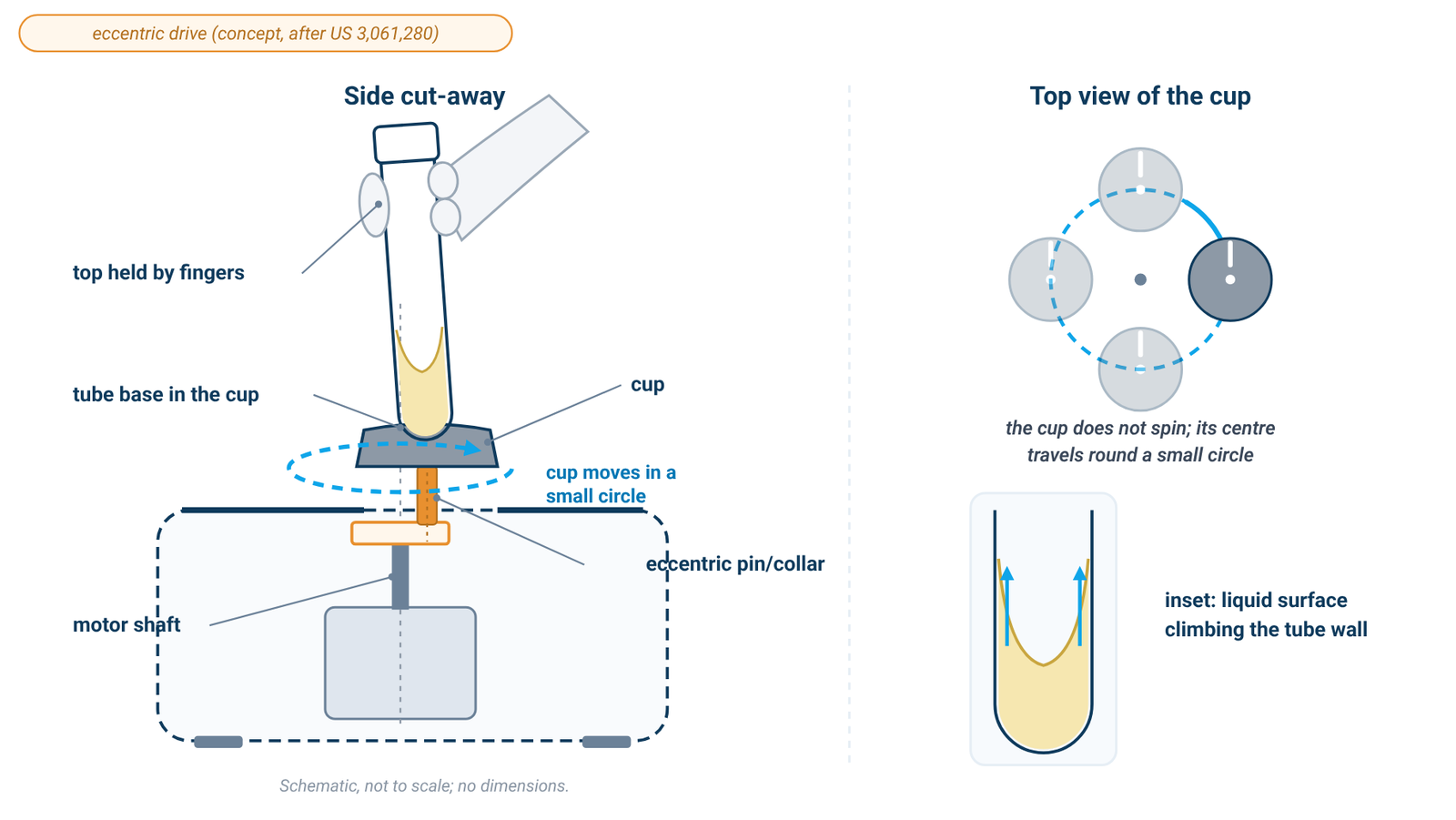
The basic design goes back to a patent filed in 1959 by Jack and Harold Kraft [1]. Their motor has a vertical shaft carrying a collar that "is eccentrically secured", and the cup on top of it is kept from spinning on its own axis. When the motor runs, the mechanism will "drive the lower end of the test tube eccentrically about the motor drive shaft at a relatively high rate of speed and through a relatively small radius of rotation" [1]. The top of the tube is held in place, in the patent by a clamp that works as "a yieldable universal coupling" and on a modern bench mixer usually by your fingers.
So the cup does not spin; its centre travels round a small circle. The tube rocks in a narrow cone, its base pushed round faster than the liquid can settle, and the liquid is thrown against the wall. Its surface dips in the middle and rises up the sides: that funnel is the vortex. ACS Material describes the same idea in one line. For the MX-F fixed speed vortex mixer, ACS Material says: "Vortex mixers are ideal for mixing liquid components in tubes and for the resuspension of cells, using an eccentric mechanism."
What the liquid does next depends on the tube and on how full it is. In studies of orbitally shaken cylinders, the free surface moves from a smooth swirl to single and multiple crested waves and then to breaking waves as the shaking speed rises; which pattern appears depends on fill height and on the orbit relative to the vessel diameter [4]. The liquid can also fall out of step with the drive. In orbitally shaken bioreactors an "out-of-phase" condition was described in which the liquid "did not move in synchronization with the shaker table" [5]. Those studies used larger vessels on shaker tables, not tubes on a vortex cup, so they should not be treated as direct evidence for tube vortexing. They do show why motor speed alone does not fully describe liquid motion: vessel geometry, fill level and the imposed orbit also matter [4][5].
2. Orbit Diameter, Revolving Diameter, Amplitude: Reading the Label
Every ALab™ vortex mixer lists the size of the head's circle, but not under the same name. The MX-S, MX-F, VM25 and VM25D use "Orbital diameter". The MX-E and MX-Mini use "Revolving diameter". The MX-S+ and MX-Pro use "Amplitude", and the MVM25 uses "Amplitude of oscillation".
A diameter is the full width of the circle traced by the centre of the head; the radius is half of it. Where "Amplitude" or "Amplitude of oscillation" is used, how that value is measured is not defined. This article therefore keeps each model's own label and number and does not turn an amplitude into a diameter or a radius.
The orbit matters because it sets how far the base of the tube travels on each turn. At a given speed, a larger circle moves the head further and faster; at a given circle, a higher speed does the same. Neither number tells you on its own how a particular sample will behave, which is why Section 4 treats the combination as a description of the head, not of the sample.
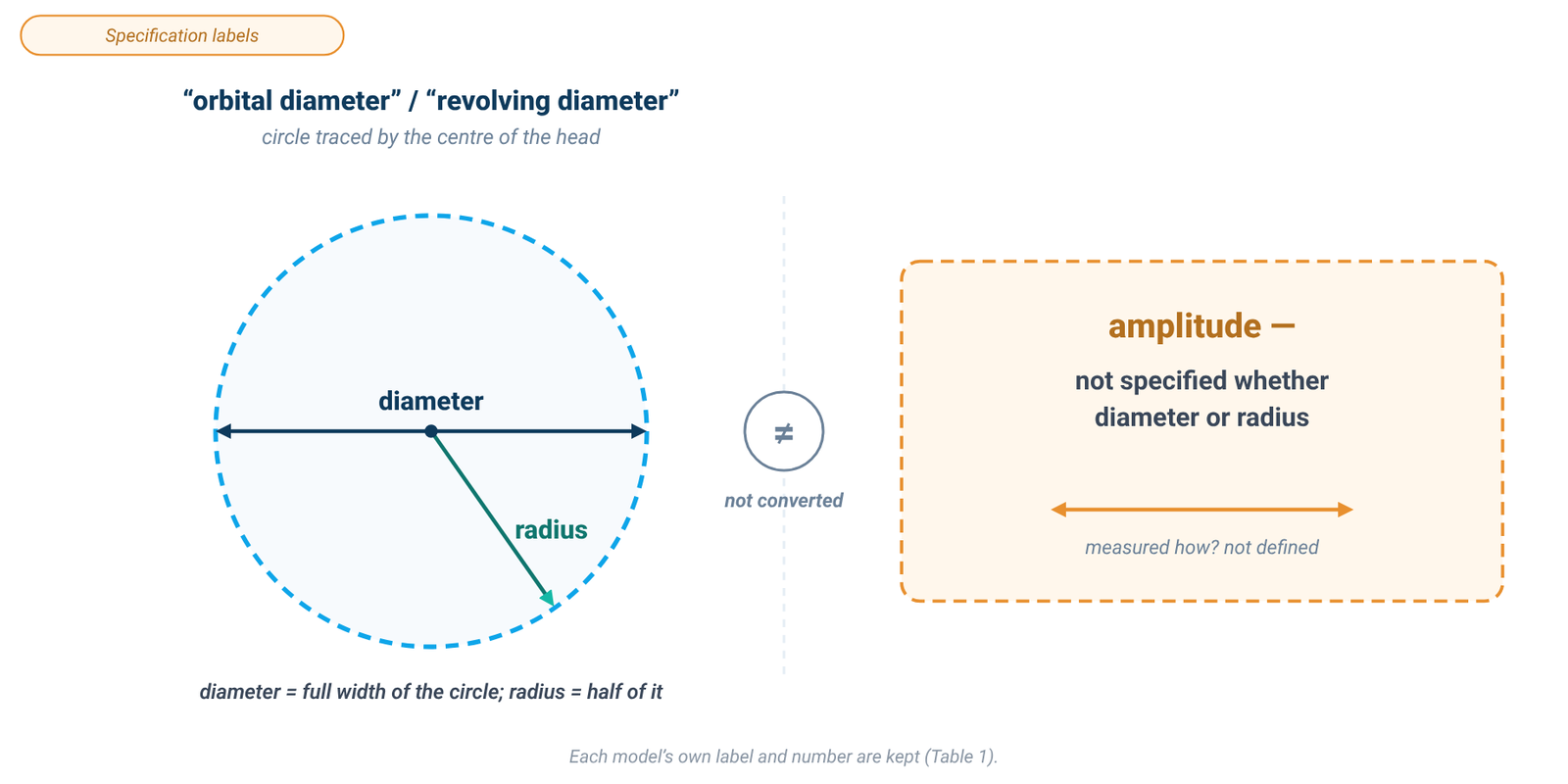
Table 1. Eight ALab™ vortex mixer series (nine models)
| Model | Product type | Speed | Speed display | Orbit label: value | Operation mode | Timer |
|---|---|---|---|---|---|---|
| MX-S | Variable speed vortex mixer | 0–3000 rpm | Scale | Orbital diameter: 4 mm | Touch operation / Continuous | — |
| MX-Pro | Infrared digital vortex mixer | 100–3000 rpm | LCD | Amplitude: 4.5 mm | IR, Continuous | 1 s – 99 min 59 s |
| MX-F | Fixed speed vortex mixer | 3000 rpm | — | Orbital diameter: 4 mm | Touch operation / Continuous | — |
| MX-E | Economic vortex mixer | 3000 rpm | — | Revolving diameter: 4.8 mm | Touch operation | — |
| MX-Mini | Mini vortex mixer (compact fixed speed mixer) | 3000 rpm (fixed) | — | Revolving diameter: 4.8 mm | Inching | — |
| MX-S+ | Digital vortex mixer | 100–3000 rpm | LCD | Amplitude: 4 mm | Touch, Continuous | 1 s – 99 min 59 s |
| MVM25 | Multi-tube vortex mixer | 500–2500 rpm | — | Amplitude of oscillation: 4 mm | Inching/Continuous mode | 1 s–9999 min |
| VM25 | Vortex mixer | 2800 rpm | — | Orbital diameter: 4 mm | Continuous | — |
| VM25D | Vortex mixer | Low range: 1300 rpm High range: 2800 rpm | — | Orbital diameter: 4 mm | Continuous | — |
Source: ACS Material product specifications (October 2026). A dash means the specification is not listed. VM25 and VM25D share one specification. Orbit labels differ by model and are not converted.
3. Vortex Mixer Speed: Fixed, Variable or Two Ranges
Fixed speed. Four of the models run at one speed. The MX-F and MX-E run at 3000 rpm, the MX-Mini lists "3000 rpm (fixed)", and the VM25 runs at 2800 rpm. With a fixed-speed mixer, shorter contact limits run time; if a lower rotational speed is required, use a model or method that provides it.
Variable speed. The MX-S variable speed vortex mixer covers 0–3000 rpm. Its speed display is a "Scale", so the dial shows a position rather than an rpm readout, and ACS Material adds: "Electronic speed control maintains constant speed even during changes in load". The MX-S+ and MX-Pro cover 100–3000 rpm with an LCD; the MX-S+ has an LCD that "displays real-time speed and time for easy adjustment and monitoring." The MVM25 covers 500–2500 rpm, with a precision cell of ±1 rpm.
Two speed ranges. The VM25D is not continuously variable. It has two settings, "Low range: 1300 rpm" and "High range: 2800 rpm". Treat it as a mixer with two fixed speeds.
Speed limits that come from the accessory
The instrument's range is not always the range you may use. The flask attachments for the MX-S, MX-S+ and MX-Pro are each listed with an operating speed of "0~1500 rpm", well below the top speed of the instrument. For the MX-S, ACS Material is explicit: "never exceed the rated speed of the instrument or of the fitted accessory, and follow your laboratory's safety procedures for vortex mixer operation." The working limit is whichever of the two is lower. Within that limit, a biosafety sheet gives the practical rule: use the "lowest speed necessary to mix the sample" [2].
4. Speed × Orbit: The Nominal Head Acceleration
Speed and orbit can be combined into one number: the acceleration of the centre of the head as it travels round its circle. Table 2 calculates it for every model with both a specified speed and an orbit diameter. The formula is:
a = (2π × rpm / 60)² × (orbit diameter ÷ 2); value in g = a ÷ 9.81 m/s²
Worked example (MX-F). The MX-F lists 3000 rpm and an orbital diameter of 4 mm. The angular speed is 2π × 3000 / 60 ≈ 314 rad/s. The radius is half the diameter, 2 mm or 0.002 m. The acceleration is 314² × 0.002 ≈ 197 m/s², and 197 ÷ 9.81 ≈ 20 g.
The same ratio of acceleration to gravity appears in studies of orbitally shaken vessels as a Froude number, written Fr = 2π²N²d/g, with N the shaking frequency in revolutions per second and d the orbital diameter [5]. It is a way to compare motions, not a prediction of mixing time or of what happens to a sample.
Table 2. Nominal head acceleration from the specified speed and orbit (calculated in this article; not a specification)
| Model | Speed | Orbit | Nominal head acceleration at rated speed (calculated) |
|---|---|---|---|
| MX-S | 3000 rpm (top of 0–3000 rpm) | Orbital diameter 4 mm | ≈ 20 g |
| MX-F | 3000 rpm | Orbital diameter 4 mm | ≈ 20 g |
| MX-E | 3000 rpm | Revolving diameter 4.8 mm | ≈ 24 g |
| MX-Mini | 3000 rpm (fixed) | Revolving diameter 4.8 mm | ≈ 24 g |
| VM25 | 2800 rpm | Orbital diameter 4 mm | ≈ 18 g |
| VM25D | Low range 1300 rpm / High range 2800 rpm | Orbital diameter 4 mm | ≈ 3.8 g / ≈ 18 g |
| MX-S+ | 100–3000 rpm | Amplitude 4 mm | — (specified value only) |
| MX-Pro | 100–3000 rpm | Amplitude 4.5 mm | — (specified value only) |
| MVM25 | 500–2500 rpm | Amplitude of oscillation 4 mm | — (specified value only) |
Calculated from each model's specified speed and orbit; not a specification. It is the acceleration of the mixing head: a tube held at the top does not follow it as a rigid body, speed under load can be lower than rated, and the figure is not comparable with a centrifuge's RCF.
What the table is not.
- Not a specification. No ALab™ vortex mixer lists an acceleration; every acceleration value is calculated here from two specified values.
- Not a centrifuge figure. A centrifuge holds a sample at a fixed radius under a steady force, while the vortex head moves a tube base round a small circle, so the two numbers are not comparable and should not be read against a centrifuge's RCF.
- Not a ranking. The models differ only because the specified speeds and orbits differ. A larger figure does not mean a model mixes better, and the acceleration must not be used to choose between models.
- Not for amplitude models. The MX-S+, MX-Pro and MVM25 list an amplitude, which may be a radius or a full throw, so those models show the specified value only.
- Top speed only for the MX-S. Its display is a scale, so the table uses the top of its range and gives no figures for intermediate dial positions.
5. Touch, Infrared and Continuous Modes
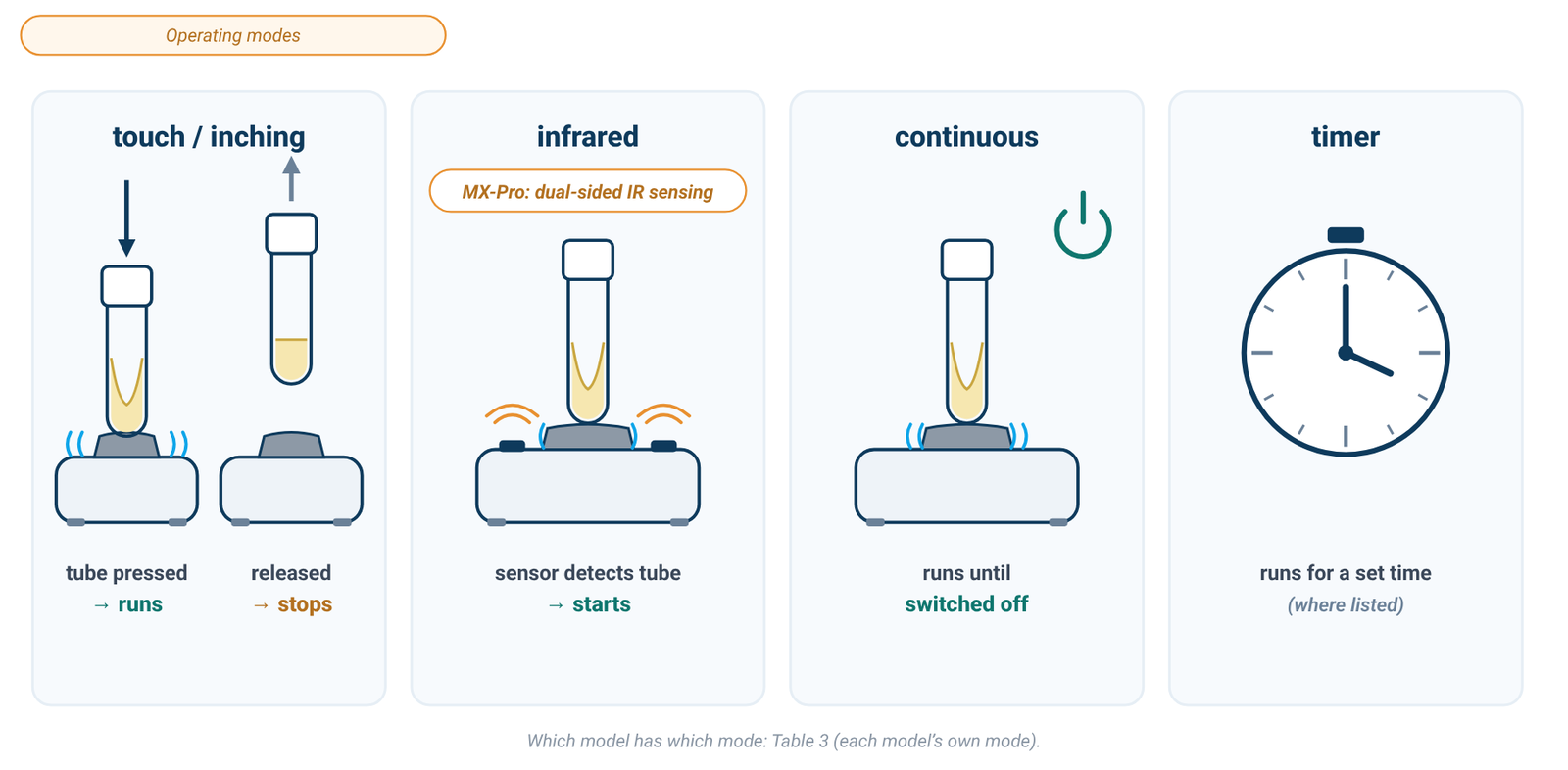
The operating mode decides how a run starts and stops, and it is where vortex mixers differ most.
Touch. In touch mode the motor runs only while a tube presses on the cup. One widely used manufacturer's manual describes it this way: touching a vessel to the cup starts the mixer, and "Releasing the pressure on the Platform or Cup will stop the mixer" [6]. Touch mode suits quick, one-tube mixing: press, count, release. The MX-Mini mode is labelled "Inching" in its specifications, while its features say: "Touch operation runs it at a fixed speed of 3000 rpm for rapid mixing of samples". This article calls it touch (inching) operation.
Continuous. In continuous mode the head runs until you switch it off or a timer ends, so your hands are free. The same manual says this mode "allows for unattended operation" and is the one to use with accessory attachments [6]. For the MX-S, the accessory application list explicitly separates "Touch mode (High speed area)" from "Continuous mode (Low speed area)" for different accessory combinations. Its standard single-tube top is marked for both modes, tube adapters on a holding rod for touch mode, and adapters on the universal top plate for continuous mode.
Infrared. One model adds a third way to start a run. According to the MX-Pro infrared digital vortex mixer description, "IR mode uses dual-sided IR sensing for automatic tube detection and mixing; Continuous mode provides continuous operation." In other words, the MX-Pro has a mode in which the mixer detects a tube and starts mixing without the cup being pressed. No sensing distance or response time is specified. The MX-Pro operation mode lists IR and Continuous and does not list a touch mode.
Timers. Three models list a timer. The MX-S+ and MX-Pro list a time range of 1 s – 99 min 59 s, and the MVM25 a timing range of 1 s–9999 min. No timer is listed for the other models.
Table 3 gives each model's own mode specification. A few points are easy to get wrong. The MX-E economic vortex mixer lists touch operation only, at a fixed 3000 rpm. The MX-Mini mini vortex mixer lists touch (inching) operation only. Neither the MX-E nor the MX-Mini lists a continuous mode. The MX-S+ digital vortex mixer pairs touch and continuous modes with its LCD timer. The VM25 and VM25D list continuous only, with no touch mode.
Table 3. Operating modes of each model
| Model | Mode specification (label: value) | Description |
|---|---|---|
| MX-S | Run type: Touch operation / Continuous | "offers Touch or Continuous operation mode" |
| MX-Pro | Operating Modes: IR, Continuous | "IR mode uses dual-sided IR sensing for automatic tube detection and mixing; Continuous mode provides continuous operation." |
| MX-F | Run type: Touch operation / Continuous | "offers two run types: Touch operation and Continuous" |
| MX-E | Operating mode: Touch operation | "Touch operation runs it at a fixed speed of 3000 rpm" |
| MX-Mini | Operating mode: Inching | "Touch operation runs it at a fixed speed of 3000 rpm for rapid mixing of samples" |
| MX-S+ | Operating Modes: Touch, Continuous | "Two operating modes, Touch and Continuous, with the time range of 1 s – 99 min 59 s shown on the LCD." |
| MVM25 | Operating mode: Inching/Continuous mode | "The MVM25 has built-in timing, continuous and touch operating modes" |
| VM25 / VM25D | Run type: Continuous | — (specification only) |
Source: ACS Material product specifications (October 2026). Where a model's mode specification and its description use different words (MX-Mini, MVM25), both are shown; this article describes only the modes in each model's own specification.
6. Tops, Adapters and Speed Limits
What sits on the head decides what you can mix and how fast. The MX-S standard top is "for mixing a single test tube or other small vessel up to 30 mm in diameter". The MX-S+ and MX-Pro come with a flat rubber sleeve as standard. Beyond that, ACS Material lists universal top plates with tube adapters that hold several tubes at once (for example 1.5–2 mL, 5 mL, 15 mL and 50 mL tubes), PCR tube adapters, an ampule/tube attachment for four vessels of 0.2–15 mL, and Erlenmeyer flask attachments for 100–250 mL flasks with their own 0~1500 rpm limit (Section 3). For the MX-S+, ACS Material notes that "Pressure-mounted accessories prevent slippage and splashing".
Microplate clamps are listed for the MX-S, MX-S+ and MX-Pro. On the VM25 & VM25D vortex mixer, the VM25 adapter is specified as "Platform shaker" and the VM25D adapter as "Platform shaker/Microplate clamp". Mixing in plate wells follows different rules from mixing in tubes; it is covered in our guide to microplate mixing.
Two habits help here. Fit accessories firmly before starting, and check the accessory's own speed limit, not just the instrument's.
7. Many Tubes at Once: Multi-Tube Vortexing
When a protocol calls for the same short mix on dozens of tubes, a multi-tube vortex mixer saves time. The MVM25 multi-tube vortex mixer is described as "For vortex mixing of tubes of different specifications, with up to 50 samples processed at the same time." Its foam clamps hold 50 tubes of φ10, φ12, φ13 or φ16 mm, 15 tubes of φ25 or φ29 mm, or 10 tubes of φ38 mm, and an acrylic clamp holds 40 tubes of 1.5/2.0 mL. It lists "Maximum loading capacity: 5 kg", a speed range of 500–2500 rpm, an amplitude of oscillation of 4 mm and a timing range.
A loaded rack is not the same configuration as a single tube pressed on a cup. Treat multi-tube vortexing as batch convenience, not as evidence that its mixing intensity is equivalent to single-tube vortexing.
8. Vortexing Technique and When Not to Vortex
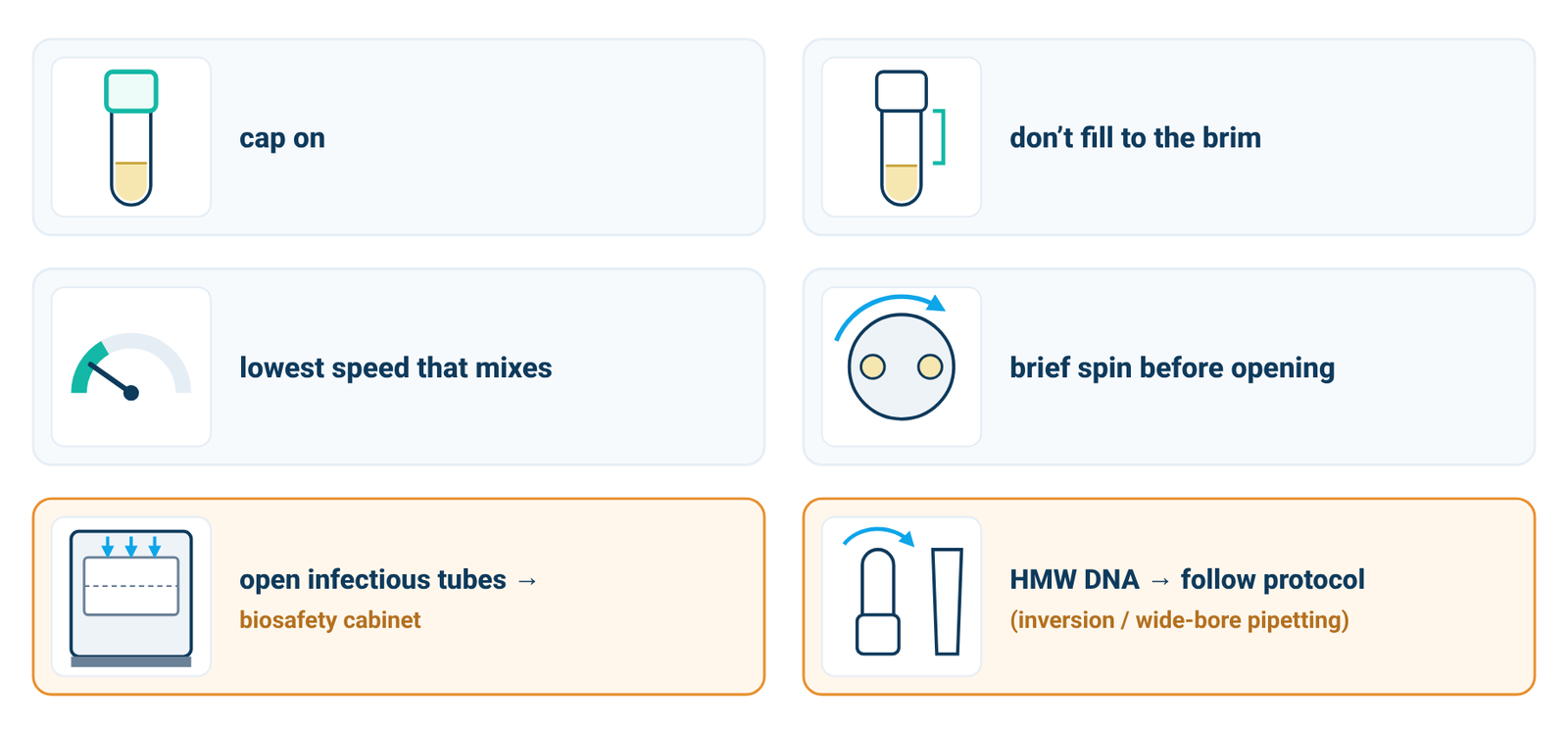
Good vortexing technique is mostly about the liquid's surface. As one biosafety sheet puts it, "The rapid swirling motion during vortex disrupts the liquid's surface, which is the primary point of aerosol creation." [2] The rules that follow are simple:
- Cap the tube. "Perform vortexing with sealed tubes or bottles whenever possible." [2]
- Leave headspace. "Do not fill vessels to the brim, as this increases the chance of splashing and aerosol generation." [2]
- Use the lowest speed that mixes [2], and avoid "over-vigorous mixing" [7].
- Spin down before opening. "Brief centrifuging of mixed tubes before opening can help move any liquid away from the cap." [7]
- Contain infectious work. Guidance for infectious specimens places procedures that can generate aerosols, such as "vortexing or sonication of specimens in an open tube", in a Class II biological safety cabinet [8].
When not to vortex. Long DNA is the classic case. A protocol for high-molecular-weight genomic DNA mixes its lysate by inverting the tube or pipetting with a wide-bore tip, and warns: "Short vortexing can be performed but could lead to DNA shearing." [3] For high-molecular-weight DNA, follow the protocol's gentler handling steps, such as inversion or wide-bore pipetting [3]. ACS Material lists cell resuspension as a use for the MX-F, but it does not establish suitability for every cell type; follow the protocol for the specific sample. For slow end-over-end mixing, see our tube roller vs tube rotator guide.
9. Choosing a Vortex Mixer by Need
Choose by how you work, not by a single number:
- One speed, touch or continuous: the MX-F at 3000 rpm.
- One speed in a compact unit, touch only: the MX-E or the MX-Mini.
- Variable speed with touch and continuous modes: the MX-S, with a scale dial.
- A digital readout and a timer: the MX-S+ (touch and continuous).
- Starting a run without pressing the cup: the MX-Pro, which has infrared tube detection, plus continuous mode and a timer.
- Two set speeds and a microplate clamp adapter: the VM25D; for a single 2800 rpm setting, the VM25.
- Batches of tubes: the MVM25.
Whatever you choose, check the accessory list and its speed limits against your tubes, flasks or plates before you buy.
10. Frequently Asked Questions
What is a vortex mixer used for?
Short, fast mixing of small volumes in tubes. The MX-F description names "mixing liquid components in tubes" and "the resuspension of cells", and the VM25 & VM25D description lists "liquid-liquid, liquid-solid, and solid-solid (powder) mixing".
What speed should I vortex at?
The lowest speed that mixes the sample [2], and never above the rated speed of the instrument or of the fitted accessory. Flask attachments for the MX-S, MX-S+ and MX-Pro are limited to 0~1500 rpm.
What is the difference between touch and continuous mode?
Touch mode runs only while a tube presses on the cup; continuous mode runs until switched off or until the timer ends [6]. Check each model's own operation mode (Table 3).
How many g does a vortex mixer produce? Is it like a centrifuge?
Table 2 gives a calculated nominal head acceleration for the models with a specified speed and orbit diameter. It describes the head, not the tube or the sample, it is not a specification, and it cannot be compared with a centrifuge.
Can I vortex DNA or cells?
It depends on the sample. High-molecular-weight DNA can shear during vortexing [3], so follow a gentler protocol such as inversion or wide-bore pipetting. ACS Material lists cell resuspension as a use for the MX-F, but suitability for a particular cell type should come from the sample protocol.
Can a vortex mixer mix microplates?
Some can, with a microplate clamp: the MX-S, MX-S+ and MX-Pro list clamps, and the VM25D adapter includes one. Well mixing has its own rules, covered in our microplate mixing guide.
Choosing a vortex mixer? See the MX-S variable speed vortex mixer for touch and continuous mixing across 0–3000 rpm, or the MX-Pro infrared digital vortex mixer for infrared tube detection, continuous mode and a timer.
11. Keep Exploring the Mixing Hub
- Laboratory mixing methods guide: every mixing method compared.
- Orbital vs linear vs rocking shakers: the same orbit vocabulary on a platform.
- Microplate shakers and mixing in wells: why plates need different rules.
- Tube roller vs tube rotator: gentle mixing for samples you should not vortex.