
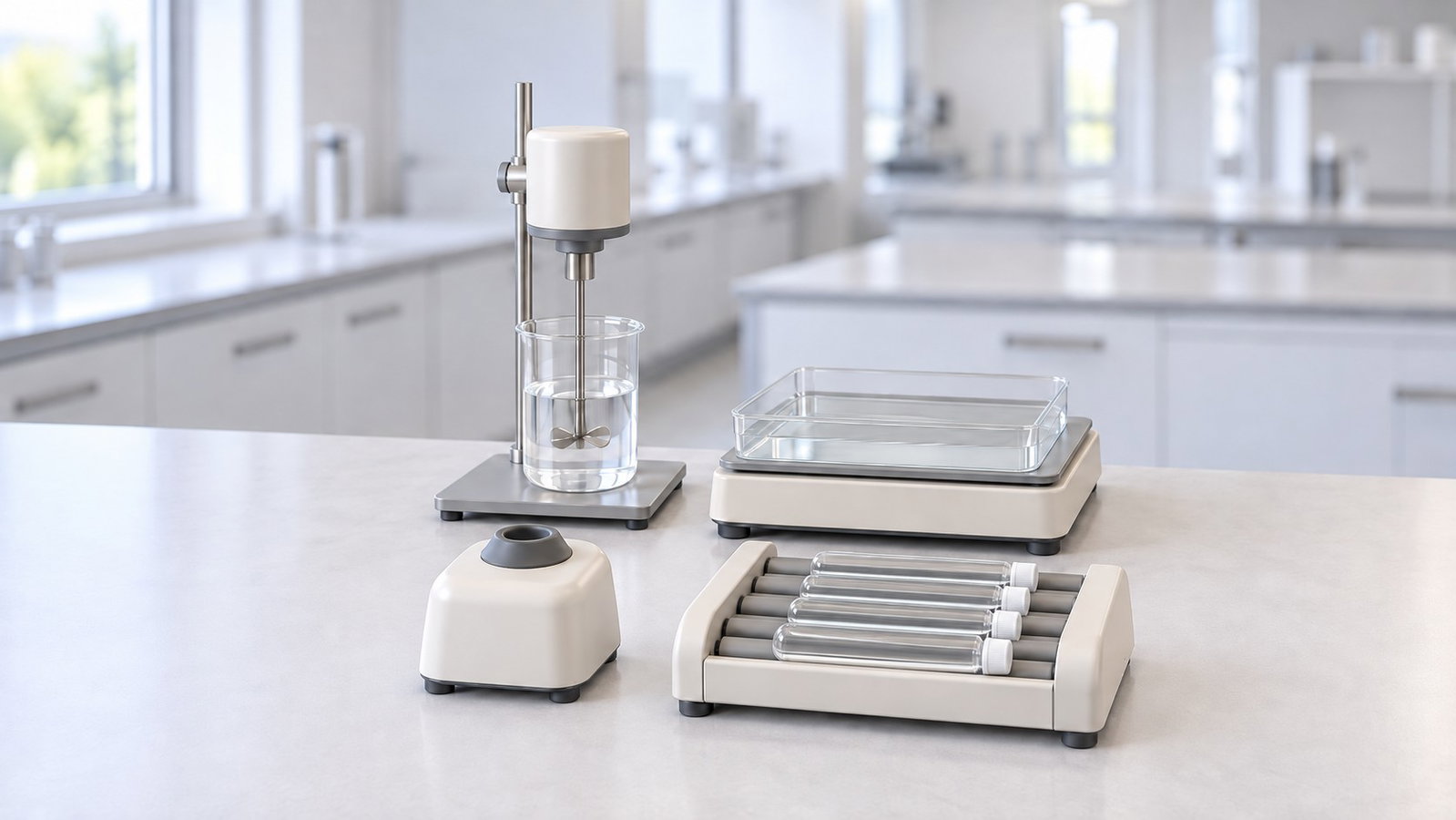
Laboratory mixer types differ most in what their motion does to a sample. Some keep a whole vessel circulating, some concentrate intense shear in a small zone, and some swirl, tip or roll closed containers to keep their contents in motion. Which class fits a job comes down to three questions: volume, viscosity, shear tolerance. How much liquid is there, how thick is it or will it become, and how much shear can the sample take before it is damaged? Magnetic stirrers suit thin liquids; overhead stirrers take over as liquids thicken or batches grow; rotor–stator homogenizers break up drops and agglomerates; vortex mixers rapidly mix individual tubes; platform shakers move flasks, trays and plates; tube rollers and rotators keep closed tubes in repeated motion; and microplate shakers and 2 mL cell disruptors handle wells and small tubes. This guide explains each class, then brings them together in a decision map. Each section links to a detailed guide. Everything here is written for research laboratory use.
Quick answer: (1) Volume: single tubes suit a vortex mixer, roller or rotator; plates suit a microplate shaker; flasks and trays suit a platform shaker; beakers and larger vessels suit a stirrer. (2) Viscosity: thin liquids suit a magnetic stirrer; thick or thickening liquids need an overhead stirrer. (3) Shear tolerance: drops and agglomerates that must be broken need a homogenizer; for proteins and long DNA, choose conditions that limit damaging agitation. No single mixer does every job.
1. How Mixing Works: Bulk Flow, Shear and the Reynolds Number
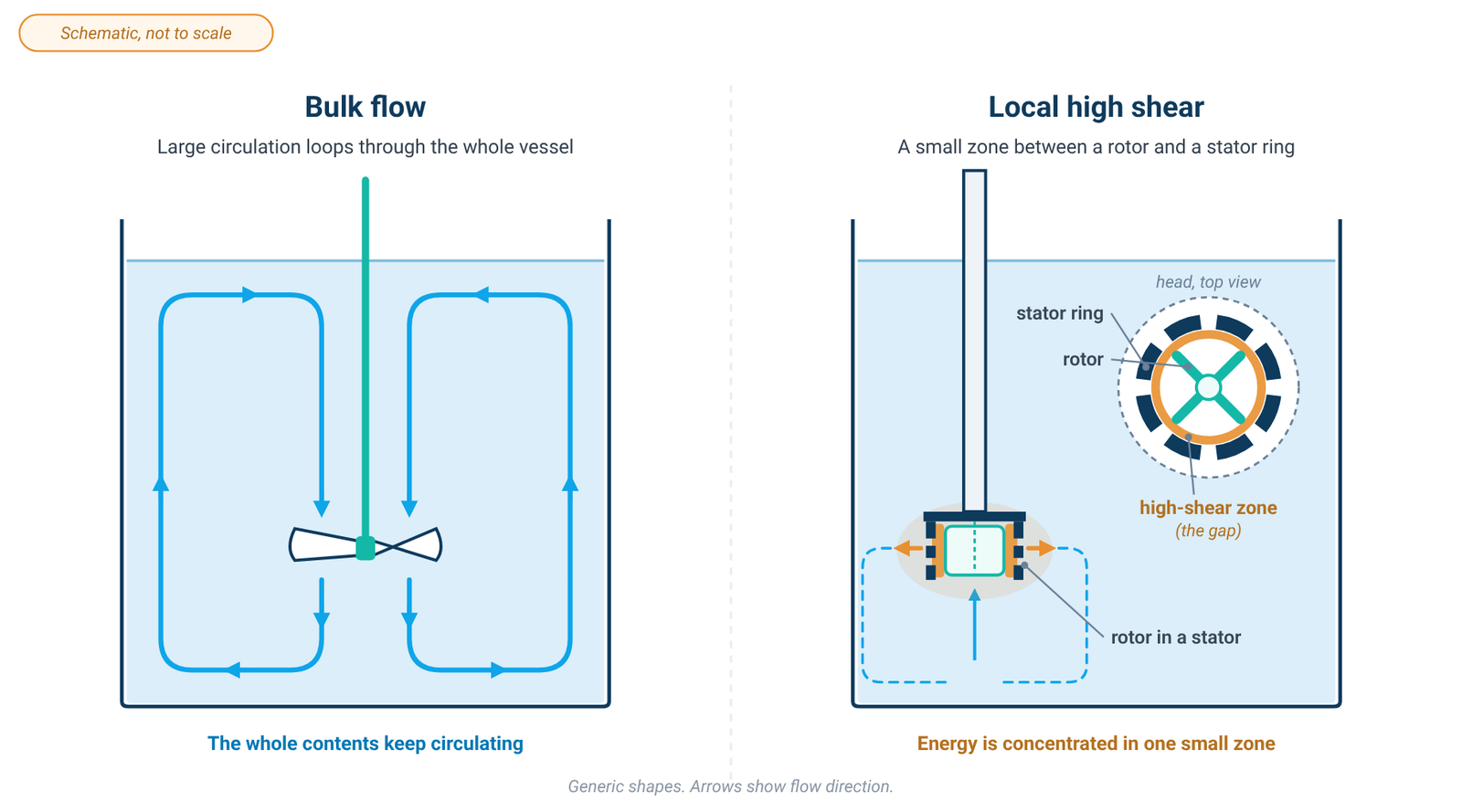
Every mixer does some mix of two jobs. The first is bulk flow: moving the whole contents of a vessel so that each part of the liquid eventually meets every other part. The second is shear: making neighbouring layers of liquid move at different speeds, which stretches and breaks drops, clumps of powder and, sometimes, the sample itself. A stirrer in a large beaker is mainly a bulk-flow device. A rotor–stator homogenizer is mainly a shear device. Vortex mixers, shakers and rollers sit between the two, each with a motion designed around a particular container.
How easily a liquid circulates depends on the balance between its inertia and its viscosity. For stirred vessels, engineers express that balance as the impeller Reynolds number, Re = ρND²/µ, "where D is impeller diameter, N is rotational speed, ρ is fluid density, and µ is fluid viscosity" [1]. A thin liquid stirred briskly has a high Reynolds number and flows turbulently, with eddies that spread added material quickly. As viscosity rises, the Reynolds number falls, and mixing passes through a transitional regime into laminar flow, where the liquid moves in smooth layers [1]. Blending then slows sharply. In Dickey's words, "Anything that is added to the surface of a viscous liquid will require a long time — many minutes to hours — to be uniformly blended." [1] The familiar impeller classes are described for stirred tanks "operating in low to medium viscosity fluids in the turbulent regime" [2]; thick liquids call for different tools and more turning effort.
High-shear devices work differently. Rotor–stator mixers "are designed to deliver a narrow region of high intensity shear and/or turbulence in order to achieve efficient mixing and emulsification" [3]. The energy is concentrated in a small zone rather than spread through the vessel, and in a batch, the shaft energy must ultimately be dissipated as heat [3].
Shear tolerance is the third axis. Proteins can aggregate under agitation: in a study of an antibody formulation, "stirring was found more stressful than shaking on the IgG1 formulation" [4]. Long DNA is fragile too; a high-molecular-weight DNA protocol warns that "Short vortexing can be performed but could lead to DNA shearing." [5] Together, these examples show why shear tolerance has to be judged for the sample: agitation that is acceptable for one material can damage another. How impeller shape and the power number change a stirred vessel is covered in our guide to overhead stirrer impeller types; what tip speed and shear rate do and do not tell you about a homogenizer is covered in our guide to the rotor stator homogenizer.
2. Magnetic Stirrers: Mixing Thin Liquids
A magnetic stirrer turns a drive magnet under its plate, and a stir bar in the vessel follows it round. Nothing passes through the vessel wall except the magnetic field, so the same set-up works with an open beaker, a stoppered flask or a sealed vial. For thin-liquid mixing, magnetic stirring is useful where the stir bar remains stably coupled to the drive.
Its limit is the coupling between drive and bar. A stir-bar data sheet notes that a bar that does not match the drive magnet will not have optimum coupling, which matters for reducing spinout [6]. As a liquid thickens, or as speed rises, the drag on the bar grows; when the drag exceeds what the coupling can transmit, the bar falls out of step and rattles instead of spinning. This decoupling is a mechanism, not a fixed viscosity figure: it depends on the bar, the drive, the vessel and the speed.
Stirring position matters as well. In one parallel-synthesis study, Cherepanova and colleagues found that "Significant differences were found in the reaction rates and sizes of the nanoparticles obtained via parallel synthesis with the same magnetic stirrer", with results depending on the location of the reaction vessel on the magnetic stirrer [7]. For comparable runs, keep the bar, vessel and position consistent and record them.
How drives, plates, heating and probes work is covered in Magnetic Stirrers and Hotplate Stirrers: How They Work and What the Specs Mean, and bar sizes and spinout in our guide to stir bar selection and decoupling.
3. Overhead Stirrers: Viscous Samples and Larger Volumes
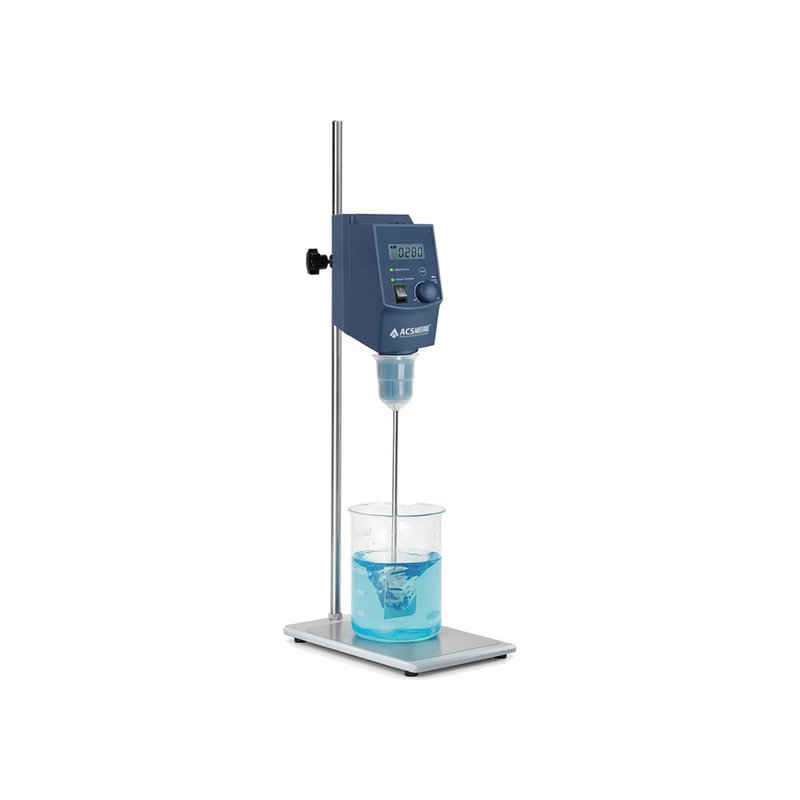
An overhead stirrer mounts its motor above the vessel on a stand. A chuck grips a stirring shaft, and the impeller on the end of the shaft turns in the liquid. Because the drive is a direct mechanical connection, there is no magnetic coupling to lose. What limits an overhead stirrer is how much turning effort, or torque, the motor can deliver at the speed you need, with the impeller and vessel you choose.
ACS Material describes the class in these terms. The OS-Pro Series LCD digital overhead stirrer is described this way: "Overhead stirrers are used for mixing medium and high viscosity samples in chemical synthesis, pharmaceutical synthesis, physical and chemical analysis and the petrochemical industry." It lists "an LCD display of speed and torque" among its features. The OS-T Plus Series overhead stirrer has a motor that "holds the set speed by adjusting the torque automatically as the sample viscosity changes." Speed holding matters because a reaction mixture can thicken as it runs, and the impeller would otherwise slow down.
Overhead stirrer specifications give three separate maximum ratings: a maximum volume measured in water, a maximum viscosity and a maximum torque. Read each one on its own. They are not one operating point that a stirrer reaches all at once, the maximum torque is not promised at top speed, and the volume figure describes water, not a viscous sample. A torque reading on a display is a useful indicator of how the load changes during a run; it is not a viscosity measurement.
Choosing an overhead stirrer therefore means matching torque, speed and impeller to the liquid and the vessel, then confirming on your own sample. How the ratings work and when to move from magnetic to overhead stirring is covered in our comparison of the overhead stirrer vs magnetic stirrer, and impeller choice in the impeller guide linked in Section 1.
4. Homogenizers: High Shear for Emulsions and Dispersions
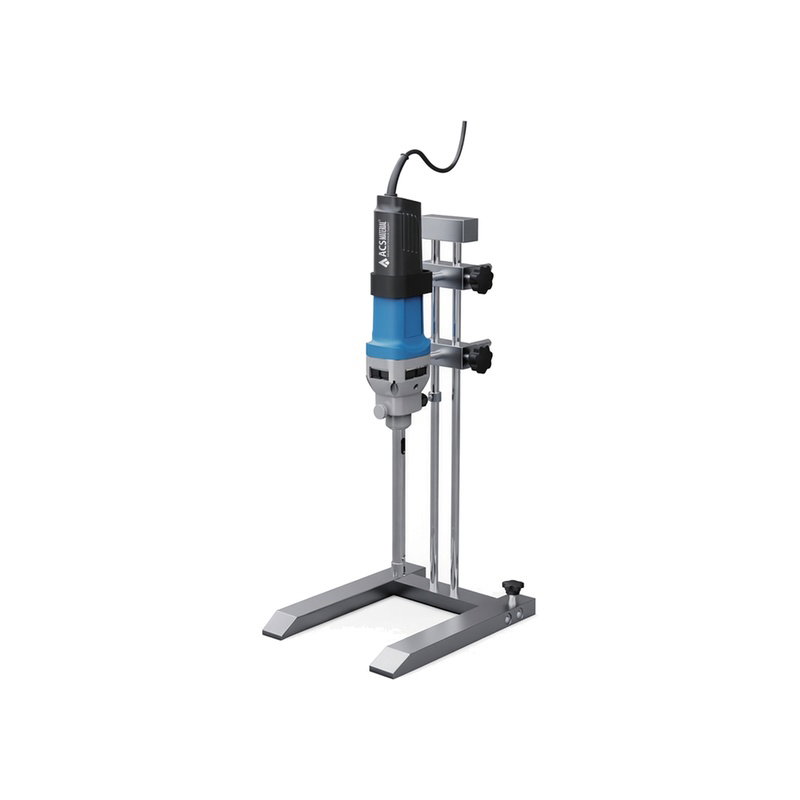
A rotor–stator homogenizer spins a rotor inside a close-fitting stationary stator. Liquid is drawn into the head, forced through the narrow gap and thrown out through openings in the stator, where drops and agglomerates break up. The D-500 high-shear homogenizer is described in one sentence: "The motor drives the rotor at high speed, and the sample is homogenized or dispersed in the gap between the rotor and the stator, usually in a short period of time." ACS Material says the instrument "is used for tasks from sample preparation to formulation study".
Unlike a stirrer, a homogenizer does not aim to move a whole vessel gently. It pulls the liquid repeatedly through a small, intense zone at the head, so the result depends on the dispersing head, its size relative to the vessel, the run time and how often the liquid passes through the head. Heads are chosen by job and volume, not by speed figures alone.
Heat is a key practical consideration. In a batch, shaft energy ultimately dissipates as heat [3]. Monitor sample temperature during homogenizing and use the temperature-control approach required by the sample and procedure.
What tip speed and shear rate mean, and how to choose a dispersing tool by volume, vessel and job, is covered in the rotor–stator guide linked in Section 1. For nanomaterials such as graphene nanoplatelets and carbon nanotubes, where the choice is often between a homogenizer, sonication and stirring, our comparison of the homogenizer vs sonicator sets out the trade-offs; neither method wins for every material. For application reading on our site, see industrial-scale graphene nanoplatelets and dispersions and graphene nanoplatelets for plasmonic Pickering emulsions (Queen's University Belfast, 2023).
5. Vortex Mixers: Rapid Mixing in Tubes
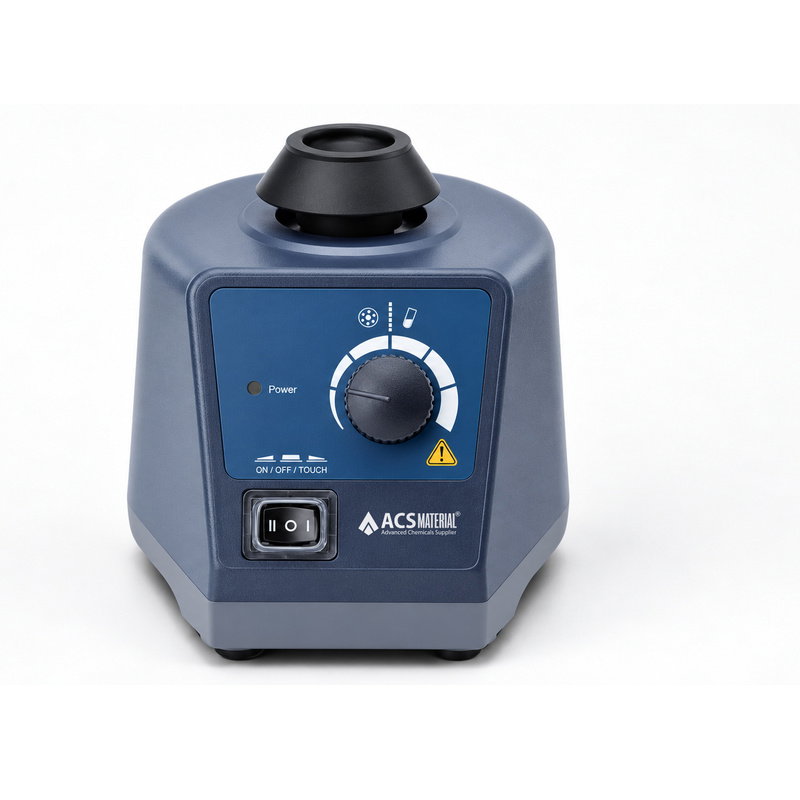
A vortex mixer drives a small cup or platform in a circular path. Press a capped tube onto the cup and its base follows the motion while the top is held, so the liquid swirls along the tube wall. It is a quick way to mix or resuspend material in an individual tube.
The MX-S vortex mixer shows a typical design: it "is a variable speed vortex mixer with a variable speed of 0–3000 rpm for gentle shaking to rapid mixing of samples". It "has an orbital mixing motion with a 4 mm orbital diameter and offers Touch or Continuous operation mode"; details of how those modes work are covered in the vortex guide. Vortex mixer specifications label their geometry in different ways, so compare those labels within the vortex guide rather than across devices.
Vortexing is intense. The swirling motion disrupts the liquid surface, which a biosafety fact sheet calls "the primary point of aerosol creation" [8], and the WHO laboratory biosafety manual lists over-vigorous mixing among the habits that create aerosols and droplets [9]. Keep tubes capped, use the lowest speed that mixes, and choose a gentler method for long DNA [5]. How orbit, speed and the operating modes work is covered in our guide to how does a vortex mixer work.
6. Platform Shakers: Orbital, Linear, Rocking and 3D
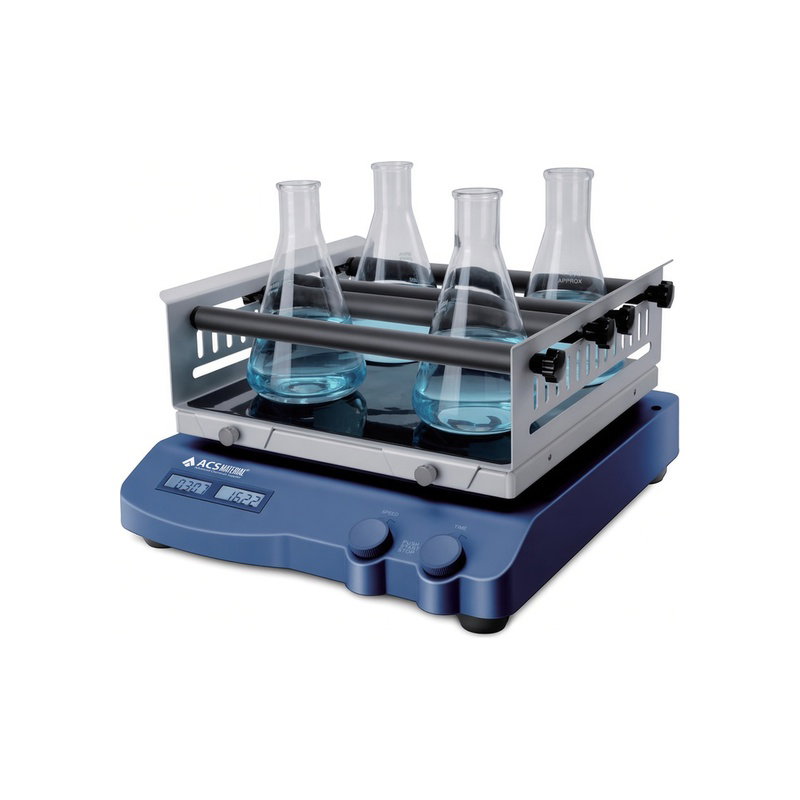
A platform shaker moves a flat platform that carries flasks, dishes, trays or plates, and the motion of the platform decides how the liquid moves. ACS Material uses four motion labels: "Orbital", "Linear (reciprocating)", "Rocking (see-saw)" and "Three-dimensional, fixed tilt angle". On an orbital shaker the platform stays flat and travels round a small circle, so liquid swirls round each vessel. A linear shaker pushes the platform straight back and forth; Heidolph describes this as "a violent horizontal shaking movement", suited to extraction work [10]. A rocking shaker tilts end to end, and a 3D shaker holds its platform at a tilt that keeps turning. Eppendorf notes that rockers "usually run at low rpms" [11], and Heidolph describes the "particularly gentle movement" of rocking and 3D wave shakers, used among other things "for staining membranes after blotting processes" [10]. On rocking and 3D shakers, the specified rpm is treated as motion cycles per minute, so compare speeds within one motion type.
The SK-O Series orbital shaker shows how wide one family can be. It describes use "in vessels from micro-centrifuge tubes through petri dishes and microplates to conical flasks" and lists: "Speed ranges run from 40 to 200 rpm up to 100 to 800 rpm, and the maximum load capacity with platform is 2 kg to 7.5 kg." Its product types carry the label "decolorizing"; in this article that label is treated as a staining/destaining use label. In the decision table below, shaker load is reported only under the specified label "Max. load capacity (with platform)".
Choose the motion first, then the vessel holder. For gels and blots, the shaker guide compares orbital and rocking approaches without treating either as universally correct. How each motion moves liquid, how to read orbital diameter, amplitude and tilt angle, and which motion suits flasks, funnels, gels and blots is covered in our comparison of the orbital shaker vs rocking shaker.
7. Tube Rollers, Rotators and Rocking Rotators
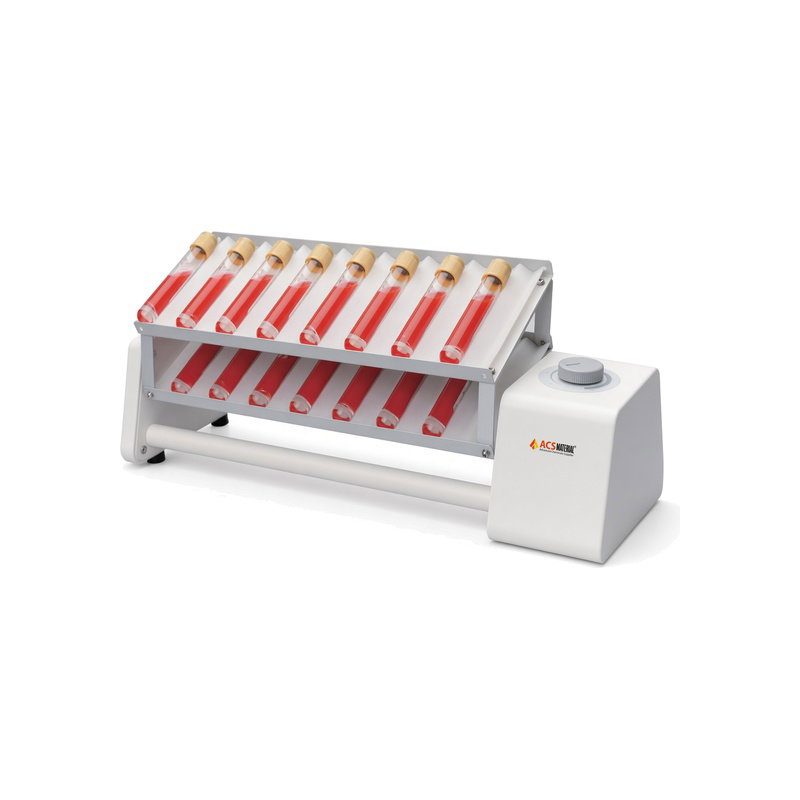
For closed tubes that need sustained motion, ACS Material distinguishes three related but different designs. A tube roller lays tubes on a set of turning rollers, so each tube rolls on its side and the liquid runs along it. A tube rotator clamps tubes to a disk or rotisserie that carries them over and over. A rocking rotator rocks a deck of tubes held in a mattress. A 3D rotating mixer, which rotates, shakes or angles a panel of tube clamps, is a fourth design again. These motions hold tubes differently, so their speed figures are not comparable across designs.
One reason to use continuous motion is to limit settling. Sedimentation takes place when "particles in suspension settle out of the fluid in which they are entrained and come to rest against a barrier" [12]; the required motion and speed remain sample-dependent. Gentle does not mean harmless: in the antibody study cited in Section 1, "The headspace in the vials had great influence on the stability of the protein formulation when stressed by shaking." [4] Agitation conditions are sample-dependent. For biosafety, the WHO manual advises: "Use sealed containers, such as screw-capped tubes." [9]
The SK-R30 rocking rotator mixer is an example of the third design: "All three models have a brushless DC motor, a continuous mode of operation and a speed range of 0–30 rpm." On a rocking rotator, the specified rpm is treated as motion cycles per minute; do not compare it with the rpm of a roller or rotator.
How rolling, rotating and rocking differ, which tube holders each design uses, and how to choose between them is covered in our comparison of the tube roller vs tube rotator.
8. Microplate Shakers and 2 mL Cell Disruptors
Small wells behave differently from flasks. In a microplate well, surface tension can hold the liquid still. Hermann and colleagues observed that "Up to a specific shaking intensity the liquid surface in the wells remains horizontal and no liquid movement can be observed", and that this critical shaking intensity must be exceeded to overcome the surface tension [13]. A microplate shaker therefore has to exceed the mixing threshold for the specific plate and liquid [13]. Use the setting specified by the method or established for that plate rather than assuming one generic speed applies.
A second small-volume job is opening cells in 2 mL tubes to prepare a lysate. That is not mixing in the usual sense: it means breaking cell walls and membranes. In mechanical lysis, the cell membrane "is physically broken down by using shear force" [14]. The review describes different cell-envelope structures and both mechanical and organism-specific enzymatic lysis routes, so the method should be chosen for the cell type [14].
Why wells resist mixing, how to set up a plate run, and how 2 mL disruption differs from vortexing is covered in our guide to the microplate shaker.
9. Choosing Between Laboratory Mixer Types: A Decision Map
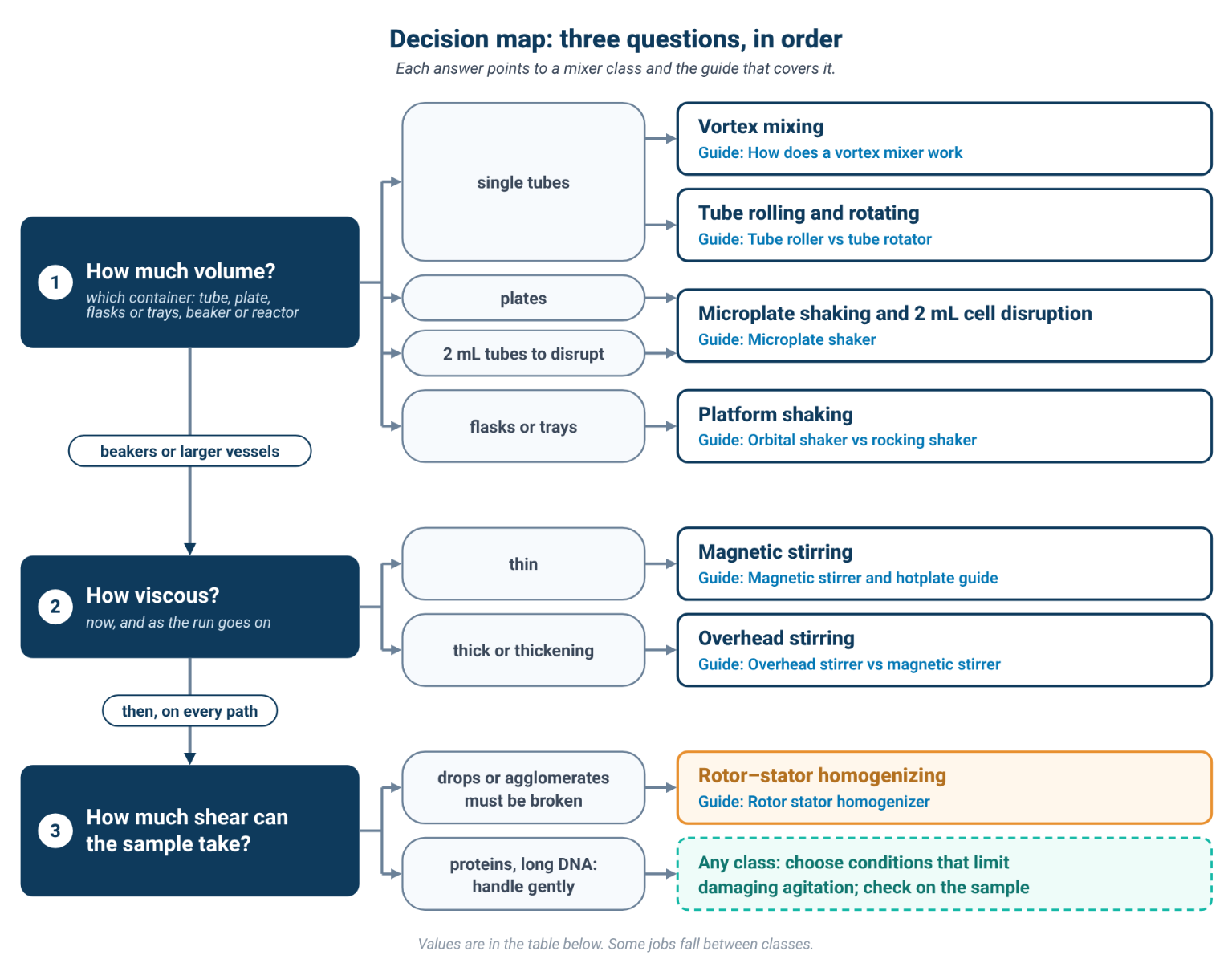
Start with the three questions from the top of this guide, in order. First, volume and container: a single tube, a plate, a set of flasks or trays, or a beaker or reactor. Second, viscosity: will the liquid stay thin, or is it thick or likely to thicken? Third, shear tolerance: does the job need intense shear to break drops or agglomerates, or must the sample be handled gently? The answers usually point to one class. The diagram below shows the path in words, and the table sets out ACS Material's specifications for each class.
| Mixer class | Motion | Speed (range ends) | Volume / capacity | Max. viscosity | Max. torque | Go to |
|---|---|---|---|---|---|---|
| Magnetic stirring | Stir bar coupled to a rotating magnet | — | — | — | — | Magnetic stirrer and hotplate guide |
| Overhead stirring | Motor-driven shaft and stirring tool | Per model (see the overhead guide) | Max. stirring quantity (H₂O): 20 L to 100 L | Max. viscosity: 10000 mPa·s to 150,000 mPa·s | Max. torque: 40 N·cm to 400 N·cm | Overhead stirrer vs magnetic stirrer |
| Rotor–stator homogenizing | Rotor in a stator | 2000 rpm to 32000 rpm | Listed dispersing-head volumes: 0.1 mL to 5000 mL | Max. viscosity: 5000 mPa·s to 10000 mPa·s | — | Rotor stator homogenizer |
| Vortex mixing | "Orbital" | 0 to 3000 rpm | Per top or adapter (see the vortex guide) | — | — | How does a vortex mixer work |
| Platform shaking | "Orbital" · "Linear (reciprocating)" · "Rocking (see-saw)" · "Three-dimensional, fixed tilt angle" | 10 to 800 rpm (rocking and 3D: cycles per minute) | Max. load capacity (with platform): 2 kg to 10 kg | — | — | Orbital shaker vs rocking shaker |
| Tube rolling and rotating | Rolling (rollers) · rotating (tube rotators) · rocking (rocking rotators) · "Rotation/Shake/Angle" (3D rotating mixer) | 0 to 80 rpm (rocking rotator and 3D mixer: cycles per minute) | Per model, by tube format (see the roller guide) | — | — | Tube roller vs tube rotator |
| Microplate shaking and 2 mL cell disruption | Plates: orbital or "horizontal rotation", by model · 2 mL tubes: "High-speed circumferential vortex and oscillation function" | Plates: 0 to 1500 rpm · 2 mL tubes: "0–3000 rpm (Adjustable)" | Up to "4 microplates" · "8 × 2 mL" | — | — | Microplate shaker |
Source: ACS Material product specifications (October 2026). A dash means the specification is not listed. Separate maximum ratings — not a combination one stirrer reaches at the same time. The homogenizer volume and viscosity entries are also separate specified limits, not one combined operating point. Ranges are the lowest and highest values specified across each family; individual models cover part of the range. Speed entries are specified range ends or, for overhead stirring, a per-model handoff; they do not make different motion types directly comparable.
Read each figure on its own, not as a set. For overhead stirrers, the volume, viscosity and torque figures are three separate maxima, and no one stirrer reaches all three together; the volume figure describes water. The homogenizer volume describes the listed dispersing heads. The speed figures describe the drive, and an rpm on one motion type cannot be compared with an rpm on another: a vortex head, an orbital platform and a rocking deck move in different ways. A dash means the value is not specified, not that the instrument lacks the property.
Some jobs fall between classes. Use the table to identify candidate mixer classes, then use the owning guide for the detailed choice and verify the final method on the actual sample, vessel and procedure.
10. Frequently Asked Questions
What are the main laboratory mixer types?
Magnetic stirrers, overhead stirrers, rotor–stator homogenizers, vortex mixers, platform shakers (orbital, linear, rocking and 3D), tube rollers and rotators, and microplate shakers. Cell disruptors for 2 mL tubes sit alongside them for preparing lysates. Each moves the sample in a different way, which is why each suits different containers and samples.
When is a magnetic stirrer not enough?
When the liquid is thick or will thicken, when the batch is large, or when the bar keeps spinning out, a direct-drive overhead stirrer is one option to evaluate. Section 3 links to the full comparison of the two.
Should I use a vortex mixer or a shaker?
A vortex mixer is designed around rapid mixing of an individual tube, while a platform shaker moves multiple vessels on a platform. For soaking, washing or staining workflows, follow the shaker protocol; for closed tubes that need sustained motion, compare a roller or rotator.
Which mixers are gentle enough for proteins or long DNA?
There is no universally gentlest mixer for proteins or long DNA. Research has shown that proteins can aggregate under agitation, with headspace playing a large part [4], and a high-molecular-weight DNA protocol warns that vortexing could lead to DNA shearing [5]. Follow the sample protocol and use the least aggressive condition that achieves the required mixing.
Can one mixer do everything?
No. Each class is built around one kind of motion and one range of containers, so a lab usually keeps several. Mixing with temperature control is a separate instrument class, covered in our dry bath and thermo mixer hub.
11. Keep Exploring the Mixing Hub
- Overhead stirrer vs magnetic stirrer: viscosity, torque and volume limits.
- Overhead stirrer impeller types: propeller, paddle, turbine, anchor and the power number.
- Rotor–stator homogenizers and tip speed: tip speed, shear rate and choosing a dispersing tool.
- Homogenizer vs sonication for dispersions: dispersing graphene, CNTs and nanoparticles.
- How a vortex mixer works: orbit, speed and touch, infrared and continuous modes.
- Orbital vs linear vs rocking shakers: orbital, linear, rocking and 3D motion for flasks, gels and blots.
- Tube roller vs tube rotator: rolling, rotating and rocking motion for closed tubes.
- Microplate shakers and mixing in wells: mixing in wells and preparing lysates in 2 mL tubes.
- Magnetic stirrers and hotplate stirrers: how they work and what the specs mean.