
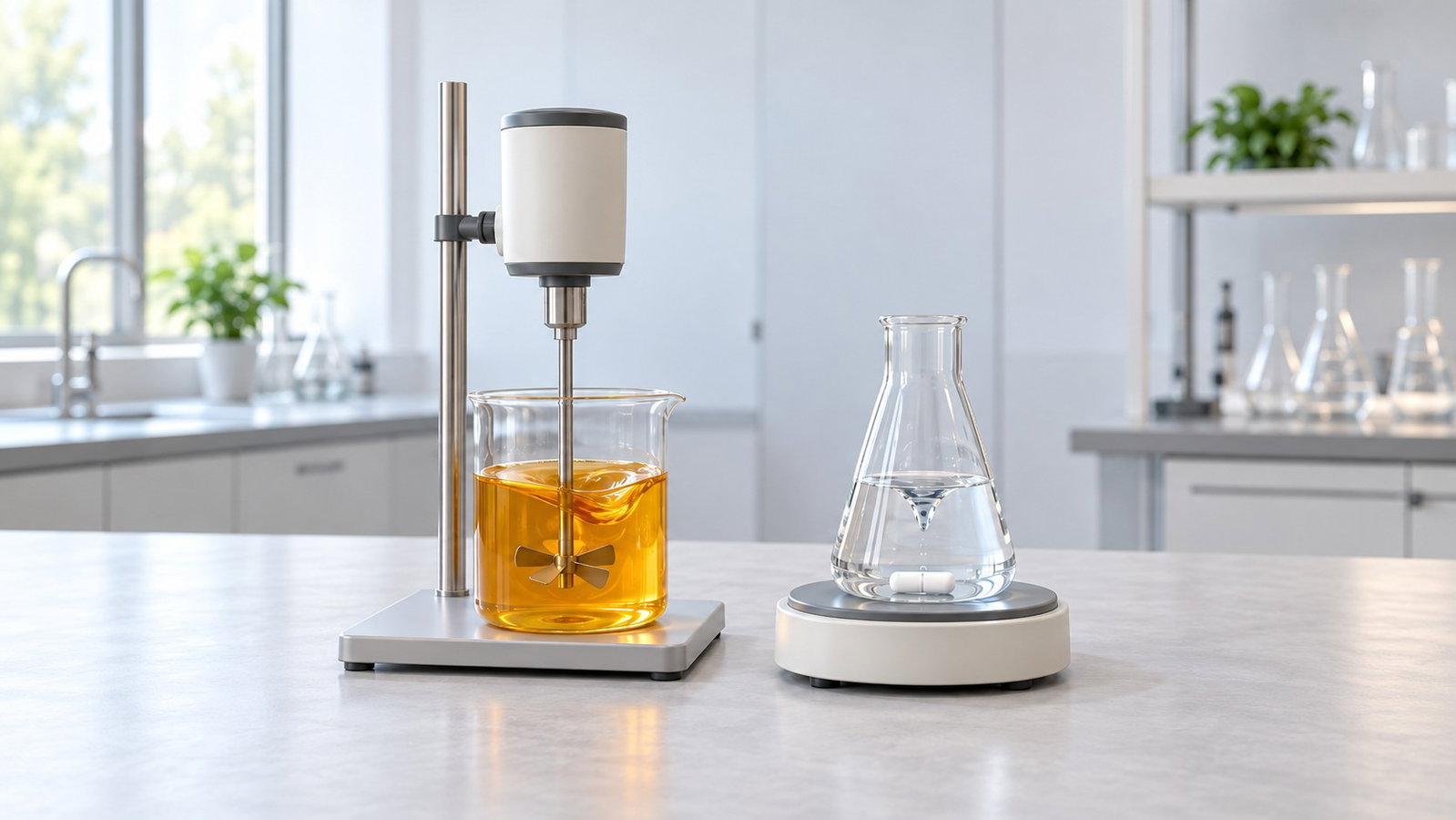
The choice of overhead stirrer vs magnetic stirrer usually comes down to three questions: how thick the liquid is, or will become; how much of it there is; and how hard the drive must work to keep it moving. A magnetic stirrer turns a bar through a magnetic coupling. An overhead stirrer turns an impeller on a shaft driven by the motor itself. This guide explains where each drive reaches its limits, what the viscosity, torque and volume ratings on an overhead stirrer actually mean, and then sets out nine ALab™ overhead models from four series in one static table, using only ACS Material's specifications. For where stirring fits among other ways of mixing, see our guide to laboratory mixing methods.
Quick answer: A magnetic stirrer suits thin to moderately thick liquids in small to medium vessels, including closed vessels, because nothing has to pass through the lid. As a liquid thickens, the bar can lose its grip on the drive magnet and spin out; that is a mechanism, not a fixed number, and it depends on the bar, the magnet, the vessel and the speed. An overhead stirrer drives its impeller mechanically, so its limits are set by the motor's torque and speed and by the impeller and vessel you use. Overhead stirrer specifications give separate ratings for maximum volume (in water), maximum viscosity and maximum torque. Read each on its own: they are not one operating point that a stirrer reaches all at once, the maximum torque is not promised at top speed, and the volume figure is for water.
1. How Each Stirrer Moves the Liquid
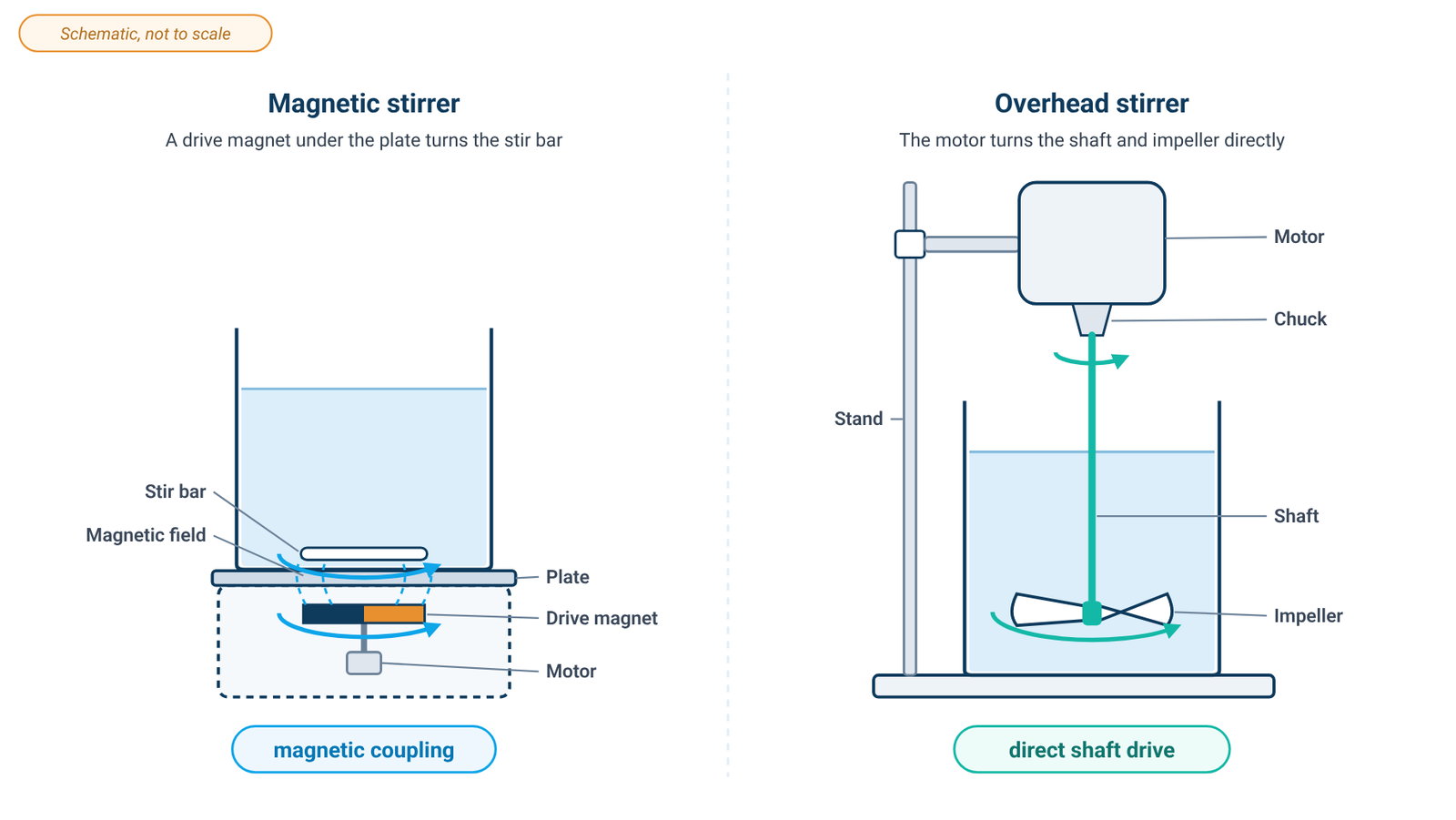
Magnetic stirrer. A motor under the work plate turns a drive magnet, and a magnetic stir bar sitting in the vessel follows it round. Everything the bar does depends on that magnetic coupling. A stir-bar manufacturer's data sheet puts the basic rule plainly: "For optimum magnetic coupling, the distance between the magnetic poles of the drive magnet and the length of the stirring bar should be equal" [1]. The same data sheet asks for the bar to be "positioned directly over the center of the drive magnet" and for the vertical distance between magnet and bar to be "kept to a minimum" [1]. Because no shaft passes through the neck, it works with a stoppered flask or sealed vial as readily as with an open beaker, and set-up is quick. Many magnetic stirrers also heat the plate. For the wider family of magnetic stirrers and hotplates, see our magnetic stirrer hotplate guide.
Overhead stirrer. Here the motor sits above the vessel on a stand. Its chuck grips a stirring shaft, and the impeller on the end of that shaft turns in the liquid. The drive is a direct mechanical connection, so it does not rely on magnetic coupling between the drive and the mixing element and therefore does not undergo stir-bar spin-out. What limits an overhead stirrer is how much turning effort the motor can deliver, at what speed, with the impeller and vessel you choose. The price of that direct drive is set-up: you need a stand and clamp, and a vessel opening that the shaft and impeller can pass through.
ACS Material lists the chuck clamp range as "Ø0.5–10 mm" for the OS-T150-E, OS-Pro and OS-S models and "0.5 to 10 mm" for the OS-T Plus models. Two series are described with a through-top design: "Through-top design of the stirring paddle for easy container change" (OS-T150-E) and a paddle "through-the-top" design "for easy container replacement" (OS-T Plus).
2. Viscosity: Where Magnetic Coupling Runs Out
Viscosity is a liquid's resistance to flow. Specifications and data sheets give it in millipascal-seconds (mPa·s); the older unit, the centipoise (cP), is the same size, since one centipoise equals one millipascal-second [8].
Why a stir bar spins out. The drive magnet pulls the bar round; the liquid drags against it. While the magnetic pull wins, the bar turns in step. When the drag wins, the bar falls out of step: it twitches, rattles, hops across the base or stops while the drive keeps turning. The same stir-bar data sheet defines the event: "Should the magnetic stirring bar lose its coupling with the drive magnet because of the speed of the drive magnet, viscosity of the fluid, or an improperly selected stirring bar length, it is said to have 'spun-out'" [1]. A second stir-bar selection guide lists the same causes and adds the vessel type [2]. Even when the bar keeps turning, a trade review of laboratory stirring notes that in thick or large samples "magnetic coupling may not be strong enough to overcome viscosity, and stir-bar vortices may not reach high enough into the fluid to provide uniform mixing" [3].
Why there is no single magnetic viscosity limit. The point at which a bar spins out depends on the bar's length and shape, the strength and pole spacing of the drive magnet, the distance through the vessel base, the vessel itself and the speed, all at once [1][2]. Stronger bar magnets, such as samarium-cobalt bars, increase the coupling and help reduce spin-out in viscous solutions or at high speed [1][2], although the same guide cautions that a powerful magnet can also increase particulate from the bar grinding on the vessel base [2]. For these reasons this guide does not give a viscosity above which magnetic stirring "fails". Our guide to stir bar sizes, shapes and decoupling covers bar choice and how to recover a bar that has spun out.
Watch for liquids that thicken. As one Lab Manager feature puts it, "viscosity can creep up without notice. Some reactions turn to thick slurries or form heavy precipitates as they progress" [4]. A batch that starts thin enough for a stir bar may later reach conditions in which it no longer stays coupled [1][4].
The overhead side. Each ALab™ overhead model carries a "Max. viscosity" rating; across the nine models these run from 10,000 mPa·s to 150,000 mPa·s (OS-T400-Plus), and Section 6 lists every model. These are ACS Material's specified ratings, not tests by us, and the impeller, vessel or speed the ratings assume is not specified. ACS Material frames the OS-Pro and OS-S category this way: "Overhead stirrers are used for mixing medium and high viscosity samples in chemical synthesis, pharmaceutical synthesis, physical and chemical analysis and the petrochemical industry."
One more caution applies to non-Newtonian samples. Their apparent viscosity depends on shear conditions. Mixing engineers handle this with an effective shear rate taken as proportional to impeller speed, and the viscosity at that shear rate [6]. A single viscosity value for such a sample is therefore context-dependent, and changing the stirring speed can change the apparent viscosity.
3. Torque: What the Rating Means and What It Doesn't
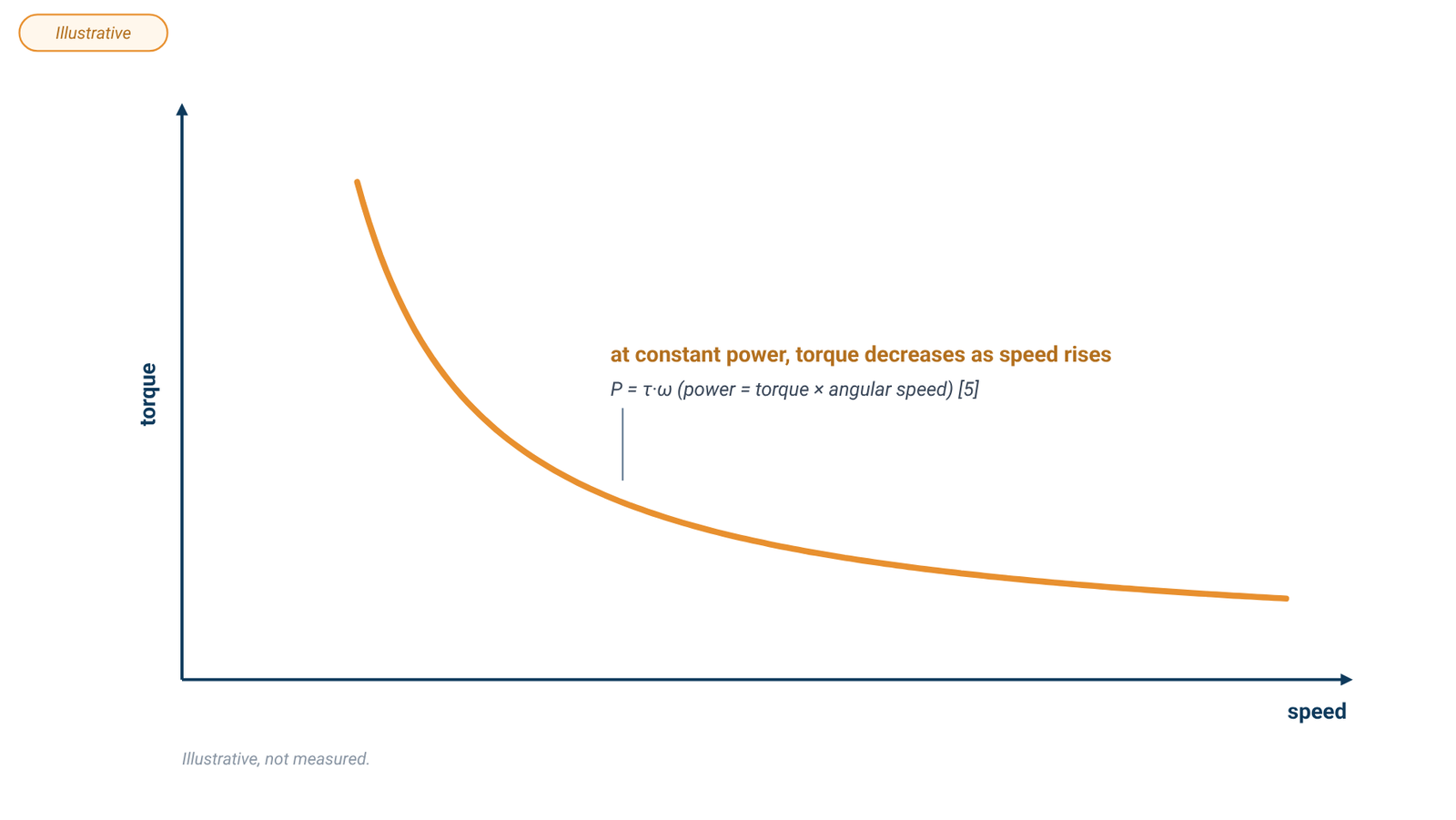
Torque is turning effort. It is the twisting force the motor applies to the shaft, given in specifications in newton-centimetres (N·cm). As the impeller turns, the liquid resists it, and the motor must supply torque to overcome that resistance. Mixing studies calculate the power an impeller draws directly from the measured torque and the rotational speed (P = 2πNΓ, where Γ is torque and N is speed) [6]. This is the stirring form of the general physics relation power = torque × angular speed (P = τω) [5].
What sets the torque a sample needs. In slow, viscous (laminar) flow, the power number falls in inverse proportion to the Reynolds number; the constant linking them is "specific to the impeller design and tank geometry" [6]. In practical terms, in that viscous regime and at a given speed with a given impeller and vessel, a more viscous liquid demands more torque. Power-consumption correlations for paddle, propeller, anchor, helical-ribbon and other impellers, developed from laminar to turbulent flow, show how strongly the result depends on impeller type and on whether the vessel has baffles [7]. Torque demand is therefore a property of the whole set-up (liquid, speed, impeller diameter and shape, vessel), not of viscosity alone. Impeller choice is the subject of our guide to overhead stirrer impeller types.
Why maximum torque and top speed are separate. A motor has a finite power. Because power = torque × angular speed [5], the same power gives less torque the faster the shaft turns, so a stirrer cannot be assumed to deliver its full rated torque across its whole speed range. For none of the four ALab™ overhead series are the speed, range or gear at which the "Max. torque" figure applies specified. Read the maximum torque as one rating and the speed range as another.
Two speed ranges. Two series split the speed range in two. The OS-T150-E lists "Low: 60–500 rpm ; high: 200–2000 rpm", and the OS-T400-Plus lists "A: 10 to 400 rpm; B: 50 to 2000 rpm". These are specified speed ranges only. How available torque differs between the ranges or gears is not specified, and neither is the range or gear the maximum-torque rating applies to.
Holding speed as the load changes. Two series describe speed control under changing viscosity. ACS Material says the OS-Pro series "holds a constant speed when the viscosity of the sample changes". For the OS-T Plus, ACS Material says "A brushless DC motor holds the set speed by adjusting the torque automatically as the sample viscosity changes." Both statements describe how the controller responds within the motor's capacity. Neither says the speed is held at the maximum rated torque.
What happens past the limit. Overhead stirring does not involve magnetic stir-bar spin-out, but overload behavior is model-dependent. For the OS-S, ACS Material says "Safety circuits allow the stirrer to stop safely under anti-stall or overload conditions", and the OS-Pro lists "Spillage and overload protection safety circuits; smooth start to prevent splatter or overflow." No stall torque is specified.
The torque display is an indicator. The OS-Pro and OS-T Plus list an LCD torque display. Treat the reading as an indicator of load: it shows how hard the motor is working and is useful for following a batch that thickens or thins over time. It is not a calibrated torque measurement or a viscosity measurement. A shaft reading also includes losses that are not in the liquid; in research rigs the torque of the empty vessel is measured and subtracted before power is calculated [6]. To know your sample's viscosity, measure it with a viscometer or rheometer.
More torque does not mean a higher viscosity rating. The OS-T150-E lists a maximum torque of 150 N·cm and the OS20-Pro 40 N·cm, yet the two have the same separate maximum-viscosity rating, 10,000 mPa·s, and the same water-volume rating, 20 L. Likewise the OS-T40-Plus and the OS20-Pro both list 40 N·cm, but their water-volume ratings are 30 L and 20 L. Compare each rating directly from the table rather than estimating one from another.
4. Volume: Read "(H₂O)" Literally
Every volume figure for the four overhead series is a water figure. The OS-T150-E, OS-Pro and OS-S specifications label it "Max. stirring quantity (H₂O)"; the OS-T Plus specifications label it "Max. volume [H₂O]". The water ratings run from 20 L to 100 L. A figure for water tells you how much low-viscosity liquid the stirrer is rated to move; it is not a capacity for a viscous sample. How much of a thick sample you can mix well depends on its viscosity, the impeller, the vessel shape and the speed, and it is not specified. Do not convert the water rating into a viscous-sample capacity; establish suitability with the actual liquid, impeller and vessel.
For magnetic-stirrer sizing, see our guide to choosing a magnetic hotplate stirrer. A Lab Manager feature notes that overhead stirrers are often specified when batch volumes are large, and "even more frequently when the operation is initially viscous or expected to develop significant viscosity" [4].
Volume is also a question of geometry: the impeller needs a sensible depth and clearance from the base and walls, and the stand must stay stable under load. Check the vessel neck, shaft length and stand together before planning a large batch.
5. Overhead Stirrer vs Magnetic Stirrer: Which One for Your Job?
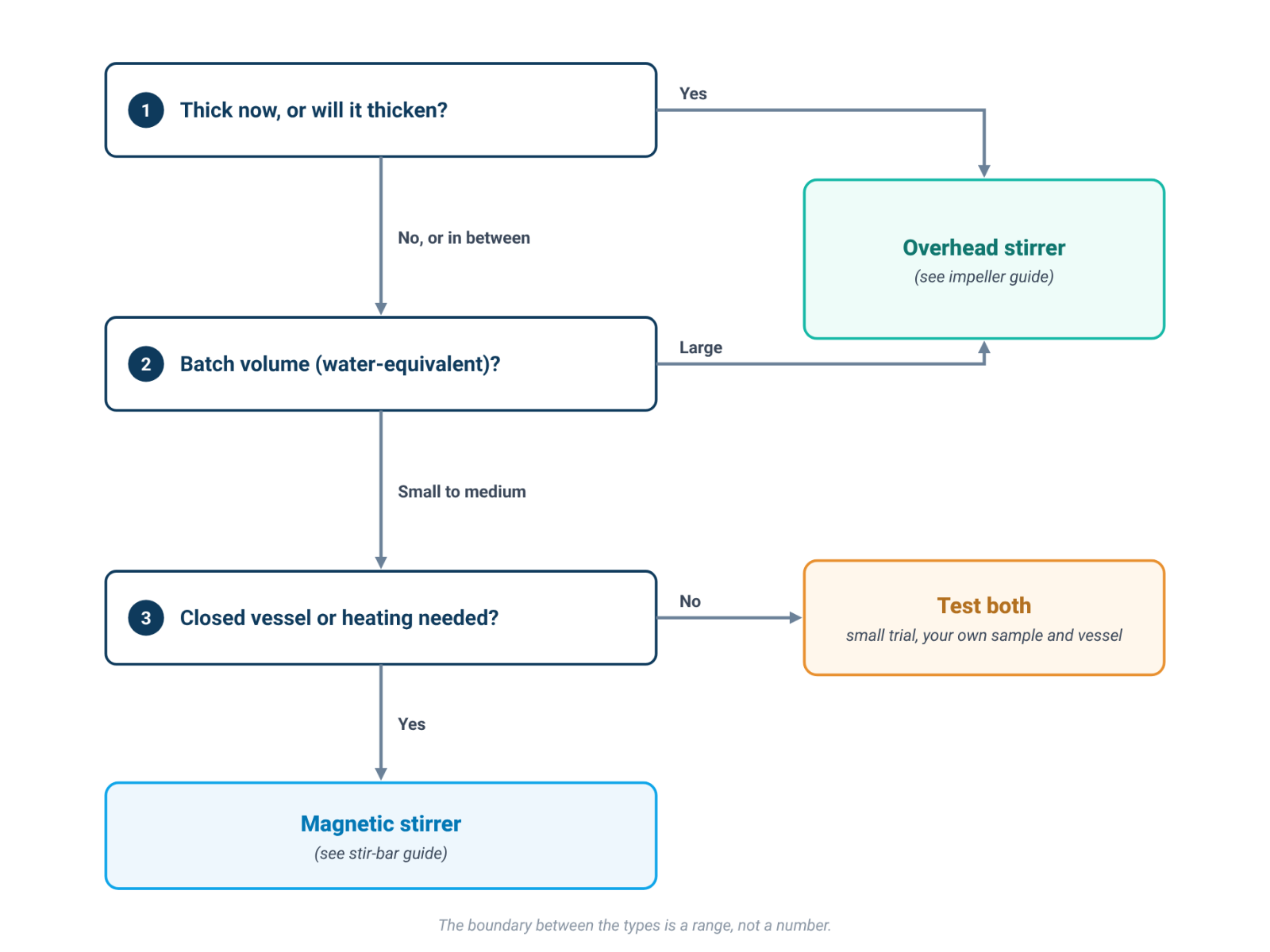
These lists describe types of stirrer, not models; the boundary between them is a range, not a number.
A magnetic stirrer is usually the simpler choice when:
- the liquid is thin to moderately viscous and will stay that way;
- the vessel is closed, sealed or small, such as a stoppered flask or a vial;
- you need heating and stirring in one unit (a hotplate stirrer; see the guide linked in Section 4);
- you run several small vessels side by side. Note, though, that a recent study found reaction rates, nanoparticle size and conversions differed between vessels placed at different positions on the same magnetic stirrer, and recommends a single-vessel control experiment in the most appropriate, usually central, position [9].
An overhead stirrer is usually the better choice when:
- the sample is viscous from the start or is expected to thicken or form heavy precipitates as the work proceeds [1][3][4];
- the batch is large in water-equivalent terms;
- you need the speed held as the load changes, or a torque reading to follow the batch;
- you need to choose the impeller (propeller, paddle, anchor and others) to suit the flow you want (see the impeller guide linked in Section 3).
The middle ground. For moderately viscous liquids in moderate volumes either type may work. Run a small trial with your own sample and vessel, watch for spin-out on the magnetic stirrer, and watch the speed and load on the overhead stirrer.
6. ALab™ Overhead Stirrers Compared
Each figure is a separate rating; a model's ratings are not one condition in which it meets them all.
Separate maximum ratings from ACS Material specifications — not a combination one stirrer reaches at the same time.
| Model | Max. volume (H₂O)¹ | Max. viscosity | Max. torque² | Speed range | Motor type | Torque display³ |
|---|---|---|---|---|---|---|
| OS-T150-E | 20 L | 10000 mPa·s | 150 N·cm | Low: 60–500 rpm ; high: 200–2000 rpm | AC three-phase motor | — |
| OS20-Pro | 20 L | 10000 mPa·s | 40 N·cm | 50–2200 rpm | Brushless DC motor | LCD |
| OS40-Pro | 40 L | 50000 mPa·s | 60 N·cm | 50–2200 rpm | Brushless DC motor | LCD |
| OS70-Pro | 70 L | 100000 mPa·s | 300 N·cm | 50–1100 rpm | Brushless DC motor | LCD |
| OS20-S | 20 L | 10000 mPa·s | 40 N·cm | 50–2200 rpm | Brushless DC motor | — |
| OS40-S | 40 L | 50000 mPa·s | 60 N·cm | 50–2200 rpm | Brushless DC motor | — |
| OS-T40-Plus | 30 L | 10,000 mPa·s | 40 N·cm | 50 to 2200 rpm | Brushless DC motor | LCD |
| OS-T60-Plus | 50 L | 50,000 mPa·s | 60 N·cm | 50 to 2200 rpm | Brushless DC motor | LCD |
| OS-T400-Plus | 100 L | 150,000 mPa·s | 400 N·cm | A: 10 to 400 rpm; B: 50 to 2000 rpm | Brushless DC motor | LCD |
¹ Volume label differs by series: "Max. stirring quantity (H₂O)" for the OS-T150-E, OS-Pro and OS-S; "Max. volume [H₂O]" for the OS-T Plus. Both are water figures, not capacities for viscous media. ² Maximum torque is one figure per model. The speed, range or gear at which it applies is not specified; do not pair it with the top of the speed range. ³ "—" = no torque display listed. Where a torque display is listed, it is an indicator of load, not a calibrated torque or viscosity measurement.
Source: ACS Material product specifications (October 2026). A dash means the specification is not listed.
7. Choosing Among the Four Overhead Series
The groups below are our own and do not rank products. Use the separate ratings as screening information only; the specifications do not establish that a model can meet its maximum volume, viscosity and torque ratings simultaneously in one setup.
- Economy, two speed ranges. The OS-T150-E LED digital economy overhead stirrer lists an AC three-phase motor, an LED speed display and the low and high speed ranges described in Section 3.
- Brushless, LED display. The OS-S series LED digital overhead stirrer (OS20-S, OS40-S) lists a brushless DC motor, an LED display and an overload protection display. No torque display is listed.
- Brushless, LCD speed and torque display, RS232. The OS-Pro series LCD digital overhead stirrer (OS20-Pro, OS40-Pro, OS70-Pro) lists an LCD showing speed and torque and an RS232 interface. A time setting ("0–99 h 59 min") is listed for the OS70-Pro only.
- Brushless, LCD, timer and temperature input. The OS-T Plus series overhead stirrer (OS-T40-Plus, OS-T60-Plus, OS-T400-Plus) lists an LCD torque display, a time setting of "0 min to 99 h 59 min", an external temperature sensor input, "PT1000 (accuracy ±0.2°C)", and "RS485, Type-C, USB" interfaces. Forward, reverse and intermittent mixing are listed for the OS-T40-Plus and OS-T60-Plus; the OS-T400-Plus has the two speed gears described in Section 3.
The OS-Pro and OS-S also list optional stirring tools, including propeller, paddle and anchor stirrers. Which impeller suits which job is covered in the impeller guide linked in Section 3.
8. Checklist Before You Buy or Set Up
- Viscosity now and later: estimate it at the start and at the end of the process, and note whether the sample is shear-thinning or forms solids.
- Batch volume: compare it with the water rating, but do not treat that water figure as a viscous-sample capacity.
- Vessel: check the neck, shape and size, and whether it must stay closed (magnetic) or can take a shaft (overhead).
- Heating: decide whether you need a hotplate stirrer, or a separate heat source under an overhead stirrer.
- Impeller: choose its type and diameter for your vessel and flow pattern.
- Speed and torque: check the speed range you need and the torque rating separately; do not assume both maxima together.
- Monitoring: decide whether you need a torque reading, a timer, a temperature input or a data interface.
- Stand and clamping: confirm the stand, clamp and shaft length for your vessel height.
9. Frequently Asked Questions
Can a magnetic stirrer mix viscous liquids?
Up to a point. Whether a bar stays coupled depends on the bar, the drive magnet, the vessel, the distance between them and the speed [1][2], so there is no single viscosity limit. If the bar spins out or the sample will thicken, use an overhead stirrer; the stir-bar guide linked in Section 2 covers bar choice.
Does a higher torque rating mean a higher viscosity rating?
Not specified. The OS-T150-E lists 150 N·cm and the OS20-Pro 40 N·cm, yet both list the same separate viscosity rating. Compare each rating directly.
Is the maximum torque available at top speed?
This is not specified. At constant power, the relation power = torque × angular speed means that higher speed corresponds to lower torque [5], but no torque–speed curve is specified. Treat maximum torque and maximum speed as separate ratings.
Can the torque display measure viscosity?
No. The LCD torque display is an indicator of load, useful for following changes during a run. It is not a calibrated torque or viscosity measurement; use a viscometer or rheometer for viscosity.
Does "max. stirring quantity" apply to thick samples?
No. It is a water figure, labelled "(H₂O)" or "[H₂O]" in the specifications. No equivalent capacity for viscous samples is specified; suitability depends on the liquid, impeller and vessel.
10. Keep Exploring the Mixing Hub
- Laboratory mixing methods guide: stirring, homogenizing, vortexing, shaking and rolling compared by volume, viscosity and shear.
- Overhead stirrer impeller types: propeller, paddle, turbine and anchor impellers and the power number.
- Stir bar sizes, shapes and decoupling: choosing a bar and recovering one that spins out.
- How to choose a magnetic hotplate stirrer: plate size, heating, volume ratings and safety features.