
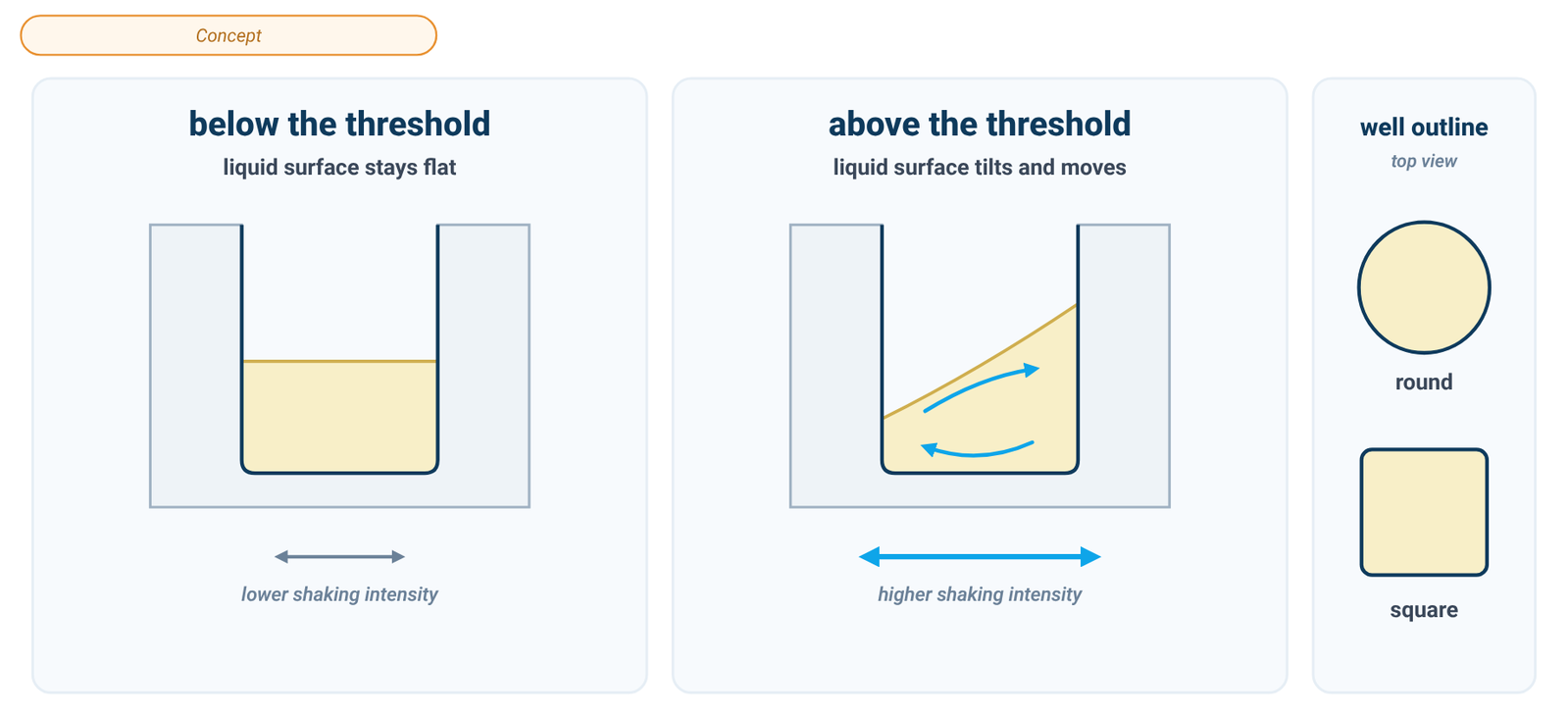
A microplate shaker has to overcome a well-mixing threshold: below a critical shaking intensity, the liquid surface can remain flat with no observable liquid movement [1][2]. Above that threshold the liquid begins to move, while a separate upper limit is set by spilling [2]. This guide explains why, what the threshold depends on, and how to set up a plate run that mixes without spilling. It then turns to a second small-volume job on the same bench: opening cells in 2 mL tubes to prepare a cell lysate. Neither job is the same as vortexing a single tube, which our guide to how a vortex mixer works covers. The ALab™ SH-P4, MX-M, MX-C, VM25D and MVM25 serve as worked examples, using only ACS Material's specifications. Everything here is written for research laboratory use. For the wider picture, see our guide to laboratory mixing methods.
Quick answer: In a microplate well, surface tension holds the liquid still until the shaking passes a threshold the literature calls the critical shaking frequency [1][2]. Start low, raise the speed until the wells visibly mix, and stay below the point where liquid spills. Where a kit insert names a shaker setting, follow the insert. Opening tough-walled cells is a separate job: it usually needs a mechanical method, or a lysis buffer and enzymes, chosen for the organism [3].
1. Why Liquid in a Well Does Not Mix by Itself
In microtiter plates, surface tension can keep the liquid surface flat until a critical shaking condition is reached [1][2]. A study of shaken microtiter plates put it plainly: "Up to a specific shaking intensity the liquid surface in the wells remains horizontal and no liquid movement can be observed." [1] The same authors noted that "This behavior is solely specific to microtiter plates and has not yet been observed for larger shaking bioreactors such as shaking flasks." [1] The literature refers to this threshold as the critical shaking frequency [2].
What sets that threshold? A later analysis of microtiter plate hydrodynamics writes it as a simple equation [2]. In words, the critical frequency rises with the surface tension of the liquid and with the well diameter, and falls as the fill volume and the shaking diameter of the instrument increase (liquid density also enters). The practical message is that there is no single speed that suits every plate or liquid: changing well geometry, fill volume, liquid properties or shaking diameter changes the threshold [2].
There is an upper limit too. "The upper limit is determined by the highest shaking frequency at which the liquid is not spilled." [2] So the usable window sits between a still surface and liquid over the rim, and the fuller the well, the narrower it gets.
Well shape matters as well. In square wells "the corners act as baffles" [1], and a study of mixing in shaken microwells found that "Mixing times are longer in cylinder wells at low shaken speeds when compared to square microwells." [4] The same study reports that "a range of rotational speeds was identified where mixing is less effective due to reduced free surface oscillation" [4], so faster is not automatically better. Surface wave patterns also change with fill height and container size [5], so check the wells by eye.
Finally, mixing a well does not have to mean shaking it. In a study of 96-well plates with fluorescent indicators, "Mixing by liquid dispensing was much more effective than by shaking." [6] That result supports treating reagent dispensing as part of the mixing step when the protocol permits, rather than assuming that additional shaking is always required [6].
2. What a Microplate Shaker Does, and How to Read Its Spec
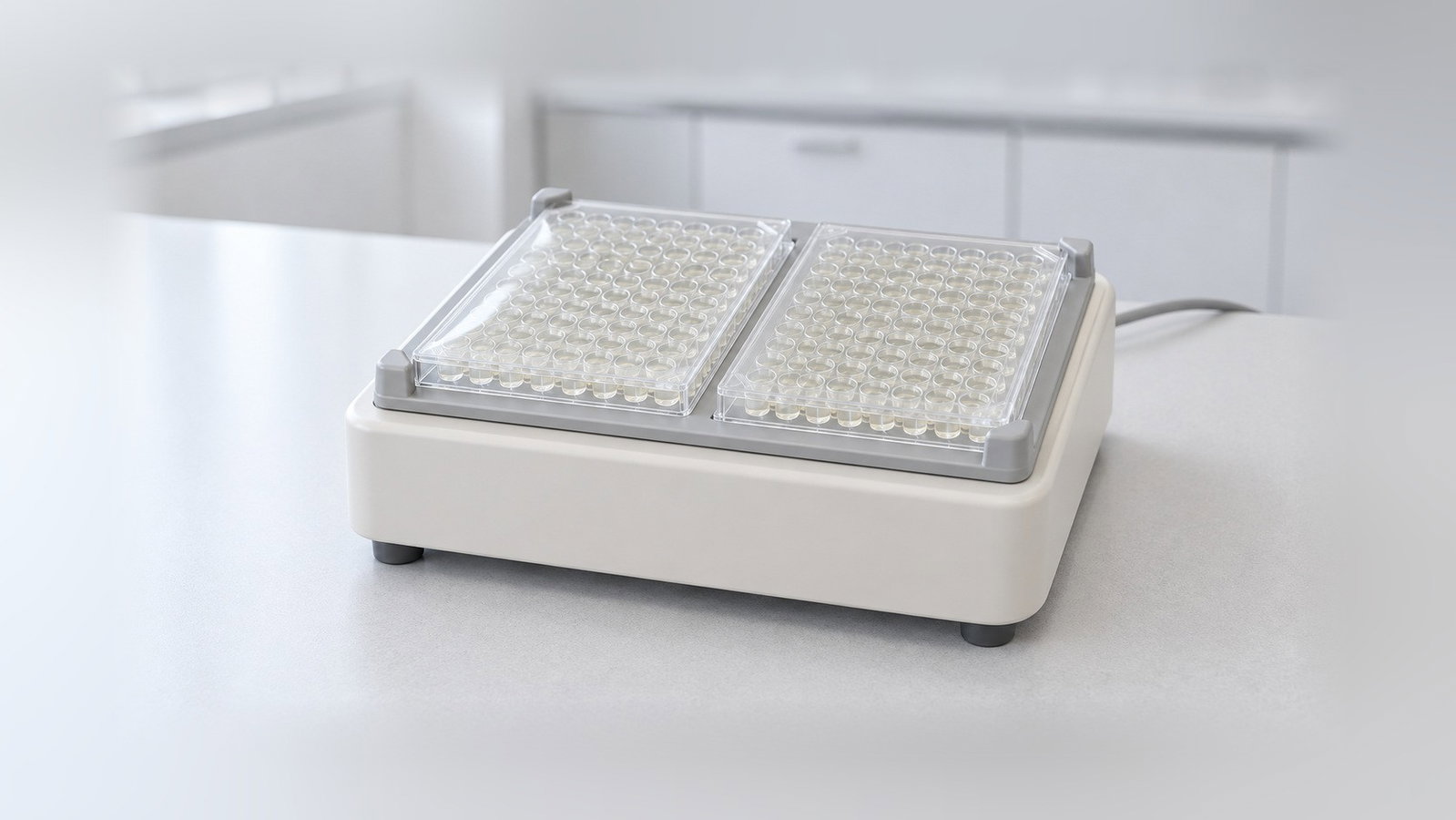
A microplate shaker holds plates flat on a platform and moves it in a small, fast, repeating path so every well gets the same motion. Nothing tilts or rolls. For tilting and rolling motions on larger trays, see our comparison of orbital, linear, rocking and 3D shakers.
Product specifications describe the size of that path in different words, and the words are not interchangeable. The SH-P4 lists "Shaking amplitude: 3 mm, horizontal rotation". The MX-M lists "Shaking Movement: Orbital" and "Orbital Diameter: 4.5 mm". Read each value under ACS Material's own label for that model. This article does not convert one label into the other, and it does not rank the two models by their numbers. Different labels can describe different measurements, and how one figure relates to the other is not specified. Orbit vocabulary on vortex heads is explained in our vortex mixer guide.
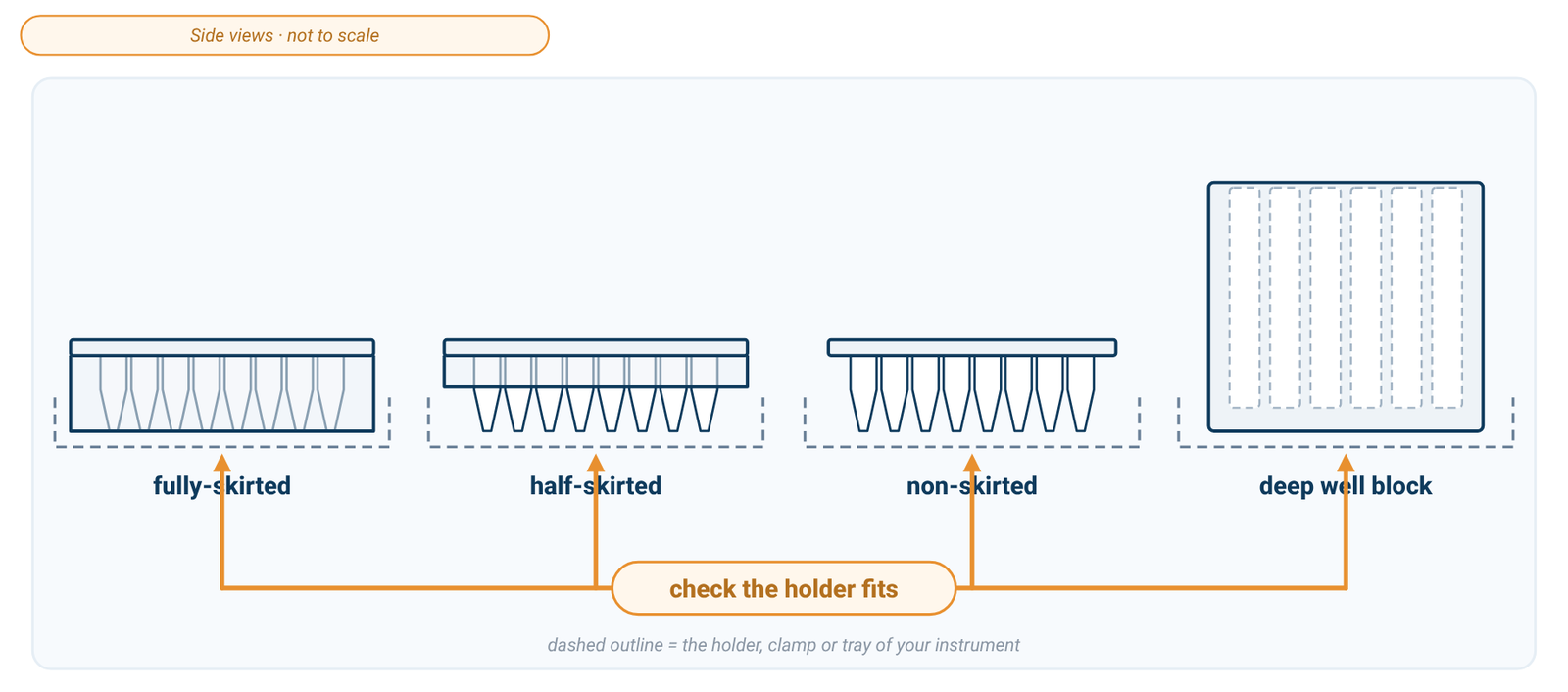
The plates themselves are more standard than the instruments. A microplate typically has 6 to 1536 wells, and "Microplates are produced with the same standardized footprint" [7]. Height is another matter. Deep well microplates are sometimes called blocks, and the ANSI SLAS height standard "does not define a standard height for deep well plates (blocks)" [7]. Skirts differ too: PCR plates come fully skirted, half-skirted or non-skirted. Before a run, check that your plate or block actually sits in the holder or clamp of the instrument you plan to use.
3. SH-P4 Microplate Shaker: Four Plates, a Timer, Bench or Incubator
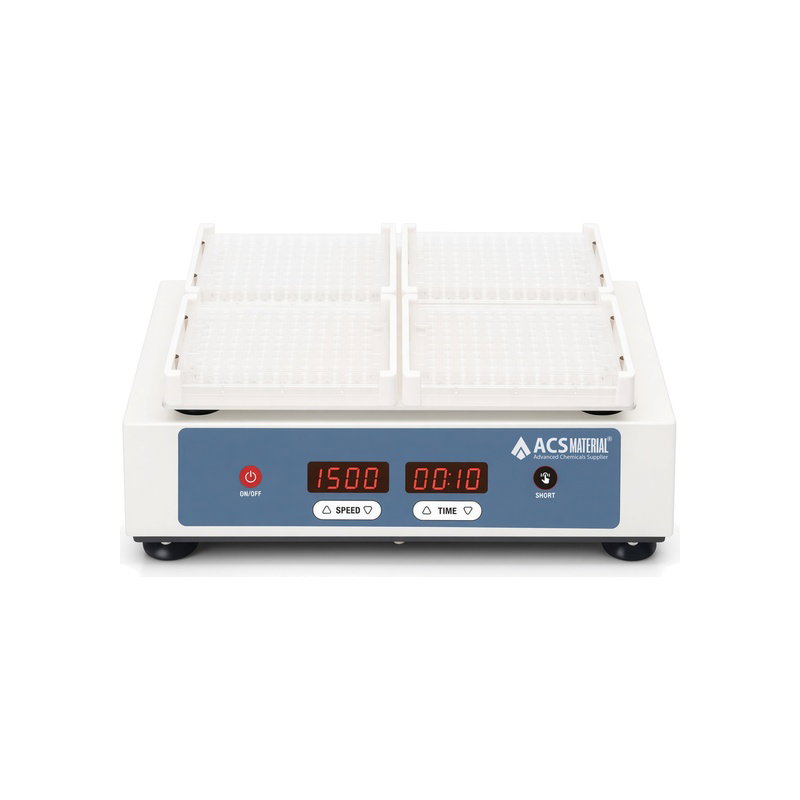
The SH-P4 microplate shaker is built for plates only. ACS Material says it "provides stable, reliable and regular shaking of up to four microplates, cell culture plates or deep well plates", and the specification lists "Sample capacity: 4 microplates, cell culture plates or deep well plates". The package includes a "Standard loading platform for 4 plates".
Its other specifications are:
- Speed range: 200 to 1500 rpm.
- Shaking amplitude: 3 mm, horizontal rotation. ACS Material's FAQ phrases it the same way: "200 to 1500 rpm with a 3 mm horizontal rotation amplitude."
- Time range: 1 min to 99 h 59 min.
- Operation: Continuous, short or timed. In ACS Material's words, "the shaker runs continuously, for short runs or on the timer".
- Display: LED (speed and time). Motor: Brushless.
One point needs care. The listed capacity names deep well plates, while the body text says "A standard loading platform holds four standard-depth multi-well plates with quick clamping". Because deep well blocks have no standard height, check that your block fits the clamp before you plan a run around it.
ACS Material also says: "The SH-P4 is designed specifically for microplates and can be used on the bench or inside an incubator." That statement belongs to the SH-P4 alone. Among its listed uses, ACS Material names "immunoassays, ELISA plate shaking, flow cytometry staining". ACS Material also notes that "Gentle shaking keeps the contents in the wells without overflow", which matches the spill limit described in Section 1: the right setting keeps liquid moving and inside the well.
4. MX-M Microplate Mixer: One or Two Plates on a Compact Base
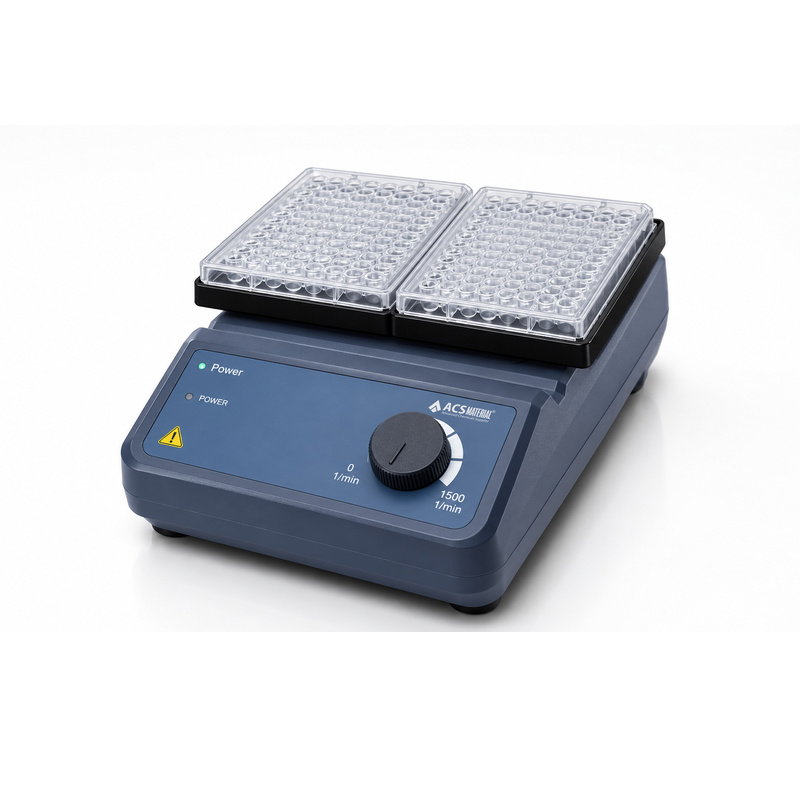
The MX-M microplate mixer is the smaller option. ACS Material says it "is used for holding single or double microplates", with "orbital shaking movement with a 4.5 mm orbital diameter, electronic speed control".
Its speed depends on the load: "Single microplate: 0–1500 rpm; double microplate: 0–1000 rpm". "Speed is controlled electronically, and the speed display is a scale." In other words, the control shows a position on a scale, not an rpm readout, so set it by watching the wells rather than by a number. The load limit is "Max. Shaking Weight (with accessory): 0.5 kg", and the motor is a "Brushless DC motor".
Most of the flexibility is in the accessories, which ACS Material describes "With adapters for most popular vessels and microtiter plates":
- A single well plate tray kit whose work plate is "suitable for fully-skirted PCR plates, cell culture plates, enzyme immunoassay plates, and deep-well plates; use with a well plate adapter for half-skirted or non-skirted PCR plates".
- "Double microplate clamps" for two plates at once.
- Tube adapters for small tubes and PCR strips, used with a "Universal top plate, used with tube adapters".
ACS Material adds a caution worth repeating: "never exceed the rated speed range or the max. shaking weight". With two plates or a heavy block, that means staying within the double microplate range and the weight limit together.
5. SH-P4 or MX-M? Choosing by Plates, Timer and Space
Table 1. SH-P4 and MX-M specifications
| SH-P4 | MX-M | |
|---|---|---|
| Product type | Microplate shaker | Microplate mixer |
| Plates held | Sample capacity: 4 microplates, cell culture plates or deep well plates | Single or double microplates ("is used for holding single or double microplates") |
| Speed | Speed range: 200 to 1500 rpm | Speed Range: Single microplate: 0–1500 rpm; double microplate: 0–1000 rpm |
| Motion / geometry (label: value) | Shaking amplitude: 3 mm, horizontal rotation | Shaking Movement: Orbital; Orbital Diameter: 4.5 mm |
| Load | — | Max. Shaking Weight (with accessory): 0.5 kg |
| Timer | Time range: 1 min to 99 h 59 min | — |
| Operation | Operation: Continuous, short or timed | — |
| Display | Display: LED (speed and time) | Speed Display: Scale |
| Motor | Motor: Brushless | Motor Type: Brushless DC motor |
| Power | Power: 80 W | Power: 20 W |
| Dimensions | Dimensions (L × W × H): 340 × 210 × 145 mm | Dimensions: 260 × 150 × 80 mm |
| Weight | Weight: 5 kg | Weight: 3 kg |
| Incubator use | "can be used on the bench or inside an incubator" | — |
Source: ACS Material product specifications (October 2026). The two geometry values use different labels; they are not converted into one another and not compared as stronger or weaker. The MX-M speed display is a scale, not an rpm readout. A dash means the specification is not listed, not that the feature is absent.
Choose by what you need to hold and how you run it, not by the speed figures:
- Four plates at once, long timed runs, or use inside an incubator: the SH-P4 microplate shaker. It has a timer and an LED display of speed and time, and ACS Material lists incubator use.
- One or two plates on a compact base, or tubes and PCR plates as well: the MX-M microplate mixer, with its tray kit, double microplate clamps and tube adapters. No timer is listed, so this article makes no timer claim for MX-M.
Neither model is a ranking of the other. The rpm and geometry figures in Table 1 sit under different labels and do not tell you which model suits a given plate; the setting that matters is found in the well, as described next.
6. Setting Up a Plate Run That Mixes Without Spilling
These steps follow from the literature in Section 1 and apply to any microplate shaker:
- Match plate and holder. Check the plate type and skirt against the holder, clamp or tray kit, and check deep well blocks for fit [7].
- Fill moderately. A fuller well spills at a lower setting, which narrows the usable window [2].
- Use the plate closure specified by the method. Follow the assay or plate instructions for any lid or seal.
- Mix on addition where the method allows it. In one 96-well study, liquid dispensing mixed more effectively than shaking [6].
- Start low and raise the speed. Increase it until the liquid surface in the wells visibly moves, then stay below the point where liquid climbs the walls or spills [1][2].
- Follow the kit insert. Immunoassay inserts often state the shaker type, its orbit and a speed range; one ELISA kit insert, for example, specifies a "Horizontal orbital microplate shaker" for its incubations [8]. Use the insert's own conditions, and check with ACS Material whether a given model matches them.
- Time the run so every plate gets the same treatment.
Shaking with temperature control is a different instrument class, covered in our dry bath and thermo mixer hub.
7. Other Ways to Hold a Plate
Some vortex mixers accept a plate clamp. The specification for the VM25 & VM25D vortex mixer lists the adapter "Platform shaker/Microplate clamp" for the VM25D; no plate count or plate type is specified for it, so check your plate against the clamp. Other vortex mixer clamps and heads are covered in our vortex mixer guide.
8. Preparing Cell Lysates in 2 mL Tubes
A plate shaker mixes what is already in solution. Getting the contents out of cells is a separate step.
8a. Why Cells Need Opening, and the Three Routes
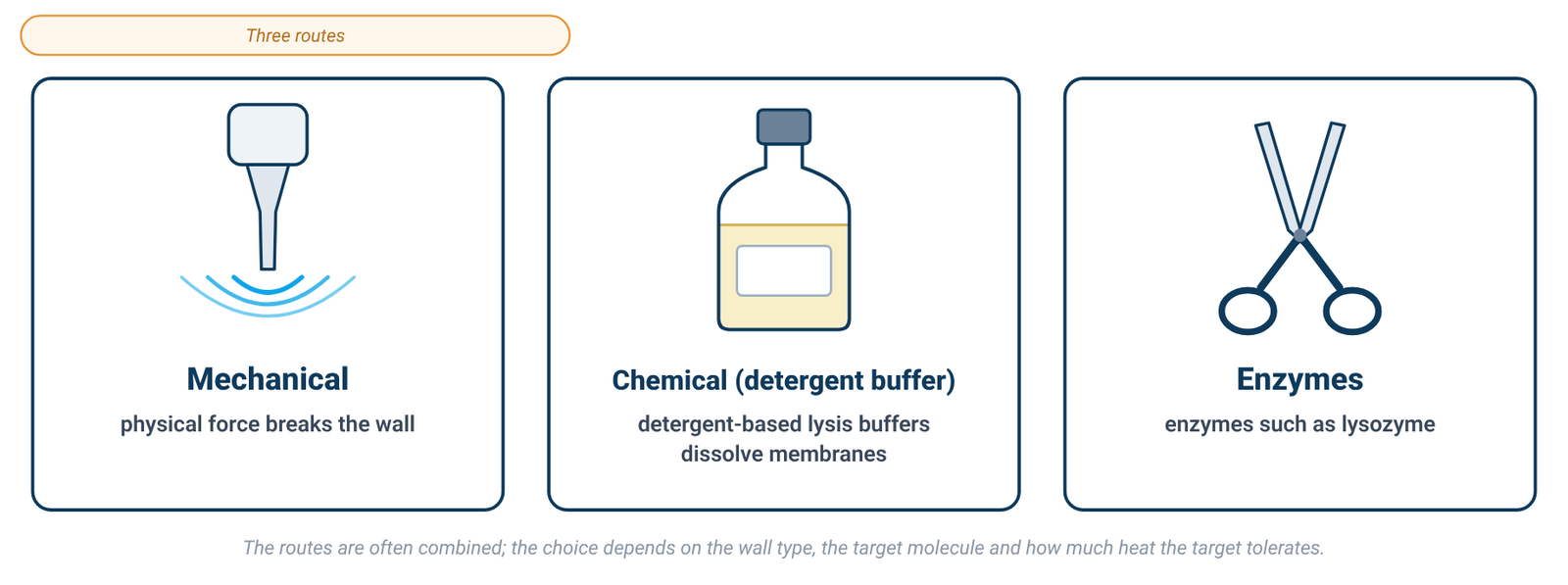
Many microorganisms protect themselves with a tough wall. "Yeast cell walls are relatively rigid structures due to the β(1,3)-glucans" [9], and in filamentous fungi "The structure of the fungal cell wall makes their disruption for nucleic acid extraction difficult." [10] Disruption methods "can be mainly classified into mechanical and non-mechanical ones" [9]. A review of cell lysis methods describes three broad routes [3]:
- Mechanical: physical force breaks the wall, for example bead milling, sonication or homogenisation.
- Chemical: detergent-based lysis buffers dissolve membranes; "Detergents are often used along with lysozymes for lysing bacteria" [3].
- Enzymatic: "Enzymatic lysis is a biological cell lysis method in which enzymes such as lysozyme, lysostaphin, zymolase, cellulose, protease or glycanase are used." [3] Cell wall lytic enzymes are described as valuable "for recovering of intracellular products from yeast or bacteria" [11].
The routes are often combined; the choice depends on the wall type, the target molecule and how much heat the target tolerates.
8b. Bead Beating in Principle
"Bead mill, also known as bead beating method, is a widely used laboratory scale mechanical cell lysis method." [3] The cells are agitated with beads so that repeated collisions provide mechanical disruption [3]. The same review warns that the collisions generate heat and that "This elevated heat may degrade proteins and RNA." [3]
8c. MX-C Cell Disruptor
The MX-C cell disruptor holds small tubes. ACS Material says it "disrupts cells, yeast, bacteria, algae, fungi, etc. to prepare cell lysates for further processing". In the literature, tough-walled cells such as yeast, fungi and many bacteria are usually disrupted by an organism-appropriate mechanical method (see Section 8b) or with lysis buffers and enzymes such as lysozyme; the right method depends on the organism and on what is being extracted [3][11].
ACS Material describes the instrument in these terms:
- Mixing motion: "High-speed circumferential vortex and oscillation function".
- Orbital diameter: 4 mm.
- Speed range: "0–3000 rpm (Adjustable)", with a scale speed display.
- Capacity: "up to 8 microtubes (capacity 8 × 2 mL)".
ACS Material is also open about its platform: the MX-C and the MX-S share the same 0–3000 rpm speed range with a scale speed display, a 4 mm orbital diameter, 60 W power, 127 × 130 × 160 mm dimensions and a 2.0 kg weight. What sets the MX-C apart is its capacity for eight 2 mL tubes. Plan the lysis method for your own organism first, and run a pilot with your own samples before committing a batch.
8d. Mixing Many 1.5/2.0 mL Tubes at Once
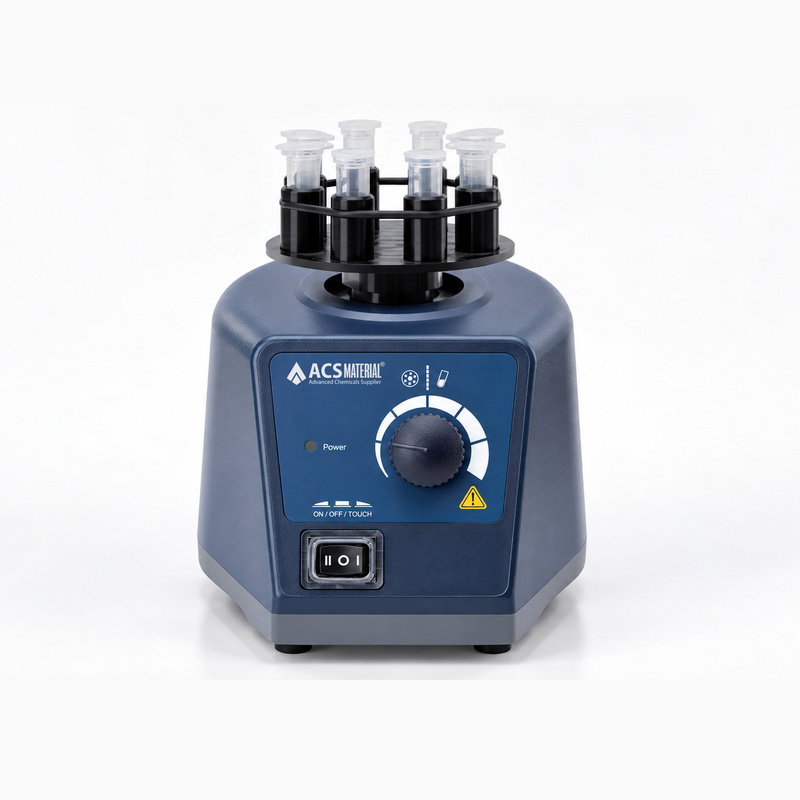
When the job is mixing a batch of tubes rather than opening cells, a multi-tube vortex mixer is the batch tool. The MVM25 multi-tube vortex mixer "can mix and process 50 samples at the same time", and its acrylic clamp "can place 1.5/2.0 mL centrifugal tubes". It lists tube clamps only and no plate holder, and it is not described as a cell disruptor. Shaking many tubes on one platform is also not the same as holding a single tube on a vortex head.
Safety for Lysates and Plates
Keep tubes closed and plates sealed while they move, avoid "over-vigorous mixing" [12], and use the lowest speed that does the job [13]. "Brief centrifuging of mixed tubes before opening can help move any liquid away from the cap." [12] Open biohazardous samples in a biosafety cabinet, as your institution's procedures require.
9. Frequently Asked Questions
What speed should I use on a microplate shaker?
There is no single number. The threshold for mixing depends on well size, fill volume, the liquid and the instrument's shaking diameter [2]. Start low, raise the speed until the wells visibly mix, and stay below spilling; where a kit insert gives a setting, follow the insert [8].
Is there a difference between a microplate shaker and a microplate mixer?
They do the same basic job: both hold plates flat and move them so the wells mix. The names follow ACS Material's product names (the SH-P4 is a microplate shaker, the MX-M a microplate mixer). Compare plate capacity, timer, display and holders rather than the name.
Can I use a deep well plate shaker for deep well blocks?
Check the holder, not just the name. The SH-P4 capacity lists deep well plates, and the MX-M tray kit lists deep-well plates. Deep well blocks have no standard height [7], so confirm that your block fits the clamp or tray.
Can a microplate shaker go in an incubator?
In this article, incubator use is listed only for the SH-P4: ACS Material says it "can be used on the bench or inside an incubator". No incubator claim is made here for MX-M, MX-C, VM25D or MVM25.
Is a vortex mixer enough to lyse cells?
For tough-walled cells, do not assume vortexing alone is sufficient. The literature describes organism-dependent mechanical methods and lysis-buffer or enzyme routes for opening these cells [3][9]. Section 8 covers the routes; vortexing is covered in our vortex mixer guide.
Choosing a plate shaker? See the SH-P4 microplate shaker for up to four plates with a timer, on the bench or inside an incubator. Or see the MX-M microplate mixer for one or two plates on a compact base, with a tray kit and tube adapters.
10. Keep Exploring the Mixing Hub
- Laboratory mixing methods guide: every mixing method compared.
- How a vortex mixer works: orbit, speed and modes on a vortex head.
- Orbital vs linear vs rocking shakers: matching platform motion to flasks, gels and blots.
- Tube roller vs tube rotator: rolling, rotating and rocking motion for closed tubes.