
A pipette controller is the hand-held device that draws liquid into a serological pipette and lets it out again, so nobody has to pipette by mouth. In a cell culture room it works alongside a second tool: a vacuum aspirator that pulls spent medium, wash buffer or supernatant out of flasks and plates into a collection bottle. This guide explains how manual and battery-powered pipette controllers differ, what the hydrophobic filter in a controller does and does not do, how to handle serological pipettes aseptically, and how vacuum aspiration systems and traps are set up for media removal. Product details come from ACS Material's ALab™ specifications. For the wider picture of pipettes, dispensers and controllers, see the pipetting and liquid handling guide.
Quick answer: Biosafety guidance is plain: "Mouth pipetting is prohibited. Mechanical pipetting devices are used." [1] A pipette controller, also called a pipette aid [2] or serological pipette filler, is that device for serological pipettes. Its hydrophobic filter "protects the pipette controller from accidental over-aspiration" [3]; it does not make a transfer sterile, which depends on sterile pipettes and aseptic technique [4]. For media removal, a vacuum aspirator collects waste into a bottle. For vacuum lines used in BSL-2 work, BMBL recommends protection "with liquid disinfectant traps and in-line HEPA filters or their equivalent" [1]; the suitability of a particular device or arrangement still requires a biosafety risk assessment.
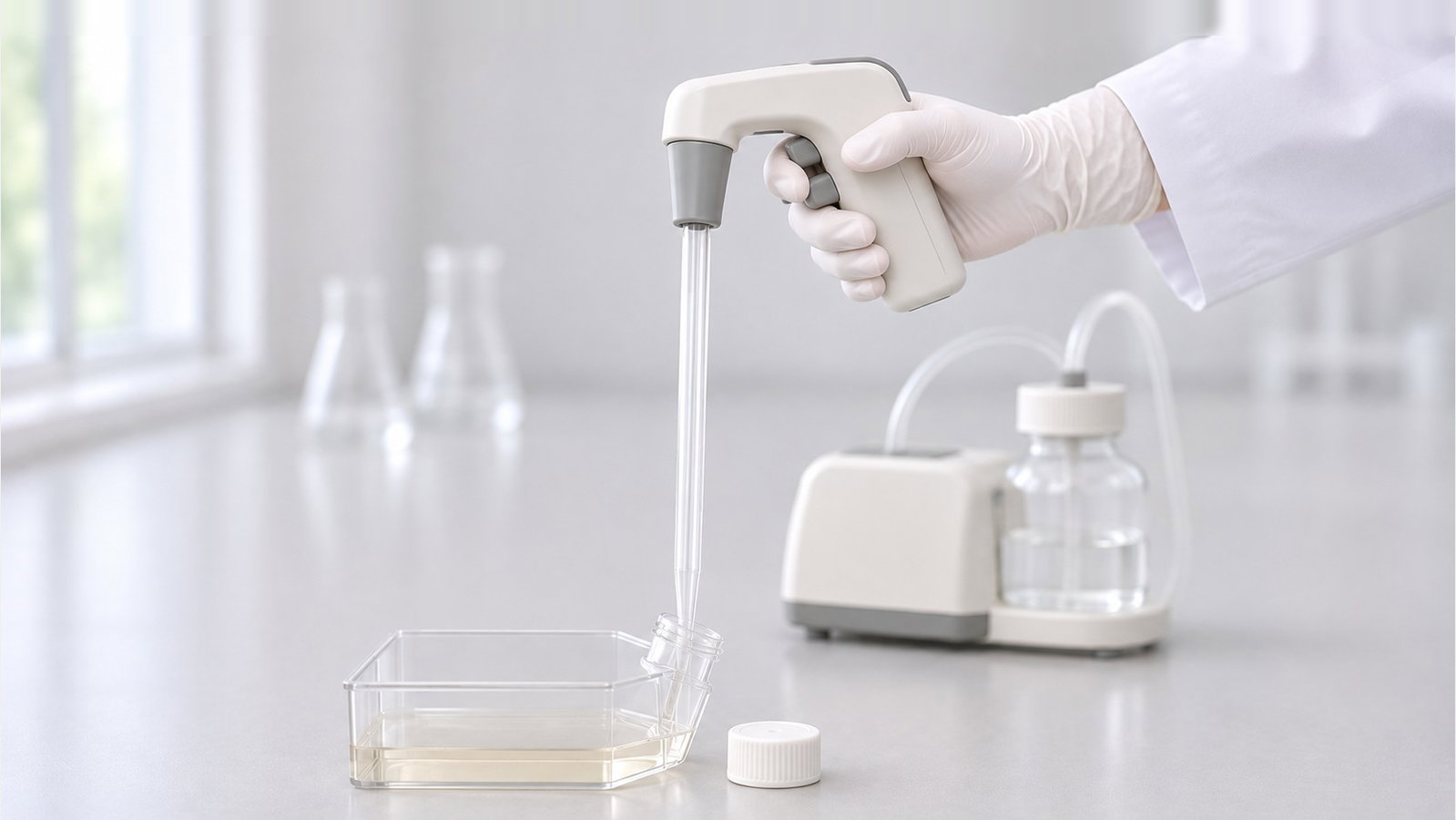
1. What a Pipette Controller Does
A serological pipette is a graduated tube open at both ends. The pipette controller seals onto its top end and creates the suction that fills it and the controlled release that empties it. One aseptic technique protocol tells students to affix "a pipette aid such as a bulb, pump, or gun" to the top of the pipette and adds, in capitals, "DO NOT MOUTH PIPET!" [2]. The WHO Laboratory Biosafety Manual lists "Prohibit pipetting by mouth." among its core requirements [5].
Serological pipettes cover a wide span. Pre-sterilized pipettes with a cotton wool plug are needed for tissue culture work, and larger ones "can deliver volumes up to 100 ml" [2]. Controllers are sized to match: the ACS Material Levo, Levo Plus and Levo ME all have a pipette range of 0.1–100 mL.
Delivered volume depends on the serological pipette and how the operator fills, reads and dispenses it; controller operation can also affect the result. Serological pipettes are read at the meniscus against their graduation marks, holding the pipette upright at eye level [2][6]. A controller provides suction and controlled release, but this article does not establish volume accuracy for any controller–pipette combination.
2. Manual, Battery and Thumb-Wheel Pipette Controller Types
Controllers fall into three practical groups.
Manual bulb controllers. Suction comes from squeezing a bulb, and valves let you meter the flow. For the Levo, ACS Material gives the steps: "Squeeze the ball to suck the liquid." Then "The filling rate can be adjusted continuously with the help of the operating rod." To empty the pipette, "Press the operating lever to drain the liquid." For the last of the liquid you "press the blow out ball". Manual controllers need no charging.
Battery (motorised) controllers. A small pump does the work, and buttons set direction and speed. The Levo Plus lists "6 levels; select the pipetting speed by pressing the up / down button", a display with "battery status, low battery warning and speed settings", and dispensing by "Motor / Gravity". The Levo ME is described with "Aspiration (upper button) and dispensing (lower button) speeds set individually, simply with finger tips". Both list Pasteur pipettes as well as serological pipettes.
Thumb-wheel pipette pumps. These are sized to fixed capacities and driven by a thumb wheel rather than a motor. The Levo E lists "2 mL, 5 mL, 10 mL and 25 mL", a "thumb wheel for precise aspiration or dispensing" and a "Side lever enables complete liquid dispensing, without a droplet remaining". ACS Material says the pumps are "Colour-coded by volume with blue, yellow, green and red" but does not pair a colour with a size; confirm the colour-to-capacity mapping with ACS Material before ordering.
Speed matters more than it seems. One controller manufacturer recommends presetting the speed to minimum for 1 and 2 ml pipets "to avoid overfilling", and a faster setting for 5–100 ml pipets matched to the volume and sample [6]. Gentle handling matters for the cells too: a cell culture guide lists too-vigorous pipetting as one cause of cell clumps after dissociation [7].
| Model | Product type | Pipettes / capacity | Aspiration speed | Power / operation | Filter | Weight |
|---|---|---|---|---|---|---|
| Levo | "Pipette Controller" | "Glass or plastic serological pipettes (0.1–100 mL)" | "Can absorb 25 mL liquid in 4 secs" | Bulb: "Squeeze the ball to suck the liquid." | "3 µm replaceable hydrophobic filter" | "118 g" |
| Levo Plus | "Pipette Filler" | "Glass or Plastic Pipette (0.1–100 mL), Pasteur Pipettes" | "25 mL < 5 s (6 levels)" | "Replaceable lithium battery" | "0.45 µm Hydrophobic" | "208 g" |
| Levo ME | "Pipette Filler" | "Glass or Plastic Pipette (0.1–100 mL), Pasteur Pipettes" | "25 mL < 7 s" | "Lithium-ion" | "0.45 µm Hydrophobic" | "200 g" |
| Levo E | "Pipette Pump" | "2 mL, 5 mL, 10 mL and 25 mL" | — | "thumb wheel for precise aspiration or dispensing" | — | — |
A dash means the specification is not listed. The aspiration-speed entries use different terms and unspecified test conditions, so they are not a like-for-like speed comparison. Battery service life is also specified: Levo Plus "More than 12 Hours of Intermittence Use" ("4–5 Hours" charging) and Levo ME "More than 8 Hours of Intermittence Use" ("2–3 Hours" charging).
3. The Hydrophobic Filter: What It Does and Does Not Do
Many pipette controllers use a hydrophobic filter between the pipette and the pump or bulb. Manuals describe its purpose in the same way. One says "The filter protects the pipette controller from accidental over-aspiration." [3] Another says "The hydrophobic filter prevents excess liquid entering the device" [6]. A third warns "Take care to avoid aspirating the liquid into the Pipette Controller which can impair performance." [8]
A wet filter is a working fault, not a minor nuisance. "Wetting of filter due to overfilling will slow or prevent fluid movement." [3] Troubleshooting tables list reduced aspirating efficiency with the cause "Filter wetted" and the fix "Replace filter" [8]. One manufacturer says the filter "should be replaced when over-aspiration or possible contamination has occurred" [9]; another suggests replacement every three months as well as after overfilling [6]. Never run a controller without its filter [9].
What the filter does not do is make your work sterile. Whether a replacement filter is supplied sterile is a separate manufacturer-stated attribute, not something established by the hydrophobic pore-size specification. One manufacturer's accessory list distinguishes a "Replacement filter, 0.45 µm, non-sterile, autoclavable" from a "Replacement filter, 0.2 µm, sterile" [9]. Neither label, by itself, establishes sterile transfers or a validated sterile fluid path. An instrument manual adds: "It is the user's responsibility to ensure proper sterilization." [8] In cell culture, asepsis comes from sterile pipettes used once, clean surfaces and careful handling [4]. The cotton plug in a serological pipette "is designed to function as a barrier to overfilling the pipette" and should not be removed [2]; the WHO manual says pipettes or tips should have cotton plugs "to reduce contamination of pipetting devices" [5].
ACS Material gives pore sizes: Levo "3 µm replaceable hydrophobic filter"; Levo Plus and Levo ME "0.45 µm Hydrophobic". These are filter specifications, not sterility claims, and this guide does not rank one against another.
4. Handling Serological Pipettes Aseptically
A good controller cannot rescue poor technique. These steps come from cell culture and aseptic technique guides.
- Open the pipette at the top. Peel the wrapper from the top end, attach the controller, and keep the tip covered until use [2][6]. "Do not unwrap sterile pipettes until they are to be used." [4]
- Touch only the top. "Touch only the top of the pipette (above the graduation marks) with your hands." [2] Keep the tip away from anything nonsterile [4].
- One pipette, one use. Use each pipette only once "to avoid cross-contamination" [4], and "Never go into a sterile solution with a used pipette" [2]. A cell culture guide adds "Avoid sharing pipettes or other equipment." [7]
- Fill slightly over, then set the meniscus. Aspirate slightly more than needed and adjust to the graduation by dispensing to waste [6]. If liquid remains on the outside, follow the applicable aseptic procedure rather than touching or wiping the sterile tip indiscriminately.
- Deliver against the wall. Dispense into the target vessel with the tip touching the vessel wall [6].
- Check the pipette type; avoid forced expulsion of biological agents. Check the label near the top of the pipette for its delivery type [2]. ISO 835 defines a blow-out type for glass graduated pipettes, in which "the last drop of liquid in the jet is expelled by blowing" [10]; this does not establish the instructions for a particular disposable plastic serological pipette. For liquids containing biological agents, follow the WHO guidance not to blow air or forcibly expel them [5]. For other work, follow the specific pipette instructions and the laboratory SOP.
- Keep the controller clean. Wipe the pipettor and other items with 70% ethanol before work [4]; clean controllers regularly with soapy water or 70 % ethanol [6].
Pipetting can generate aerosols or splashes. For BSL-2 procedures involving potentially infectious aerosols or splashes, BMBL includes pipetting among activities for which a properly maintained BSC or other physical containment device is used when possible; where that is not possible, it calls for appropriate personal protective equipment and administrative controls based on a risk assessment [1]. This is guidance about the procedure, not an endorsement of any ACS Material controller or aspirator for use inside a cabinet. Training matters as much as hardware: the WHO manual requires that all personnel be adequately trained in the correct use of pipettes [5].
Serological pipettes are read by meniscus; air-displacement micropipettes set volume with a piston and use different techniques, covered in forward versus reverse pipetting.
5. How Vacuum Aspiration Works for Media Removal
Changing medium, washing a monolayer and passaging all begin the same way: "Remove and discard the spent cell culture medium from the culture vessel." [4] Many labs do this with an aspirator: a pipette or tip on a hose, a collection vessel, and a vacuum source. A cell culture handbook lists an "Aspiration pump (peristaltic or vacuum)" among expanded cell culture equipment [4].
When the vacuum comes from a house line or a separate pump, biosafety guidance asks for a protected set-up. BMBL states: "Vacuum lines in use are protected with liquid disinfectant traps and in-line HEPA filters or their equivalent. Filters are replaced, as needed, or are on a replacement schedule determined by a risk assessment." [1] University biosafety offices describe the same layout:
- Catch flask (A) pre-filled with a disinfectant selected under the laboratory biosafety SOP. As one institution-specific example, where household bleach is used, Kentucky guidance calls for pre-filling flask A so that household bleach makes up 10 % of the flask's final contents when the flask is full, followed by 20 minutes of contact time [11]. This is not a universal recipe for all waste streams or an instruction to fill the flask completely.
- Overflow flask (B) between the catch flask and the vacuum. One office leaves it empty [11]; another puts disinfectant in it at about 10–15% of the flask volume [12]; a third places the tube into the solution in flask B "to minimize aerosols" [13]. Follow your own institution's version.
- In-line HEPA filter or risk-assessed equivalent (C) before the vacuum port, consistent with BMBL vacuum-line guidance [1]. Do not assume that an arbitrary hydrophobic filter meets that requirement. Replace the filter if liquid reaches it or it clogs, according to the applicable system procedure [12].
- Spill tray or secondary containment under both flasks [11][13].
Disinfectant does not last indefinitely. Princeton EHS warns that bleach diluted with water loses effectiveness after 24 hours and calls for fresh bleach and adequate contact time before disposal; it also advises against alcohol in the flask [13]. Follow the institution's validated disinfectant concentration, contact time and disposal rules rather than combining different universities' procedures. For fill limits, Wisconsin guidance says never more than 2/3 full [12], while Princeton uses about 75 % as its point for initiating disinfection and disposal [13].
A benchtop aspirator with its own pump and bottle changes the hardware but does not automatically satisfy vacuum-line containment guidance. Whether disinfectant is used in its bottle, what overflow and filter protection is needed, and where the device may be placed must be determined from its manual and a biosafety risk assessment. No product information cited here establishes BSC placement approval or compliance with the BMBL trap arrangement.
6. Comparing SafeVac, EcoVac and Smart VAC
The three ACS Material vacuum aspirators differ mainly in size, bottle volume and control. Values below are from ACS Material's specifications.
| Model | Product type | Vacuum range | Flow / speed | Bottle | Noise | Dimensions | Weight |
|---|---|---|---|---|---|---|---|
| SafeVac | "Vacuum-controlled aspiration system" | "0–600 mbar" | "15 L/min (air)"; "17 mL/s (liquid)" | "4 L" | "≤55 dB" | "180×240×450 mm" | "3 kg" |
| EcoVac | "Economical vacuum aspirator" | "0–500 mbar" | "15 L/min (air)"; "17 mL/s (liquid)" | "2 L standard; 1 L optional with adaptor" | — | "180×240×340 mm" | "2.8 kg" |
| Smart VAC | "Bench-top compact vacuum aspirator" | "0–600 mbar" | "1.6 L/min (air)" | "1L collection bottle in standard package; 500mL bottle with an adaptor, or filtration flask optional" | "53 dB" | "127×144×244 mm" | "0.5 kg" |
A dash means the specification is not listed. SafeVac and EcoVac specifications give both air flow and a maximum liquid aspiration speed; Smart VAC reports air flow only. Without a common tubing, tip, liquid and test setup, those values are not a controlled throughput comparison and do not support calculated time-per-flask figures.
SafeVac is the larger system. It lists a "Level detection system prevents bottle overfill", a "Control knob for vacuum setting; adjustable vacuum level with indicator light" and "Self-closing connectors to avoid escape of drops or aerosols from disconnected bottle." ACS Material names uses in "cell culture, DNA extraction, microplate waste removal".
EcoVac sits in the middle, with a "Brushless motor" and "two-level continuous aspiration". ACS Material lists a standard 2 L collection bottle and names "removal of culture media" among its applications. That bottle capacity does not establish compatibility or suitability for every liquid, biological risk group or containment setup. It states a "Collection bottle outlet with hydrophobic filter"; that does not establish HEPA-or-equivalent vacuum protection as described in Section 5.
Smart VAC is the smallest, at "0.5 kg". It lists a "1mL tip detrusion adapter, 8-channel tip detrusion adapter" and names "removal of supernatant from pellets" and vacuum filtration among its applications. These product descriptions do not establish a spill-response procedure or suitability for biohazardous cleanup.
How to choose: match the bottle to the waste volume of a typical session, and check whether you need adjustable vacuum for delicate monolayers or a compact unit for occasional supernatant removal. Then apply Section 5 to whichever unit you choose.
7. Cleaning and Autoclaving
Clean controllers regularly, replace damaged mounts or filters, and treat a wetted filter as a fault [3][6]. For aspirators, empty and disinfect collection bottles promptly under your biosafety protocol; one biosafety office says trap flasks should ideally be disinfected and emptied as soon as you are done or daily [12].
Autoclaving is component-specific. One controller manual permits autoclaving named removable parts but warns against autoclaving the controller body [9]. WHO separately cautions that "pipettes are unlikely to withstand the autoclaving process" [5]; that is not a product-specific instruction for an ALab controller. Follow the applicable model manual and only autoclave the parts it explicitly permits.
| Model | What ACS Material says about autoclaving |
|---|---|
| Levo | Silicone adapter: "For 0.1–100 mL pipette tip; fully autoclavable" |
| Levo Plus | Adapter: "Silicone adapter for pipette tip, fully autoclavable" |
| Levo ME, Levo E | — |
| SafeVac | Autoclave component: "Tube; waste bottle; operation handle" |
| EcoVac | "The parts in contact with liquids can be autoclaved." |
| Smart VAC | "500mL collection bottle (autoclavable)" |
A dash means no autoclave statement is given; ask the manufacturer before autoclaving any part. Autoclaving a part is not the same as keeping a process aseptic; sterile technique still applies [4][8].
8. Levo: A Manual Pipette Controller for Everyday Serological Work
For routine serological work without charging or speed menus, the Levo is a manual pipette controller. ACS Material says:
| Field | Description |
|---|---|
| Product Type | "Pipette Controller" |
| Compatible pipettes | "Glass or plastic serological pipettes (0.1–100 mL)" |
| Aspiration speed | "Can absorb 25 mL liquid in 4 secs" |
| Filter | "3 µm replaceable hydrophobic filter" |
| Silicone adapter | "For 0.1–100 mL pipette tip; fully autoclavable" |
| Weight | "118 g" |
ACS Material adds that it "can realize the midway refill, drains drip by drip with precise control, and has a button for the last drop of liquid". If you prefer motorised speed levels, compare the Levo Plus and Levo ME; for fixed small capacities, the Levo E.
For media removal, the SafeVac pairs a "4 L" bottle with a "Level detection system prevents bottle overfill" and a "Control knob for vacuum setting; adjustable vacuum level with indicator light"; its listed autoclave components are "Tube; waste bottle; operation handle". Compact alternatives are the EcoVac and Smart VAC.
9. Checklist: Pipette Controller and Aspirator Use
- Never pipette by mouth; use a mechanical device [1][5].
- Set a slow speed for small pipettes to avoid overfilling [6].
- Keep the filter in place and dry; replace it after any over-aspiration [3][9].
- Do not count on the controller filter for sterility; use sterile pipettes once and handle them by the top [2][4].
- Follow your SOP on blow-out, and never forcibly expel biological material [5].
- Protect vacuum lines with the disinfectant trap, overflow protection and in-line HEPA filter or risk-assessed equivalent specified by your biosafety programme [1][11].
- Empty and disinfect waste before the flask is too full; refresh bleach [12][13].
- Autoclave only the parts ACS Material or the manual names.
10. Frequently Asked Questions
What is a pipette controller?
It is a hand-held device that fills and empties serological pipettes by suction and controlled release, replacing mouth pipetting [1][2]. It is also called a pipette aid or pipette filler.
Does the filter in a pipette controller keep my culture sterile?
No. The hydrophobic filter protects the controller from over-aspiration [3]. Sterility depends on sterile, single-use pipettes and aseptic technique [4].
How often should I change the controller filter?
Whenever it gets wet or after over-aspiration or possible contamination; one manufacturer also suggests every three months [6][9].
Do I need a trap with a vacuum aspirator?
BMBL describes disinfectant traps and in-line HEPA filters or their equivalent for vacuum lines in use [1], including protected house-line arrangements. A self-contained aspirator does not automatically meet the same containment objective; its required protection depends on its manual and the laboratory biosafety risk assessment.
Which ACS Material parts can be autoclaved?
The Levo and Levo Plus list the silicone adapter; SafeVac lists the tube, waste bottle and operation handle; EcoVac the parts in contact with liquids; Smart VAC the 500mL collection bottle. No autoclaving is specified for the Levo ME and Levo E.
11. Keep Exploring the Pipetting Hub
- Pipetting and liquid handling guide: pipettes, dispensers and controllers from microliters to milliliters.
- How to use a micropipette: forward vs reverse pipetting and the errors that matter.