
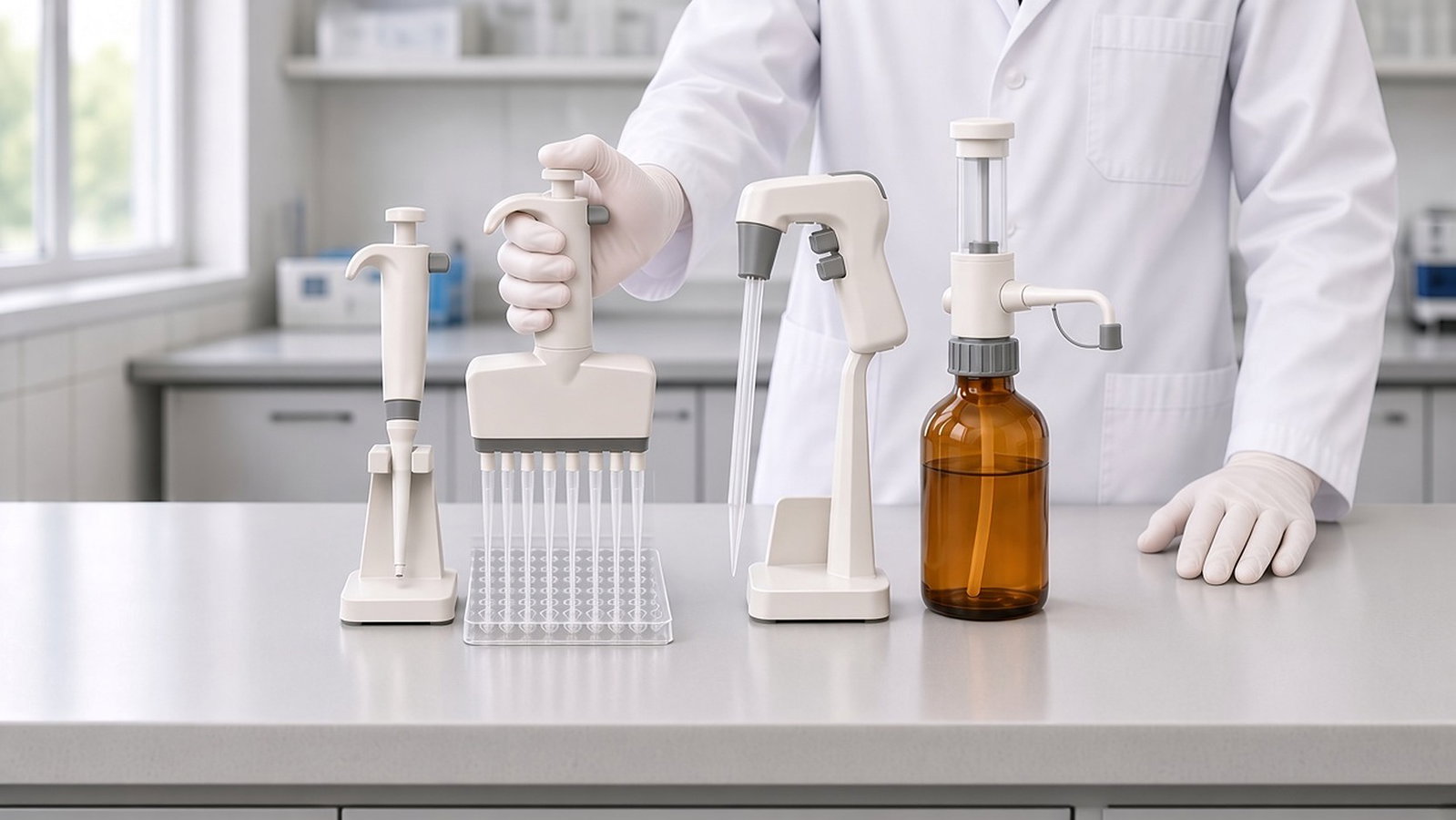
Pipette types differ more than their shared name suggests: an air-displacement micropipette that moves 2 µL, an electronic pipette that dispenses twelve equal aliquots, a bottle-top dispenser that delivers 25 mL of reagent and a pipette controller that fills a 10 mL serological pipette all solve different problems. Choosing among them comes down to three questions. How much liquid do you move at a time? How many times do you move it? And what is the liquid: aqueous, viscous, volatile, corrosive or biological? This guide walks through each tool class from microliters to milliliters, explains the principles that set their accuracy, and points to a detailed guide for each topic in the ACS Material pipetting hub. Product details come from ACS Material's ALab™ specifications and are named as examples, not recommendations.
Quick answer: For single transfers from about 0.1 µL to 10 mL, use an air-displacement micropipette and pick the smallest range that covers your volume [1]. For long series of equal aliquots, consider an electronic pipette's repeat mode or a positive-displacement stepper [2]. For 96-well plates, a multichannel pipette fills a column or a row in one stroke [3]. For repeated reagent volumes in milliliters, a bottle-top dispenser delivers "preset liquid volumes" straight from the bottle [4], and for titration, a burette delivers until an end point is reached [5]. For serological pipettes up to 100 mL, use a pipette controller, because "Mouth pipetting is prohibited." [6]
1. Pipette Types at a Glance: How Air Displacement Works
Piston-operated pipettes are widely used for transfers in the microliter and milliliter range. ISO 8655 distinguishes air-displacement and positive-displacement pipettes by how the piston relates to the liquid. In an air-displacement pipette, "a body of air" sits "between the piston and the surface of the liquid" (Type A); in a positive-displacement pipette, the piston is "in direct contact with the surface of the liquid" (Type D) [7]. The air cushion is what makes the common micropipette convenient, because the sample touches nothing but the disposable tip. It is also what makes the delivered volume sensitive to the liquid's density, viscosity and vapour pressure, and to temperature [8][9].
Within air displacement there are further choices: fixed-volume or variable-volume, manual or electronic, single-channel or multichannel. Variable-volume pipettes cover a "usable volume range", for example "between 10 µl and 100 µl" [7]. Beyond the micropipette sit four more tool classes that this guide covers: steppers and repeaters for long series of aliquots, bottle-top dispensers and burettes for reagents and titration, pipette controllers for serological pipettes, and vacuum aspirators for removing liquid rather than measuring it.
Positive displacement is an alternative inside the pipette family. Because the piston contacts the liquid directly rather than acting through an air cushion, this principle can reduce some liquid-property effects associated with air displacement; suitability for viscous, dense or volatile liquids still depends on the instrument, consumable and method [2][7][8]. Positive-displacement systems may require dedicated tips or syringes. Fixed-volume pipettes deliver one nominal volume and avoid an adjustable-volume setting on that instrument, although the user must still select the correct pipette.
Two terms run through every section. Systematic error is how far the mean delivered volume sits from the set volume; random error is the scatter between repeated deliveries, often given as a coefficient of variation (CV), which ISO 8655-1 defines as "random error expressed as a percentage of the mean delivered" volume [10]. Data sheets give both, and they are not interchangeable.
2. Choosing a Pipette Volume Range
The nominal volume of a variable pipette is the top of its range, and a pipette is generally most accurate near that top. One manufacturer's buyers guide gives the rule plainly: "the highest accuracy levels are achieved by choosing the smallest volume pipettes capable of handling your volumes" [1]. The reason is partly physical. As the set volume falls, the dead air volume becomes larger relative to the liquid, so the relative error grows [8], and one handbook notes that the user's skill and technique can add more uncertainty than the pipette itself [2].
The Hipette single-channel range, which ACS Material lists as "Ten models, 0.1–10000 µL", shows the effect in its own specifications. At a test volume of 100 µL, the 10–100 µL model is listed at ±0.80 µL (±0.8 %) systematic and ±0.20 µL (±0.2 %) random error, while the 100–1000 µL model at the same 100 µL is listed at ±3.00 µL (±3.0 %) systematic and ±0.60 µL (±0.6 %) random error. Same liquid volume, larger figures on the larger pipette. The values are the manufacturer's specifications, not ISO 8655 limits.
In practice, keep the volume you pipette most often in the upper part of the range, and when a method spans several volumes, use two pipettes rather than stretching one. A 1000 µL pipette is a poor fit for 100 µL. The full argument, with the standard's tolerance tables, is in the guide to choosing a pipette volume range.
3. Pipetting Technique: Forward and Reverse Modes
An air-displacement pipette has two plunger stops. In forward pipetting you press to the first stop, aspirate, then press through to the second stop to blow out the last drop; calibration procedures prescribe this mode with aqueous solutions [9]. In reverse pipetting you press to the second stop before aspirating, then dispense only to the first stop, leaving a residue in the tip that is discarded. Reverse mode is "recommended for use with viscous or volatile solutions", but one study found that using it with aqueous solutions "leads to significant overdelivery of up to 2.3%" [9].
Technique details add up. The same study measured effects from pre-wetting, immersion depth, plunger speed, tip wiping and temperature, and warned that compounded errors "can easily reach 12%" [9]. Its checklist includes pre-wetting tips, working at temperature equilibrium, aspirating with the pipette vertical, using consistent plunger speed and avoiding tip wiping [9].
The step-by-step method for both modes, with the error sources ranked, is in the guide to using a micropipette with forward and reverse pipetting.
4. Pipette Calibration and ISO 8655
Pipette performance can change with use, handling and maintenance, so delivered volume should be checked at an interval appropriate to the method and risk [13]. ISO 8655-1 separates two ideas. Calibration establishes the relationship between selected and delivered volume, and it "requires no operation which permanently modifies the apparatus and does not require adjustment of the device" [10]. Adjustment is the separate step of changing the pipette so it delivers closer to the set volume.
The reference method is gravimetric: water is dispensed and weighed, and the masses are converted to volumes. ISO 8655-6 sets out that procedure [11]. Results are judged against maximum permissible errors in ISO 8655-2, which differ by nominal volume and by pipette type; a summary of the 2022 limits gives, for example, 0.8 % systematic and 0.3 % random error for a single-channel air-displacement pipette above 50 µL up to 100 µL [12]. The cited 2022 limits distinguish 10 %, 50 % and 100 % of nominal volume; use the test settings applicable to the instrument and its stated usable range, rather than assuming that 10 % of nominal volume is always its minimum setting [12]. Results are only as good as the conditions: water, pipette and tips at the same temperature, a draught-free bench and the same technique each time. How often to test depends on use; one national good practice guide says "at least once a year but wherever possible every three to four months" [13].
Manufacturers describe their products' relationship to ISO 8655 in their own words. Any claim such as "In accordance with ISO8655" is a manufacturer-stated assertion, not independent certification or evidence of a particular test report. The QPette, for instance, is listed "In accordance with ISO8655" and "Easy to calibrate and maintain with tool supplied." A model's listed errors describe that model; they are not the standard's limits. The procedure, the Z-factor and how to read acceptance limits are in the guide to pipette calibration and the ISO 8655 gravimetric method.
5. Electronic or Manual Pipette?
In an electronic air-displacement pipette, "aspiration and dispensing are controlled by a microprocessor and are initiated by pressing a trigger, rather than by using the thumb to press or release a plunger button" [2]. The measuring principle is the same as in a manual pipette; what changes is how the piston moves. That matters most for repetitive work. Depending on the model and mode, an electronic pipette may dispense several aliquots after one aspiration or automate mixing and dilution steps. These functions are not universal to electronic pipettes; for example, the dPette and dPette+ modes differ as shown below.
Ergonomics is the other reason labs consider them. OSHA's laboratory ergonomics fact sheet advises: "Use latch-mode or electronic pipetters for repetitive pipetting." [14] A manual alternative for long series is a repeater, sometimes called a stepper; repeater pipettes "work on the positive displacement principle" and dispense a drawn-up volume "in multiple, equal aliquots" [2]. A stepper is a dispenser, not a micropipette, and its volume per step depends on the tip and dial setting.
The dPette+, listed together with the simpler dPette, shows how functions can differ within one family: "dPette single-channel: pipetting and mixing; dPette+ single-channel: pipetting, mixing, stepper and dilution; dPette+ 8-channel: pipetting, mixing and stepper". Its single-channel models cover "Five volume ranges, 0.5–1000 µL (dPette+ and dPette)". A manual pipette remains a sensible choice for occasional transfers, for methods that change volume constantly and for benches where charging and programming add more steps than they save. Many labs keep both: manual pipettes for everyday single transfers, an electronic pipette for plate work, serial dilutions and long series of aliquots. Action counts and the practical costs of switching are compared in the guide to electronic and manual pipettes.
6. Multichannel Pipettes for Microplates
Microplates set the geometry. For a standard 96-well plate, ANSI/SLAS 4 specifies that wells "should be arranged as eight rows by twelve columns", with well centres 9 mm apart [3]. That is why the two common multichannel formats exist: an 8-channel pipette fills one column per stroke, a 12-channel pipette one row. As a calculated illustration, filling all 96 wells takes 96 aspirate-and-dispense cycles with a single-channel pipette, 12 with an 8-channel and 8 with a 12-channel.
Multichannel pipettes have their own accuracy limits. ISO 8655-2:2022 gives multichannel pipettes a separate table, and a summary of that table lists 1.6 % systematic and 0.6 % random error above 50 µL up to 100 µL, against 0.8 % and 0.3 % for single-channel pipettes [12]. Uneven tip seating shows up as channel-to-channel differences, so press tips on evenly and check that every tip holds the same liquid level.
On the ACS Material list, 16-channel pipettes are offered in the Hipette series only, as "16-channel (1–20 and 5–100 µL)". The Toppette shows the common pairing: "8 and 12 channel pipettes are available for standard 96-well plate." Its 8-channel and 12-channel models are each listed with "Four volume ranges, 0.5–300 µL". Plate layouts, reservoir use and how to judge channel-to-channel variation are in the guide to multichannel pipettes and microplates.
7. Bottle-Top Dispensers and Electronic Burettes
For repeated transfers of reagent from a bottle, especially at milliliter volumes, a bottle-top dispenser may be more practical than a pipette. A bottle-top dispenser screws onto the reagent bottle and delivers a set volume with each piston stroke. In the words of ISO 8655-5, "Dispensers are used for the accurate repetitive delivery (dispensing) of preset liquid volumes." [4] One bottle-top dispenser operating manual instructs users to prime until the discharge tube is bubble-free and to discard the first few deliveries [15]; follow the applicable model manual rather than treating these steps as identical for all dispensers. To interpret a percentage error quoted at nominal volume, convert it to an absolute volume: the same absolute error would be a larger percentage of a smaller delivery. That arithmetic alone does not predict the dispenser's actual error at a smaller setting.
The DispensMate has six ranges, "0.5 to 5, 1.0 to 10, 2.5 to 25, 2.5 to 30, 5.0 to 50, 5.0 to 60 mL", with "±0.5% (all ranges)" systematic and "±0.2% (all ranges)" random error, and it asks users to "check chemical compatibility for the intended reagent and concentration". Compatibility depends on the wetted materials, the parts the reagent touches, so check every reagent against them before the dispenser goes on the bottle. Hydrofluoric acid is a special case that this guide does not cover; see the bottle-top dispenser guide.
Titration needs a different instrument. ISO 8655-3 describes burettes as dispensing "until external criteria such as pH or conductivity are met, at which point it is necessary to know the accurate volume dispensed" [5]. A motorized piston burette adds titrant in small steps near the end point and displays the total. One titration guide recommends using "between 20 and 90 percent of the nominal burette volume" as general sizing guidance [16], not a specification for every instrument. Bubbles in the tubing can make the indicated volume differ from the liquid actually delivered [16]. The dTrite is described as an "Electronic bottle-top burette with built-in magnetic stirrer" covering "0.01 to 99.99 mL" with a resolution of 10 µL. Manual and electronic dispensers, accuracy tables and titration practice are covered in the guide to bottle-top dispensers, electronic burettes and titration.
8. Pipette Controllers and Vacuum Aspirators
Serological pipettes are graduated glass or plastic tubes for milliliter transfers, and larger ones "can deliver volumes up to 100 ml" [17]. They are never filled by mouth. Biosafety guidance is direct: "Mouth pipetting is prohibited. Mechanical pipetting devices are used." [6] A pipette controller is that device. It attaches to the top of the pipette to provide aspiration and controlled release. Delivered volume depends on the serological pipette, the operator's meniscus reading and technique, and how the controller is used; read the meniscus at eye level with the pipette vertical [17].
Controllers range from manual bulb designs to battery models with adjustable speed. Many controllers include a hydrophobic filter near the pipette connection. One user manual explains that the filter "protects the pipette controller from accidental over-aspiration" [18]; it is not a sterility barrier, and aseptic transfers depend on sterile pipettes and aseptic technique [17]. The Levo, for example, lists "Glass or plastic serological pipettes (0.1–100 mL)" and a "3 µm replaceable hydrophobic filter".
Vacuum aspirators do the opposite job: they remove spent medium, washes or supernatant into a collection bottle. Their primary job is waste removal rather than calibrated volume delivery, so assess vacuum control, overflow protection, waste handling and the applicable biosafety safeguards. In BSL-2 work, "Vacuum lines in use are protected with liquid disinfectant traps and in-line HEPA filters or their equivalent." [6] For a protected vacuum-line arrangement, the laboratory biosafety assessment should address the disinfectant trap, overflow protection and an in-line HEPA filter or equivalent as described by BMBL [6]. Do not infer that a generic hydrophobic controller filter or any ACS Material aspirator automatically meets this requirement. Manual and battery controllers, filter care, aseptic handling and aspirator set-up are in the guide to pipette controllers and vacuum aspirators for cell culture.
9. Autoclaving and Contamination Control
Three words are often mixed up. Autoclavable means a part is built to survive a steam cycle. Sterilization "describes a process that destroys or eliminates all forms of microbial life" [19]. And contamination-free use depends on what happens after the cycle: fresh tips, careful handling and clean storage. Autoclavable is therefore not the same as sterile.
Pipette tips, aerosols and handling are important possible pathways for cross-contamination. One pipetting guide explains that "Every time you aspirate liquid, aerosols are generated inside the pipette tip", which can reach the pipette and later samples "even if you change tips in between" [20]. The same guide lists typical triggers for decontaminating a pipette, including when "a pipette is placed on the bench with liquid inside its tip" [20]. Important controls include suitable filter tips where aerosols matter, fresh tips between samples and regular cleaning [20]. A filter tip does not by itself establish sterility.
Autoclave statements differ by model and by part, so check exactly what each statement covers:
| Example product | What ACS Material says about autoclaving |
|---|---|
| MicroPette Plus | "Fully autoclavable: 121 °C, 1 ATM; no pre-treatment needed" |
| DispensMate | "121°C (liquid-contact parts only)" |
| Levo | Silicone adapter: "For 0.1–100 mL pipette tip; fully autoclavable" |
These three examples show why autoclave permissions cannot be generalized between products or parts. For each other model, check ACS Material's information and the manual rather than assuming whole-instrument, lower-part or accessory autoclaving. The MicroPette Plus also lists what follows a cycle: a "12 hour cooling and drying period; grease the piston and rubber seals after every 10 autoclave cycles". The model-by-model autoclave scope, UV limits and filter-tip use are in the guide to autoclaving pipettes and avoiding cross-contamination.
10. Pipette Types and Tools: A Decision Map
The table below brings the classes together. Volume figures are the lowest and highest specified values within each class, not a promise that one instrument, size or accessory covers every volume between them. Some individual instruments do span their stated endpoints; others require different models or tip and dial combinations. The multichannel entry also combines channel configurations, so its upper endpoint must not be assumed for every channel count. Check the specifications of the individual model for the actual usable range.
| Tool class | Range ends | Typical job |
|---|---|---|
| Manual air-displacement pipette, single-channel | 0.1–10000 µL | Single transfers of aqueous liquids |
| Electronic pipette, single-channel | 0.5–20000 µL | Repeat dispensing, mixing, programmed dilution |
| Multichannel pipette (8 or 12 channels) | 0.5–1000 µL | Filling 96-well plates by column or row |
| Manual positive-displacement stepper | 10 µL to 5 mL per step | Long series of equal aliquots |
| Bottle-top dispenser | 0.01–100 mL | Repeated reagent volumes from the bottle |
| Electronic burette or titrator | 0.01–99.999 mL | Titration to an end point |
| Pipette controller | 0.1–100 mL (serological pipettes) | Milliliter transfers with serological pipettes |
A single protocol may involve several of these tasks. As a hypothetical workflow illustration, not a prescribed procedure, preparing a buffer and a 96-well assay plate might use a bottle-top dispenser to add 50 mL of stock reagent to a flask, a serological pipette on a controller to make a 10 mL working solution, an 8-channel pipette to load 100 µL per well, and a single-channel pipette in its smallest suitable range for 2 µL of a standard. Each step uses the tool whose range and principle suit that volume, and each tool is checked on its own schedule.
Three habits apply to every task. Match the tool to the volume, keeping routine volumes in the upper part of the range. Check delivered volume at a set interval, gravimetrically for piston instruments, as described in the calibration guide. And match the tool and its wetted parts to the liquid: reverse mode or positive displacement for viscous and volatile liquids, filter tips where aerosols matter, and confirmed chemical compatibility for every reagent on a dispenser.
11. Frequently Asked Questions
What are the main pipette types?
The main pipette types are air-displacement micropipettes (manual or electronic, single- or multichannel), positive-displacement pipettes and steppers, and serological pipettes used with a pipette controller. For larger repeated volumes, bottle-top dispensers and burettes take over. ISO 8655 classes piston pipettes as air displacement (Type A), where an air cushion sits between piston and liquid, or positive displacement (Type D), where the piston touches the liquid [7]. Most everyday micropipettes are air-displacement (Type A) designs.
Which pipette type is most accurate?
No pipette type is most accurate in every case. Accuracy depends on using a pipette near the top of its range, on technique and on the liquid. For a given volume, the smallest range that covers it usually gives the smaller error [1]. For viscous or volatile liquids, reverse mode or positive displacement may perform better than forward pipetting with an air-displacement pipette. Compare systematic and random error at the volume you actually use, not only at nominal volume.
When should I use reverse pipetting?
Reverse pipetting may help with viscous or volatile liquids because it retains an excess volume in the tip instead of requiring a final blow-out into the sample; it does not eliminate technique-dependent error [9]. For aqueous solutions, forward pipetting is the standard, because reverse mode can overdeliver aqueous samples [9]. Whichever mode you use, use it consistently within a method.
How often should a pipette be calibrated?
Set a documented testing interval based on use and required accuracy. One national good practice guide recommends testing at least annually and, where possible, every three to four months, taking into account usage, number of users, liquid type and manufacturer recommendations [13]. Check a pipette at once if it has been dropped, has leaked or gives unexpected results, and keep a record of every test.
Do I need a pipette controller for serological pipettes?
Yes. Mouth pipetting is prohibited in biosafety guidance, and a mechanical pipetting device is used instead [6]. Manual bulb controllers suit occasional use; battery controllers with adjustable speed suit frequent transfers. A controller's filter protects the device, not the sterility of the transfer, and the volume is read from the pipette's own graduations.
12. Keep Exploring the Pipetting Hub
- How to use a micropipette: forward vs reverse pipetting and the errors that matter.
- Pipette calibration and ISO 8655: gravimetric method, Z-factor and acceptance limits.
- Choosing a pipette volume range: why a 1000 µL pipette is a poor fit for 100 µL.
- Electronic vs manual pipettes: repeat dispensing, ergonomics and throughput.
- Multichannel pipettes and microplates: 8, 12 and 16 channels compared.
- Autoclaving pipettes and avoiding cross-contamination: filters, tips and sterilization.
- Pipette controllers and vacuum aspirators: serological pipetting and aspiration for cell culture work.