
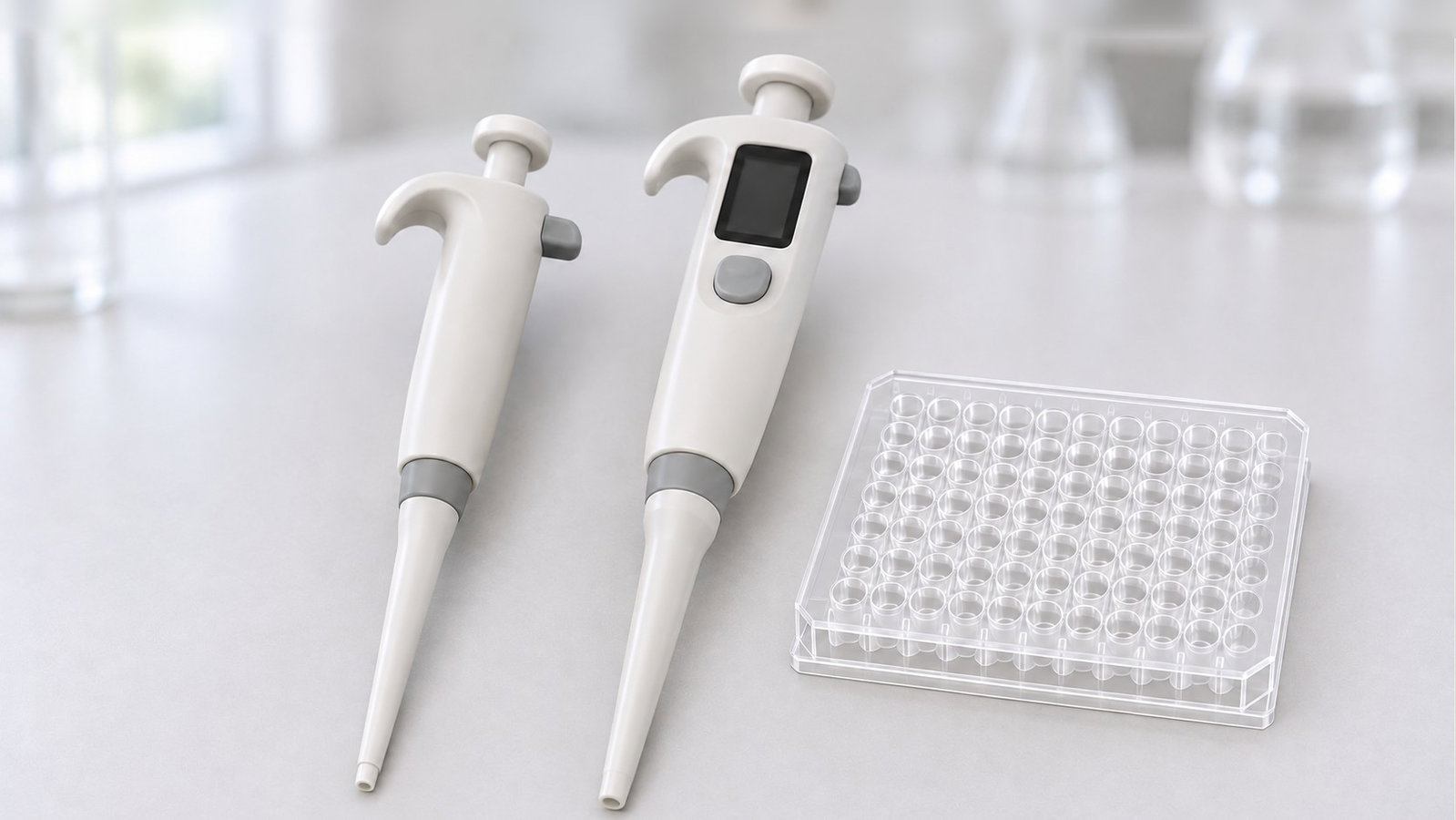
The electronic pipette vs manual pipette question usually comes up when a lab's workload changes: more plates, more aliquots, longer sessions at the bench. Both types are air-displacement pipettes that move a piston to aspirate and dispense; the difference is whether your thumb or a motor moves it. This guide compares the two on the three points that most often decide the purchase: repeat dispensing, ergonomics and throughput. It includes a calculated 96-well example and a checklist, and it says plainly where the evidence is thin. For the wider picture of pipettes, dispensers and controllers, see the pipetting and liquid handling guide.
Quick answer: A manual pipette is enough when you pipette a few volumes, a few times, with changing settings. An electronic pipette earns its place when one volume is dispensed many times, when protocols repeat, or when you spend long periods pipetting. Its main advantages are modes such as repeat dispensing, which delivers several aliquots from one aspiration, and motor-driven aspiration and dispensing at a set speed instead of a thumb-driven plunger [1][2]. Workplace ergonomics guidance suggests electronic or light-touch pipettes for repetitive pipetting [3], but the published studies show associations, not proof that any pipette prevents hand or arm problems. For the plate-based example in section 4, a manual multichannel pipette already cuts the operation count more than switching to electronics does.
1. Electronic Pipette vs Manual Pipette: What Actually Differs
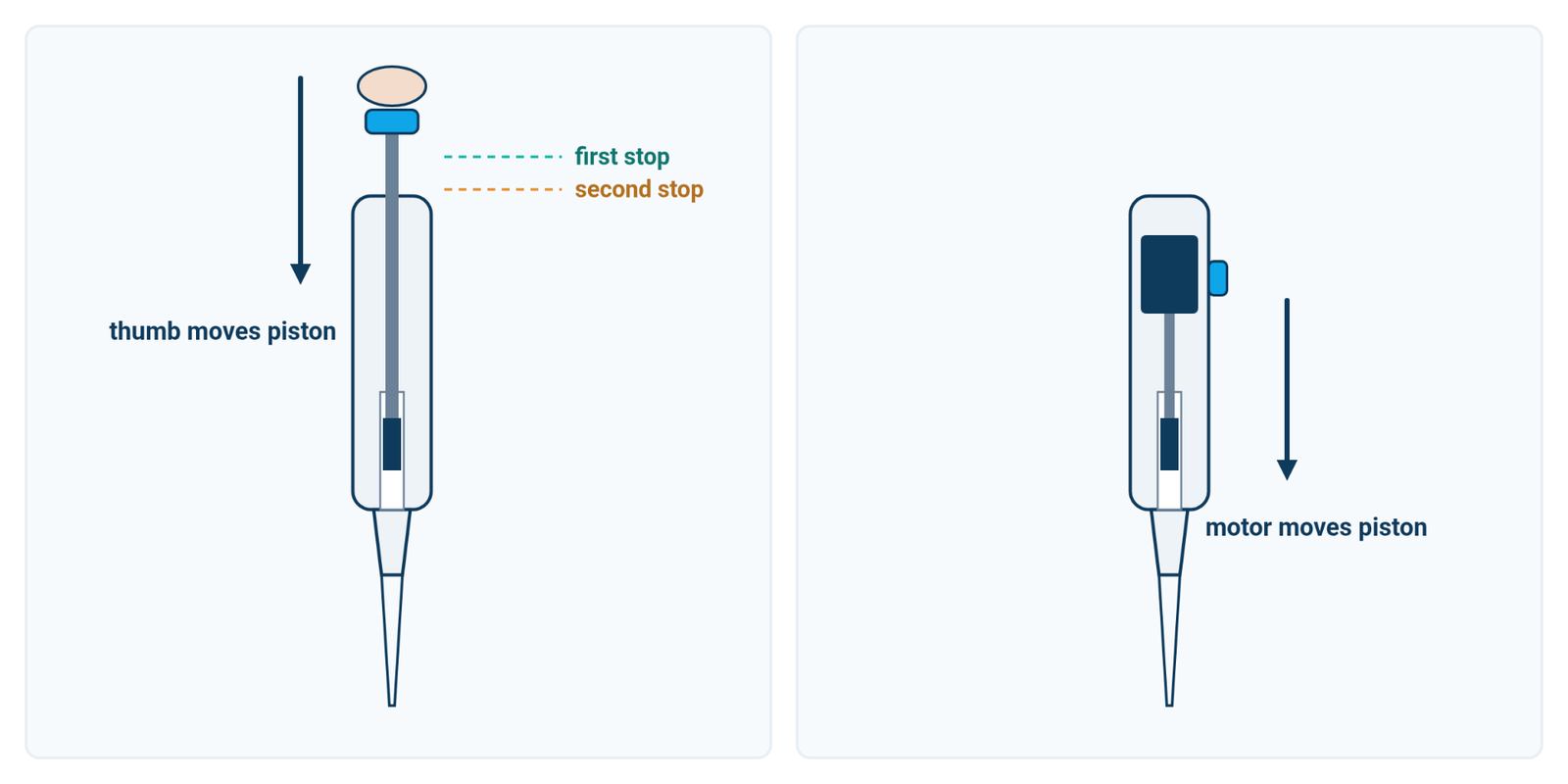
In forward pipetting with a manual air-displacement pipette, you set the volume, press the plunger to the first stop before immersing the tip, release it smoothly to aspirate, then press to the first stop to dispense and continue to the second stop for blow-out. The speed and smoothness of each stroke depend on the user, which is why technique guides spend so much time on rhythm and consistent plunger movement [1][4].
In an electronic air-displacement pipette, "aspiration and dispensing are controlled by a microprocessor and are initiated by pressing a trigger, rather than by using the thumb to press or release a plunger button" [1]. Electronic pipettes have been available since the mid-1980s [1]. The volume is set through buttons, a wheel or a screen rather than by twisting the plunger, and the piston runs at a programmed speed.
The measurement standards treat both as piston pipettes. ISO 8655-6, the gravimetric reference procedure, notes that for electronic motorised pipettes "aspiration and delivery of test liquid are automatic", and tells the user to refer to the manufacturer's instructions for speed settings [5]. The 2022 edition of ISO 8655-2 added an informative annex for motorised pipettes, including testing in multi-dispensing mode [6]. Volume-range choice still matters: an electronic pipette can also show larger relative errors near the lower end of its specified range, although performance depends on the model. The advice in the guide to choosing a pipette volume range applies to both.
Summary of the practical differences:
| Manual (air-displacement) pipette | Electronic (motorised air-displacement) pipette | |
|---|---|---|
| What moves the piston | Your thumb, via the plunger | A motor, started by a button or trigger [1] |
| Aspirate/dispense speed | Set by the user's thumb | Selectable on many models [1] |
| Volume setting | Dial or plunger twist | Buttons, wheel or screen [2] |
| Modes beyond pipetting | Usually none on the pipette itself; separate repeaters exist [1] | Often repeat dispensing, mixing, dilution and others [1][2] |
| Power | No electrical power needed | Often battery-powered; rechargeable models need charging |
| Forces on the hand | Plunger and tip-ejection forces from the thumb [7][8] | Mostly button and tip-ejection forces; still repetitive [9][10] |
2. Repeat Dispensing: One Aspiration, Many Aliquots
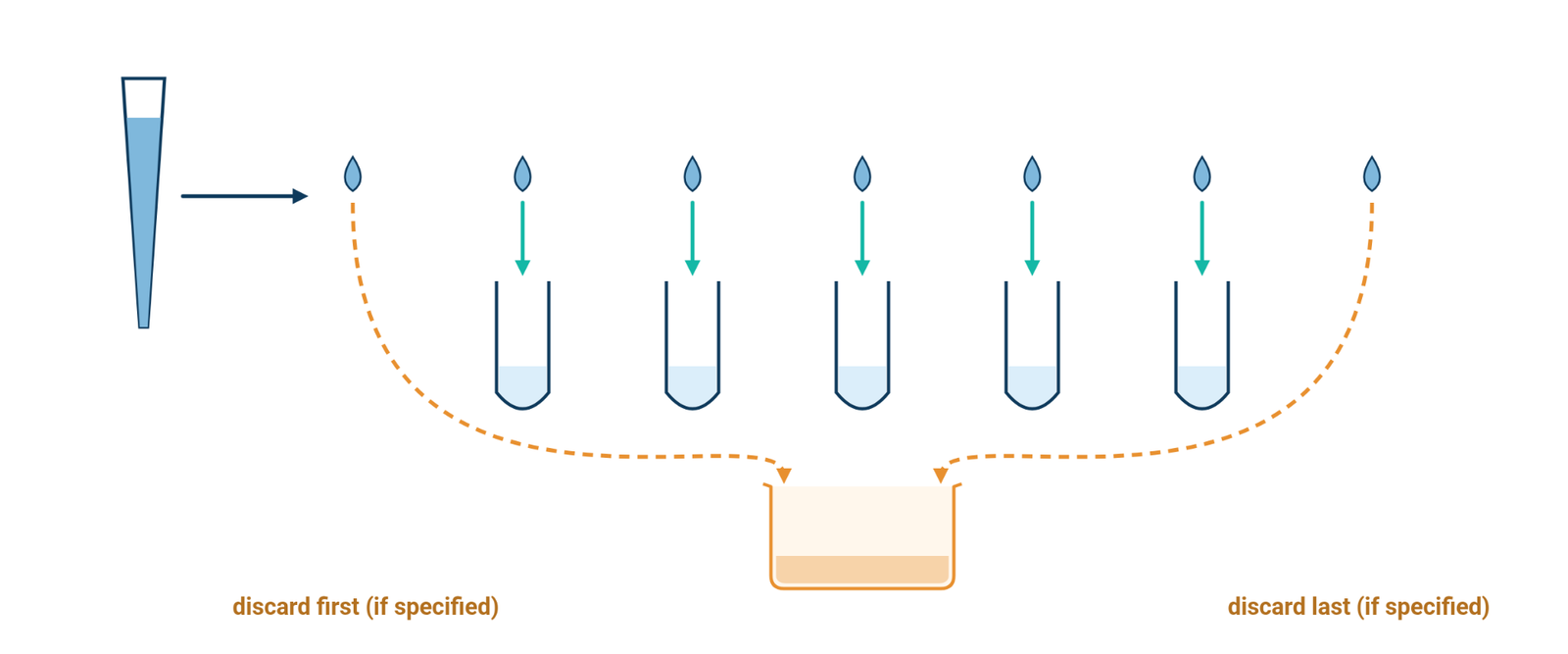
Repeat dispensing (also called multi-dispensing or, on some instruments, a stepper mode) is the clearest functional difference between the two types. The pipette aspirates once, then delivers the same volume several times without refilling the tip [2]. One handbook describes repeated or sequential pipetting as the kind of work that "can benefit from electronic pipettes since they can be used for repeat dispensing and can be programmed for specific pipetting protocols" [1].
A manual air-displacement pipette has no equivalent mode: each aliquot needs its own aspiration and dispense. The manual alternative is a dedicated repeater, sometimes called a stepper. Repeater pipettes "work on the positive displacement principle": they draw in a large volume and dispense it "in multiple, equal aliquots", and they come in electronic or manual versions [1]. Guidance notes that repetitive dispensers need a minimum of refills but still involve repetitive thumb motions and force [10].
Account for first and last aliquots. One pipetting guide recommends discarding both in electronic repeat-dispense mode: the first can be affected by the change from aspiration to dispensing, and the last can carry accumulated volume error [2]. ACS Material gives the same discard advice for that dispenser. Follow the instructions for the specific instrument and mode; when both aliquots are discarded, liquid use and action counts increase (section 4).
Test it the way you use it. If repeat dispensing is how the pipette will be used, it is worth checking performance in that mode as well. ISO 8655-2 notes that, for electronic motorised pipettes, "an additional set of measurements can be done using dispense mode" [6].
Other modes that electronic pipettes commonly offer include programmed mixing, serial dilutions and controlled titrations [1]. One manufacturer frames multiple modes as "avoiding the need for separate repeater, dilutor and titrator pipettes" [2]. Which modes a given model has varies, so check the specification before you assume.
3. Ergonomics: What the Studies Show, and What They Do Not
Pipetting is a high-repetition hand task, and occupational health researchers have studied it for decades. The findings are associations between pipetting exposure and reported complaints, not tests of whether a type of pipette prevents them.
- A Swedish study of 128 female laboratory technicians using plunger-operated pipettes found hand ailments twice as common as in a reference group of female state employees, and associated more than 300 h/year of pipetting with increased risk of hand and shoulder ailments [11].
- A questionnaire survey of 80 pipette users and 85 non-users found elbow and hand complaints significantly more common among users. Almost 90% of those in the longest continuous-use group (more than 60 minutes) reported hand complaints, and almost all of the women who reported difficulties identified plunger operation as a design deficiency [12].
- A study of thumb strain concluded that "some form of automation ought to be taken into consideration if the amount of pipetting work tends to increase", and that pipettes should have as little button resistance as possible [13].
- Laboratory measurements with a manual pipette found peak thumb force about 11% higher when pipetting high-viscosity liquids than low-viscosity ones [7]. A biomechanical model estimated that muscle forces in the thumb are about 2.3 times the push force on the plunger during dispensing [8].
What do these studies mean for the choice of pipette? The main load in manual pipetting comes from repeatedly pressing the plunger, especially for long continuous periods. One university ergonomics service states that an electronic pipette "eliminates most of the pipetting forces altogether", while a multichannel pipette "reduces repetition" [9]. Another notes the trade-offs: electronic pipettes still involve some repetition, accuracy varies by model, and they cost more than other options [10]. OSHA's laboratory ergonomics fact sheet lists "Use latch-mode or electronic pipetters for repetitive pipetting" alongside equally important advice on posture, grip, breaks and workstation layout [3].
Electronic does not automatically mean comfortable. In a user study of 5 manual and 5 electronic single-channel pipettes, no single pipette was rated best on every attribute; the features associated with greater hand and arm comfort were lower tip-ejection force, lower blowout force and good balance in the hand [14]. A heavy electronic pipette with a stiff tip ejector may be no improvement on a light manual one.
Whatever you use, the practical measures are the same:
- Limit continuous pipetting; guidance suggests around 20 minutes at a stretch, with a short break of 1–2 minutes [1][3].
- Keep the wrist straight, the elbows close to the body and the grip relaxed; sit close to the work [3].
- Use low-profile tubes and waste containers so you are not reaching up [3].
- Use as little force as possible to load and eject tips [3][10].
- Rotate pipetting tasks and remove unnecessary steps from protocols [10].
This article is general information, not health advice. If pipetting causes discomfort, speak to your occupational health or environmental health and safety (EHS) service.
4. Throughput: Counting the Actions for a 96-Well Plate
Speed comparisons in brochures depend on the task, the operator and what is counted. A simpler way to see where the gains come from is to count the actions needed for one common job: adding 50 µL of the same reagent to every well of a 96-well plate, using the same tip(s) throughout.
| Setup | Assumption per aspiration or filling | Aspirations / fillings without discards | Dispenses without discards | Total actions without discards | With first and last aliquot discarded (scenario) |
|---|---|---|---|---|---|
| Manual single-channel | 1 aliquot | 96 | 96 | 192 | n/a |
| Manual 8-channel | 1 aliquot per channel (one column) | 12 | 12 | 24 | n/a |
| Electronic single-channel, repeat dispense | 6 aliquots of 50 µL (300 µL aspirated) | 16 | 96 | 112 | 24 aspirations + 144 dispenses = 168 |
| Electronic 8-channel, repeat dispense | 6 aliquots of 50 µL per channel | 2 | 12 | 14 | 3 aspirations + 18 dispenses = 21 |
| Manual positive-displacement stepper | 48 steps of 50 µL per filling (StepMate: 2.50 mL tip, dial setting 1) | 2 | 96 | 98 | 3 fillings + 102 steps = 105 |
Calculated illustration, not a verified operating protocol or product specification. The no-discard columns show arithmetic baselines, not necessarily recommended operation; ACS Material specifically advises discarding its first and last dispense. The 6-aliquot example assumes 300 µL aspirated and six nominal 50 µL dispenses, not a demonstrated capability of a particular electronic pipette. With two discards per filling, each six-dispense cycle gives four usable aliquots and each 48-step StepMate filling gives 46. Tip changes, plate handling, required residual or extra aspiration volume, time and hand force are excluded. Follow each instrument's actual mode instructions; fewer counted actions do not establish faster or ergonomically better performance.
Three points stand out. First, the biggest single step is going from one channel to eight: a manual 8-channel pipette needs 24 actions against 192 for a manual single-channel, a reduction that comes from parallel channels, not from electronics. Multichannel pipettes are covered in the guide to multichannel pipettes and microplates. Second, repeat dispensing removes most of the aspirations, but with only a few aliquots per aspiration, discarding the first and last aliquot, where recommended, eats into the saving. Larger aspiration volumes, smaller aliquots, or both make it more worthwhile. Third, a manual positive-displacement stepper needs fewer actions than single-channel repeat dispensing in this example, because one filling covers many more aliquots, and it needs no battery, though each step is still a thumb action [10].
In real work, programmable modes may save setup time, while charging and menu navigation can add steps; the table measures none of these effects.
5. Accuracy and Consistency
Manufacturers often claim electronic pipettes are more precise. One handbook states that because "the microprocessor eliminates human error and variability in moving the piston, electronic pipettes produce more consistent data than manual pipettes", especially in serial dilutions where errors compound [1]. Another describes them as "less operator-dependent" [2]. A national measurement guide notes that electronically controlled pipettes "can reduce errors resulting from uneven aspiration and delivery" [4].
These are plausible mechanisms, but the volume-consistency claims here come mainly from manufacturer literature and a measurement guide. The sources reviewed for this article do not establish an independent controlled comparison of delivered-volume accuracy between manual and electronic pipettes; the independent comparison in section 3 concerns ergonomic attributes [14]. The careful reading is that a motor removes one source of variation, the user's plunger stroke, and leaves the rest: volume-range choice, tip fit, immersion depth, pre-wetting, liquid properties and temperature. An electronic pipette used near the lower end of its stated usable range still needs its accuracy and repeatability checked at that setting.
For viscous or foaming liquids, adjustable speed may be useful when the instrument and protocol support it: one handbook recommends faster settings for aqueous samples and slower settings for "viscous, foaming or shear-sensitive samples" [1]. On a manual pipette, the same control comes from the user's thumb, and viscous liquids raise the force needed [7].
Calibration follows the same standard for both types: the ISO 8655 gravimetric procedure applies, and forward pipetting is the test mode [5]. Electronically controlled pipettes "must always be operated in accordance with the manufacturer's recommendations" [4]. Some electronic models provide user calibration or reminder features [2]. A menu or adjustment function does not by itself establish the actual delivered volume; verification still requires an appropriate measurement procedure.
6. When a Manual Pipette Is the Better Fit
A manual pipette remains the sensible choice in many labs:
- Occasional transfers. When the workload involves relatively few repetitions, repeat-dispense modes may offer little practical benefit; consider the task and time saved rather than a fixed daily-count cutoff.
- Frequently changing volumes in small numbers. Turning a dial is quick; repeat modes help only when the same volume repeats.
- No battery or charging. A mechanical manual pipette does not depend on a battery or charging schedule.
- Budget. Electronic pipettes cost more than manual ones [10]; several well-chosen manual pipettes may serve a lab better than one electronic model.
- Light-touch designs exist. Manual pipettes vary widely in plunger and tip-ejection force [9][14]. For example, the ALab™ Hipette is described this way: "The entire pipette is lightweight with a light press force." Its single-channel range is specified as "Ten models, 0.1–10000 µL".
| Task pattern | Reasonable first choice | Why |
|---|---|---|
| Occasional pipetting, varied volumes | Manual single-channel | Simple, no charging, fast volume changes |
| Same volume into many tubes | Electronic with repeat dispense, or a manual stepper | Fewer aspirations [1][2] |
| Same volume across microplates | Multichannel (manual or electronic) | Parallel channels cut actions most (section 4) |
| Serial dilutions, titrations, programmed mixing | Electronic with those modes | Programmed, repeatable piston movement [1] |
| Long daily pipetting sessions | Electronic or light-touch manual, plus breaks and workstation changes | Lower plunger forces; guidance in section 3 [3][9] |
| Repeated aliquots of a liquid that is difficult to handle by air displacement | Consider a positive-displacement repeater | Different displacement principle; check the specific dispenser, tips and liquid requirements [1] |
7. dPette+ and dPette: What ACS Material Specifies
The ALab™ dPette+ shares a product listing with the simpler dPette. ACS Material lists the product types as "dPette+: Multi functional Electronic Pipette; dPette: Simple Electronic Pipette". The two differ in their functions, which ACS Material gives as:
"dPette single-channel: pipetting and mixing; dPette+ single-channel: pipetting, mixing, stepper and dilution; dPette+ 8-channel: pipetting, mixing and stepper"
ACS Material lists "stepper" for dPette+ single-channel and 8-channel, and "dilution" for dPette+ single-channel; plain dPette is listed for pipetting and mixing only. Here, stepper is discussed in the context of repeat dispensing, but its cycle and dispense count are not defined. For the dPette+ 8-channel, ACS Material's operating note describes how to "rotate the knob back and forth quickly to switch pipetting, continuous dispensing and other function settings". How many aliquots one aspiration can deliver is not specified.
Other points ACS Material lists:
| Item | Description |
|---|---|
| Single-channel | "Five volume ranges, 0.5–1000 µL (dPette+ and dPette)" |
| 8-channel | "dPette+: five volume ranges, 0.5–300 µL" |
| Battery | "Li-ion battery" |
| Charging | "dPette+ 8-channel: dual charging modes — USB charger or charging stand" |
| Operation | "Minimal force for pipetting operation." · "2 buttons for all operational settings." |
| Speed | "Adjustable speed for aspiration and dispensing." |
| Calibration | "Self-calibration applicable." · "dPette+ 8-channel: connect it to the computer, with the free software provided for calibration." |
| Calibration reference | "ISO 8655" |
ACS Material gives one specification table, "Single-channel (one table shared by dPette+ and dPette)"; it lists a shared set of single-channel error specifications but does not present an independent measured accuracy comparison between the models. As section 5 explains, you should still verify performance at the volumes and in the mode you use.
Related options on the same site. The ALab™ E-Pette is an electronic pipette with a "2.1-inch OLED HD touchscreen" and "Nine ranges, 0.5–20000 µL"; ACS Material lists the functions "Pipetting, dispensing, auto-dispensing, manual pipetting, pipetting + mixing, multi-dispensing, custom dispensing, dilution, titration". For repeat dispensing without electronics, the ALab™ StepMate is a "Stepper (repetitive dispenser)" working by "Positive displacement", with steps per filling of "48 / 23 / 15 / 11 / 8 at dial settings 1 / 2 / 3 / 4 / 5" and a dispensing volume per step of "10 µL to 5 mL (depends on tip and dial setting)". It is a repetitive dispenser, not a micropipette. ACS Material also advises: "Discard the first and last dispensed volume for best precision."
8. Checklist: Choosing Between Electronic and Manual
- [ ] Estimate how many aspirate–dispense actions you do per day and how long your longest continuous session is.
- [ ] Note how often the same volume is dispensed repeatedly; that is where repeat dispensing pays.
- [ ] For microplate work, consider a multichannel pipette first (section 4).
- [ ] Choose the volume range for your working volumes, whichever type you buy.
- [ ] Check which modes a model actually lists (repeat dispense, dilution, mixing); they vary between models.
- [ ] Try the pipette in the hand: weight, balance, tip-ejection force [14].
- [ ] Plan for charging and battery life on electronic models.
- [ ] Plan breaks, posture and workstation layout regardless of pipette type [3].
- [ ] Check the instrument's repeat-dispense instructions; where specified, discard the first and last aliquot [2].
- [ ] Verify performance gravimetrically in the mode you use [5][6].
9. Frequently Asked Questions
Is an electronic pipette more accurate than a manual pipette?
Not automatically. A motor removes the variation of the user's plunger stroke, and manufacturers report more consistent results [1][2], but range choice, tips and technique still matter. Accuracy varies by model [10].
What is repeat dispensing (multi-dispensing)?
One aspiration followed by several dispenses of the same volume, without refilling the tip [2]. One guide recommends discarding the first and last aliquots; follow the instrument's own operating instructions [2].
What is a stepper pipette?
A repeater or stepper dispenses a larger drawn-up volume as multiple equal aliquots. Many work on the positive displacement principle and come in manual and electronic versions [1].
What do ergonomics studies say about repetitive pipetting?
Studies associate prolonged manual plunger use with reported hand and arm complaints [11][12]. Ergonomics guidance suggests electronic or light-touch pipettes for repetitive work [3][9], but these cited studies do not establish that changing pipette types prevents complaints. Breaks, posture and workstation layout are also part of the guidance [3]. For discomfort, consult your occupational health or EHS service.
Can the dPette do repeat dispensing?
ACS Material lists "stepper" among the dPette+ functions only; the dPette is listed for "pipetting and mixing".
10. Keep Exploring the Pipetting Hub
- Pipetting and liquid handling guide: pipettes, dispensers and controllers from microliters to milliliters.
- Choosing a pipette volume range: why a 1000 µL pipette is a poor fit for 100 µL.
- Multichannel pipettes and microplates: when parallel channels pay off.