
Most adjustable pipettes will let you dial in a volume far below their maximum. A 100–1000 µL pipette can be set to 100 µL, but the volume it actually delivers and whether it meets a method's tolerance depend on its performance at that setting. The pipette volume range you choose can affect relative error even before handling technique is considered. This guide explains what a volume range and a nominal volume are, why relative error grows toward the bottom of a range, what a product specification table shows at the same 100 µL in two different ranges, and how to choose a range for the volumes you actually pipette. It covers manual air-displacement pipettes. For the wider picture of pipettes, dispensers and controllers, see the pipetting and liquid handling guide.
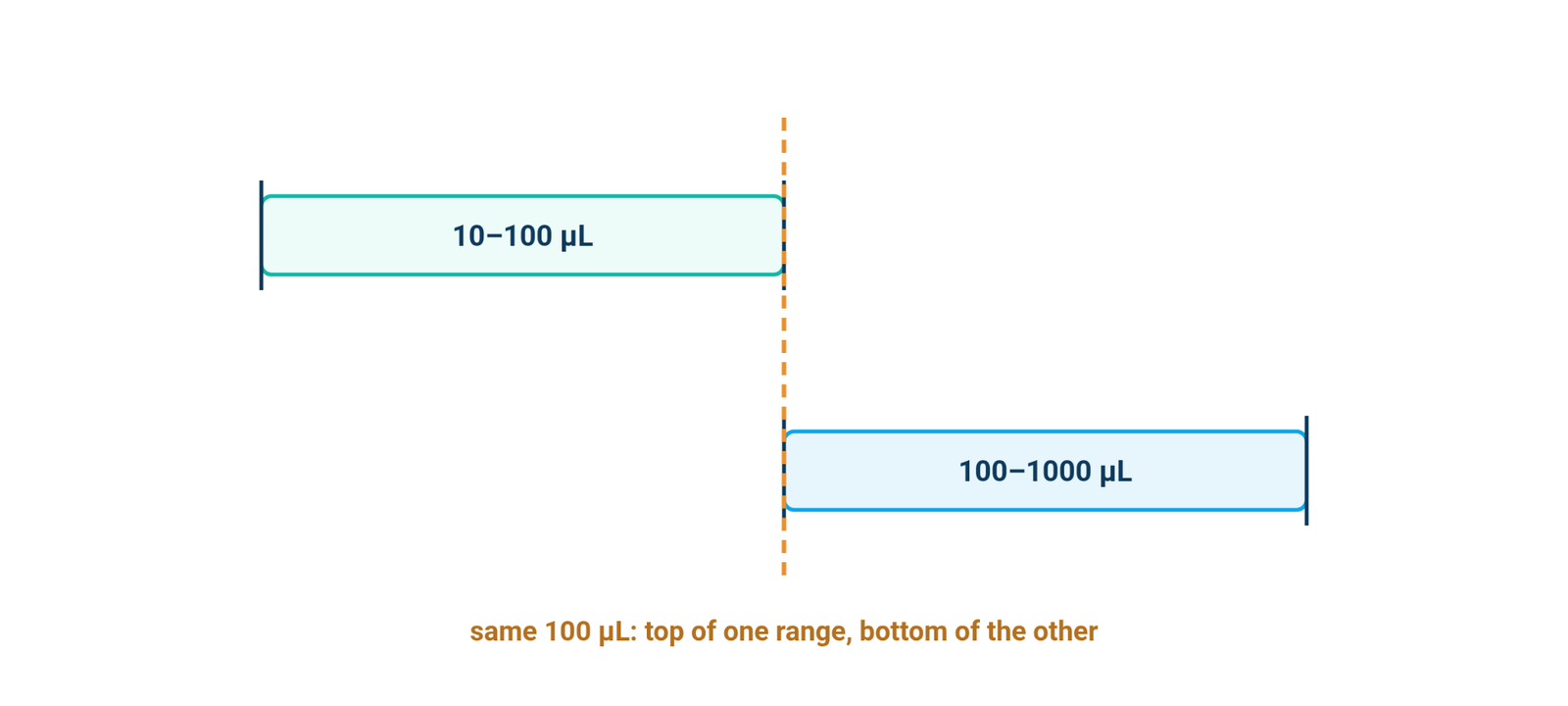
Quick answer: Choose the smallest pipette whose range covers your volume, so that the volume sits in the upper part of the range [1][2]. When absolute error in microlitres does not fall proportionally with the selected volume, relative error increases; the actual change depends on the pipette and test conditions [3][4][5]. At 100 µL, a 100–1000 µL pipette is working at the bottom of its range, while a 10–100 µL pipette is at its nominal volume. For the ALab™ Hipette, the 100–1000 µL model's stated errors at 100 µL are three to four times those of the 10–100 µL model at the same volume (calculated from the listed values; section 4). A 1000 µL pipette can deliver 100 µL; it is simply a poor fit for it.
1. What a Pipette Volume Range Means
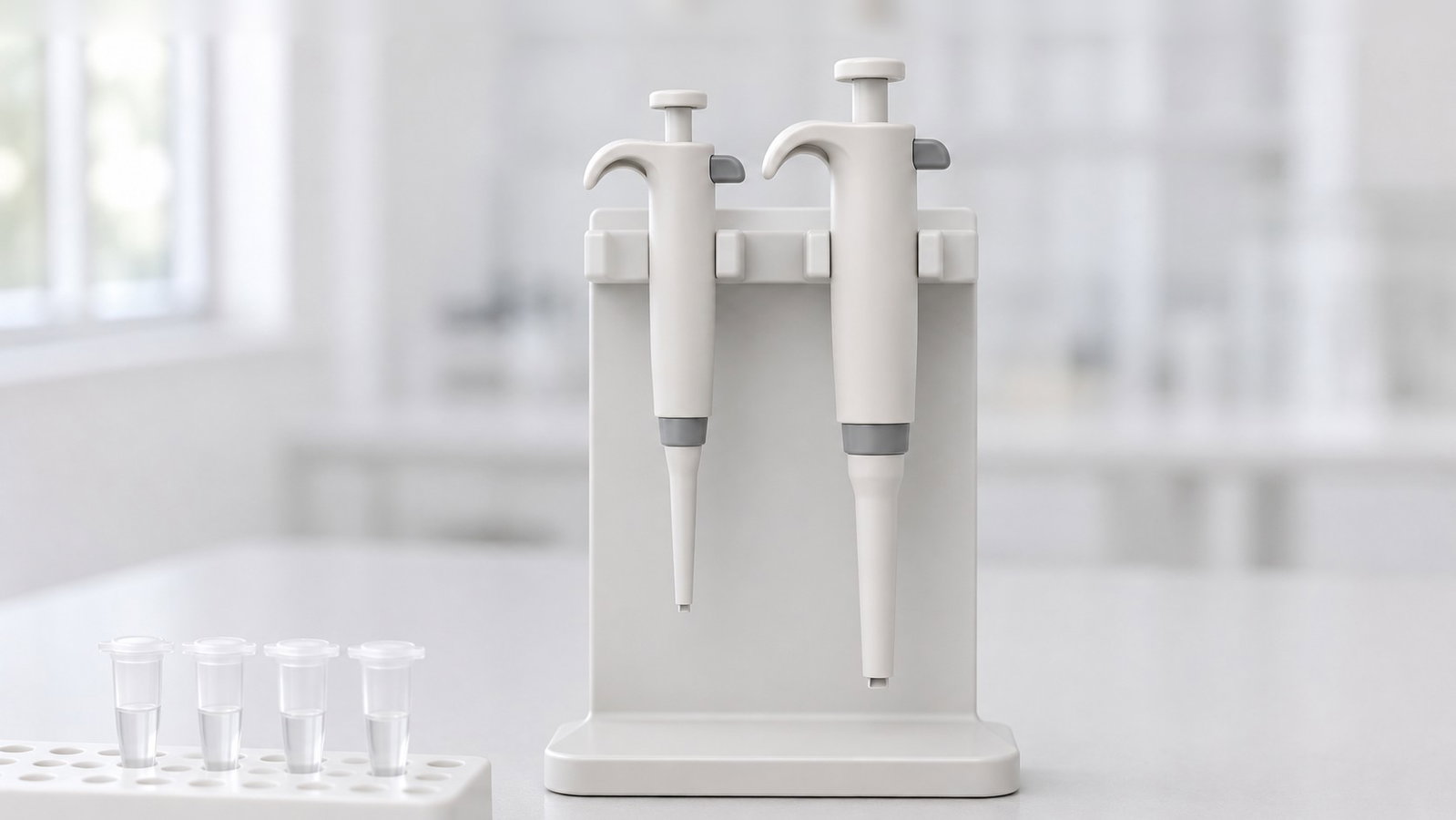
ISO 8655-2 distinguishes fixed-volume pipettes, which dispense only their nominal volume, from variable-volume pipettes, which dispense volumes selectable by the user within a specified usable volume range, "e.g. between 10 μl and 100 μl" [6]. The nominal volume is the upper limit of that usable range as specified by the manufacturer [7][8]. A pipette sold as 10–100 µL therefore has a nominal volume of 100 µL, and a 100–1000 µL pipette has a nominal volume of 1000 µL [3].
Many manual pipettes have a lower limit around 10% of nominal volume, but the stated usable range is model-specific; some ranges extend below that rule of thumb. Manually operated pipettes usually allow volumes as low as 10% of the nominal volume [9], and one pipette manufacturer's handbook describes 10–100% of nominal volume as the normal operating range for most pipettes, while noting that the performance specifications change as the volume setting decreases [5]. Ranges from adjacent pipette sizes overlap, so most volumes can be set on more than one pipette. 100 µL, for example, lies within both a 10–100 µL and a 100–1000 µL range. The question is not whether a pipette can be set to a volume, but how well it performs there.
2. Why Relative Error Grows Toward the Bottom of the Range
Two things happen as you dial an adjustable pipette down.
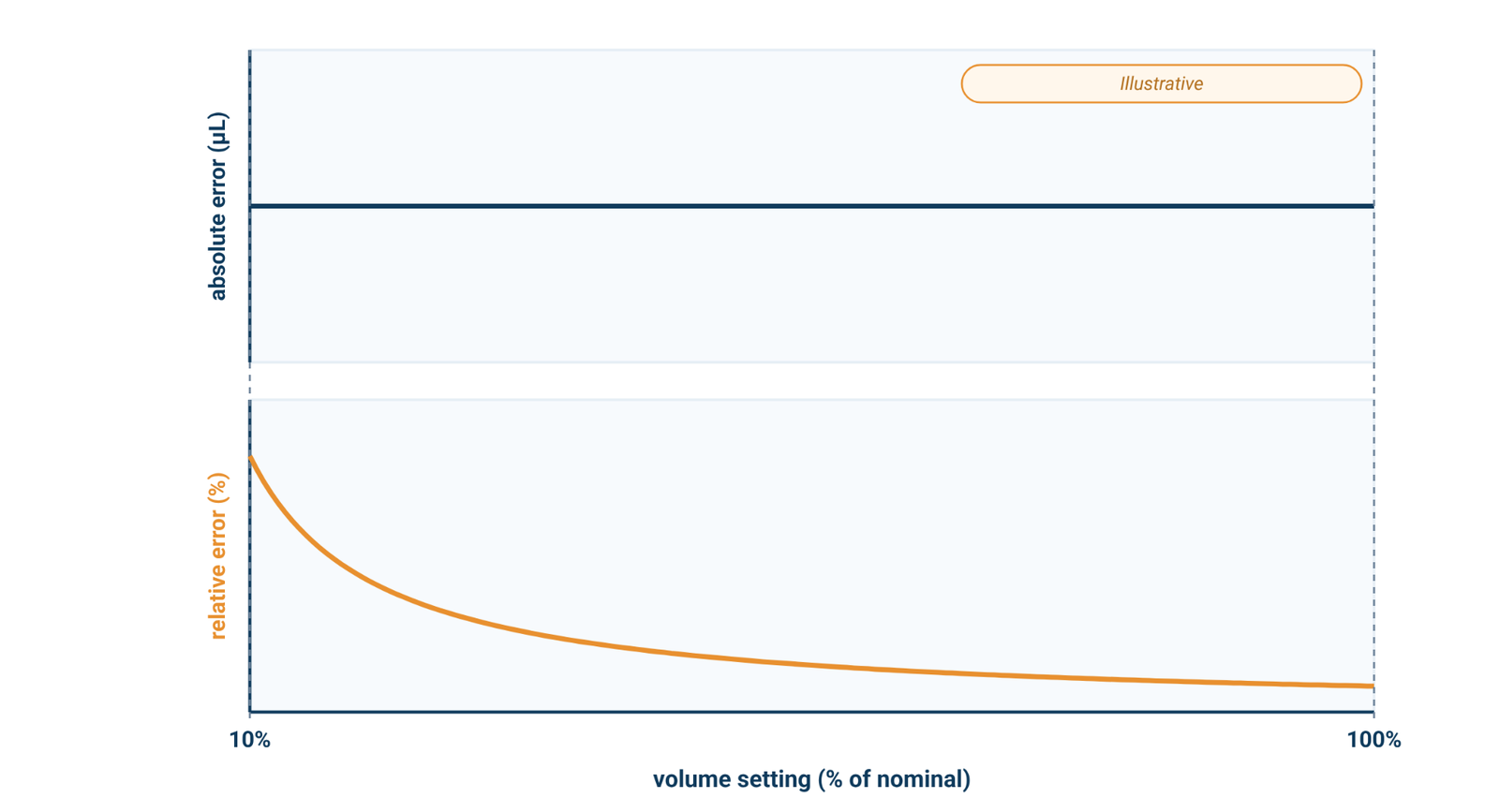
Absolute error need not shrink in proportion to volume. One calibration-system supplier's lab report proposes working tolerances of 2% of full scale at all volume settings, so that for a 10–100 µL pipette the same absolute limit applies at every setting: ±2.0% at 100 µL becomes ±20.0% at 10 µL [3]. One pipette manufacturer's guide shows the same arithmetic for a 100 µL pipette: an inaccuracy of 0.8 µL is 0.8% of the delivered volume at 100 µL but 8% at 10 µL [4]. These are tolerance illustrations, not measurements, but they show the pattern: a fixed error in microlitres becomes a larger share of a smaller delivery.
The air cushion takes a larger share. In an air-displacement pipette, a pocket of air sits between the piston and the liquid [7]. As the set volume decreases, the dead air volume becomes larger relative to the liquid. One manufacturer's technical note explains that, because of this increase in dead volume, the relative deviation is greater at small pipetting volumes: with a 100 µL pipette, the relative error at 10 µL is greater than at 100 µL [10]. Another guide states that below 35% of the nominal volume "the volume of dead air in the pipette becomes quite large" and the risk of inaccurate and imprecise dispensing increases [2]. Mechanical limits of the piston movement and the compressibility of air are also cited as reasons why accuracy declines at lower volumes [4].
Technique matters more at the bottom of the range. Pipetting within the upper part of the range "is less technique dependent and reduces user related errors" [2]. One handbook notes that the user's skills and technique may contribute even more uncertainty to the delivered volume than the pipette itself [5]. Pre-wetting, temperature, immersion depth and plunger rhythm are covered in the guide to forward and reverse pipetting.
3. How Specification Tables Show This
Adjustable-pipette specification tables often show three test volumes per range. This layout is consistent with the ISO 8655-6 gravimetric reference procedure, which requires at least the nominal volume, 50% of nominal (or the closest possible setting), and the usable lower limit or 10% of nominal (whichever is greater), with ten or more measurements at each volume [11]. A similar table layout does not establish that a manufacturer's listed values were obtained using that procedure. A national measurement good practice guide describes the same three points [8]. For a 100–1000 µL pipette, the lowest of those points is 100 µL; for a 10–100 µL pipette, 100 µL is the top one.
Each test volume carries two figures. ISO 8655-1 defines systematic error as the deviation of the mean delivered volume from the nominal or selected volume, which relates to accuracy, and random error as the scatter of delivered volumes around their mean, which characterises precision; expressed as a percentage of the mean it is the coefficient of variation (CV) [7]. Read both columns, and read them in microlitres as well as in percent.
A manufacturer's stated errors are not the same as the maximum permissible errors that ISO 8655-2 sets out in its own tables [6]. Treat a specification table as what that manufacturer states for that model, under conditions that the table may not give.
4. The Same 100 µL in Two Ranges: What One Specification Table Shows
ACS Material lists ALab™ Hipette single-channel models with ranges of 10–100 µL and 100–1000 µL, and both include a 100 µL test volume. For the 10–100 µL model, 100 µL is its nominal (top) test volume. For the 100–1000 µL model, 100 µL is the lowest listed test volume. The table below shows only those two 100 µL values.
| Hipette single-channel model | Increment (µL) | Test volume (µL) | Systematic error (µL) | Systematic error (%) | Random error (µL) | Random error (%) |
|---|---|---|---|---|---|---|
| 10–100 µL | 0.1 | 100 | ±0.80 | ±0.8 | ±0.20 | ±0.2 |
| 100–1000 µL | 1 | 100 | ±3.00 | ±3.0 | ±0.60 | ±0.6 |
At the same 100 µL, ACS Material lists a systematic error of ±3.00 µL for the 100–1000 µL model against ±0.80 µL for the 10–100 µL model, and a random error of ±0.60 µL against ±0.20 µL. As a calculated illustration (simple division of the listed values, not an ACS Material claim), that is 3.75 times the systematic error and 3 times the random error. ACS Material also lists the volume setting step for each model: 0.1 µL for the 10–100 µL model and 1 µL for the 100–1000 µL model.
What this comparison does and does not show:
- It compares two specifications at one volume, 100 µL, the only volume that appears as a test volume for both models. It says nothing about any volume between the listed test volumes, and none should be read into it.
- The values are ACS Material's specifications. They are not ISO 8655 maximum permissible errors, and the liquid, technique and conditions behind them are not specified.
- It is consistent with the general guidance in sections 2 and 5, but that guidance comes from the literature, not from this table.
Measurements in the literature point the same way. In one manufacturer's application guide, ten dispenses of 100 µL ethanol with reverse pipetting and pre-wetting gave a CV of 0.69% with a 5–120 µL electronic pipette and 1.70% with a 50–1000 µL electronic pipette, with user, mode and technique held constant; the guide concludes that, when pipetting 100 µL of a reagent, a smaller nominal volume pipette should be chosen instead of a 1000 µL pipette, "even though it might be possible to pipette 100 µL with both" [12]. A 2018 Japanese study likewise found accuracy and reproducibility to be excellent when the micropipette's total capacity was near the volume taken [13].
5. How to Choose a Pipette Volume Range
Start with the rules of thumb
- Choose the smallest pipette that can handle the volume. Two pipette manufacturers' guides give this as their rule of thumb, because pipettes are most accurate at their nominal volume [1][2].
- Keep the volume in the upper part of the range. A long-standing empirical guideline is to work between 35% and 100% of the nominal volume [2][5]. One guide recommends keeping the target volume within 50–100% of the nominal range [4].
- Hand over to the next size down. One best-practice study recommends using a variable-volume pipette only down to the nominal volume of the next smaller pipette available [9]. With 10–100 µL and 100–1000 µL pipettes on the bench, that means switching to the 10–100 µL pipette for volumes from 10 µL through 100 µL; smaller transfers require a range that actually includes them.
- Treat 10% of nominal volume as a common rule of thumb, not a universal cutoff. Many guides advise avoiding lower settings [5][14], but check the manufacturer's stated usable range and verify performance against the method's tolerance; some listed ranges extend below 10%.
The 35% figure is a guideline, not a law. The handbook that describes it points out that there is no solid scientific evidence that the safe working range is always 35–100% of nominal volume, and that sample properties and the instrument both affect the delivered volume [5].
Then check against the tolerance you need
A more rigorous approach starts from the accuracy your method needs. One handbook explains that a pipette's usable volume range depends on the maximum uncertainty of delivered volumes that is still acceptable to the user: absolute uncertainty increases with volume, but relative uncertainty increases as volume decreases, and the point where relative uncertainty meets your tolerance is the pipette's practical minimum volume [5]. The same handbook combines both error types into an "uncertainty in use of a single delivered volume", calculated as the absolute systematic error plus k times the random error, with k = 2 for ten repeated measurements, and suggests a safety factor for user, liquid and environmental effects [5].
The lab report cited above gives a worked example. A method needs a 100 µL dispense with 3% accuracy, and the laboratory has been using a 200 µL pipette set to 100 µL. Under its suggested tolerances, that pipette would be tested against 4% at 100 µL, which is too loose for the method; the report instead proposes a 100 µL pipette used at full scale, tested against 2% [3]. These 4% and 2% values are that report's suggested working tolerances, not ISO 8655 maximum permissible errors or ACS product specifications.
A worked range check
The table applies the rules of thumb above to a few example volumes, using the ten single-channel range names listed for the Hipette. The target volumes are illustrative examples; the percentages are calculated as target volume ÷ nominal volume and rounded to the nearest whole percent. They are not measured errors or product specifications.
| Target volume | Ranges that include it | Target as % of nominal | Range that keeps it in the upper part |
|---|---|---|---|
| 15 µL | 2–20, 5–50, 10–100 µL | 75%, 30%, 15% | 2–20 µL |
| 100 µL | 10–100, 20–200, 30–300, 100–1000 µL | 100%, 50%, 33%, 10% | 10–100 µL |
| 250 µL | 30–300, 100–1000 µL | 83%, 25% | 30–300 µL |
| 700 µL | 100–1000, 500–5000 µL | 70%, 14% | 100–1000 µL |
| 3000 µL | 500–5000, 1000–10000 µL | 60%, 30% | 500–5000 µL |
If one protocol calls for several volumes across a wide span, two or three pipettes with adjacent ranges usually serve better than one large one. Where the method's tolerance is tight, check the chosen pipette gravimetrically at the volume you use, as described in the pipette calibration guide.
6. Other Factors That Interact With Range
Liquid properties. Pipettes are adjusted with water [6]. With liquids of a different density, one technical note calculates, for a 1000 µL nominal setting, a deviation of +0.2% for methanol and −0.78% for concentrated sulfuric acid, and explains that the relative deviation is greater at small pipetting volumes [10]. If a pipette is corrected by changing its volume setting for one liquid, that correction applies only to that individual value, not to the whole range [10].
Fixed versus variable volume. Where one volume is pipetted all day, a fixed-volume pipette is an option: in the measurement work summarised in one good practice guide, fixed-volume pipettes performed better than variable-volume pipettes with both trained and untrained operators [8].
Testing small volumes. Gravimetric testing becomes harder as volume falls. ISO 8655-6 notes that, particularly for small tested volumes, errors due to evaporation of the test liquid during weighing should be taken into consideration [11]. This is one reason to check small-volume pipettes carefully and under stable conditions.
7. Hipette: What ACS Material Specifies
The ALab™ Hipette mechanical pipette is a manual adjustable pipette. ACS Material lists the following, relevant to range selection:
- Single-channel ranges. "Ten models, 0.1–10000 μL": 0.1–2.5, 0.5–10, 2–20, 5–50, 10–100, 20–200, 30–300, 100–1000, 500–5000 and 1000–10000 µL. The two models used in section 4 each give the increment and the systematic and random error at three test volumes.
- Multichannel. 8-channel and 12-channel versions, each with "Five volume ranges, 0.5–300 μL".
- Range identification. "Different colored caps correspond to different volume ranges."
- Volume setting. A volume lock design that "Prevents accidental changes in volume", and a 4-digit display.
- Sets. ACS Material lists three pipette sets that combine several ranges, for example Set 1: "0.5–10 µL + 10–100 µL + 100–1000 µL", with a linear stand, cap opener and pen.
- Calibration reference. ACS Material lists "Calibration reference: ISO 8655-2" and notes: "User calibration should refer to the industrial standard ISO8655-2."
ACS Material advises choosing a channel configuration or set "and the volume range that matches your volumes." It does not state a recommended working range within each model's range; for that, use the guidance in section 5.
8. Checklist
- List the volumes your protocol uses, and the accuracy each step needs.
- For each volume, pick the smallest pipette whose range includes it.
- Aim for the upper part of the range; treat the 10% guideline as a rule of thumb, subject to the model's stated usable range and your method's tolerance.
- When a volume sits at the bottom of one range and the top of the next smaller one, use the smaller pipette.
- Read systematic and random error in both µL and % at the manufacturer's listed test volumes; do not assume the nearest listed result applies to an untested working volume.
- For tight tolerances or unusual liquids, check gravimetrically at the working volume.
9. Frequently Asked Questions
Can I use a 1000 µL pipette for 100 µL?
A 100–1000 µL pipette can be set to 100 µL, but that is the bottom of its range, where relative error is largest. A pipette whose nominal volume is close to 100 µL is the better fit [9][12].
What is the nominal volume of a pipette?
The upper limit of its usable volume range as specified by the manufacturer [7]. For a 10–100 µL pipette it is 100 µL [3].
What is the lowest volume I should set?
The manufacturer's stated usable lower limit sets what can be selected, while your method's tolerance determines whether it is suitable. Avoiding settings below 10% of nominal and aiming for 35–100% are general literature guidelines, not universal cutoffs [2][5][14].
Why do specification tables list three volumes?
ISO 8655-6 tests variable-volume pipettes at the nominal volume, 50% of nominal, and the lower limit of the range or 10% of nominal, whichever is greater [11].
Does a percentage error stay the same across the range?
No. An absolute error that stays roughly constant in microlitres becomes a larger percentage as the volume decreases [3][4].
10. Keep Exploring the Pipetting Hub
- Pipetting and liquid handling guide: pipettes, dispensers and controllers from microliters to milliliters.
- How to use a micropipette: forward vs reverse technique and the handling errors that shift volume.
- Pipette calibration and ISO 8655: calibration vs adjustment and the gravimetric check.