
A multichannel pipette aspirates and dispenses through several tips at once; when its channel layout matches the plate, one stroke can serve a whole row or column rather than a single well. This guide compares 8- and 12-channel pipettes, the two formats built around the 96-well plate, with 16-channel models, which on the current ACS Material product list are offered in the Hipette series only. It covers how channel count maps onto a plate, what ACS Material specifies for each series, how accuracy limits differ from single-channel pipettes, and the technique that keeps every channel delivering the same volume. A calculated stroke count and a checklist close the guide. For the wider picture of pipettes, dispensers and controllers, see the pipetting and liquid handling guide.
Quick answer: Choose the channel count to match the plate. A 96-well plate has eight rows and twelve columns [1], so an 8-channel pipette fills one column per stroke and a 12-channel pipette fills one row [2]. Six series on the ACS Material list come in 8-channel versions and five in 12-channel versions; the 16-channel format is offered in the Hipette series only, in two volume ranges. For the nominal-volume category illustrated in section 4, ISO 8655-2:2022 specifies wider maximum permissible errors for multichannel than for single-channel pipettes [3]. That does not establish that a particular multichannel model is less accurate. Tip fit and technique can affect delivery across channels, and individual-channel problems also matter; check more than one channel [2][4].
1. What a Multichannel Pipette Is and When It Pays
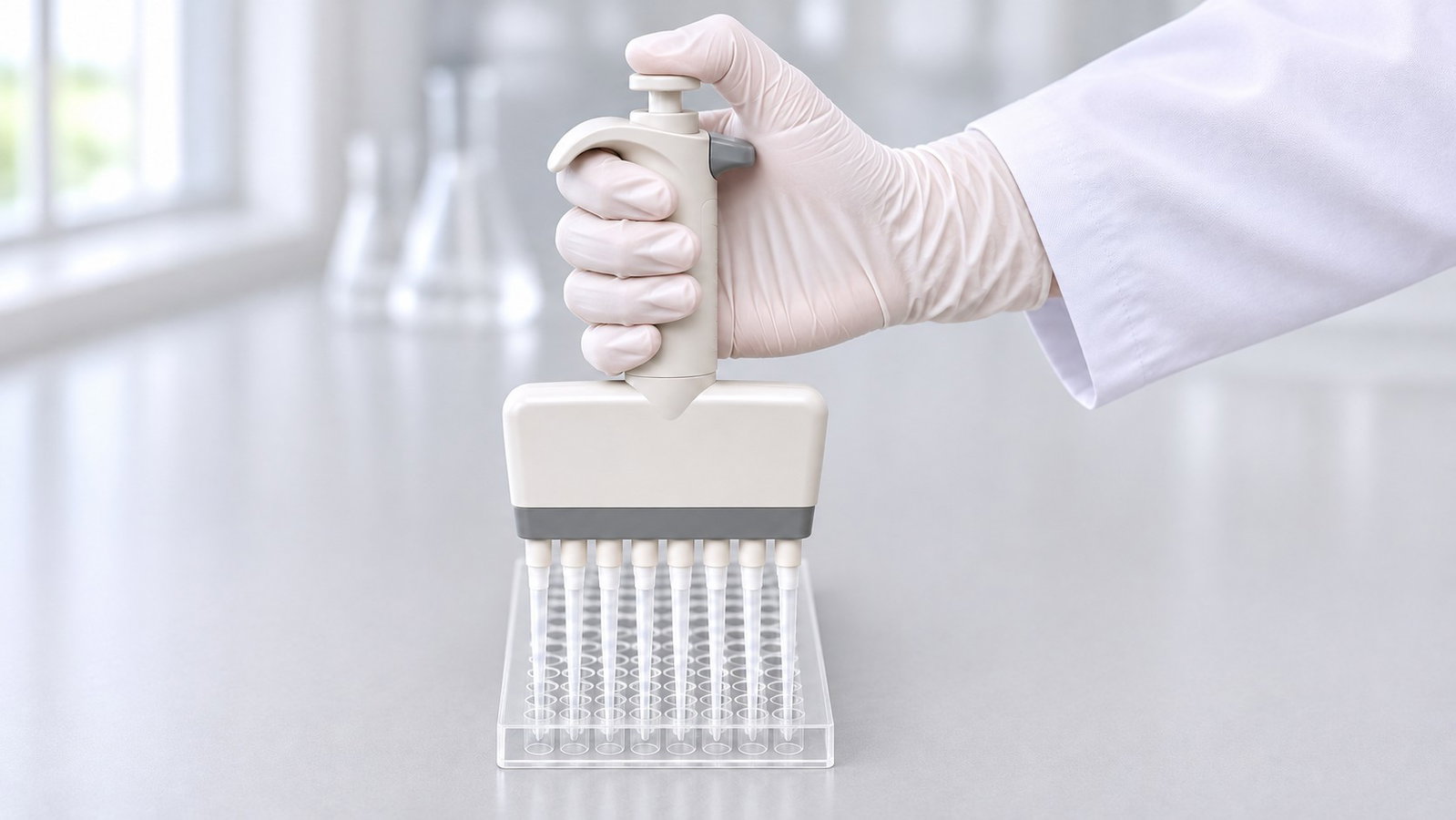
A multichannel pipette combines several pistons and cylinders in one unit so that it can deliver "equal volumes of liquid simultaneously through multiple tips" [4]. Most are air-displacement pipettes that work like their single-channel equivalents: set the volume, press the plunger to the first stop before immersing the tip, release it smoothly to aspirate, then press to dispense. The difference is that one stroke moves liquid in every channel.
The measurement standard treats them as a pipette type of their own. ISO 8655-2:2022 covers "single-channel and multi-channel pipettes", and its designation examples include an 8-channel pipette written as "Pipette ISO 8655 - A - 200 × 8" and a 12-channel pipette as "Pipette ISO 8655 - A - 20-200 × 12" [5]. The standard also requires the tips on a multichannel pipette to sit "with parallel axes in the same plane in order to allow for even liquid dispensing in the target vessels, e.g. the adjacent wells of a microplate", and it limits how far the tip ends may stray from that line [5].
When is it worth switching? One handbook suggests that once you have enough samples, "e.g., 24 or 48 samples", it may make sense to move from tubes to a plate format, and that "multichannel pipettes will speed up the workflow" [6]. The same source adds a caution: multichannel pipettes "don't always offer sufficient finesse in specific steps (e.g., separating layers, biphasic samples)" [6]. A buyer's guide makes the mirror-image point: when you pipette to and from tubes and vessels of various sizes "with no degree of uniformity", a single-channel pipette is the better fit [7].
2. 8, 12 or 16 Channels: Matching the Plate
The 96-well plate is the format the 8- and 12-channel designs are built around. For a standard 96-well plate, ANSI/SLAS 4 specifies eight rows and twelve columns, with adjacent well centers spaced 9 mm apart in both directions [1]. This is plate geometry, not a statement about any ACS Material pipette's tip spacing. That layout is why the two common channel counts exist:
| Channel count | Fills per stroke on a 96-well plate | Typical use described in literature |
|---|---|---|
| 8 | One column (8 wells) | Transfers from reservoirs or plates to entire columns [2] |
| 12 | One row (12 wells) | Transfers from reservoirs or plates to entire rows [2] |
| 16 | Does not match a complete 8-well column or 12-well row | Higher-density plate use is discussed in general literature [6] |
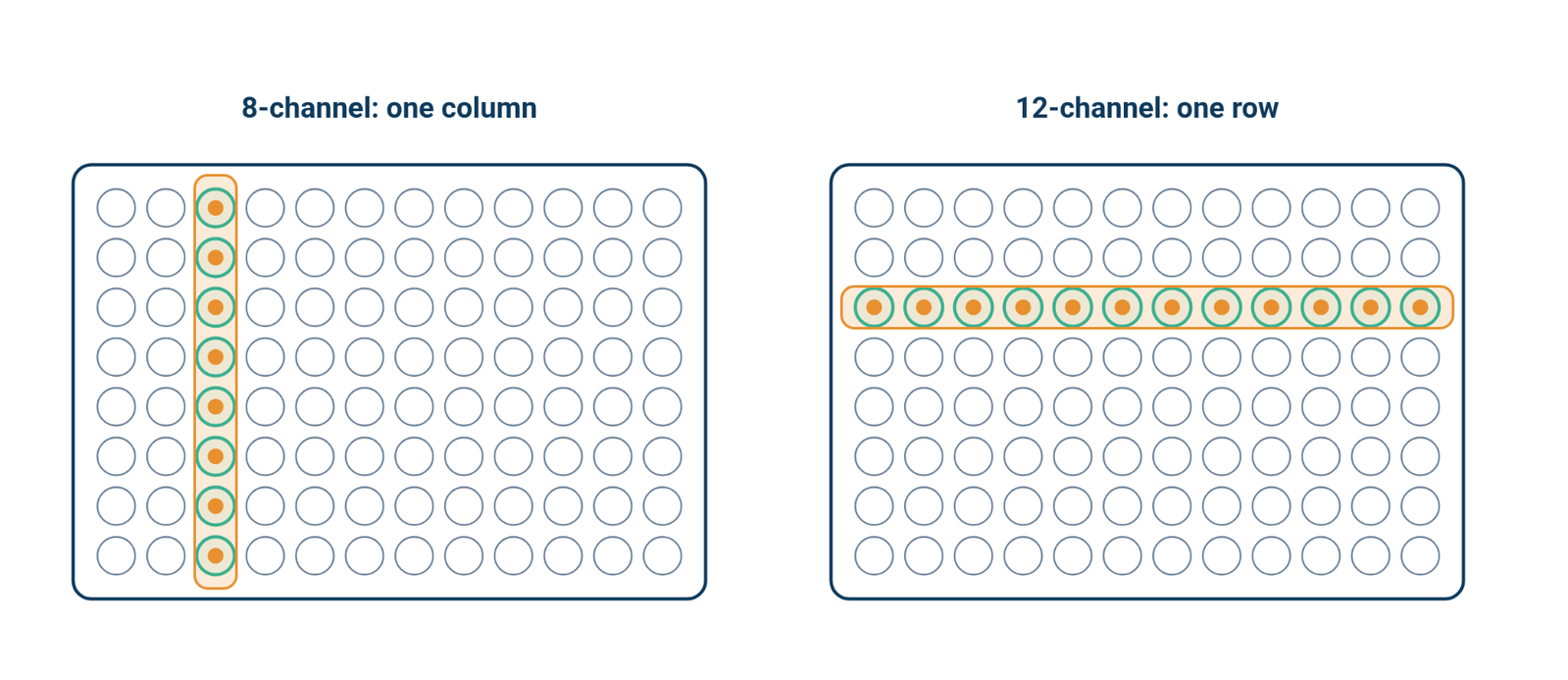
8 or 12? The choice mostly follows your plate layout. If samples or standards run down columns, an 8-channel pipette matches the layout; if they run along rows, a 12-channel pipette does, with fewer strokes per plate (section 7). Many labs keep both.
What about 16? One handbook describes 16- and 24-channel pipettes as the route that has "allowed researchers" to set up higher-density plates manually [6]. That is a general statement about the format. ACS Material lists the Hipette 16-channel models by volume range but does not state which plate format or tip spacing they are intended for, so confirm the intended plate with ACS Material before you order.
Some multichannel pipettes have adjustable tip spacing for moving samples between labware with different well distances [6].
None of the six ACS Material series discussed below is described with adjustable tip spacing, and just one names a plate format: for the Toppette, ACS Material says, "8 and 12 channel pipettes are available for standard 96-well plate."
3. 8-, 12- and 16-Channel Pipettes on the ACS Material List
The table below reports the multichannel configurations ACS Material lists. A dash means the configuration is not listed; it does not independently establish that no such configuration exists.
| Series | Type | 8-channel | 12-channel | 16-channel |
|---|---|---|---|---|
| ALab™ Hipette | Manual | "Five volume ranges, 0.5–300 µL" | "Five volume ranges, 0.5–300 µL" | "Two volume ranges, 1–100 µL" (1–20 and 5–100 µL) |
| ALab™ Mi-Pette | Manual | "Four volume ranges, 0.5–300 µL" | "Four volume ranges, 0.5–300 µL" | — |
| ALab™ Mi-Pette-LTS | Manual | Listed (ranges confirmed on the quotation) | Listed (ranges confirmed on the quotation) | — |
| ALab™ MicroPette Plus | Manual | "Seven volume ranges, 0.5–1000 µL" | "Six volume ranges, 0.5–300 µL" | — |
| ALab™ Toppette | Manual | "Four volume ranges, 0.5–300 µL" | "Four volume ranges, 0.5–300 µL" | — |
| ALab™ dPette+ | Electronic | "dPette+: five volume ranges, 0.5–300 µL" | — | — |
Source: ACS Material product specifications (October 2026). The Mi-Pette-LTS listing gives "Single-channel, 8-channel and 12-channel" and states that the "volume range and channel configuration" are "confirmed on the quotation", so no ranges are given here. The plain dPette shares a listing with the dPette+ and is described as a "simple electronic pipette (single-channel)". The E-Pette electronic pipette is single-channel and is not included; the HiPette-LTS channel configurations are also confirmed on the quotation, so it is not included either.
Reading the table:
- 16-channel: Hipette is the series on the list with a 16-channel version, in two ranges, "1–20 and 5–100 µL".
- Larger 8-channel volumes: the MicroPette Plus 8-channel span runs to 1000 µL; ACS Material's FAQ gives it as "8-channel adjustable (0.5–10 to 100–1000 µL)". Among the other 8-channel series with a listed volume span, the spans end at 300 µL; Mi-Pette-LTS ranges are not listed.
- Electronic 8-channel: the dPette+ is the electronic option. ACS Material lists the functions "dPette+ 8-channel: pipetting, mixing and stepper".
- Design features ACS Material describes: the MicroPette Plus lists "Dispensing head rotates for effortless pipetting convenience." and "Individual piston and tip cone assembly."; the Toppette lists "Dispensing head rotates for optimum pipetting convenience." and "Individual piston and tip cone assemblies allow easy repair and maintenance." The Mi-Pette-LTS lists "LTS tips; thin-wall tips; front stop design" and "Low tip ejection force", and states: "The front stop design ensures one-step sealing for all channels, resulting in more consistent volumes across multi-channel pipetting."
4. Accuracy: Why Multichannel Limits Are Wider
A multichannel pipette has multiple liquid-delivery paths that must be checked. ISO 8655-2:2022 sets out a separate table of maximum permissible errors for multichannel pipettes [3][5]. In one pipette manufacturer's secondary comparison of the 2022 ISO limits, the nominal-volume category above 50 µL through 100 µL lists maximum permissible systematic/random errors of 0.8 %/0.3 % for single-channel and 1.6 %/0.6 % for multichannel air-displacement pipettes [3]. These are ISO limit examples, not measurements of any ACS Material pipette. The standard's tables are not reproduced here; use the current edition for the full limits.
Separate from the ISO limits above, ACS Material lists manufacturer error values for the Hipette at a 100 µL test volume. These are not ISO maximum permissible errors and cannot by themselves establish ISO conformity:
| Hipette configuration | Volume range | Systematic error at 100 µL | Random error at 100 µL |
|---|---|---|---|
| Single-channel | 10–100 µL | ±0.80 µL (±0.8 %) | ±0.20 µL (±0.2 %) |
| 8-channel | 10–100 µL | ±1.00 µL (±1.0 %) | ±0.50 µL (±0.5 %) |
| 12-channel | 10–100 µL | ±1.0 µL (±1.0 %) | ±0.5 µL (±0.5 %) |
| 16-channel | 5–100 µL | ±1.00 µL (±1.0 %) | ±0.6 µL (±0.6 %) |
Source: ACS Material product specifications (October 2026). These are product specifications, not ISO 8655 maximum permissible errors. The 16-channel model covers a different volume range (5–100 µL). Whether the multichannel values apply to each channel or to the pipette as a whole is not specified.
Within the Hipette specifications, the multichannel error values at 100 µL are numerically larger than the single-channel values. That is a comparison of product specifications, not a comparison with ISO limits or a measurement of actual delivered volumes. For work sensitive to differences between wells, read the specifications for the chosen configuration and evaluate channel performance as appropriate (section 6).
5. Technique for Even Results Across Channels
Tip seating, liquid supply and operator technique are important, readily checked sources of variation; faults in individual channels can matter too.
Seat every tip the same way. "Another common problem is tips that loosen, leak, or fall off" [2]. A national measurement guide recommends loading tips from a tip rack, which "is especially important for multi-channel pipettes where all the tips should be the same height in order to draw up and dispense identical amounts of liquid" [4]. The same guide advises using the tips recommended by the pipette's manufacturer, because those can be relied on to fit properly [4]. Tip straightness matters as well: one handbook notes that tip curvature "becomes most problematic when several tips are used in parallel on a multichannel pipette" [6]. Mismatched pipettes and tips "usually require more force to load/eject and may not seal properly" [6].
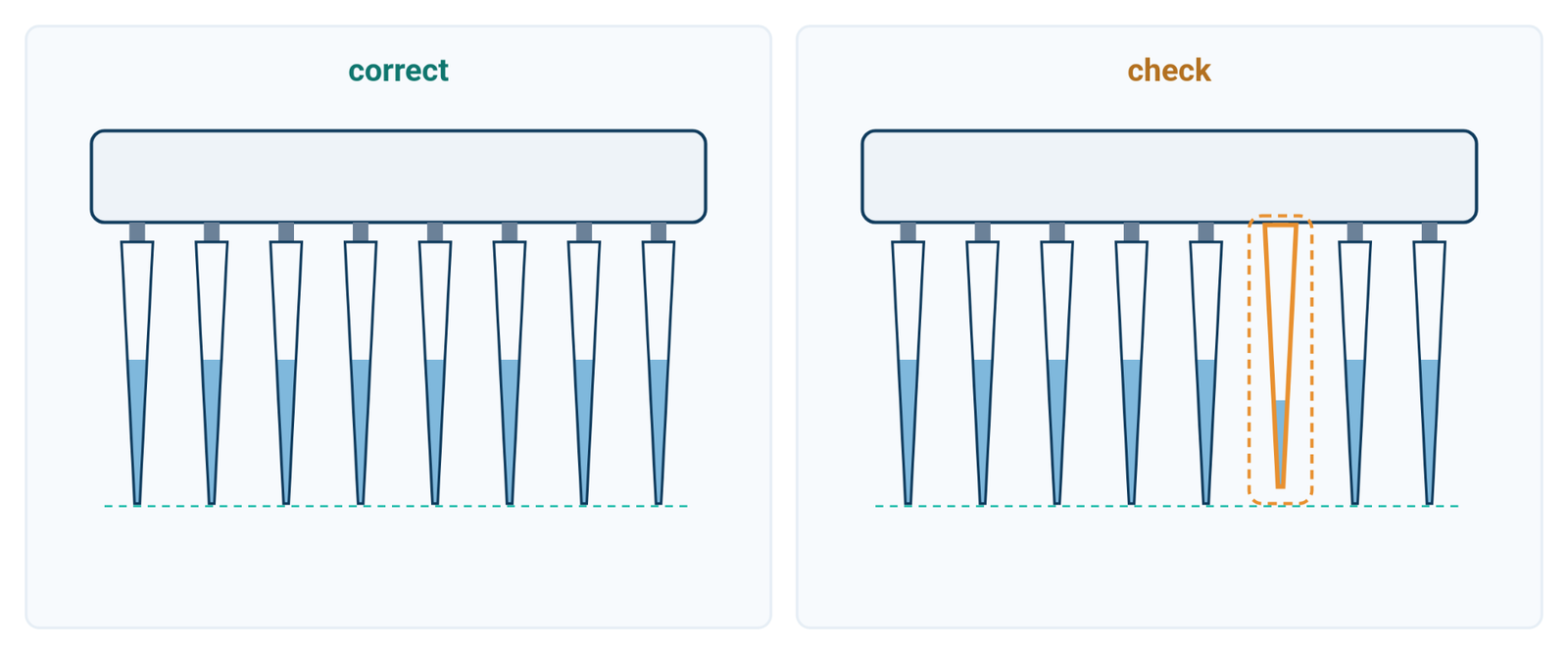
Look along the tips after aspirating. Unequal liquid heights can indicate a seating, leakage or aspiration problem; a liquid level that falls while the pipette is held steady is a warning sign of a leak [2]. Inspect and correct the cause before dispensing into the plate.
Give the reservoir enough liquid. In a V-bottom reservoir, "as the liquid level lowers, the reagent starts to pool in multiple locations. As a result, a number of pipette tips may aspirate air" [2]. Maintain enough liquid for all tips to aspirate consistently; refill or replace the reservoir when the level becomes too low [2].
Plan the plate. Even with fewer strokes, keeping track of which column or row you have filled is where manual plate work most often slips; one study describes the execution of manual pipetting plans for microplates as "error-prone" [8]. A printed plate map, a consistent direction of work and covering finished rows or columns all help.
Keep the hand comfortable. One university ergonomics service lists "a multi-channel reduces repetition" among the features of ergonomic pipettes [9], and one handbook suggests adding "multichannel, electronic pipettes or repeaters for repetitious work" [6]. Fewer strokes do not remove the load of fitting and ejecting tips, which "often requires more force than pipetting" [2], so try the pipette in the hand and take regular breaks.
6. Checking a Multichannel Pipette
Because each channel has its own piston and tip, routine checks should cover more than one channel. ISO 8655-6:2022, the gravimetric reference procedure, has a clause of its own for multi-channel pipettes [10]. It also addresses the balance: when a single-channel balance is used exclusively for multichannel pipettes, its required repeatability and uncertainty values "are double the values" in its balance table, and a multi-channel balance is "only valid for multi-channel pipettes" [10].
Weighing every channel one by one is slow. A 2023 review notes that gravimetric testing has low throughput and is tedious for multichannel pipettes, and describes photometric checks run in a 96-well format with a plate reader as a way around this [11]. In that review's own reproducibility data for serial dilutions, a 12-channel pipette gave a mean inter-day CV below 1 % [11]. That is one lab's result, not a general figure.
For a limited routine screen, one manufacturer's guide suggests checking the first and a middle channel and evaluating results per test volume and per channel [2]. That two-channel screen cannot establish the performance of every channel. For a calibration or a claim about all channels, follow the applicable complete procedure and retain channel-specific results [10].
7. Throughput: Counting Strokes for a 96-Well Plate
How many aspiration and dispense actions can a multichannel pipette eliminate? The illustration counts actions for adding the same volume of one reagent to every well of a 96-well plate, keeping the same tip or set of tips throughout; it does not measure elapsed time.
| Setup | Strokes needed to cover 96 wells | Aspirations | Dispenses | Total actions |
|---|---|---|---|---|
| Single-channel | 96 wells, one at a time | 96 | 96 | 192 |
| 8-channel | 12 columns of 8 | 12 | 12 | 24 |
| 12-channel | 8 rows of 12 | 8 | 8 | 16 |
Calculated illustration, not a measurement or product specification. One aliquot per aspiration per channel; tip changes, reservoir refills and plate handling are not counted. A 16-channel pipette is not shown because no 96-well use is specified for it. Fewer actions do not by themselves mean less time or less load on the hand.
Going from one channel to eight cuts the action count by a factor of eight; going from eight to twelve saves a further third. Beyond that, the gain comes from dispensing several aliquots per aspiration, which many electronic pipettes offer. The dPette+ 8-channel lists a stepper function, and ACS Material describes how to "rotate the knob back and forth quickly to switch pipetting, continuous dispensing and other function settings". How repeat dispensing changes the count, and when it is worth it, is covered in the comparison of electronic and manual pipettes.
8. Hipette: 8-, 12- and 16-Channel Options
The ALab™ Hipette is a manual adjustable pipette offered as single-channel, 8-, 12- and 16-channel versions. ACS Material lists:
| Item | Description |
|---|---|
| Single-channel | "Ten models, 0.1–10000 µL" |
| 8-channel and 12-channel | "8-channel and 12-channel (five ranges each, 0.5–10 to 30–300 µL)" |
| 16-channel | "16-channel (1–20 and 5–100 µL)" |
| Display | "4-digit display" |
| Calibration reference | "ISO 8655-2" |
Other points ACS Material lists:
- "Different colored caps correspond to different volume ranges."
- ACS Material says that "a volume lock design prevents accidental changes in volume".
- "Can freely rotate 360° in any direction."
- "The entire pipette is lightweight with a light press force."
- On tips, ACS Material describes an elastic nozzle function: "No need for repeated tapping; a light touch can securely attach the pipette tips, providing good tightness and consistency for multi-channel pipetting and reducing the force required for ejection." No specific tips are named, so check tip fit with ACS Material.
A lab that needs 8-, 12- and 16-channel pipettes can therefore stay within one series. The plate format and tip spacing for the 16-channel models are not specified; ask ACS Material before ordering if that matters for your plates.
9. Checklist: Choosing and Using a Multichannel Pipette
- [ ] Sketch your plate layout: samples down columns (8-channel) or along rows (12-channel)?
- [ ] For a 16-channel pipette, confirm the intended plate format with ACS Material first.
- [ ] Choose the volume range for your working volumes, not the widest available.
- [ ] Read the specification for the multichannel configuration you will use, not the single-channel figure.
- [ ] Use the tips recommended for the pipette and load them from a rack so that all sit at the same height [4].
- [ ] After aspirating, check that all liquid columns are the same height [2].
- [ ] Keep enough surplus liquid in the reservoir [2].
- [ ] Work from a printed plate map.
- [ ] Check performance channel by channel, and record results per channel [2][10].
- [ ] Use a single-channel pipette for steps that need finesse, such as separating layers [6].
10. Frequently Asked Questions
What is a multichannel pipette used for?
Transferring the same volume into several wells at once, most often across 96-well plates: an 8-channel pipette fills a column and a 12-channel pipette fills a row per stroke [1][2].
Should I buy an 8-channel or a 12-channel pipette?
Follow your plate layout. If you work down columns, an 8-channel pipette fits; if you work along rows, a 12-channel pipette needs fewer strokes per plate. Many labs use both.
Which ACS Material pipettes come in 16-channel versions?
On the current ACS Material list, the Hipette series only, in two ranges: "16-channel (1–20 and 5–100 µL)". The plate format is not specified, so confirm it with ACS Material.
Are multichannel pipettes less accurate than single-channel pipettes?
Not necessarily. ISO 8655-2:2022 specifies separate, and in the nominal-volume example above wider, maximum permissible error limits for multichannel pipettes [3]. Those are acceptance limits, not proof that any particular model is less accurate. Evaluate the product specifications and check performance across channels using suitable tips and technique [2][4].
How do I check that every channel delivers the same volume?
Test channel by channel and record the results per channel [2]. Gravimetric testing is a reference method [10]; photometric checks in a 96-well format can make routine checks faster [11].
11. Keep Exploring the Pipetting Hub
- Pipetting and liquid handling guide: pipettes, dispensers and controllers from microliters to milliliters.
- Electronic vs manual pipettes: repeat dispensing, ergonomics and throughput.