
A bottle top dispenser screws onto a reagent bottle and delivers a set volume with each stroke of its piston, so the reagent goes from bottle to vessel without being poured. Motor-driven models provide electronic dispensing controls; an electronic burette delivers and records titrant volume, while an electronic titrator may add titration-specific control and recording functions. Some models also include a stirrer. This guide covers how these instruments work, how to read their accuracy figures, how to check reagent compatibility and how burettes fit titration. It ends with a full section on hydrofluoric acid (HF), a reagent that attacks glass and needs precautions well beyond those for ordinary acids. For the wider picture of pipettes, dispensers and controllers, see the pipetting and liquid handling guide.
Quick answer: A bottle-top dispenser is a piston instrument built for "accurate repetitive delivery (dispensing) of preset liquid volumes" from a reservoir [1]. Choose one by the volume you dispense, check that your reagent does not attack its wetted materials, and prime it until no air remains [1][2]. A burette is different: it delivers titrant until "external criteria such as pH or conductivity are met" and records the volume [3]. For hydrofluoric acid, glass-containing dispensers are excluded [2]; any HF work requires a functioning fume hood, PPE selected for the specific concentration and task, unexpired calcium gluconate gel available for skin-exposure response, no lone working and prior qualified EHS review [4][5].
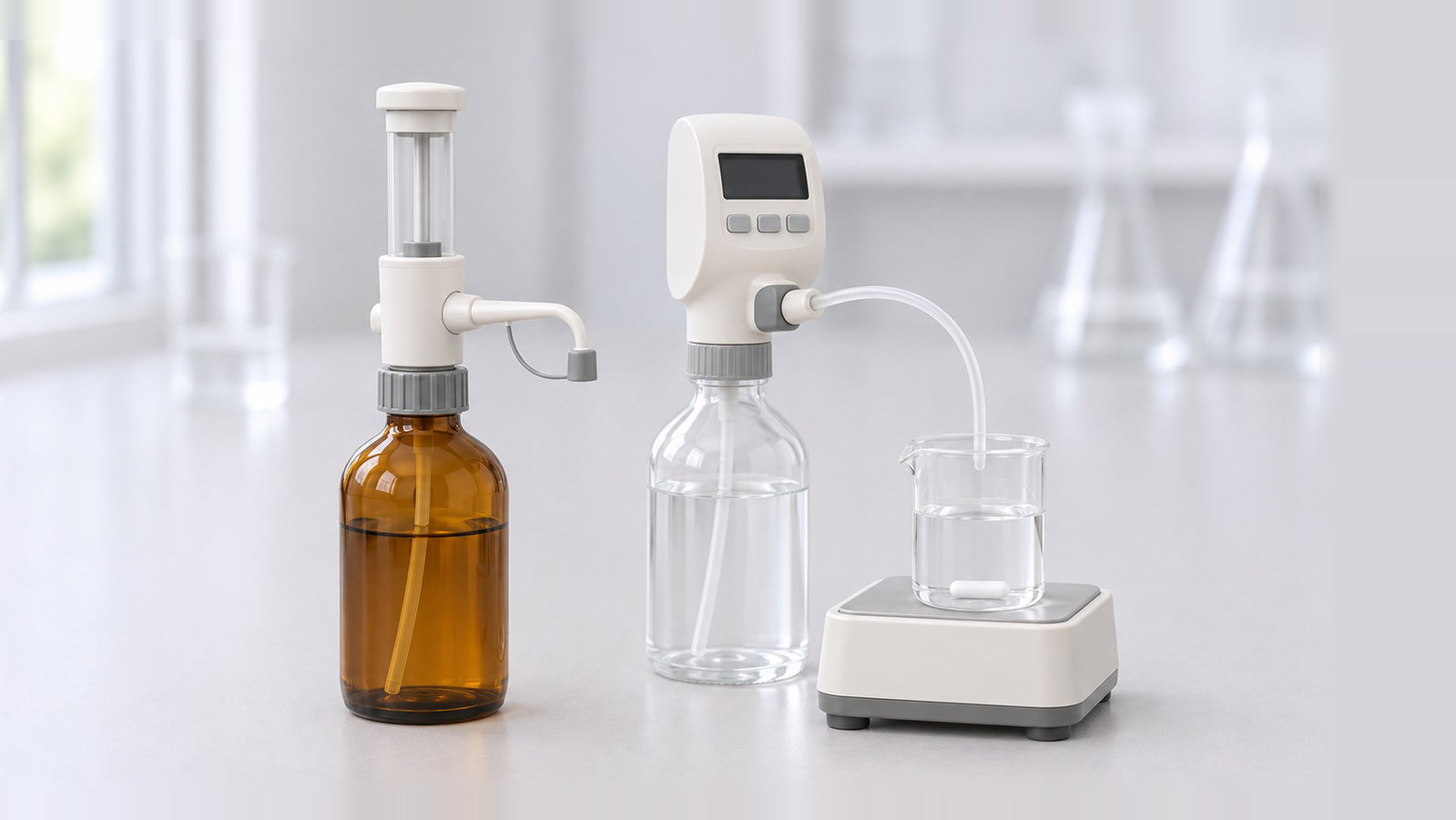
1. What a Bottle Top Dispenser Is and How It Works
The measurement standard for these instruments describes the principle simply. "During operation, the aspiration tube dips into the reservoir containing the fluid to be dispensed." After the system has been primed, the piston aspirates liquid as it moves one way and delivers it as it moves back [1]. "Dispensers can be constructed with or without valves" [1]; most bottle-top designs use an intake valve and a discharge valve so liquid can only move from bottle to outlet. The standard also notes that performance depends on the aspiration and delivery tubing, which is why the tubing supplied with the instrument is part of the system [1].
In practice the user deals with five parts: the piston and cylinder, which set the volume; the valves, often with a recirculation (reflux) valve that returns liquid to the bottle while priming; the intake tube, adjusted to reach near the bottom of the bottle; the discharge tube and its closure cap; and threaded adapters for different bottle necks.
Prime the instrument according to its operating manual before dispensing. One operating manual describes setting the valve to recirculate, giving several short strokes, then dispensing until the discharge tube is free of bubbles and discarding the first few volumes [2]. Its handling rules: point the discharge tube away from people, "Never press down the piston when the discharge tube closure is attached", and stop at the first sign of a sticking valve or leak [2].
2. Bottle Top Dispenser Accuracy: Reading the Specifications
Specification sheets give two figures: systematic error (accuracy), how far the mean delivery sits from the set volume, and random error (precision, often a coefficient of variation, CV), the scatter between deliveries. ISO 8655 is a multi-part series for piston-operated volumetric apparatus; Part 5 covers dispensers with nominal volumes from 1 µL up to 200 mL, and Part 3 covers burettes up to 100 mL [1][3]. Both point to the gravimetric procedure in ISO 8655-6 for determining volume [1][6].
Three points help when comparing data sheets:
- Percent versus microlitres. Convert a percentage at nominal volume into an absolute-volume error before comparing it with a smaller setting: the same absolute error would represent a larger percentage of a smaller delivery. That arithmetic does not predict an individual dispenser's performance. As an illustration of limits, ISO 8655-5:2022 Table 1 (and the calculation approach in clause 6.2) lists maximum permissible systematic errors for single-stroke dispensers with nominal volume above 0.5 mL as 0.60 % at nominal volume, 1.2 % at 50 % and 6.0 % at 10 %; these are standard limits, not ACS Material measurements [1].
- Choose the smallest range that covers your volume.
- Published error figures are not the standard's limits. A manufacturer's published error figures are not ISO 8655 maximum permissible errors. When a product page says "Conforms to ISO 8655," that is the manufacturer's own conformity claim; the wording alone does not establish independent certification or documented test results.
The DispensMate page shows the first point clearly. It lists "±0.5% (all ranges)" systematic error, and its per-range table converts that to microlitres: the 0.5 to 5 mL range is listed at ±25 µL systematic and ±10 µL random, the 5.0 to 60 mL range at ±300 µL and ±120 µL. The DispensMate-E page gives values per test volume: in the 2–10 mL range, 0.5 % (50 µL) systematic at 10 mL but 5 % (100 µL) at 2 mL. The volume error only doubles, from 50 µL to 100 µL, but the percentage error rises tenfold.
Delivered-volume performance can change with use or maintenance; one operating manual recommends gravimetric testing every 3 months for the dispenser it covers, not as a universal interval for ACS Material models [2]. The method is set out in the guide to pipette calibration and the ISO 8655 gravimetric method.
3. Chemical Compatibility and Liquid Limits
Compatibility is decided by the wetted materials, the parts the liquid touches. Manuals pair a list of those materials with a list of operating exclusions. One manual for a glass-and-fluoropolymer dispenser states that the liquid contacts only "PTFE, FEP and Borosilicate glass" and excludes, among others, "Liquids attacking borosilicate glass (e.g. hydrofluoric acid)", explosive liquids and suspensions that may clog the instrument [2]. It adds that "Compatibility of the instrument for a specific application (e.g. trace material analysis, food sector etc.) must be checked by the user" [2].
Physical limits matter too. For that particular dispenser, the manual specifies a working temperature of 15 to 40 °C and a maximum vapour pressure of 600 mbar, viscosity of 500 mm²/s and density of 2.2 g/cm³, and warns that "Liquids, which form deposits may make the piston difficult to move", such as crystallizing solutions and concentrated alkalis [2]. These figures are not operating limits for the ACS Material products listed below.
For ACS Material models, the following manufacturer-reported materials and limits do not establish a complete wetted-parts inventory or compatibility with a particular reagent or concentration:
| Model | Materials | Other published limits |
|---|---|---|
| DispensMate | "PTFE, FEP, borosilicate glass (BSG), PP" | — |
| DispensMate-E | "PTFE, FEP, PVC, PP" | Maximum pressure "500 mbar"; maximum viscosity "500 mm²/s"; maximum liquid temperature "40°C"; maximum liquid density "2.2 g/cm³" |
| DispensMate-Pro | "Inert materials, glass/PTFE piston" | — |
| DispensMate-HF | Piston, cylinder, valve ball and seat: "High-purity ceramic"; valve spring: "Special alloy"; inlet and outlet tubes: "FEP" | — |
— = not specified; it does not mean there is no limit. The DispensMate page puts the step in plain words: "check chemical compatibility for the intended reagent and concentration". The dFlow page does the same for its liquids: "Bases, saline solutions, acids and some organic solvents; check compatibility for the intended reagent." When in doubt, ask the manufacturer before the dispenser goes on the bottle.
4. Manual or Electronic Dispenser?
A manual dispenser is quick to set up and needs no power. An electronic dispenser uses motor-driven volume delivery and, where listed on the model page, can offer continuous or multi-step modes. The total dispensing range and maximum piston lift are different specifications; check the instrument's instructions rather than assuming how it delivers volumes larger than one lift.
The dFlow page describes an "Electronic bottle-top dispenser" with a "Stepper motor" drive, a "Max. piston lift" of 10 mL and a volume range of "0.1 to 99.9 mL", with dispensing modes "Continuous or stepper" and a resolution of 100 µL. At 10 mL, its page lists a relative error R of 0.5 % and a CV of 0.3 %.
The dFlow-Pro page lists three sizes (10, 25 and 50 mL), six dispensing modes including "automatic multi-step (up to 10 steps)" and "titration", a rotary valve for "quick venting and reagent recirculation", a standard drying tube and "Transparent and amber (standard)" windows; it notes that "the amber window suits light-sensitive liquids such as iodine solution, potassium permanganate and silver nitrate". Its titration mode is described as "Manual or continuous titration until stopped, with the titration volume displayed (e.g., volumetric flask preparation, pH adjustment)." At 10 mL in its smallest size, the page lists ±50 µL (±0.5 %) systematic and ±30 µL (±0.3 %) random error.
5. Electronic Burettes and Titration
In titration, the equivalence point is the stoichiometric point of the reaction; the observed end point comes from a measurable signal, such as an indicator change or pH reading, and need not coincide exactly with it [7]. "The difference between the end point's volume and the equivalence point's volume is a determinate titration error" [7], so a burette has to deliver small increments near the end point and report the total volume accurately.
A piston burette measures volume by piston travel, and "The continuous addition of titrant is the classic way to perform a titration with motorized piston burettes" [8]. Three rules from a titration error guide apply [9]:
- Size the burette to the titration. One titration guide recommends that "between 20 and 90 percent of the nominal burette volume should be used during titration" [9]; treat this as general sizing guidance, not an operating specification for each ACS Material model.
- Keep bubbles out. Gas bubbles in the tubes are "one of the most common error sources in titrimetric analysis with a semi-automatic or automatic titration system"; they can make the indicated volume differ from the liquid actually delivered [9].
- Protect the titrant. Some titrants need protection from carbon dioxide, for example with an absorption tube filled with sodium hydroxide on a carrier [8], and light-sensitive titrants are kept from light.
The dTrite page describes an "Electronic bottle-top burette with built-in magnetic stirrer" with a volume range of "0.01 to 99.99 mL", a 10 mL piston lift, a resolution of 10 µL, "External control, including stirrer and burette program" and a "Remote control panel". The page positions it for routine work "in analytical chemistry, the food industry and water analysis", where "an electronic burette with its own stirrer and a remote control panel replaces a glass burette and a separate stirrer". At 10 mL, its page lists R 0.2 % and CV 0.07 %.
For more programmable work, the dTrite-Pro electronic titrator page lists three sizes (10, 25 and 50 mL), discharge modes "Single drop, fixed volume, manual", stirring at 5 levels, "Clear and brown (standard)" windows, memory for 1000 records and PC software for upstream control. Its page names "Acid-base, redox, precipitation and complexation titrations." and advises: "Use the brown window for light-sensitive titrants". For the 10 mL size at 10 mL, the page lists R 0.2 % (20 µL) and CV 0.07 % (7 µL).
6. Hydrofluoric Acid: Hazards and Precautions
This section is educational screening only. It is not a safety certification and does not replace your institution's HF standard operating procedure (SOP), the reagent's safety data sheet or training by your environmental health and safety (EHS) office. Before any HF work, the institution's qualified EHS and technical personnel must review and authorize the procedure, the reagent concentration, and written compatibility evidence for the complete dispenser wetted path; a product name or page designation is not authorization.
Why HF is different. HF is used in trace-element work; one US EPA digestion method adds "3 ± 0.1 mL concentrated hydrofluoric acid to the vessel in a fume hood" and notes that it may require "specialized non-glass components" in the analysis [10]. The NIOSH Pocket Guide lists HF as corrosive to metals and notes it "Will attack glass and concrete." [11]; an OSHA method describes it as attacking "glass and any silicon-containing material" [12]. The health hazard is worse than its corrosivity suggests. CDC states that HF "goes easily and quickly through the skin and into the tissues in the body", that "Skin contact with hydrogen fluoride may not cause immediate pain or visible skin damage", and warns that even small splashes of solutions containing high concentrations of hydrogen fluoride can be fatal [13]. OSHA's chemical database lists a federal 8-hour PEL of 3 ppm and, separately, a Cal/OSHA 8-hour PEL of 0.4 ppm [14]. The applicable occupational limit depends on jurisdiction; neither is a recommended working concentration. NIOSH lists 30 ppm as immediately dangerous to life or health (IDLH), an emergency hazard designation rather than a usable exposure level [11].
Minimum precautions described by EHS offices. University EHS guidance agrees on a core set of controls:
| Control | What the guidance says |
|---|---|
| Fume hood | "Always handle HF in a properly functioning laboratory hood and in an area equipped with an eyewash and safety shower." [4] Keep the sash as low as possible [5][15]. |
| Never alone | "Never work with HF alone." [4] Others present "must be familiar with the operation's hazards and emergency procedures" [5]. |
| Calcium gluconate | "Ensure that non-expired calcium gluconate antidote is on hand before handling HF." [4] Keep 2.5% calcium gluconate gel in the lab and replace it before it expires [5][16]. |
| Eye and face | Goggles and face shield; "safety glasses with side shields do not provide adequate eye protection" [5][15]. |
| Gloves and body | Select gloves for the actual HF concentration, contact scenario and breakthrough data under the reagent SDS and EHS-approved procedure; Stanford lists butyl rubber or neoprene among options. Use appropriate splash protection, lab coat, long pants and closed-toe shoes [5][15]. |
| Containers | "Glass containers must not be used to store or transport HF, as HF reacts with glass." [15] Stanford lists Teflon and polypropylene as compatible materials [5], but the actual container, closure, adapter, tubing and dispenser still require condition-specific compatibility review. |
| Exposure response | Activate emergency assistance immediately and use the eyewash or safety shower according to the written HF exposure SOP; obtain urgent medical evaluation even if symptoms are delayed. Calcium gluconate gel is stocked for skin exposure response, not for application to eyes; trained personnel must follow the institution's route-specific first-aid procedure [4][5][15]. |
| Spill readiness | Have an HF-specific spill plan and EHS-approved compatible spill supplies before starting. Do not assume ordinary acid spill kits, sand or silica-containing absorbents are suitable; follow the institution's evacuation and responder criteria [5]. |
| Training | Written SOP, HF-specific training and the safety data sheet at hand before work starts [15]. |
Material compatibility. The glass-containing dispenser described in the operating manual excludes HF [2]. The DispensMate product page directs readers to the DispensMate-HF model for HF, but this page cross-reference is not evidence of chemical compatibility for any particular HF concentration or procedure. The DispensMate-HF page describes a "Bottle-top dispenser for hydrofluoric acid" with a volume range of "1.0 to 10 mL" in 0.2 mL increments, a "Vernier-adjustable volume guide rail" and a reflux valve. The page gives the reason for a dedicated design, "Hydrofluoric acid is widely used in trace analysis, and it attacks glass.", and lists its wetted materials as: piston, cylinder, valve ball and seat, "High-purity ceramic"; valve spring, "Special alloy"; inlet and outlet tubes, FEP. At 10 mL, it lists a systematic error of 50 µL (0.5 %) and a random error of 20 µL (0.2 %).
Two cautions apply. First, one university fact sheet advises: "Do not use glass, ceramic, or other incompatible containers with HF." [5] That guidance addresses containers, while the DispensMate-HF page lists "High-purity ceramic" for its piston, cylinder, valve ball and seat; the two descriptions do not establish compatibility for the complete instrument. Do not infer suitability from the model name. Obtain the ceramic composition or grade, written compatibility evidence for every wetted component, and permitted HF concentration, temperature and contact conditions from ACS Material. Qualified technical and EHS personnel must resolve the material question before the model is recommended or used. Second, bottle-mounted dispensing can avoid a separate transfer step, but it does not establish reduced exposure risk or remove HF hazards. The DispensMate-HF page itself says: "Follow your laboratory's HF safety procedures and personal protective equipment requirements."
7. Cleaning, Maintenance and Autoclaving
Stop use if the piston becomes hard to move. Clean before changing reagent, storage or autoclaving, using the model-specific instructions and a cleaning liquid compatible with the reagent and instrument. The distilled-water rinse in the cited manual applies to that dispenser, which excludes HF [2]. For HF equipment, use only an EHS-approved decontamination and waste-handling procedure, and dismantle only as the instrument manual permits. Liquids that crystallise or leave deposits need more frequent cleaning [2]. For certain non-HF titration applications, one guide recommends ceramic valves for continuous operation or titrants that crystallise easily, such as potassium permanganate [9]. This is not evidence that ceramic parts tolerate HF.
Autoclaving is model-specific:
| Model | Autoclaving |
|---|---|
| DispensMate | "121°C (liquid-contact parts only)" |
| DispensMate-Pro | "Fully autoclavable at 121°C" |
| DispensMate-E, DispensMate-HF, dFlow, dFlow-Pro, dTrite, dTrite-Pro | — |
— = not specified; do not autoclave those instruments without model-specific instructions permitting it. For the DispensMate, the statement covers the liquid-contact parts, not the whole instrument. Autoclaving at 121 °C is not a substitute for cleaning, and removing reagent residue comes first.
8. DispensMate: A Manual Bottle Top Dispenser for General Reagents
For everyday reagents dispensed by hand, the DispensMate covers six ranges from 0.5 to 60 mL. Its published specifications:
| Specification | Published text |
|---|---|
| Product type | "Bottle-top dispenser" |
| Volume ranges | "0.5 to 5, 1.0 to 10, 2.5 to 25, 2.5 to 30, 5.0 to 50, 5.0 to 60 mL" |
| Systematic error | "±0.5% (all ranges)" |
| Random error | "±0.2% (all ranges)" |
| Calibration | "Conforms to ISO 8655" |
| Materials | "PTFE, FEP, borosilicate glass (BSG), PP" |
| Autoclaving | "121°C (liquid-contact parts only)" |
| Adapters supplied | "S40, GL32, GL38, GL25, GL28" |
The ISO wording is the manufacturer's own conformity claim, not evidence of third-party certification or a tested compliance report. The page adds: "A closure cap protects the user from exposure to the reagent, and the dispenser is easy to disassemble and clean for periodic maintenance." Because its wetted materials include borosilicate glass, the DispensMate is not for HF; the page points to the DispensMate-HF instead, but that cross-reference is not evidence of HF compatibility (see section 6). Choose the range by the volume you dispense most often, and check compatibility for each reagent and concentration.
All eight instruments at a glance (see each product page for full tables):
| Model | Volume | ISO wording |
|---|---|---|
| DispensMate | "0.5 to 5, 1.0 to 10, 2.5 to 25, 2.5 to 30, 5.0 to 50, 5.0 to 60 mL" | "Conforms to ISO 8655" |
| DispensMate-E | "1–5, 2–10, 5–30, 10–60 mL" | — |
| DispensMate-Pro | "0.5 to 5, 1.0 to 10, 2.5 to 25, 5.0 to 50 and 10 to 100 mL" | — |
| DispensMate-HF | "1.0 to 10 mL" | "ISO 8655" (quality standard) |
| dFlow | "0.1 to 99.9 mL" | "ISO 8655" (quality standard) |
| dFlow-Pro | "0.01 to 10 mL, 0.02 to 25 mL, 0.02 to 50 mL" | "ISO 8655 (dispensing accuracy per ISO 8655-5)" |
| dTrite | "0.01 to 99.99 mL" | "ISO 8655" (quality standard) |
| dTrite-Pro | "0.010 (10 mL size) or 0.020 (25 and 50 mL sizes) to 99.999 mL" | "ISO 8655" (quality standard) |
— = not specified. These are manufacturer statements: "Conforms to ISO 8655" is a manufacturer conformity claim, while a "quality standard" entry merely names ISO 8655. Neither establishes independent certification or independently verified performance.
9. Checklist: Choosing and Using a Bottle-Top Dispenser
- Match the range to the volume you dispense most, and check the model's error figures at that setting [1].
- Check every reagent and concentration against the wetted materials and the manual's exclusions [2].
- Prime until the discharge tube is free of bubbles, and discard the first deliveries on first use [2].
- Point the outlet away from people, and close the discharge cap between uses [2].
- For titration, one guide suggests using 20–90 % of nominal burette volume; also check the chosen model and keep bubbles out of the tubing [9].
- Check delivered volume gravimetrically at a set interval [2][6].
- Autoclave only as the product page or manual states.
- For HF: prior qualified EHS/technical approval, a written SOP and training; a functioning hood and accessible eyewash/shower; concentration-specific PPE; unexpired skin-exposure calcium gluconate gel; no lone work; no glass and verified compatibility throughout the fluid path; and an HF-specific spill plan [4][5][15].
10. Frequently Asked Questions
What is a bottle top dispenser used for?
It delivers repeated, preset volumes of a reagent straight from its bottle, without pouring [1]. Typical uses are adding acids, bases, buffers or solvents in fixed amounts.
How accurate is a bottle-top dispenser?
Check the data sheet for systematic and random error at the volume you use. For the same absolute-volume error, the percentage error is larger at a smaller delivery volume; use the model's error figures at the intended setting [1].
What is the difference between a dispenser and a burette?
A dispenser delivers a preset volume; a burette delivers titrant until an end point is reached and records how much was used [1][3].
Can I use a standard bottle-top dispenser for hydrofluoric acid?
No. HF attacks glass, and the operating manual cited here for a glass-containing dispenser excludes it [2][11]. A manufacturer's HF designation is not enough: obtain written compatibility evidence for the complete fluid path at the proposed HF concentration and operating conditions, and require qualified EHS and technical approval before any use.
Which ACS Material dispensers can be autoclaved?
The DispensMate page states autoclaving at 121 °C for liquid-contact parts only; the DispensMate-Pro page states it is fully autoclavable at 121 °C. The other pages in this guide do not state autoclaving.
11. Keep Exploring the Pipetting Hub
- Pipette types and liquid handling: choosing the right tool from microliters to milliliters.
- Pipette calibration and ISO 8655: gravimetric method, Z-factor and acceptance limits.