
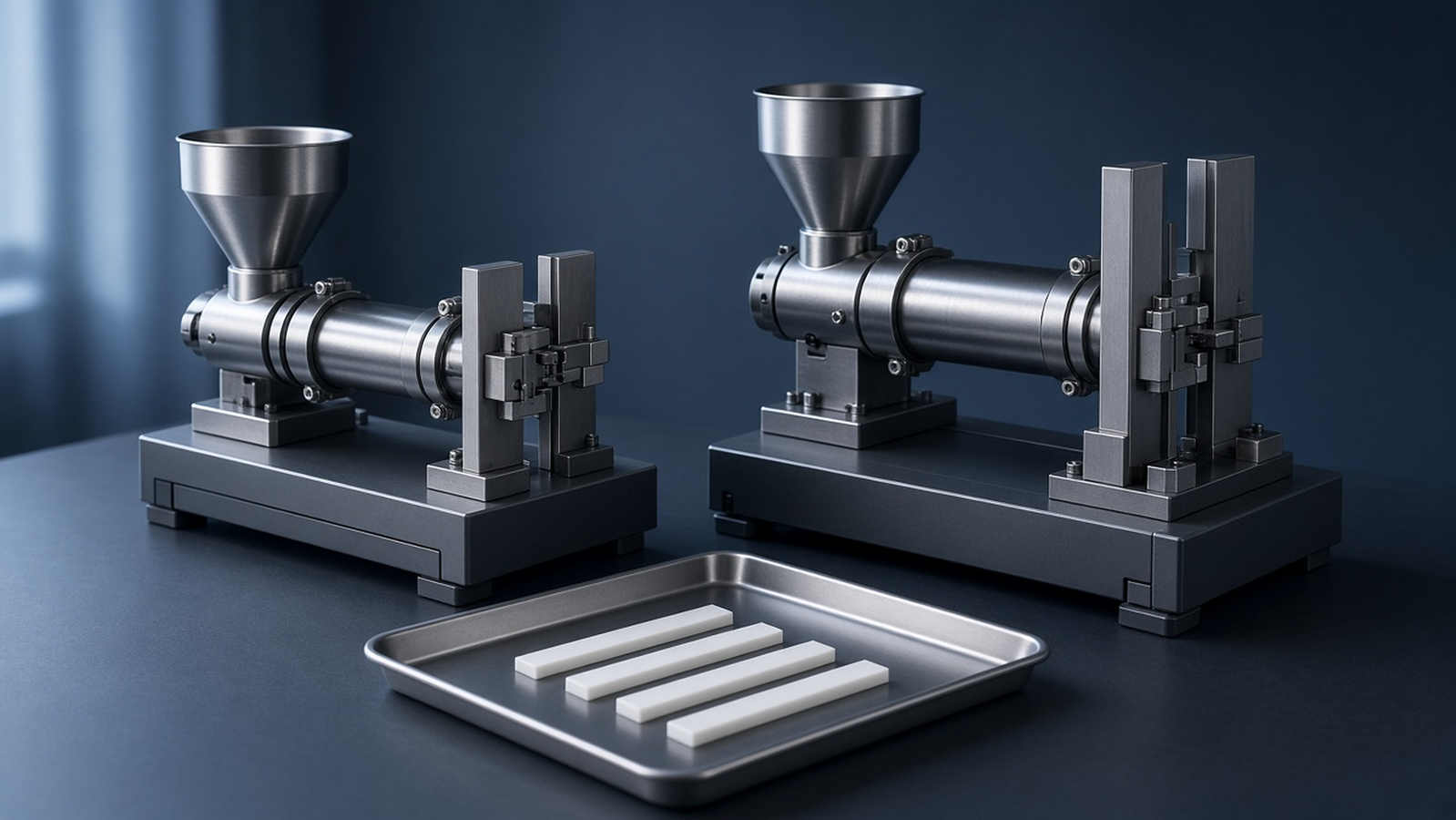
The Polytevo Series Precision Injection Molding Machine page describes a pair of machines, the pneumatic ACS-7003 and the hydraulic ACS-7003H. This guide compares them the way a specimen-maker has to: by the settings an injection cycle needs, by the figures each model lists with its own units, and by what has to be prepared on site, without ranking them.
1. The short answer: compare the figures, not the drive labels
The two machines on the Polytevo Series Precision Injection Molding Machine page share a 20 mm single-screw structure, heating zones 1/2/3 and a PLC color touch screen. They differ in drive, in the units and ranges of the figures the page lists, in the materials listed and in what the site has to supply.
This guide does not rank the two. Choosing between a pneumatic and a hydraulic version is a decision about the material quantity per shot, the materials to be molded, the utilities the room can supply and the settings that the specimen record has to contain. No study cited here compares the two drive types on a laboratory machine, so a statement that one gives better specimens than the other would go beyond the evidence.
Section 2 explains the settings and their evidence; section 3 describes the drives; section 4 compares the published figures; section 5 lists site requirements; section 6 gives quotation questions; section 7 outlines the run record. The cluster entry point, Molding Plastic Test Specimens: Injection, Transfer, Compression, places injection molding next to the transfer and compression routes, and Transfer Molding vs Injection Molding for Small Specimen Batches compares the injection route with the vertical transfer machine.
2. What an injection cycle sets, and why a specimen record needs it
An injection cycle plasticizes the material, fills the mold, holds pressure while the part solidifies, cools it and ejects it. A published practice for molding thermoplastic test specimens exists to describe those steps in a uniform way and to report the conditions uniformly, because the exact conditions needed vary with the material, and its ISO counterpart states the same purpose.1,2 Test method reference: ISO 294-1:2017 and ASTM D3641-24.2,1 The ASTM practice assumes reciprocating screw machines, so check how a machine’s plasticizing and injection movements are arranged before relying on a practice written for that arrangement.1
The following studies illustrate effects of particular preparation settings. In injection-molded polypropylene tensile bars, the melt temperature and the injection pressure changed the thickness of the skin, intermediate and core layers, and the tensile yield strength, the impact strength and the shrinkage rose with the combined thickness of the two oriented outer layers.3 Tensile bars of impact-modified polypropylene blends molded at different injection speeds showed a skin-core morphology in both the matrix and the blends.4 In short-glass-fiber-reinforced PBT, the filling time, the melt temperature, the mold temperature and the packing pressure changed the tensile properties through fiber orientation.5 In polypropylene molded with different temperatures on the two mold surfaces, the morphology and the distribution of the mechanical modulus through the sample changed.6
A fifth study concerned repeatability rather than specimen properties: in molding integrated-circuit trays, the repeatability of the cavity-pressure curve was affected by the switchover point from speed control to pressure control, the injection speed, the holding pressure and the holding time.7 These studies concern particular materials, formulations, molds and operating conditions; none compares the two Polytevo drive configurations or predicts their performance. They illustrate why the relevant preparation settings and any changes should be recorded.
3. Pneumatic and hydraulic: what the labels say on the page
On the Polytevo Series Precision Injection Molding Machine page the ACS-7003 is pneumatic with a hyperbolic arm clamping device, and the ACS-7003H is hydraulic with a servo hydraulic system. The page says that the ACS-7003H adds a hydraulic drive with adjustable injection pressure, locking force, ejection force and back pressure. Both models list a 20 mm screw and heating zones 1/2/3 up to 360°C.
Those are the page’s labels. How each drive holds a pressure setting from one shot to the next, and how closely the locking force is controlled, are questions that the listed figures do not answer; they are questions for the quotation (section 6). This guide cites no study that compares a pneumatic and a hydraulic drive on a laboratory machine.
The page describes both models as single-screw machines with replaceable molds.
Plasticizing in a single-screw injection unit is a topic of its own in the literature. Melt homogeneity in the screw chamber is investigated because it directly affects the quality of molded parts, and one study modeled the plasticizing process of a single-screw unit by computational fluid dynamics to examine the thermal melt homogeneity.8 That is a modeling study of an industrial-type unit, and it says nothing about the machines on the page. For machine families and units in general, injection molding handbooks give a longer treatment.9
4. What the page lists for each model
This section reports what the page says on 15 November 2026, and no literature appears in it. Each figure keeps the page’s label and unit. The page prints the locking force of the ACS-7003 as 5 T and that of the ACS-7003H as 0–150 kN adjustable, so the two are in different units and this guide does not convert between them. The mold size is printed with the dimension labels L × W × T for the ACS-7003 and L × D × T for the ACS-7003H, and it is reproduced as printed.
| Page label | ACS-7003 (pneumatic) | ACS-7003H (hydraulic) |
|---|---|---|
| Drive | Pneumatic | Servo hydraulic system |
| Locking force | 5 T (hyperbolic arm clamping device) | 0–150 kN adjustable |
| Shot / injection volume | 25 cm³ (injection stroke 0–80 mm) | 0–28 cm³ (0–90 mm) |
| Injection pressure | 57 MPa | 0–178 MPa adjustable |
| Feeding screw speed | 0.1–60 rpm | 1–136 rpm |
| Hopper capacity | 0.2 L | 3 L |
| Mold size | 360 × 90 × 72 mm (L × W × T) | 280 × 90 × 72 mm (L × D × T) |
| Opening stroke | 70 mm (excluding the mold) | 120 mm (maximum) |
| Suitable materials | PP, PE, PA, ABS, PBT etc. | PP, PE, ABS, PLA, PET, PC, PBT etc. |
| Power supply | Single phase 220 V ±10%, 50 Hz; 2.2 kW; 10 A | AC 380 V ±10%; 50/60 Hz; 6.5 kW |
Figures are copied from the page and keep the page’s labels and units; the page lists them as one comparison table and its row order is kept. Nothing in the table is converted.
The page lists the following adjustable settings for the ACS-7003H: injection pressure 0–178 MPa, back pressure 0.5–6 MPa, up to three adjustable injection sections, ejection force 0–8 kN and 12 formula record groups. For both models it lists an injection resolution of 0.1 mm and a temperature accuracy of ±0.5°C at constant temperature.
Two mold types are listed. The integrated mold needs the entire mold to be disassembled to replace it, and the fast changing mold lets the mold core be changed in 10 seconds. The page lists the mold itself as optional, as a specimen mold or a customized mold, and an optional mold temperature control with a cooling channel and quick couplings, for which a TMC or chiller is prepared by the user. The page lists specimen types of stretch, impact, light transmittance, electric breakdown, shrinkage, fluidity, thermal deformation and color plate.
5. What to prepare on site
The page assigns different utilities to the two models, and the quotation confirms the supplied configuration.
For the ACS-7003, the page lists the following published requirements.
- Power. Single phase 220 V ±10%, 50 Hz.
- Air source (user supplied). Compressed air pipeline or air compressor; air pressure ≥0.8 MPa; air compressor capacity ≥60 L.
- Water source. Required only if a water cooling function is added.
For the ACS-7003H, the page lists the following published requirements.
- Power. AC 380 V ±10%.
- Hydraulic oil (user supplied). Prepared by the user.
- Water source. Required only if a water cooling function is added.
Confirm the utilities required for the quoted configuration.
6. Questions to settle on the quotation
The figures above are page figures, and the supplied configuration is confirmed on the quotation. These questions turn the comparison into a short list that fits the decision; they are guidance from this guide, not a published rule.
- Locking force in one unit. The page prints T for one model and kN for the other. Ask for both in the same unit and for the definition used, then compare.
- Settings you need to record. If your record needs injection speed, the switchover from filling to holding, holding pressure and time, back pressure and cooling time, ask which of them can be set and read on the model you pick, and at what resolution.
- The mold. The page lists the mold as optional. Ask which mold type and which specimen cavity the quotation includes, and whether a mold made for one model fits the other: the page lists different mold sizes and opening strokes.
- Plasticizing arrangement. If you will follow a practice written for reciprocating screw machines, ask how the screw and the injection movement are arranged in the model.
- Utilities. Compare the supply listed for each model with the room: single phase 220 V and an air source for one, AC 380 V and hydraulic oil for the other.
- First shots. Decide how many first shots are discarded and how a changed setting is recorded before the first specimen is molded.
7. What a run record for an injection specimen contains
Whichever model is chosen, a run record turns a set of bars into evidence. A practical list, drawn from the settings discussed in section 2, is the material and lot, how and how long it was dried, the barrel zone temperatures, the mold temperature and the way it was controlled, the injection speed or time, the switchover, the holding pressure and time, the cooling time, the mold and cavity used, the number of discarded shots, the order in which specimens were molded, and the date and operator. This is a guide to what is worth writing down, not a published checklist.
The same record, with a few fields added, serves the transfer route compared in Transfer Molding vs Injection Molding for Small Specimen Batches, and the compression route has its own record plan, reached from the cluster entry point, Molding Plastic Test Specimens: Injection, Transfer, Compression.
8. FAQ
Is a pneumatic injection molding machine used for test specimens?
The page lists the ACS-7003 for classroom teaching and small sample making, with specimen types including stretch, impact, light transmittance, electric breakdown, shrinkage, fluidity, thermal deformation and color plate. Whether a specimen meets the requirements of a given test method depends on the mold, the material and the settings, and the supplied configuration is confirmed on the quotation.
What does the hydraulic ACS-7003H list that the pneumatic ACS-7003 does not?
The page lists adjustable injection pressure, back pressure, up to three injection sections, ejection force and 12 formula record groups for the ACS-7003H. It lists a shot volume of 25 cm³ for the ACS-7003 and 0–28 cm³ for the ACS-7003H, and a hopper capacity of 0.2 L and 3 L. Whether the ACS-7003 allows any of the adjustable settings is a question for the quotation.
Which materials does each model list?
The page lists PP, PE, PA, ABS and PBT for the ACS-7003 and PP, PE, ABS, PLA, PET, PC and PBT for the ACS-7003H, and each list ends with “etc.” Check the material you plan to mold against the quotation, because a listed material does not fix the settings it needs.
Can I compare the locking forces directly?
Not from the page alone. It prints 5 T for the ACS-7003 and 0–150 kN adjustable for the ACS-7003H, in different units and with different descriptions, and this guide does not convert them. Ask for both in one unit on the quotation.
What should a run record contain?
At least the material and lot, its drying, the barrel and mold temperatures, the injection, holding and cooling settings, the mold and cavity, the number of discarded shots and the order of molding. Section 7 gives the list, and it is guidance rather than a published checklist.
9. Keep exploring the Lab-Scale Polymer Processing Knowledge Hub
This guide belongs to the molding-specimens cluster of the Lab-Scale Polymer Processing and Testing: A Workflow Guide, which places every machine of the Polytevo Series by ACS Material in the stage of the lab route where it is used. The cluster starts at Molding Plastic Test Specimens: Injection, Transfer, Compression; related guides:
- Molding Plastic Test Specimens: Injection, Transfer, Compression. Entry guide to the cluster: a route map from compound to specimen, by what the specimen has to represent.
- Transfer Molding vs Injection Molding for Small Specimen Batches. Two ways to mold a small compounded batch, and the record that travels with the specimens.
To discuss a configuration, describe the material and its form, the specimen types and the number of specimens you need, the utilities available in your laboratory, and the mold or plate size you plan to use, then send it through Request a Quote. Specifications are as published on each product page, and final configurations are confirmed on quotation.